



For centuries, people have imagined kingdoms above the ordinary world: cities hidden in the clouds, ships sailing through the sky, strange inhabitants arriving from unreachable realms, civilizations existing somewhere beyond the horizon we can actually see. Some modern versions place those civilizations astonishingly high, sometimes even in the ozone layer, while others connect them to medieval legends, mysterious aerial sightings, forgotten technologies, or literary visions of floating islands. It makes for an irresistible mystery, and it is also a story in which several very different things have been quietly stitched together into one.
There really was a medieval belief in people who sailed through the clouds. There really is a ninth-century account of an alleged realm called Magonia. Jonathan Swift really did write about a flying island whose astronomers claimed to have discovered two moons of Mars more than a century before they were actually observed, and Hayao Miyazaki later transformed Laputa into one of cinema’s most memorable floating civilizations. Alongside those genuine traditions sit claims that become much harder to trace: aerial cities supposedly photographed or witnessed at impossible altitudes, mysterious “fortresses” with no identifiable historical source, and collections of names that appear to have been assembled from unrelated traditions entirely. Once those layers are separated, the story does not become less strange, it becomes stranger in a different way, because the real history shows that humans never needed advanced aircraft, hidden civilizations, or visitors from another dimension to imagine kingdoms in the sky. We have been building them in our minds for a very long time.
The “Civilization in the Ozone Layer” Is a Modern Anachronism

One of the easiest claims to investigate is also one of the easiest to expose as a modern construction: the idea that an ancient civilization lived specifically in the “ozone layer.” The problem isn’t merely that no ancient civilization has ever been archaeologically demonstrated there, it’s that the language itself belongs to a much later scientific world. Ozone was identified as a distinct substance through the work of Christian Friedrich Schönbein in the nineteenth century, and he gave it the name ozone in 1840. Scientists only later established that much of atmospheric ozone concentrates high in the atmosphere, and by the late nineteenth and early twentieth centuries, researchers were beginning to understand what we now call the stratospheric ozone layer.
That doesn’t mean ancient people couldn’t imagine beings living above the clouds. They certainly could, and clearly did. It means we shouldn’t retroactively hand those older stories modern scientific vocabulary and then treat the resulting sentence as though it were an ancient belief in its own right. There is an enormous difference between “people imagined a kingdom in the sky” and “people knew about a civilization occupying the ozone layer.” The first is historically fascinating. The second has no established ancient source at all.
The Aerial Sightings That Cannot Be Traced
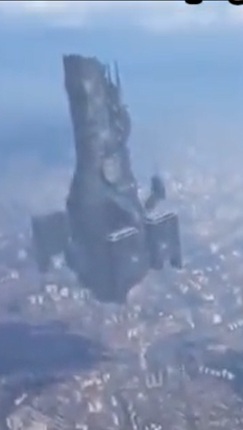
Modern versions of the story sometimes add apparently precise details: an enormous anomaly at a particular altitude, an aircraft crew encountering a city in the sky, a pilot later recovering memories of an extraordinary encounter under hypnosis. Precision can make a story sound documented, but it isn’t the same thing as documentation. For the claimed “80-kilometer anomaly” and the supposed 1988 Chilean aviation encounter presented in versions of this story, no sufficiently specific primary record has been located that would allow the claims to be independently verified: no clearly identified aviation report, meteorological record, named crew testimony, airline documentation, or contemporary investigation establishes the episodes as described. That doesn’t prove nobody ever reported seeing something unusual. It means the particular stories, in the form in which they circulate now, cannot presently be treated as established historical events.
The distinction matters because UFO and aerial-anomaly folklore has a remarkable ability to acquire detail as it travels. A vague encounter becomes a date. A date becomes a location. A location acquires an aircraft, the aircraft acquires a crew, and a strange memory becomes a recovered memory. By the time the story reaches the internet, it can look like a historical case file even when nobody can identify the original document behind it.
Then We Reach Magonia
Here, finally, the trail becomes real. In the early ninth century, Agobard, bishop of Lyon, wrote a treatise attacking what he regarded as an absurd popular belief about hail and thunder. His purpose wasn’t to preserve a supernatural tradition for future generations, it was to destroy one, and yet in trying to refute the belief, Agobard ended up preserving one of the strangest pieces of medieval folklore we possess. According to his account, people believed there was a region called Magonia from which ships came through the clouds. These aerial sailors supposedly collected crops that had been knocked down by hail and storms and carried them back to their homeland, working with tempestarii, people believed to possess magical control over storms, a struggle over unseen agency and ritual explanation that echoes across many traditions, including the very different context of Voodoo, a religious tradition shrouded in mystery and misconception.
Agobard didn’t merely say he’d heard a vague rumor. He described a specific incident in which four people, three men and a woman, were accused of having fallen from one of these aerial ships. They were captured, bound, and brought before a crowd that wanted them stoned to death. Agobard intervened, and the supposed evidence collapsed under his questioning. That detail is extraordinary, not because it proves medieval aircraft existed, but because it shows something more historically valuable: a ninth-century community could possess a coherent, shared story about aerial visitors, a distant sky-realm, weather magic, and stolen crops, and could act violently on the assumption that the story was literally true.
Magonia Was Real as a Story. Its Geography Is Another Question.

There is another fascinating complication. The word Magonia itself appears only once in the surviving work of Agobard, which in historical terminology makes it a hapax legomenon, a word or expression recorded only a single time in the surviving textual record. That doesn’t mean Agobard invented the entire belief out of nothing, far from it. Earlier Frankish sources contain references to figures known as maones, associated with magical theft of crops, and a 2021 study by medieval historian Juan Antonio Jiménez Sánchez examined the linguistic and textual history of these traditions, arguing that Magonia may itself have developed from older terminology, ultimately involving the name Hemonia associated with Thessaly. That’s a scholarly hypothesis about the word’s history, not a proven reconstruction of what Agobard’s informants originally meant.
This is precisely the kind of uncertainty that makes historical folklore genuinely interesting rather than merely quaint. We have the testimony. We have related traditions. We have a named realm, and people who apparently believed in it enough to nearly kill four strangers over it. What we don’t have is a medieval map locating Magonia somewhere above the atmosphere, a surviving population from that kingdom, or an independent contemporary account proving that aerial ships actually crossed the sky. Magonia is therefore best understood as exactly what the surviving evidence gives us: a mythical place preserved inside a ninth-century Christian polemic against a popular belief about weather and supernatural agents.
The Most Interesting Part of the Story Is What Agobard Was Actually Arguing About
It’s tempting to read Agobard as an early witness to UFOs. He wasn’t. He was a bishop trying to persuade people that storms and hail weren’t controlled by magical weather-workers, a struggle over unseen agency and ritual explanation that echoes across many traditions, and his account sits within a broader medieval debate over how ordinary people should understand destructive natural events. That makes the story unexpectedly modern. When a harvest was destroyed, the damage needed an explanation, and someone had to be responsible for it. The tempestarii provided one candidate; the distant inhabitants of Magonia provided another. The storm became not merely weather but an event with agents, intentions, and victims. In other words, the sky was never empty. It was populated by a story people needed to tell themselves.
The “Four Spirits” Are a Modern Collage, Not Medieval Magonia

Some modern retellings go considerably further, assigning named supernatural rulers or spirits to Magonia, presenting figures such as “The Mambo,” “The Diviner,” “The Mage,” and “The Forest Woman” as though they belonged to the original medieval tradition. They don’t appear anywhere in Agobard’s ninth-century account. There is, however, a detail that may have helped create the confusion: Agobard really does describe four alleged visitors from the sky, three men and one woman, but they aren’t named spirits or rulers. They’re captives whom a crowd accused of falling from the supposed aerial ships of Magonia, the same four people from the stoning story above. And “mambo” creates its own obvious chronological problem, since it’s associated with Haitian Vodou, a religious tradition that developed in a very different historical and geographical setting centuries after Agobard was writing. The result is a familiar pattern in modern mythology: genuine fragments from one tradition get combined with vocabulary borrowed from another, then presented as though they’d always belonged to one continuous ancient system.
Then Jonathan Swift Built a City in the Sky
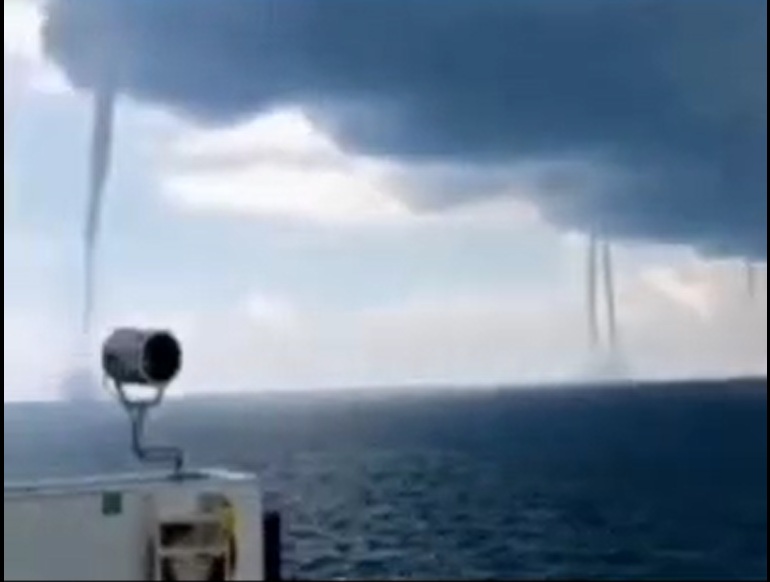
More than eight centuries after Agobard, another writer placed an entire society above the Earth. In Gulliver’s Travels, published in 1726, Jonathan Swift introduced Laputa, a flying island inhabited by people obsessed with mathematics, music, and astronomy. Unlike Magonia, Laputa isn’t an ancient legend preserved by a medieval bishop, it’s literature, deliberately absurd, satirical literature. And yet Swift gave his fictional astronomers an astonishing astronomical detail: they claimed to have discovered two moons orbiting Mars. Phobos and Deimos wouldn’t actually be observed until 1877, when astronomer Asaph Hall discovered them at the U.S. Naval Observatory in Washington, D.C., more than a century and a half after Swift wrote his satire.
This is one of those cases where the real story is better than the viral version. Swift’s fictional astronomers placed the inner moon three Martian diameters from Mars and the outer moon five, giving orbital periods of ten and twenty-one and a half hours. Those numbers obey the mathematical relationship associated with Kepler’s laws, but they aren’t close matches to the actual orbits of Phobos and Deimos: modern values put Phobos at roughly 1.4 Martian radii from the planet’s center and Deimos at roughly 3.5, with real orbital periods of about 7.6 and 30.3 hours respectively. So Swift didn’t secretly reproduce the actual orbital data, and what he did instead was still remarkable in its own right: he imagined two moons around Mars long before astronomy had confirmed Mars possessed any moons at all.
That number wasn’t pulled from nowhere, either. Johannes Kepler had already speculated that Mars might possess two satellites, reasoning from the known number of moons around Earth and Jupiter and from his broader ideas about planetary order. Swift was writing within a scientific culture already fascinated by exactly that possibility, which makes the episode less supernatural but not one bit less interesting. Swift’s achievement wasn’t prophecy. It was the imaginative use of contemporary astronomy to build a fictional civilization whose absurdity stayed anchored to real mathematics, which is a very different thing from predicting the future, and considerably more revealing about how scientific ideas actually enter literature.
Laputa Became Something Else Entirely
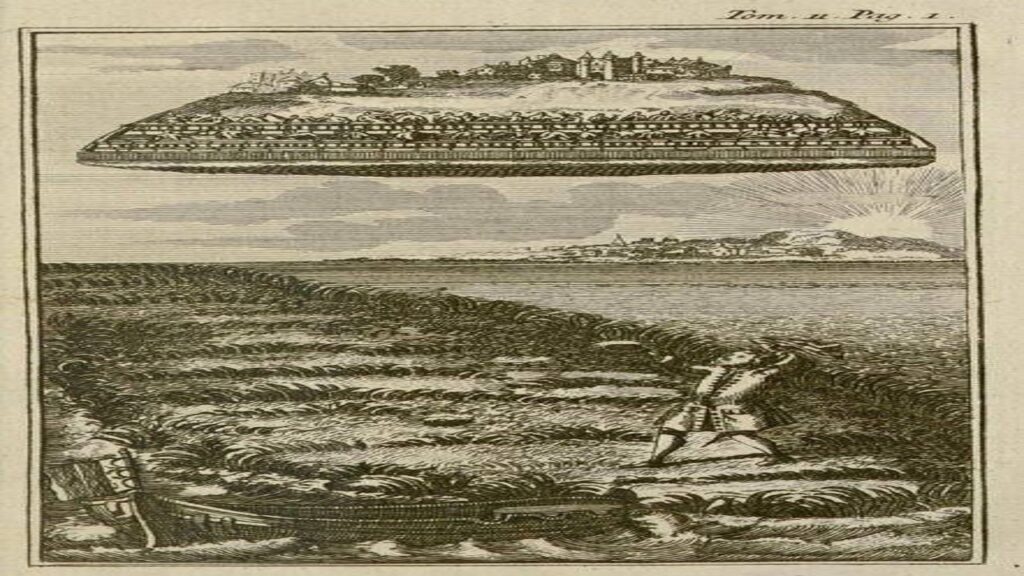
The flying island didn’t remain confined to Swift’s satire. Centuries later, the image of Laputa became part of a much larger cultural imagination about lost civilizations, technological societies, and worlds hidden above the ordinary one. Hayao Miyazaki’s Castle in the Sky, released in 1986 and identified by Studio Ghibli as Miyazaki’s own work as writer and director, transformed the name into a different kind of legend entirely: a technologically sophisticated floating civilization that has become one of animation’s most enduring images of a lost world above the clouds. Miyazaki’s Laputa isn’t evidence for an ancient aerial civilization. It’s something more revealing than that, a modern artist taking an old literary image and rebuilding it around modern anxieties about technology, nature, militarism, memory, and lost knowledge.
The “Fortress of Five Moons” Has a Different Problem
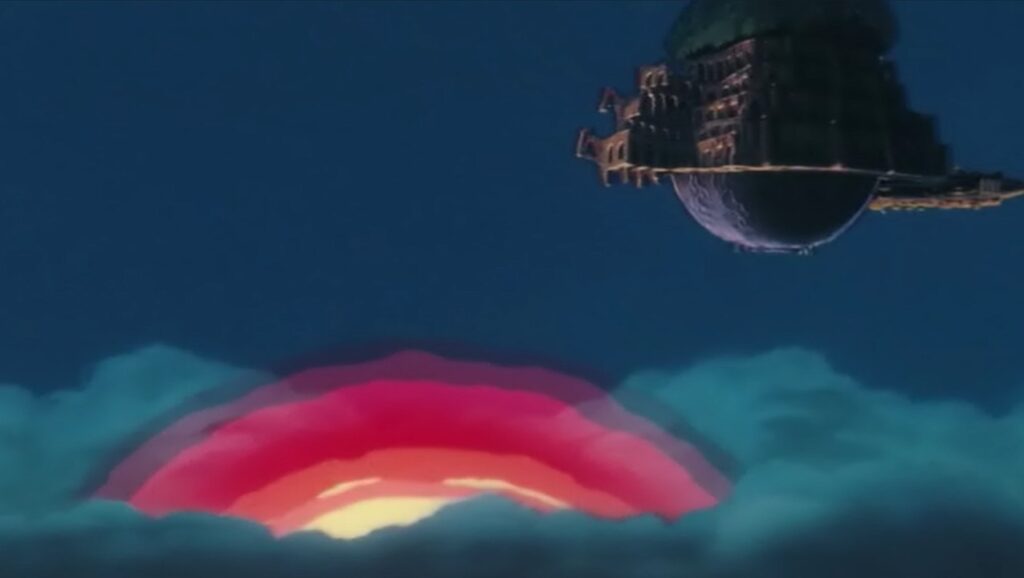
Another claim sometimes inserted into this family of stories concerns a supposed “Fortress of Five Moons,” allegedly documented in 1636. Unlike Magonia, we have a named medieval text to examine; unlike Swift, we have a surviving literary work to read. Here, the documentary trail simply disappears. No identifiable contemporary 1636 source establishing such a fortress has been located for this investigation, no manuscript, book, archival record, contemporary witness, or identifiable first publication, so the claim shouldn’t be presented as a documented historical event. That doesn’t require declaring the story was deliberately fabricated by any particular person. It requires something much simpler: treating an untraceable story as unverified, and leaving it there.
Carlos Castaneda and the Idea of Other Realities
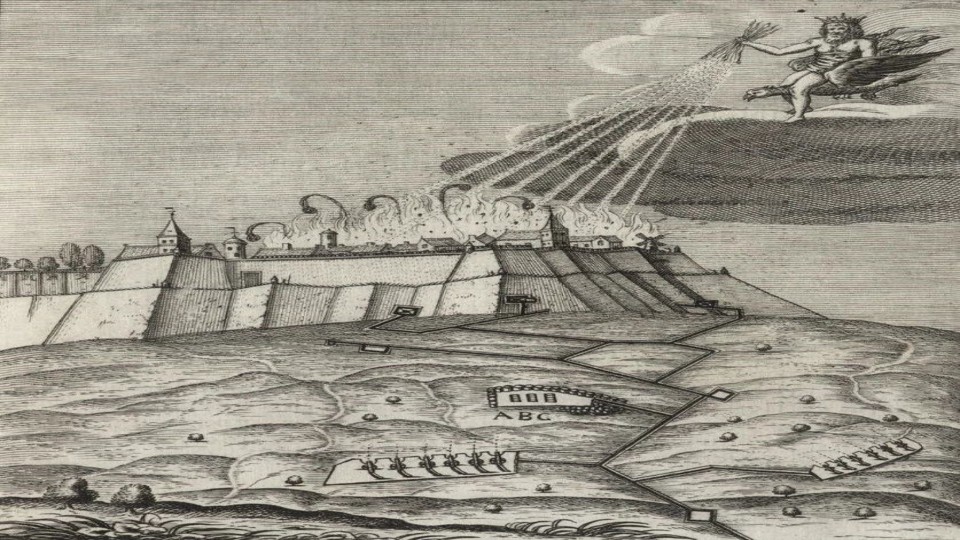
There’s another tradition that belongs in this story, although it belongs there as philosophy and literature rather than as historical evidence. Carlos Castaneda described an “assemblage point” in his books as part of a larger system in which shifts in perception could produce radically different experiences of reality, a system with real parallels in other documented traditions of altered perception, including Robert Monroe’s out-of-body experiences and the Toltec path. Whatever one thinks of Castaneda’s broader claims, this is a documented feature of his published worldview, and it should be treated as an intellectual and spiritual system associated with a twentieth-century author, not quietly promoted backward into evidence for medieval flying kingdoms it never touched.
That distinction may seem obvious, but it’s actually one of the most common ways mythology grows. A medieval story supplies the ancient atmosphere. A nineteenth-century scientific concept supplies the vocabulary. A twentieth-century occult writer supplies the alternate-reality mechanism. A modern UFO account supplies the eyewitness. And suddenly all of the pieces appear to belong to one enormous hidden tradition, when usually, they simply don’t.
Why the Sky Keeps Becoming a Place for Hidden Civilizations
There’s a deeper pattern underneath all of this. Humans have always placed the unknown somewhere: beyond the mountains for one culture, beneath the earth for another, across an uncrossable ocean for a third. In medieval Europe, the clouds could become a frontier populated by mysterious beings who arrived with storms. In eighteenth-century satire, an island could float above humanity and let Swift turn astronomy into social commentary. In modern science fiction, entire civilizations occupy orbital habitats, hidden dimensions, or distant planets instead. The location keeps changing. The psychological function underneath it stays remarkably stable: the unknown becomes easier to imagine once we give it a geography. “Something is out there” is vague. “There is a kingdom above the clouds whose inhabitants arrive in ships” is a story, and stories are simply much easier for human beings to remember, transmit, and believe.
What the Documented History Actually Gives Us
Once the layers are separated, the supposed ancient aerial civilization largely disappears, but something much more interesting takes its place. There is a genuine ninth-century account from Agobard of Lyon describing a belief in Magonia, ships traveling through the clouds, storm-makers, and people accused of falling from those ships, historical evidence for a belief, not evidence that the belief was physically true. There is a genuine linguistic mystery surrounding the name Magonia itself, whose surviving form is exceptionally rare and whose origin remains actively debated among historians. There is a genuine literary curiosity in Swift’s 1726 description of two Martian moons, decades before Phobos and Deimos were actually discovered in 1877, even though the specific orbital figures Swift supplied were never accurate predictions of the real moons. There is a genuine modern cultural afterlife for Laputa in Castle in the Sky, where an eighteenth-century satirical image becomes a lost technological civilization floating above the Earth. And there are modern stories of aerial cities, fortresses, and civilizations whose sources cannot presently be traced well enough to treat them as historical evidence at all.
That is enough. We don’t need to manufacture an ancient ozone civilization to make this subject fascinating, because we already have something stranger: a medieval bishop trying to reason people out of a belief in ships crossing the clouds; a mythical country whose name may itself have been constructed from older folklore; a satirist imagining an airborne civilization and accidentally landing on the correct number of moons around Mars; and a modern culture that keeps rebuilding the same basic idea every time the unknown acquires a new vocabulary to hide behind.
The Kingdom Was Never Found. The Idea Was.

There’s no archaeological evidence establishing a hidden civilization in the ozone layer. No medieval source examined here establishes that Magonia was a physically existing kingdom above the clouds. No surviving seventeenth-century record located for this investigation establishes the supposed Fortress of Five Moons, and Swift’s Laputa was fiction from the very beginning. Yet dismissing all of it as “just mythology” would miss the most interesting part of the story.
These stories reveal something remarkably persistent about the human imagination: when the world above us is too distant to investigate, we populate it anyway. We turn clouds into oceans, the sky into geography, astronomical discoveries into prophecies, storms into agents, and unreachable places into kingdoms. The modern version simply gives the old imagination new coordinates. Once, the hidden kingdom was Magonia. Later, it was Laputa. Today it might be an aerial civilization, an orbital city, a secret dimension, or a structure supposedly hovering somewhere above the clouds. The geography changes because our knowledge changes. The impulse behind it never does. We keep looking into the sky and wondering what might be hidden there, and perhaps that is the real kingdom these stories have always been describing, not a civilization above the clouds, but the enormous territory between what humanity can observe and what humanity can imagine.