




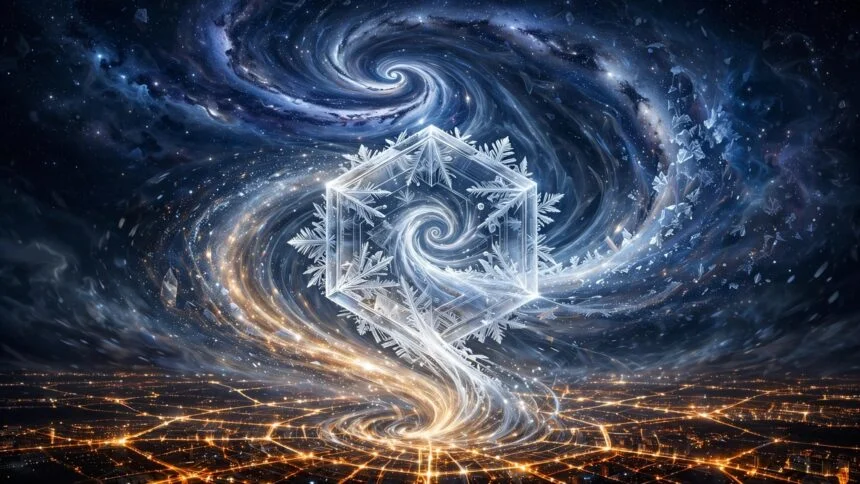
If the flow of energy through the universe stopped for even a moment, how much of what looks solid and permanent would simply disappear? Not slowly. Instantly. A whirlpool isn’t a thing. It’s a shape water makes while it’s moving through a drain, and the instant the water stops, the whirlpool doesn’t slow down and fade, it’s just gone, because it was never an object to begin with. It was a pattern, borrowed from a flow. The Second Law of Thermodynamics says disorder should only increase, and for a century physicists took that to mean the universe was one long, slow drain toward formlessness.
But snowflakes, galaxies, cities, and living cells are all, in the most literal physical sense, whirlpools. They aren’t things chaos failed to destroy. They’re patterns that exist only because something keeps flowing through them, and the moment that flow stops, so do they.
The Law That Should Have Made Everything Formless

The history here is genuinely settled physics, worth stating precisely before anything else. In 1850, Rudolf Clausius formalized what would become the Second Law of Thermodynamics: in any closed system, entropy, a measure of disorder or, more precisely, the number of ways a system’s components can be arranged while looking the same from the outside, only increases over time. Ludwig Boltzmann gave the law its statistical foundation decades later, showing that disordered states vastly outnumber ordered ones, so a closed system left alone will overwhelmingly drift toward disorder simply because there are so many more ways to be disordered than ordered. A shuffled deck stays shuffled. A dropped glass doesn’t reassemble. Heat flows from hot to cold, never the reverse, without outside work. That’s real, foundational, extensively tested nineteenth-century physics. Taken at face value, it seems to predict a universe sliding steadily toward featureless uniformity, a “heat death” of maximum disorder. For over a century, that’s exactly what physicists assumed order and chaos meant: two ends of one dial, with reality being dragged inexorably toward the chaotic end.
The Physicist Who Found the Loophole Physics Had Been Missing

This is where the real story gets interesting, and it belongs to one specific, named scientist working out one specific, precise correction to a century of assumption. Ilya Prigogine, born in Moscow in 1917 and working for most of his career at the Free University of Brussels, spent the 1960s studying something the Second Law’s classical formulation had quietly ignored: what happens in systems that aren’t closed. Clausius and Boltzmann had described isolated systems, sealed off from their surroundings. But almost nothing in the real universe is actually isolated. Stars pour energy into space. Sunlight pours energy into Earth. Rivers carry matter downhill. Prigogine studied what happens to entropy in open systems, ones continuously exchanging energy or matter with their environment, and found something the classical picture had no room for: far from equilibrium, under a continuous flow of energy, these systems don’t drift toward disorder at all. They spontaneously organize into new, stable, complex whirlpools of their own, structures that exist only because energy is flowing through them, and that Prigogine named dissipative structures, order sustained by dissipation rather than destroyed by it. He won the 1977 Nobel Prize in Chemistry for the discovery, “for his contributions to non-equilibrium thermodynamics, particularly the theory of dissipative structures.” The discovery that eventually won a Nobel Prize starts with something anyone can watch happen on their own stove. His own favorite illustration happened in a kitchen, not a laboratory: heat a shallow pan of liquid from below. Below a certain temperature, heat just conducts upward randomly. Above it, the liquid spontaneously organizes into a perfect honeycomb of hexagonal convection cells, millions of molecules moving in coordinated unison, a real, visible, repeatable phenomenon called Bénard instability, the exact same drain-shaped logic as a whirlpool, just turned on its side. Nothing designed that hexagonal pattern. The flow of energy through the system organized it by itself. It’s a strange thing to realize that the same physics governing why a spiral galaxy holds its shape is sitting, in miniature, on top of a stove.
Why a Snowflake Is Already an Answer to This Question

The everyday example deserves its own real physics, since it’s been sitting in plain sight the entire time. A snowflake begins as a single, structureless water molecule in a cloud, no more organized than the vapor surrounding it. As it falls through air at a specific temperature and humidity, water molecules attach to it fastest at the sharpest points of its growing crystal, the points that protrude furthest into the surrounding, moisture-richer air, a process physicists call diffusion-limited aggregation. That local rule alone, sharper points grow faster, applied to a hexagonal ice lattice determined by the actual molecular geometry of water, produces the six-armed symmetry every snowflake shares, while the exact branching pattern stays different every time because it’s shaped by the exact, unrepeatable turbulence the specific crystal falls through. No molecule “knows” it’s building a hexagon. There’s no blueprint anywhere in the cloud. The crystal is a whirlpool made of ice instead of water: energy and matter flow through the system, following simple local rules, and intricate, repeatable global order falls directly out of the flow itself, no different in kind from water spiraling toward a drain.
The Same Physics, Scaled Up to Galaxies
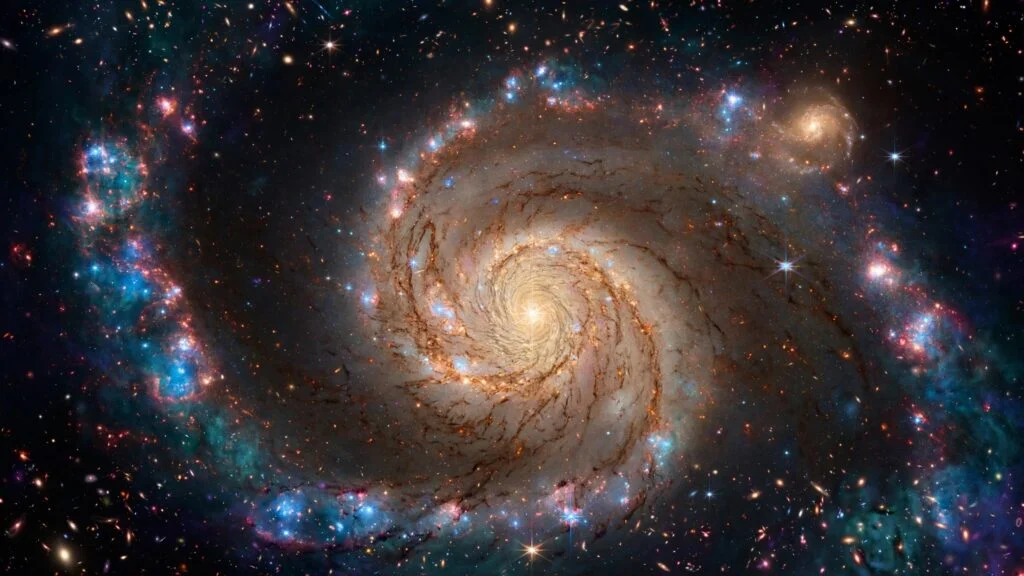
The same underlying logic, structure emerging from flow and instability rather than being imposed from outside, operates at the largest scales astronomers study. A young galaxy begins as a roughly uniform cloud of gas and dark matter, gravitationally collapsing under its own weight. As it collapses, the cloud’s rotation, present from the start as tiny, random variations in the primordial universe, gets amplified: conservation of angular momentum means a collapsing, rotating cloud must spin faster as it shrinks, exactly like a skater pulling in their arms. That faster spin flattens the collapsing cloud into a disk, since material can collapse freely along the spin axis but gets held up by rotation in the disk plane, and gravitational instabilities within that disk, denser regions pulling in even more material, organize the gas further into the spiral arms astronomers actually observe, a whirlpool the width of a hundred thousand light-years, made of stars instead of water, held in shape by gravity instead of a drain. Different, specific physics from a snowflake’s diffusion-limited aggregation, but the same deep structural principle: simple local rules, applied under a continuous flow of energy and matter, generating large-scale order no external designer needed to specify in advance.
Whether Life Itself Is Just This Physics, Running Long Enough
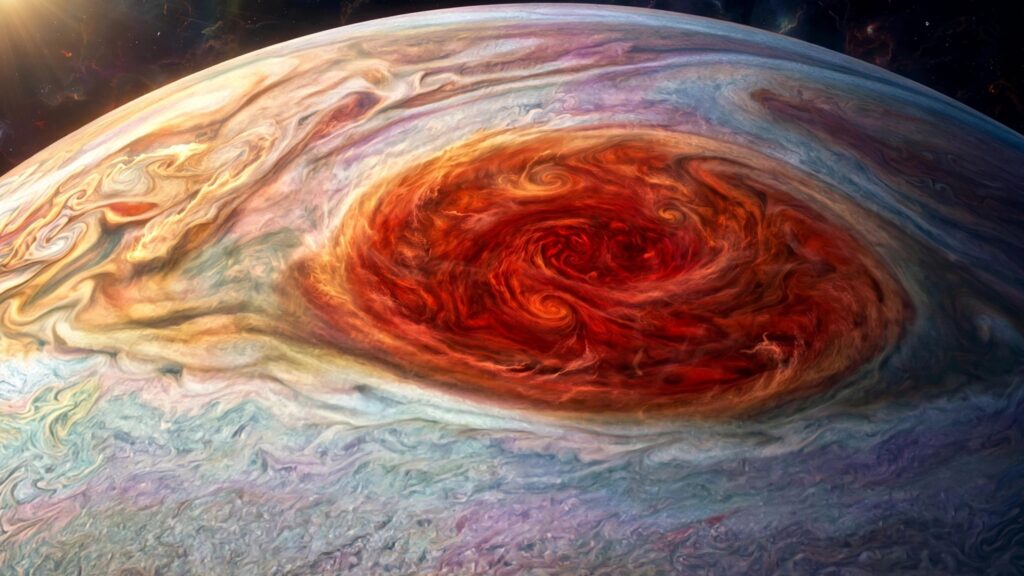
This deserves careful, honest framing, since it’s a genuinely serious scientific hypothesis, not yet a settled consensus. In 2013, MIT physicist Jeremy England, then 31, proposed what he called dissipation-driven adaptation: mathematically, groups of atoms exposed to a sustained external energy source, sunlight, geothermal heat, chemical gradients, will statistically tend to restructure themselves into forms that dissipate that energy more efficiently, and self-replicating structures happen to be exceptionally effective at exactly that, since a structure that copies itself doubles its own capacity to absorb and disperse energy. England published supporting theoretical work in Nature Nanotechnology in 2015, and researchers have since tested pieces of the hypothesis in the lab with results researchers describe as genuinely promising, though origin-of-life science remains actively contested territory generally. Physicist Sara Walker offered a useful, honest caution worth including directly: Jupiter’s Great Red Spot is a real, textbook dissipative structure, a self-sustaining storm that’s persisted for at least three centuries by continuously dissipating atmospheric energy, and by England’s own framework it counts as exactly the same category of phenomenon as a bacterium. Nobody considers the Great Red Spot alive. That’s not a flaw in the hypothesis so much as a real, honest reminder of exactly how much further the theory needs to go before dissipative structure alone explains life, rather than merely describing a necessary condition for it. Whether or not England’s specific hypothesis holds up in full, the framework it’s built on, order emerging from energy flow rather than opposing it, is the same one running through every structure covered above, from convection cells to cities.
Cities Run on the Exact Same Mathematics

This is where the pattern leaves physics and biology entirely and becomes something that shapes daily human life directly, and the research behind it is precise, published, and genuinely surprising. In a landmark 2007 paper in the Proceedings of the National Academy of Sciences, physicist Geoffrey West, then president of the Santa Fe Institute, working with Luís Bettencourt, José Lobo, Dirk Helbing, and Christian Kühnert, analyzed data across hundreds of cities worldwide and found something no one had proven with this precision before: cities obey real, measurable mathematical scaling laws, structurally identical to the scaling laws governing metabolism in living organisms. Infrastructure, roads, power lines, gas stations, scales sublinearly with population, following a consistent exponent around 0.85: a city twice the size of another needs only about 85 percent more infrastructure per person, not twice as much, a genuine, built-in economy of scale. Meanwhile, indicators of social and economic output, wages, patents, GDP, but also crime, disease, and pollution, scale superlinearly, roughly 15 percent above linear: a city twice the size doesn’t just produce twice the innovation, wealth, and unfortunately crime, it produces measurably more than double. No planner designs a city to behave this way. No city government sets out to make itself 15 percent more innovative per capita at twice the population. The pattern falls directly out of how humans self-organize when energy, resources, and information flow through a dense network, the exact same underlying architecture as a snowflake’s growth rule or a Bénard cell’s convection pattern, just running on people instead of water molecules.
Why the Internet Grew Hubs Instead of Staying Flat

The same architecture shows up again in a network no one designed to look this way either. Physicists Albert-László Barabási and Réka Albert showed in the late 1990s that networks which grow over time under a simple rule, new nodes preferentially connect to already well-connected nodes, a phenomenon they called preferential attachment, spontaneously develop a small number of extremely well-connected hubs surrounded by a vast majority of sparsely connected nodes, a “scale-free” structure mathematically distinct from a random network. The World Wide Web is the textbook real-world case: it grew from a single page in 1991 to over a trillion indexed pages by 2023, with no central authority assigning links, yet it settled into exactly the hub-and-spoke scale-free shape the mathematics predicts, a small number of massively linked sites, Google, Wikipedia, major platforms, and an enormous long tail of barely connected pages. Nobody at CERN in 1991 designed the web to end up this way. The shape emerged from a simple local rule, new connections favor already-popular destinations, run billions of times, the same underlying grammar as a growing snowflake crystal or an expanding city, order without an architect, built entirely from flow and simple local rules repeated at scale.
The Idea Itself Has Been Evolving, Right Up to This Year
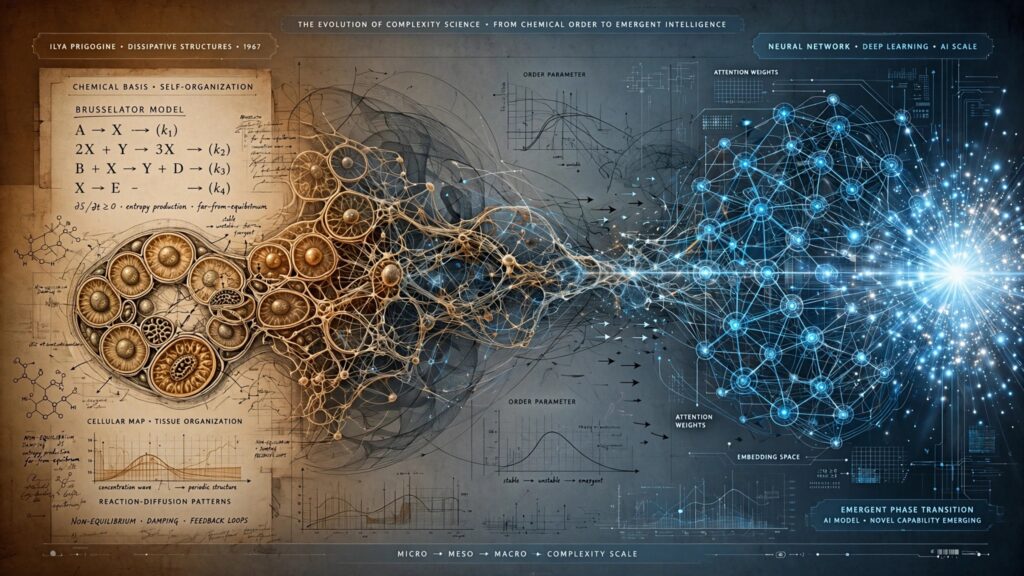
What’s genuinely striking, tracked across the decades since Prigogine, isn’t just that the mechanism keeps reappearing. It’s that the concept describing it has kept spreading into fields that didn’t exist yet when he first named it. Prigogine’s own 1977 Nobel Prize was awarded for chemistry. Within a decade, biologists were applying the same framework to metabolism and cellular organization. By the 1990s, physicists studying networks had adopted the language directly, Barabási himself has cited complexity science’s broader vocabulary in describing scale-free growth. By the 2000s, urban researchers at the Santa Fe Institute, an institution built specifically to study complex, self-organizing systems across disciplines, were applying it to city data. And in 2022, a team of researchers led by Jason Wei published a paper titled, with real, direct simplicity, “Emergent Abilities of Large Language Models,” documenting that large AI systems sometimes gain entire new capabilities suddenly, at particular scale thresholds, in ways smaller versions of the same architecture simply don’t show. That claim is itself genuinely, actively contested: a 2023 Stanford paper by Rylan Schaeffer, Brando Miranda, and Sanmi Koyejo argued that at least some of these apparent jumps may be an artifact of how researchers chose to measure performance, a “mirage” rather than a true phase transition, real, ongoing scientific disagreement about whether the sharpest, most recent example of this pattern is genuine emergence or a measurement illusion. Either way, the same word, the same century-old concept Prigogine first gave rigorous form to, is now the exact term researchers reach for to describe what happens inside the most advanced technology humanity has ever built. The idea didn’t just explain snowflakes. It grew right alongside everything else, becoming the concept scientists needed once they started building systems complex enough to organize themselves in ways their own designers didn’t fully predict.
What This Actually Means, and the Better Question It Leaves Behind
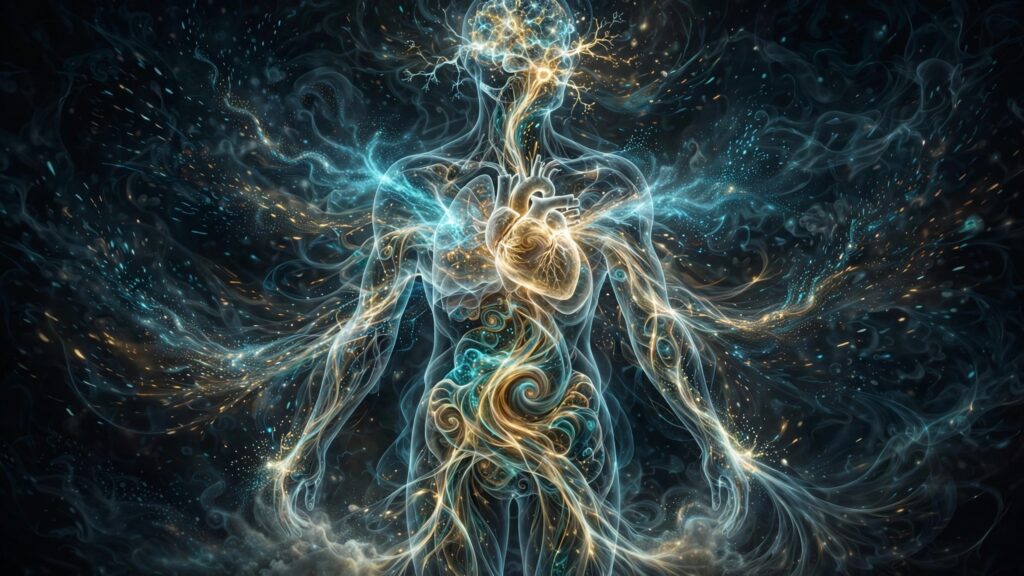
None of this is metaphor stretched across unrelated fields for poetic effect. It’s the same measurable, published, Nobel-recognized physics, appearing at wildly different scales because the underlying logic doesn’t actually care what it’s built from. Clausius and Boltzmann were right that isolated systems drift toward disorder. Prigogine showed the universe is nowhere near as isolated as that picture assumed, and that a continuous flow of energy through an open system doesn’t just permit order, it actively organizes it, from Bénard’s hexagons to a snowflake’s branches to a spiral galaxy’s arms to Jeremy England’s still-contested account of life’s origin to Geoffrey West’s precisely measured city mathematics to Barabási’s scale-free web to a debate happening in AI labs right now about what their own systems are quietly doing at scale. And it’s true of the reader holding this sentence in mind right now. Almost none of the atoms in a human body stay in place for a lifetime. Skin, blood, and the lining of the gut turn over in days or months. Even slower tissue like bone rebuilds itself across years. Atoms are continuously swapped out, breathed in, eaten, shed, replaced, in a continuous flow of matter and energy that never actually stops for the roughly eighty years a human life lasts. What stays constant isn’t the material. It’s the pattern the material keeps flowing through, the exact same relationship a whirlpool has with the water passing through it, a galaxy has with the gas orbiting inside it, a city has with the people moving through its streets today who weren’t born when its oldest buildings went up. This was never really a question about snowflakes, or cities, or chatbots. It was always a question about emergence itself, and about something considerably closer to home: not what a person is made of, but what a person is a pattern in. We no longer need to ask why order survives chaos. Prigogine already answered that in 1977. The open question now is why reality is so astonishingly, relentlessly good at inventing order in the first place, good enough to build spiral galaxies, good enough to build cities, good enough, apparently, to keep building the reader, one replaced atom at a time.
The Foundations