Here is the claim, as it usually gets told: in the 1930s, a French anthropologist sat with elders of the Dogon people in Mali and heard something impossible. They told him Sirius, the brightest star in the sky, has an invisible companion. They told him it is unimaginably dense, so heavy a piece of it the size of a grain of sand would crush a house. They told him it takes fifty years to complete its orbit. Western telescopes would not photograph that companion star clearly until decades later. So how did a society with no telescopes know any of this?
Here is the actual timeline, the one that rarely makes it into the retelling: Sirius’s invisible companion was predicted in 1844. Its fifty-year orbital period was calculated in 1850. It was seen through a telescope in 1862. Its impossible density, the fact that it is a white dwarf packing roughly the mass of the sun into a ball the size of Earth, was measured and published in 1915. Every one of those facts was sitting in Western astronomical journals for at least fifteen years, and in the case of the orbital period, for eighty-six years, before the anthropologist in question ever set foot in Mali.
The mystery was never how the Dogon could have known something Western science hadn’t figured out yet. Western science had figured it out first, by a wide margin. The actual mystery, and it is a genuinely interesting one, is how a story built on a backwards timeline became one of the most repeated claims in the entire ancient-mysteries genre.
What Astronomers Actually Knew, and When
The chain of discovery is a matter of public record and worth laying out in full, because the dates are the whole argument.
In 1844, German astronomer Friedrich Bessel noticed that Sirius wasn’t moving in a straight line. It wobbled, tracing a slight wave through the sky instead of a clean path, and Bessel concluded the only explanation was an unseen companion massive enough to tug it off course through gravity alone. He couldn’t see the companion. He didn’t need to. The wobble was proof enough.
In 1850, astronomer C.A.F. Peters used the wobble data to calculate an orbit for the still-invisible object. His figure: a period of approximately fifty years. This is the number that shows up, decades later, in the Dogon material, already sitting in a published astronomical calculation six years before anyone had even seen the star it described.
In 1862, American telescope makers Alvan Clark and his son Alvan Graham Clark were testing a new lens, the largest refracting lens in the world at the time, by pointing it at Sirius simply because it was bright and convenient. They saw a faint companion sitting almost exactly where Bessel and Peters had said it should be. Sirius B stopped being a calculation and became an observed object, confirmed and published across scientific journals in the United States and Europe within weeks.
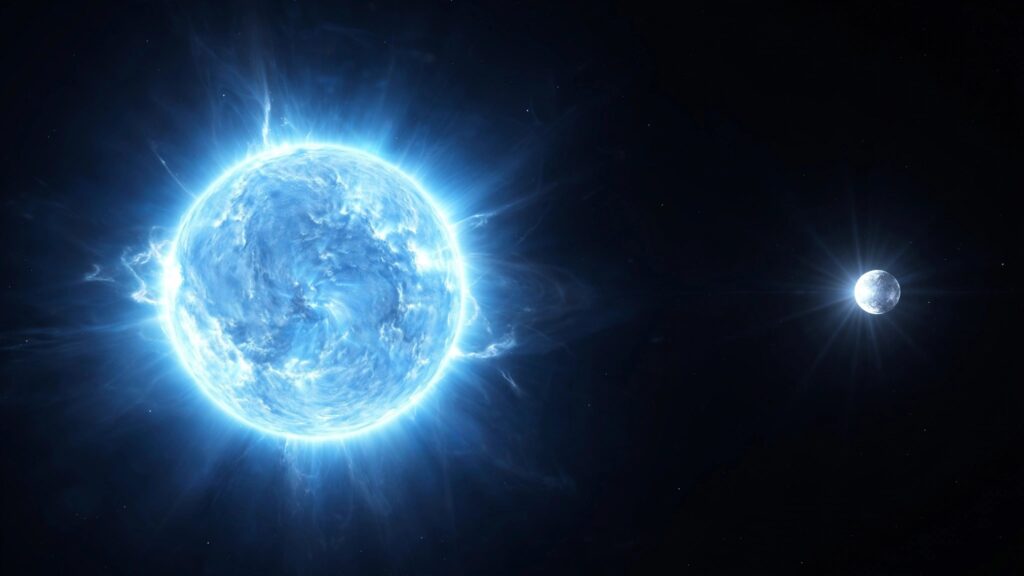
In 1915, astronomer Walter Adams at Mount Wilson Observatory photographed the spectrum of Sirius B and found something that briefly baffled the field: its light matched a hot, early-type star, but it was a thousand times fainter than it should have been at that temperature. The only resolution was that Sirius B packed roughly the sun’s mass into a volume not much bigger than Earth, a density so extreme that a teaspoon of its material would weigh tons. This finding, published and discussed in the astronomical literature of the 1910s and 1920s, established Sirius B as one of the founding examples of what astronomers would soon start calling a white dwarf.
Existence: 1844 and 1862. Orbital period: 1850. Extreme density: 1915. By any measure, this was mainstream, published, thoroughly discussed astronomy for at least a decade and a half before French anthropologist Marcel Griaule began his fieldwork with the Dogon in the 1930s.
What Griaule Actually Recorded
Griaule was a real, credentialed French ethnographer who conducted extensive fieldwork with the Dogon over more than two decades, culminating in material published with his collaborator Germaine Dieterlen. The most consequential material came from a Dogon elder named Ogotemmêli, whose extended conversations with Griaule in 1946 form the core of Griaule’s best-known book on Dogon cosmology, published in French in 1948.
According to Griaule and Dieterlen’s published account, the Dogon described a star they called Po Tolo, associated with Sirius, made of a substance heavier than anything on Earth, orbiting on a fifty-year cycle central to their calendar of ceremonies. Taken at face value and stripped of its context, that description lines up with Sirius B closely enough that when the material reached a wider audience, it read like an impossible transmission of advanced astronomical knowledge from a society with no telescopes.
The claim did not become a global phenomenon through Griaule’s own academic publications, which were sober and cautious by comparison. It became famous through Robert Temple’s 1976 book The Sirius Mystery, which took Griaule and Dieterlen’s ethnographic material and built it into a full argument for ancient extraterrestrial contact, proposing that amphibious beings from the Sirius system had visited West Africa in the deep past and left this astronomical knowledge behind. Temple’s book is where the story most people know actually comes from, not from the original anthropological fieldwork itself.
The Investigation Nobody Mentions
The most important part of this story is also the part that gets left out of nearly every retelling: someone actually went back and checked.
In the late 1980s, Dutch anthropologist Walter van Beek led an extended field study specifically designed to verify Griaule’s claims among the Dogon, spending significant time in the same region, working with elders in the same communities. He published his results in the journal Current Anthropology in 1991, and the findings were not what Temple’s book, or the decades of retellings that followed it, had led anyone to expect.
Van Beek found no trace of the detailed Sirius B knowledge outside the small circle of people who had spoken directly with Griaule decades earlier. Ordinary Dogon informants across the region, when asked about Sirius, gave answers that did not match each other and did not match what Griaule had published. Even among people connected to Griaule’s original informants, there was disagreement about basic details, including which star Po Tolo actually referred to. Several people van Beek interviewed told him plainly that they had learned about the star, and its supposed properties, from Griaule and his research team, not the other way around.

There is a further detail that matters here and rarely gets mentioned. Griaule had academic training in astronomy before he ever went to Mali, and by his own team’s account he brought star charts and astronomical reference material into the field with him, material he used, at least in part, to help frame questions and interpret what he was told. An anthropologist who already knows what Sirius B is, asking questions about a star with a French-supplied chart in hand, is not a neutral recording instrument. Van Beek’s conclusion, stated plainly in his published paper, was that the specific Sirius B details most likely entered the conversation through Griaule rather than emerging independently from Dogon belief.
What This Actually Demonstrates
None of this means Dogon cosmology is uninteresting, or that Griaule fabricated his fieldwork out of nothing, or that Ogotemmêli’s conversations with him were staged. Dogon cosmology is genuinely rich, and Griaule and Dieterlen’s broader ethnographic record remains a serious contribution to the study of West African religious systems, independent of the Sirius B question specifically. What van Beek’s investigation establishes is narrower and, in its way, more useful: the single most famous, most widely repeated data point in this entire story, the specific astronomical facts about Sirius B, does not hold up as evidence of pre-contact indigenous knowledge once someone actually goes back to check it against the people themselves.
What makes this case worth telling in full, rather than just filing it under debunked and moving on, is how cleanly the chronology alone does the work. You do not need van Beek’s fieldwork to see the problem, though it confirms it. You only need a calendar. Sirius B’s existence, orbital period, and extreme density were public, published, peer-discussed astronomical facts before Griaule was born in some cases, and certainly before he ever conducted a single interview in Mali. A story that only works if Western science learned this later than an isolated culture did cannot survive contact with the actual publication dates. It survived anyway, for fifty years, because the publication dates are inconvenient to check and the story is a genuinely good one to tell.

That is the real pattern here, and it is worth sitting with rather than rushing past. Impossible knowledge claims are compelling in direct proportion to how inconvenient the actual dates are to look up. Sirius B’s dates are not inconvenient. They are sitting in plain sight, in journals anyone can still read, saying the same thing they said in 1915: humans already knew.
The Resonance Archives