



Long before satellites divided the planet into coordinates, human beings were already drawing maps of a different kind. They placed the center of existence somewhere.
Sometimes it was a mountain rising above the world. Sometimes a sacred stone. Sometimes a temple, a pillar, a tree, a primordial mound, or a place described as the navel of the earth. The form changed from civilization to civilization, but the underlying idea remained remarkably stable: the world was not merely a collection of places. It had a center.
That recurring image is known as the Axis Mundi, the world axis. It is one of comparative mythology’s most persistent patterns, appearing in traditions separated by geography, language, and enormous stretches of time. Mesopotamia had sacred centers where heaven and earth were joined. Egypt had the primordial mound. Greek tradition had Delphi’s omphalos. Biblical literature spoke of the foundations and ordering of the earth. Hindu and Buddhist cosmology placed Mount Meru at the center of the cosmic order.
None of this proves that these civilizations inherited a single lost map of the world. It doesn’t prove that a physical pillar runs through the planet. It doesn’t prove that an ancient civilization discovered some geological structure modern science has missed.
Something more interesting is happening. Again and again, human beings imagined reality itself as something that needed a center.

The World Had to Be Anchored Somewhere
The instinct appears with particular clarity in the Book of Job. In one of the Hebrew Bible’s most famous passages, God answers Job from the whirlwind, demanding to know where Job was when the earth’s foundations were laid, who stretched the measuring line across it, and what its footings were set upon.
The language is not a geological textbook. It is poetry. The point is precisely that Job was not present at creation and cannot comprehend the scale of the order being described. Yet the imagery is striking. The earth is imagined through the language of measurement, foundations, footings, and a cornerstone.
The world is not presented as an arbitrary pile of matter. It has been established. It has dimensions. It has a structure. And that structure is intelligible through the architectural vocabulary human beings use when they build things themselves.
The same conceptual instinct appears elsewhere in the ancient world, although in radically different religious forms. At Nippur in Mesopotamia stood the Ekur, the temple complex associated with the god Enlil, part of which was known as Duranki, “the bond of heaven and earth,” a name attached to the site’s role as a cosmic connection point where heaven and earth were understood to meet.
The language is revealing. The sacred place isn’t merely where worship happens. It is where the worlds meet.
The Egyptian Mound That Rose From Chaos
Egypt provides a different version of the same problem.
In Heliopolitan creation theology, the primordial world begins with the emergence of the Benben, the sacred mound rising from the primordial waters. The image is extraordinarily simple. Before ordered creation, there is water and undifferentiated potential. Then something rises. The mound becomes the first point of stable existence.
Later Egyptian sacred architecture gave the image a physical counterpart in the temples of Heliopolis, where the Benben became associated with a sacred stone and with the solar god Atum.
The important point is not whether Egyptian priests believed the entire planet literally rested on a rock. The important point is that creation was represented as the emergence of order from an undifferentiated state, with a particular place serving as the first point at which that order became manifest.
The center comes first. Everything else unfolds from it.

Delphi Was the Navel of the World
The Greek version is even more explicit.
At Delphi stood the omphalos, literally the “navel.” The name tells the entire story. Delphi was not merely a temple where Apollo was worshipped. It occupied a privileged position within Greek sacred geography as a center of the world.
The image appears in ancient literature as well as archaeology. Euripides refers to Delphi as the place understood as the center and navel of the earth.
There is something psychologically revealing about the metaphor. A navel is not merely a point in space. It is the mark of connection. It indicates where something was once attached to something else.
The human body therefore supplied a model for imagining the cosmos. The world had a center because the human body had a center. The universe could be imagined as something alive, ordered, and connected because the human being already experienced existence through an embodied center.
That may be one reason the Axis Mundi appears so often in human cultures. The metaphor was already inside us.

Mount Meru and the Vertical Universe
Indian cosmology developed the same structural idea on a much larger scale.
Mount Meru occupies the center of Hindu and Buddhist cosmological traditions as the cosmic mountain around which the ordered universe is arranged.
Here the Axis Mundi is no longer simply a stone or temple. It becomes a mountain. And the mountain does something the stone cannot do as easily. It gives the cosmos a vertical structure. There is below. There is above. There are different realms. The mountain connects them.
That verticality becomes one of the defining characteristics of world-axis imagery across cultures. The sacred center is often simultaneously a point of orientation and a route between levels of reality. Heaven is above. The human world is here. The underworld is below. The axis connects all three.
The result is not merely a geographical map. It is a map of existence itself.
The Same Architecture Keeps Returning
This is where the comparison becomes genuinely interesting.
The examples are not identical. Duranki is not Mount Meru. The Benben is not the Omphalos. The biblical cornerstone is not the Egyptian primordial mound. And none of these traditions should be flattened into interchangeable versions of one universal religion. Their theological systems are different. Their histories are different. Their gods are different. Their cosmologies are different.
Yet they repeatedly assign extraordinary significance to the same structural ideas: center, foundation, vertical connection, orientation, order, and the boundary between worlds.
The Axis Mundi can therefore be understood less as a single object than as a mythological function. Something has to tell human beings where the world is centered. Something has to distinguish ordered reality from surrounding chaos. Something has to provide a route between the human realm and whatever lies beyond it.
Sometimes that function is performed by a mountain. Sometimes a temple. Sometimes a stone. Sometimes a tree. Sometimes a pillar. The object changes. The architecture remains.
The World Tree Is the Same Question in Another Form
One of the most widespread variants is the World Tree.
Trees are almost perfectly suited to the role. Their roots disappear into the earth. Their trunks occupy the human world. Their branches reach upward. A single living structure therefore appears to inhabit multiple realms simultaneously.
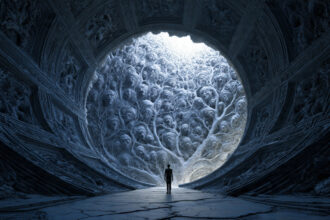
The cosmic tree becomes an Axis Mundi without needing to be a stone or mountain. The symbolism is almost unavoidable. The tree is vertical. It is alive. It connects levels. It grows upward while remaining rooted below. It therefore provides an intuitive physical model for a universe understood as layered rather than flat.
The same basic architecture can appear again and again without requiring the cultures that produced it to have shared a single historical source. That possibility matters. Similarity does not automatically establish transmission.
Humans have independently invented wheels, boats, calendars, counting systems, flood stories, sky gods, creation myths, burial practices, and countless other cultural forms. Sometimes traditions spread. Sometimes they transform through contact. And sometimes different societies arrive at similar solutions because they are solving similar cognitive problems.
The Axis Mundi may belong partly to that third category.
Why Does the Human Mind Need a Center?
A center provides orientation. Without one, a landscape is simply a collection of directions. With one, the landscape becomes a world.
This distinction matters psychologically. Human beings do not experience space as neutral geometry. Places acquire meaning. A birthplace becomes home. A grave becomes sacred. A mountain becomes a landmark. A temple becomes a center. A city becomes a capital.
The physical world becomes organized around points of significance. Ancient cosmology extended that process to the entire universe. If a civilization could establish a sacred center on Earth, that center could become the point from which heaven, earth, and the underworld were imagined as related.
The temple therefore became more than a building. It became a miniature cosmos. The mountain became more than geology. It became the place where heaven touched earth. The stone became more than stone. It became the point at which order entered the world.

The Fascination With a Hidden Physical Axis
Modern culture has not abandoned the idea. It has changed its vocabulary.
The ancient world imagined sacred mountains beneath which the architecture of reality was anchored. Modern audiences sometimes imagine hidden structures beneath oceans, mysterious alignments across continents, ancient meridians, submerged monuments, or unknown geometric networks connecting sacred sites.
The technologies have changed. The instinct has not.
A satellite image containing an ambiguous line can become a new kind of sacred geography. A coordinate can acquire symbolic significance. A mathematical alignment can begin to look intentional. A geological feature can be transformed into evidence of an invisible architecture.
This is where pattern recognition becomes important. Humans are extraordinarily good at finding structure in complexity. That ability is one of the reasons civilization exists. It is also one of the reasons ambiguous patterns can become meaningful before they become verified.
A line on a map is real. The conclusion drawn from the line may not be. That distinction is exactly the kind of boundary worth maintaining when exploring mysteries.
The Ocean Floor Doesn’t Need a Secret Spine
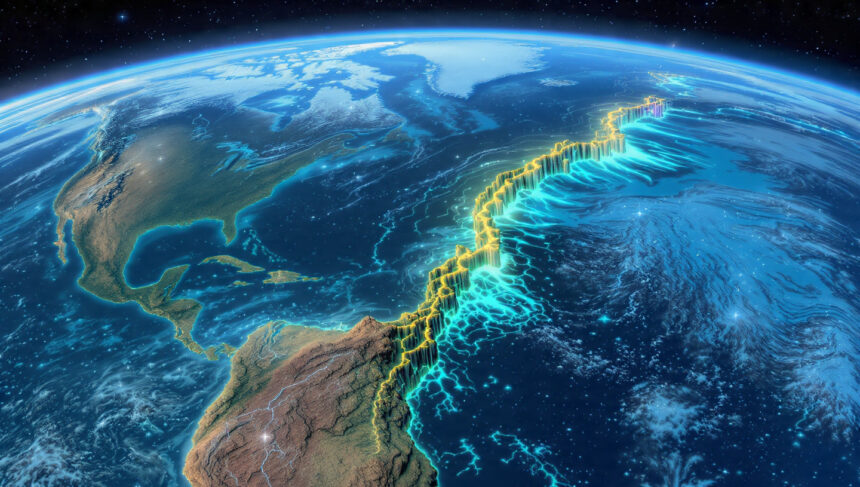
Modern mapping has produced some spectacular images of the ocean floor, and those images have occasionally been presented online as evidence of enormous artificial structures or geometric lines crossing the seabed.
The problem is that maps are not photographs of reality. Satellite altimetry and sonar produce measurements that must be processed, combined, interpolated, and visualized. Seams, artifacts, and apparent geometric structures can emerge from the way datasets are assembled.
That doesn’t make the technology deceptive. It makes interpretation necessary.
The distinction is crucial: a strange image is an observation. A hidden civilization is an interpretation. The distance between those two statements is where investigation begins.
And this is precisely where the ancient Axis Mundi becomes unexpectedly relevant. Ancient cultures also looked at an enormous, complicated world and searched for structure. They simply expressed the structure through myth. Modern culture often expresses it through maps, mathematics, satellite imagery, and theories of hidden infrastructure. The human impulse is remarkably continuous.

A World With a Center Feels Different
Perhaps that is why the Axis Mundi has survived so well.
A world without a center is difficult to inhabit psychologically. It is immense. It is directionless. It offers no obvious answer to the question of where meaning begins.
A world with a center is different. There is somewhere to stand. There is somewhere to return. There is a point from which the heavens can be understood. There is a boundary between ordinary space and sacred space. And there is, above all, the comforting possibility that reality possesses an underlying architecture.
That possibility appears everywhere. At Nippur, heaven and earth were joined. At Heliopolis, ordered creation emerged from primordial waters. At Delphi, the world possessed a navel. In Indian cosmology, Mount Meru occupied the cosmic center. In biblical poetry, the earth had foundations and a cornerstone.
Different traditions. Different histories. Different metaphysics. Yet the same astonishing human gesture: find the center.
The Axis Mundi Is Not Evidence of a Lost World
The convergence is tempting to overinterpret.
If distant cultures independently imagined cosmic mountains and sacred centers, perhaps they all remembered something real. Perhaps an ancient civilization once possessed knowledge later civilizations forgot. Perhaps there was a physical structure behind the myths. Perhaps the stories preserve memories of a world that looked different before some prehistoric catastrophe.
Those are possible hypotheses in the abstract. But the myths themselves do not establish them.
There is no archaeological evidence demonstrating a single worldwide Axis Mundi civilization from which these traditions descend. There is no geological evidence for a literal stone spine holding the planet together. And the similarities between traditions are not sufficient, by themselves, to prove a common historical source.
That is where the mystery should remain. Not because the evidence is weak. Because the question is more interesting when the evidence is allowed to remain evidence.
What the Ancient World Was Really Telling Us
The most important thing about the Axis Mundi may therefore have nothing to do with what lies beneath the earth.
It may have to do with what happens inside the human mind when confronted with existence itself. A world is easier to understand when it has a center. A cosmos is easier to inhabit when heaven, earth, and the unknown can be connected by a single image. A temple becomes powerful when it is not merely somewhere humans go to worship, but the place where the universe itself seems to touch the ground.
That is why the Axis Mundi keeps returning. Not because every civilization secretly possessed the same forbidden map. Not because a physical stone spine has been hidden beneath the ocean. And not because mythology can be treated as geology simply by reading it literally.
The deeper convergence is conceptual. Across radically different civilizations, human beings repeatedly imagined that reality has an organizing center. Sometimes they called it a mountain. Sometimes a stone. Sometimes a navel. Sometimes a tree. Sometimes a temple.
But beneath all those images lies the same ancient intuition: the world must connect somewhere.
And perhaps that is the real reason the Axis Mundi never disappeared. The coordinates changed. The civilizations disappeared. The temples became ruins. The old gods acquired new names. But the human need to find the point where everything meets remained.