



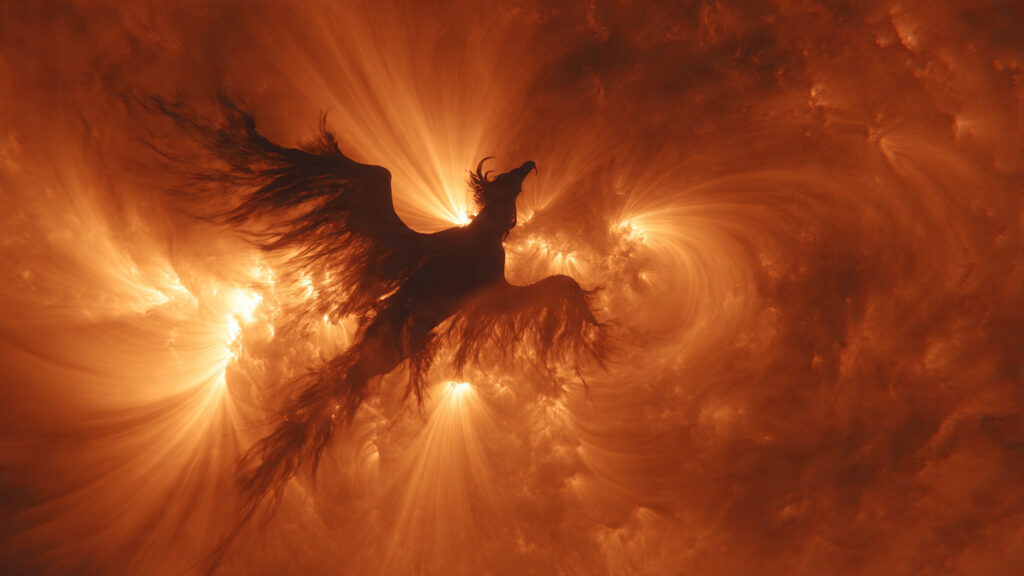
The image is real, and so is the institution behind it. Russia’s Space Research Institute did photograph a bird-shaped structure in LASCO coronagraph data on February 2, 2026, and a similar shape genuinely appeared in the same instrument’s imagery in May 2025. Both sightings share the exact same telling detail: the object appears in a single frame and is completely absent ten minutes before and ten minutes after.
That’s not the signature of something ten times Earth’s diameter approaching the sun. It’s the signature of a well-documented, decades-studied artifact, a high-energy particle striking the camera’s sensor, especially likely during the elevated X-class flare activity the sighting itself coincided with.
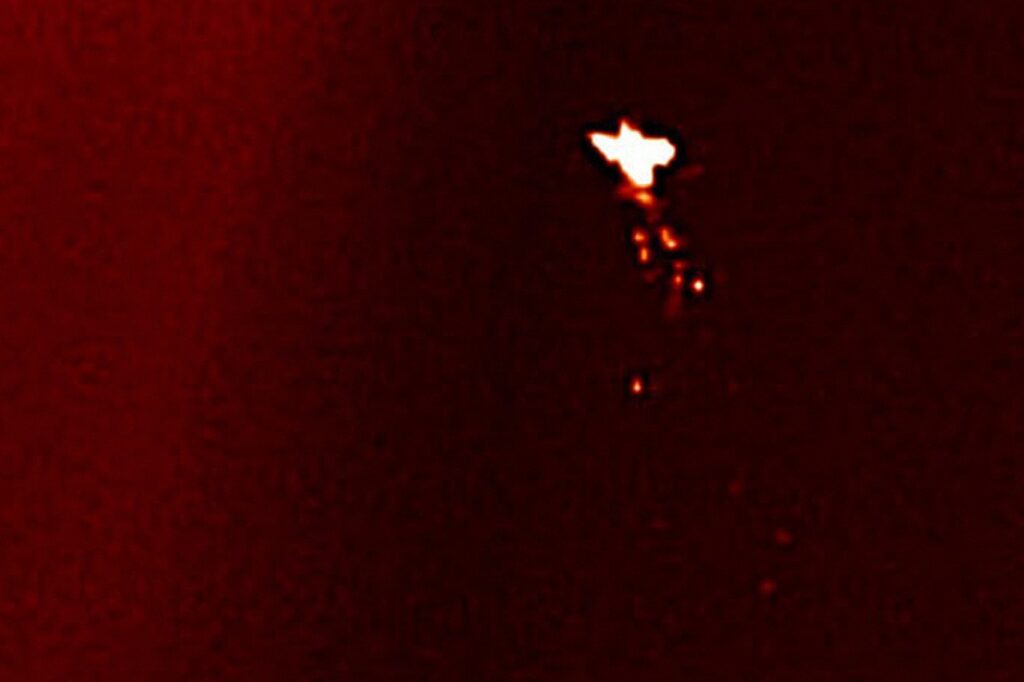
Photo: © Laboratory of Solar Astronomy of the Space Research Institute of the Russian Academy of Sciences
What LASCO Actually Is, and What It Recorded
The Large Angle and Spectrometric Coronagraph, LASCO, is a genuine NASA and ESA instrument aboard the SOHO spacecraft, launched December 2, 1995 and stationed at the Sun-Earth L1 Lagrange point ever since, where it blocks the sun’s direct light with an internal occulting disk to photograph the much fainter corona around it. Russia’s Solar Astronomy Laboratory at the Space Research Institute of the Russian Academy of Sciences, IKI RAS, is a documented, established institution, and it genuinely reported a bird-shaped structure in LASCO’s C2 channel at 10:00 UTC on February 2, 2026, with a claimed wingspan around 150,000 kilometers, roughly ten times Earth’s diameter, located about 2 million kilometers above the solar surface. A nearly identical shape had genuinely appeared in LASCO imagery in May 2025 as well, also widely reported at the time. Neither sighting is invented. Both are documented, publicly reported observations from an established institution using functioning spacecraft hardware.
Why It Vanished in Ten Minutes
This is the detail that actually resolves the mystery, and it comes from the sighting’s own reporting. In both the February 2026 and May 2025 cases, the shape appeared in exactly one frame and was completely absent from the frames captured ten minutes before and ten minutes after. A physical object large enough to dwarf Earth, however it propelled itself, cannot appear and vanish within a single ten-minute exposure window. Even at extreme velocities, an object of that claimed scale would need to cross an enormous distance to disappear from the field of view entirely, and would show at least partial presence in adjacent frames as it entered or exited. What does behave exactly this way is a documented LASCO artifact: high-energy particles striking the CCD detector directly, producing sudden, complex, transient shapes confined to a single frame, an effect solar physicists call a “snowstorm” during major particle events, and separately documented in peer-reviewed analysis of cosmic-ray spallation events recorded by LASCO throughout its operational history. The February sighting occurred during exactly the kind of elevated X-class flare activity that produces this effect, high-energy particles genuinely bombarding the spacecraft’s sensors at elevated rates.

The Documented History of LASCO Artifacts
This particular class of anomaly has a long, well-documented paper trail predating this sighting by decades. Bright planets or stars passing through LASCO’s field of view have repeatedly saturated the camera’s CCD detector, producing streaked, saucer-like “bleeding” artifacts along the sensor’s readout direction, a well-characterized hardware behavior, not an unexplained phenomenon. During genuine solar particle storms, high-energy particles striking the CCD directly produce exactly the kind of chaotic, dramatic, single-frame “snowstorm” imagery mission scientists have documented and published on repeatedly, including peer-reviewed analysis of cosmic-ray spallation events recorded across LASCO’s more than twenty years of continuous operation. Diffraction and stray light around the occulting disk add further, separately documented visual complexity. None of these mechanisms are speculative. They’re the well-understood cost of operating a sensitive optical instrument in a high-radiation space environment for three decades.

A Particle Strike, Not a Herald
None of the genuine facts here need an ancient prophecy or a mechanical reset to remain interesting. An actual Russian research institute, using a genuine thirty-year-old NASA and ESA spacecraft, did photograph a striking, bird-shaped anomaly twice, nine months apart, during periods of documented elevated solar activity. The single-frame appearance and disappearance, the detail that makes the sighting feel so uncanny, is also the detail that most directly points to its actual, documented cause: a high-energy particle strike on a CCD sensor, a well-characterized artifact with a documented research history stretching back to the spacecraft’s earliest years in orbit. The actual story here isn’t a herald arriving on schedule. It’s a genuinely sensitive, aging piece of space hardware doing exactly what sensitive, aging space hardware does when the sun gets loud.