




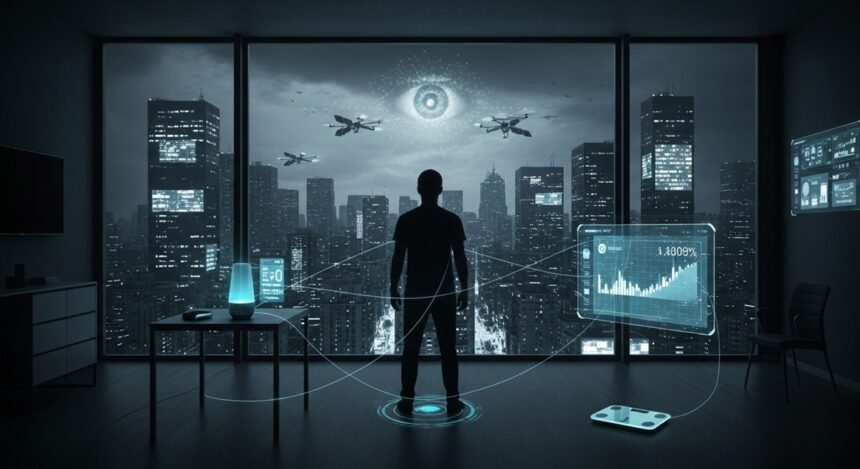
The most dangerous privacy stories are not necessarily the most frightening ones. They are the ones that sound too ordinary to become conspiracy theories: a smart speaker listening for commands, a car recording how you drive, an algorithm learning the shape of your body from a camera, a digital payment system capable of enforcing rules that cash never could. Those technologies are real, the data collection is documented, and in several cases regulators have already intervened.
That makes the fabricated stories attached to them particularly counterproductive. The “15-minute city” is not a plan to trap residents inside geofenced districts. The Japanese scientist supposedly turning sewage into hamburger meat was not the researcher behind a secret food technology program. And the existence of increasingly sophisticated biometric systems does not establish that governments already possess a hidden system capable of identifying everyone from skeletal outlines. The real privacy problem is more consequential than the mythology because it can be documented, measured, challenged, and regulated.
The Smart Home Really Is a Data Collection System
Start with the devices sitting inside people’s homes. Smart speakers, connected doorbells, security cameras, televisions, thermostats, and other internet-connected products are not passive appliances in the traditional sense. They are sensors connected to software platforms, and many transmit information to manufacturer-controlled servers so that voice commands can be processed, footage stored, alerts generated, or services personalized. The important question is therefore not whether these devices are secretly listening to every conversation in some science-fiction sense. It is what information they are technically capable of collecting, where that information goes, how long it remains there, who can access it, and what a company is permitted to do with it.
There are already concrete examples of those questions becoming regulatory cases. Amazon agreed in 2023 to pay $25 million to resolve allegations concerning retention of children’s Alexa recordings and violations of federal children’s privacy rules, while Amazon and the FTC separately reached a $5.8 million settlement concerning Ring’s handling of customer video and employee access. The significance is not that these cases prove every smart device is spying on its owner. They demonstrate something much more mundane and therefore much more important: data generated inside private spaces can become corporate data, and once it does, the boundary between “my home” and “your database” becomes a legal question.
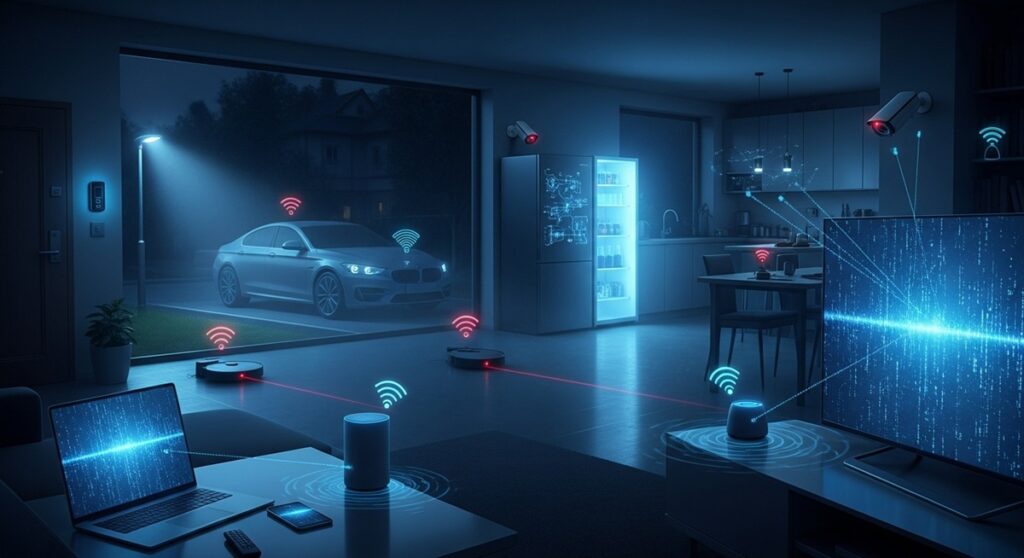
The same principle extends beyond the living room. Modern vehicles increasingly function as mobile sensor platforms, collecting information about location, driving behavior, vehicle performance, connected devices, and, in some circumstances, other aspects of the driver’s interaction with the car. General Motors became a particularly important case because reporting and subsequent regulatory action focused on the collection and sharing of driving-behavior information with consumer-reporting entities. In January 2025, the Federal Trade Commission announced a proposed order restricting GM and OnStar from providing certain driving-behavior information to consumer reporting agencies for five years. Whatever one’s position on connected-car technology, this is not a hypothetical privacy threat. It is the kind of dispute that exists precisely because the technology already exists.
Even the Health Question Is More Complicated Than the Myth
There is another category of concern that deserves a cleaner distinction: electromagnetic exposure. The World Health Organization’s International Agency for Research on Cancer classified radiofrequency electromagnetic fields as “possibly carcinogenic to humans” in 2011. That classification does not mean ordinary Wi-Fi, Bluetooth, or smart-home exposure has been established as a cause of cancer. It reflects limited evidence and scientific uncertainty. The responsible conclusion is therefore neither “wireless technology is harmless because scientists said so” nor “every connected device is poisoning the population.” It is that exposure, dose, frequency, and evidence matter, and the question should be evaluated through exposure measurements and epidemiology rather than fear.
The 15-Minute City Never Meant a Prison
This is where a legitimate discussion about urban design gets transformed into something it was never intended to be. The 15-minute city is a genuine planning concept associated especially with Carlos Moreno: the idea that residents should be able to reach ordinary necessities, such as shops, schools, services, parks, workplaces, and other daily destinations, within roughly fifteen minutes by walking or cycling. Its purpose is to reduce dependence on private automobiles and make neighborhoods more locally functional. Whether particular implementations are attractive, practical, equitable, or politically desirable is entirely open to debate. But none of those questions turns the concept into a system of compulsory confinement.
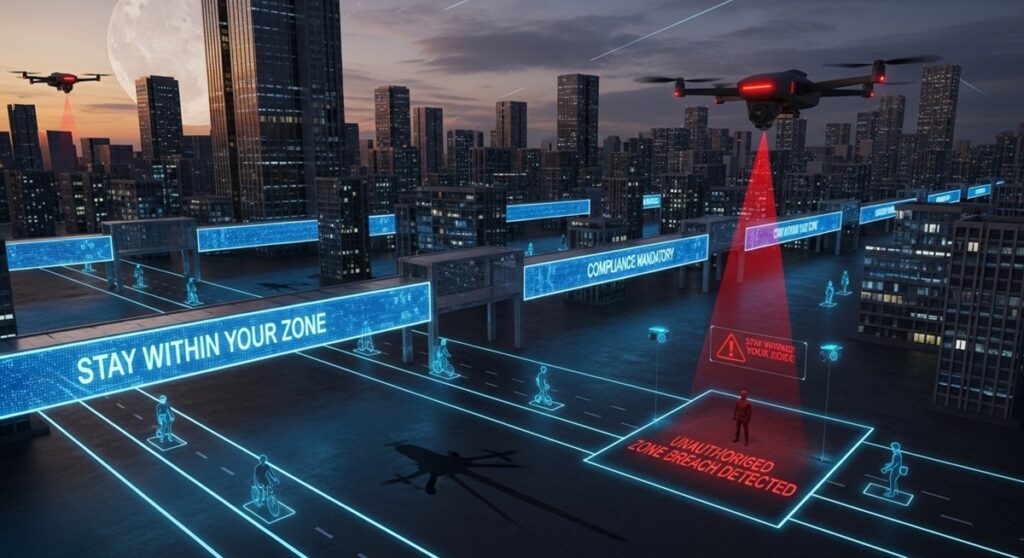
The confusion became particularly intense in Oxfordshire, where proposed traffic filters were presented online as though they were the enforcement mechanism for a 15-minute city. They were not. Traffic filters are physical or regulatory measures intended to alter vehicle movement on particular roads, the 15-minute city is a broader urban-planning philosophy. Critics can reasonably argue that traffic restrictions may inconvenience drivers, shift traffic elsewhere, affect businesses, or be poorly designed. Those are real policy arguments. The claim that the policy creates six zones from which residents need government permission to escape is something else entirely, and it requires evidence that has never been produced.
This distinction matters because dismissing an exaggerated claim does not require pretending every underlying policy is perfect. Cities really are experimenting with congestion charges, low-traffic neighborhoods, parking restrictions, emissions zones, automated enforcement, and redesigned road networks. Citizens are entitled to scrutinize those measures. What they do not need is a fictional mechanism of confinement in order to justify doing so. A policy can be controversial without being a secret prison.
The Sewage Burger Scientist Was Never There
The “Mitsuyuki Ikeda” story is a useful demonstration of how a fabricated authority can acquire the appearance of scientific legitimacy simply by being repeated often enough. The story claimed that a Japanese researcher had developed a process for converting human sewage into protein resembling ground beef. It sounded like the perfect collision of environmental technology, food scarcity, disgust, and futuristic biotechnology, and the story was repeated by major media outlets before the underlying source was properly examined.
When journalist Justin Elliott investigated the story in 2011, the trail led not to a published scientific paper but to a YouTube video. The supposed laboratory and researcher could not be independently verified, and details in the footage itself raised obvious questions about its authenticity. The result is important for a reason that goes beyond one bizarre story: a scientific claim does not become scientific because it contains a laboratory, a Japanese name, technical language, or footage of people wearing white coats. The chain of evidence has to lead somewhere, to an identifiable researcher, an institution, a methodology, results, and ideally an independently accessible publication or replication.
The lesson is almost embarrassingly simple. A strange technology can be real. A strange technology can also be invented. The difference is not how bizarre the claim sounds. It is whether someone can follow the evidence back to its source.
Biometric Identification Is Real, But That Doesn’t Mean the Skeleton Is Being Tracked
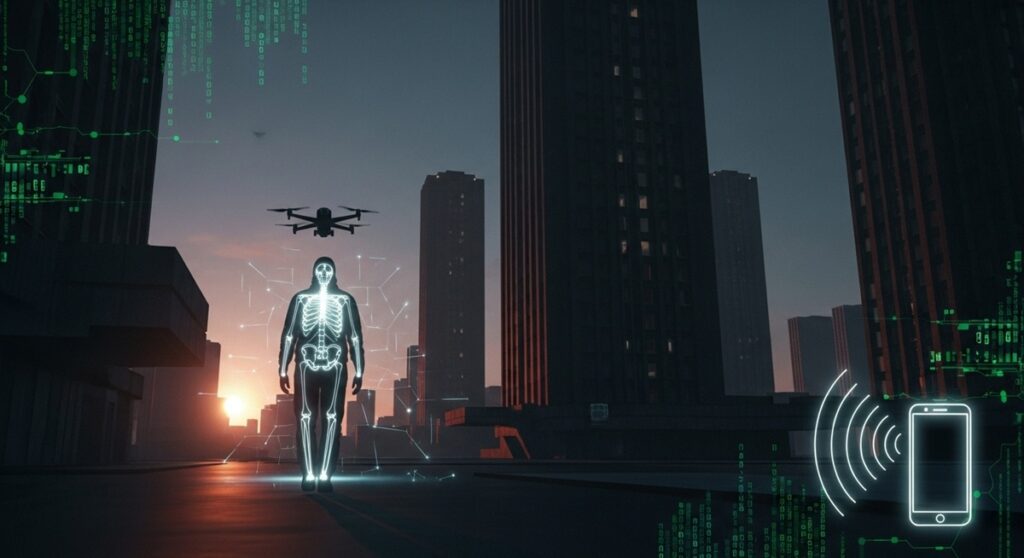
There is, however, a genuine technological frontier hiding behind some of the exaggerated biometric stories. Computer vision has become remarkably capable at estimating human pose, body shape, gait, and other physical characteristics from ordinary imagery. Research in human-pose estimation and three-dimensional body reconstruction has produced systems capable of extracting surprisingly detailed information from photographs and video, even when the subject is partially obscured or the footage is imperfect. These techniques have legitimate applications in medicine, sports, robotics, accessibility, animation, and security.
That capability creates a legitimate privacy question without requiring a secret “skeletal surveillance” program, the same evidentiary gap examined in claims about anonymous authority and how we’re persuaded by scientifically proven facts without names. The relevant issue is that a person’s body can increasingly become an identifier. A face is only one biometric. Gait, body proportions, movement patterns, voice, iris characteristics, fingerprints, and other measurable traits can all contribute to identification or profiling. The more sensors become capable of extracting those characteristics automatically, the more important it becomes to ask what constitutes biometric information, who can collect it, whether consent is required, and how long the resulting profile can be retained.
CBDCs Create a Real Policy Question, Not a Predetermined Dystopia
Central bank digital currencies belong in the same category: real technology and a real policy argument. A digital currency can, depending on its architecture, permit forms of transaction control or programmability that physical cash cannot. That does not mean every CBDC will be designed that way, nor does technical capability establish political intent. The distinction is crucial because the architecture of a payment system can be changed by law, regulation, technical design, and institutional safeguards.
The European Central Bank’s digital-euro project, for example, has repeatedly emphasized privacy and has rejected the idea that the digital euro should function as programmable money in the sense of restricting what a user can purchase. Critics can still question whether those safeguards will be sufficient, whether implementation will preserve meaningful financial privacy, and how much transactional information intermediaries will ultimately possess. Those are serious questions precisely because the underlying infrastructure is real. A person does not need to believe in a secret plan to make money expire in order to demand that digital money remain private and freely usable.
The Pattern Is Not “Everything Is a Conspiracy”
There is a recurring mistake in debates about technology and control: genuine surveillance is sometimes used to make an impossible claim sound plausible, while an impossible claim is then used to make genuine surveillance sound equally implausible. Both moves are intellectually destructive. The fact that companies really have collected sensitive data does not make every story about hidden technological control true. Conversely, the existence of ridiculous conspiracy theories does not erase the documented cases in which corporations or governments actually collected, retained, shared, or misused personal information.
The better method is almost brutally simple: separate the layers. Ask what technology exists. Ask what it actually measures. Ask who operates it. Ask what records demonstrate its use. Ask what regulators have established. Then ask what part of the story has been added afterward by commentators, social-media accounts, anonymous sources, or people trying to turn an ordinary technological development into a total theory of society.
A Problem Big Enough Without Embellishment
None of the legitimate concerns require a fictional scientist, a secret urban prison, or an invisible surveillance technology. Smart devices really can generate intimate information. Connected vehicles really can record extraordinarily detailed behavioral data. Computer vision really can turn images of a person’s body into measurable biometric characteristics. Digital payment systems really can be designed with capabilities that deserve scrutiny. And companies have already faced enforcement actions over the way they handled some of this information.
That is the uncomfortable part worth keeping. Privacy does not need an apocalypse narrative to be endangered. It can erode through terms of service nobody reads, permissions nobody understands, databases nobody sees, defaults nobody changes, and technical capabilities that become normal before lawmakers decide what limits should apply to them.
The fake stories are easier to dismiss because they are supposed to be. The real ones are harder. They involve contracts, databases, regulatory filings, corporate incentives, technical standards, and laws written years after the technology they govern has already entered millions of homes. That is where the serious fight over privacy is happening.
The most effective way to protect privacy is therefore not to believe every warning. It is to become harder to fool. Demand the source. Follow the data. Read the policy. Separate what a machine can theoretically do from what it demonstrably does. Because the real threat does not require a secret master plan. It only requires a useful technology, a valuable dataset, weak boundaries, and nobody paying attention.
The same real-versus-fake surveillance pattern runs through the through-wall radar story, where a genuine Cold War technology gets stretched into a claim about smartphone cameras seeing through clothing that was never true
The 16 billion password breach was one of those real threats, though the number itself picked up its own layer of exaggeration on the way to going viral.
Smart dust is where this same distinction matters most. The engineering is real. Airborne nanochips monitoring populations at scale are not.