



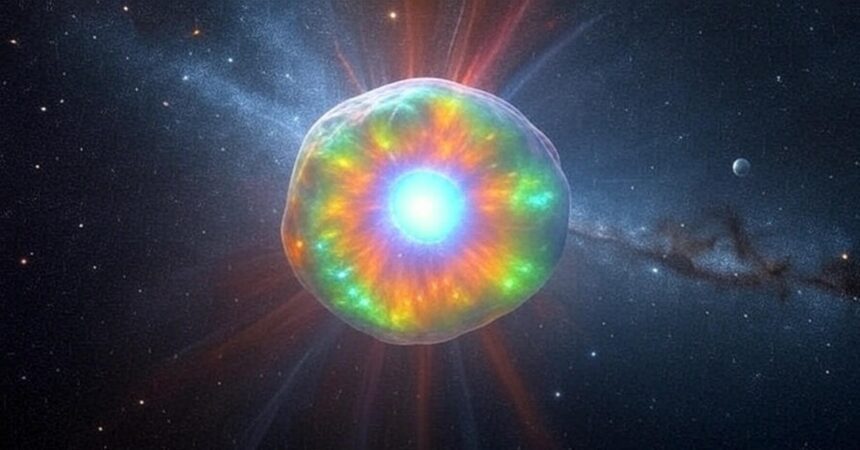
3I/ATLAS was never an ordinary comet. It was the third confirmed interstellar object ever seen passing through our Solar System, moving on a hyperbolic trajectory from another planetary system and carrying chemical information from a place humanity had never sampled before. That alone would have made it one of the most important astronomical discoveries of the decade. Then the strange details began accumulating: an unusual anti-tail, extreme isotopic ratios, an exceptionally high deuterium abundance, a diffuse X-ray glow, substantial gas production and a possible formation environment colder and older than anything represented by the comets we know from home. Those facts made 3I/ATLAS genuinely extraordinary. They did not, however, turn it into a spacecraft.
The distinction matters because the object went through a remarkable transformation in public perception. In the first weeks after its discovery, limited observations produced uncertain estimates, competing interpretations and a minority hypothesis that its unusual characteristics might have an artificial explanation. As the observational record expanded, the central classification question became much clearer, even as the deeper scientific questions multiplied. NASA classifies 3I/ATLAS as an active interstellar comet. Hubble constrained its solid nucleus to roughly 440 meters to 5.6 kilometers. JWST and other instruments measured its gases and isotopes. X-ray observatories detected the kind of emission expected when cometary gas interacts with the solar wind. And a dedicated Breakthrough Listen search found no credible radio technosignature. The mystery did not disappear. It changed.

A Cosmic Rainbow | What the Telescope Actually Saw
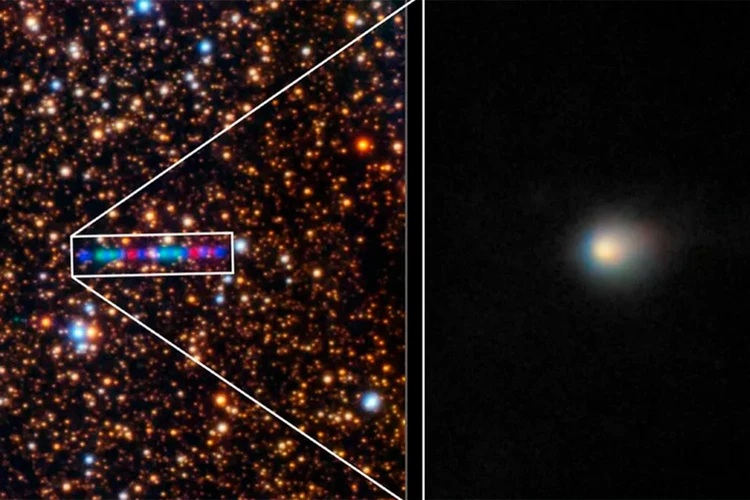
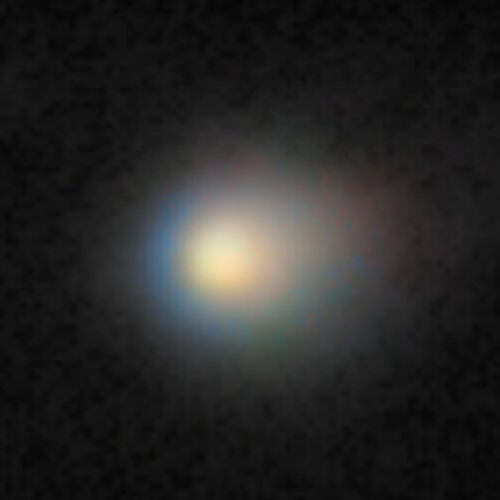
The spectacular images of 3I/ATLAS can make the object look almost artificial because astronomical photography is unlike ordinary photography. Gemini North and other observatories collect extremely faint photons through filters and combine exposures to reveal structures invisible to the human eye. A color composite can therefore be scientifically meaningful without representing what a person would literally see by looking through a telescope. The colors are assigned to measured wavelengths so astronomers can distinguish features in the coma and surrounding material. What looks like a cosmic painting is actually a map of light.
The Object Is Not the Coma
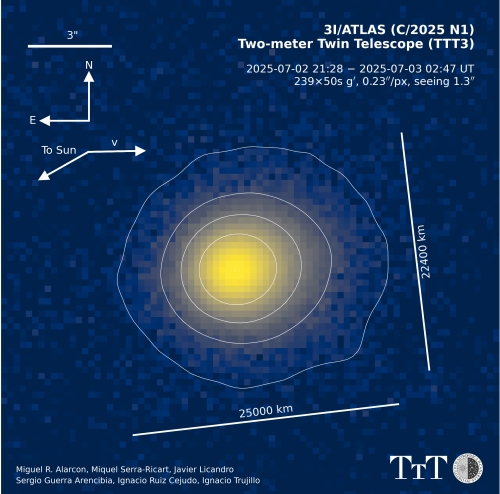
One of the earliest sources of confusion was scale. A comet does not consist solely of the solid nucleus at its center. As sunlight warms the nucleus, volatile material escapes and produces a surrounding coma of gas and dust that can extend thousands or even millions of kilometers. A telescope therefore sees a luminous cloud vastly larger than the solid body generating it. NASA’s Hubble analysis initially allowed a nucleus as small as roughly 320 meters, while the current NASA estimate places the diameter between about 440 meters and 5.6 kilometers. The enormous figures that circulated online, tens of thousands of kilometers across, were not measurements of a solid alien craft. They were, at best, confusion between the extended coma and the nucleus itself.
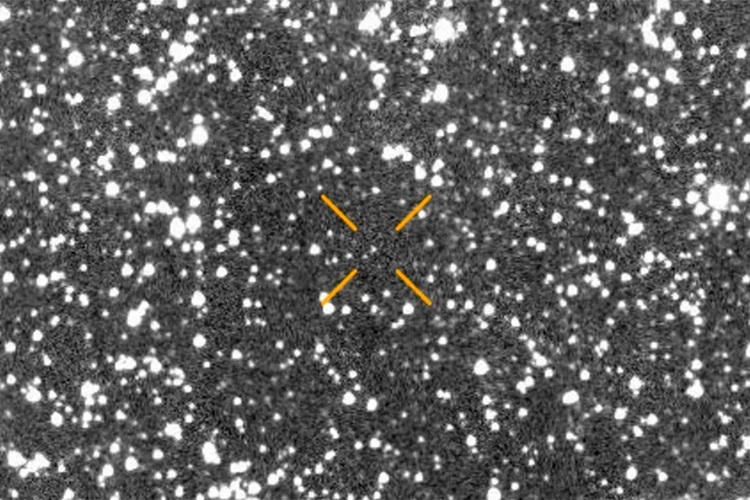
And there is an important scientific caveat: even Hubble does not directly photograph the bare nucleus with the precision of a laboratory ruler. The solid nucleus is buried inside the surrounding coma. Astronomers infer its size by modeling the brightness and structure of the dust environment and constraining how much material the nucleus could contain. That is why a range is scientifically meaningful. The correct conclusion is not that someone finally measured an exact diameter. It is that the earlier gigantic estimates have no physical basis in the subsequent observations, while the nucleus is constrained to kilometer scale rather than planetary scale.
The Comet Question Was Settled by Its Behavior
Early uncertainty about whether 3I/ATLAS should be described as a comet or something more unusual was reasonable. Newly discovered interstellar objects are observed under difficult conditions, often with incomplete spectra and limited time. But the classification question became progressively less ambiguous as observations accumulated. NASA now describes 3I/ATLAS as an active comet because observations show an icy nucleus surrounded by a coma of gas and dust. Its activity is not a cosmetic resemblance to a comet. It is the physical behavior expected when volatile material is heated and escapes into space.
That distinction is important when evaluating extraordinary claims. A spacecraft can theoretically be designed to imitate almost anything. But the scientific burden is not to ask whether an artificial explanation is imaginable. It is to ask whether the observations require one. In the case of 3I/ATLAS, the growing body of observations increasingly fits a natural cometary model without requiring an engineered object.
The “Strange” Features Were Real. That Doesn’t Make Them Artificial.
One reason 3I/ATLAS became such fertile territory for speculation is that it really did look unusual. That should not be denied. Its chemistry is unlike the chemistry of familiar Solar System comets, its gas production was unusually high, its dust morphology attracted attention, and its orbital history offered astronomers an unprecedented opportunity to study material formed around another star. But “unusual” and “artificial” are not synonyms. An object can be rare precisely because humanity has only observed three interstellar objects in total.
The Anti-Tail That Pointed the Wrong Way
One of the most visually striking features was an apparent anti-tail extending in the direction of the Sun. Ordinary comet tails are usually discussed as though they simply point away from the Sun, because sunlight and the solar wind push material outward. An apparent structure pointing sunward therefore looks immediately paradoxical. But the physics of cometary dust is more complicated. A published MNRAS study modeled the 3I/ATLAS structure as an anisotropic extension of the snow line: ice grains released in the sunward direction can survive longer because their sizes and sublimation rates differ with illumination angle, allowing them to remain visible farther from the nucleus.
That is an important distinction. The anti-tail is genuinely unusual. The fact that it is unusual is exactly why astronomers studied it. But an unusual morphology is not evidence of propulsion merely because it looks unfamiliar. In this case, a quantitative cometary model can reproduce the observed behavior using sublimation physics and the geometry of the grains. The strange feature therefore became scientifically useful without becoming evidence of engineering.
The X-Ray Glow Was Real Too
Then came another apparently extraordinary observation: 3I/ATLAS was seen glowing in X-rays. ESA’s XMM-Newton observed it for roughly 20 hours on December 3, 2025, while Japan’s XRISM observed it for 17 hours in late November. 3I/ATLAS became the first interstellar comet imaged in X-ray light. That sounds exotic because X-rays are associated in popular imagination with stars, black holes and high-energy astrophysics. But comets in our own Solar System can also produce X-rays when gas escaping from their nuclei interacts with the solar wind.
That does not make the observation boring. Quite the opposite. X-ray observations can reveal gases and interactions that are difficult to study at optical wavelengths, including signatures involving hydrogen and nitrogen. ESA reported a diffuse X-ray region extending roughly 400,000 kilometers around the nucleus, consistent with a large cloud of gas interacting with the solar wind. The observation therefore adds another window into the chemistry and physics of an object formed around another star. The extraordinary part is not that a reactor was detected. The extraordinary part is that humanity got to watch interstellar cometary material interact with our own Sun’s environment in X-rays.
Its Chemistry Is Stranger Than Its Appearance
The deepest mystery surrounding 3I/ATLAS is not its shape. It is its chemistry.
A June 2026 Nature study led by Martin Cordiner, using JWST measurements, found an extraordinary isotopic signature. Water in 3I/ATLAS has a deuterium-to-hydrogen ratio of approximately 0.98 percent, more than an order of magnitude above known Solar System comets. Its carbon isotope ratios are also far outside the typical range measured in Solar System material. Taken together, those measurements point toward a formation environment colder than roughly 30 kelvin and relatively poor in heavy elements. The object therefore preserves a chemical history from a planetary system that evolved under conditions profoundly different from those that produced our own.
This is where the word “ancient” becomes useful, but only if it is used carefully. The Nature study does not establish that a comet spent exactly 12 billion years wandering through space. Its authors note that tracing the object’s Galactic trajectory that far into the past is extremely difficult. Instead, the isotopic chemistry, interpreted through models of Galactic chemical evolution, allows the material to have accreted as long ago as roughly 12 billion years. That would make 3I/ATLAS a preserved fragment of a planetary system that formed during the early history of the Milky Way.
That possibility is more profound than the claim that 3I/ATLAS is simply “very old.” We are potentially looking at material that formed under conditions from a different era of Galactic chemical evolution. The comet is not merely visiting from another star. Its molecules may be carrying a record of a version of the Milky Way that existed billions of years before the Sun was born.
The Speed Was Extraordinary Because the Object Came From Somewhere Else
3I/ATLAS was also exceptionally fast. When discovered, NASA gives its speed at roughly 221,000 kilometers per hour, rising to approximately 246,000 kilometers per hour at perihelion as the Sun accelerated it gravitationally. After passing the Sun, the object began slowing again as it climbed out of the solar gravitational well. That behavior is exactly what celestial mechanics predicts for an interstellar object on a hyperbolic trajectory.
The speed is therefore spectacular without being mysterious. 3I/ATLAS did not arrive traveling at one constant velocity because gravity does not work that way. It entered the Solar System with enormous excess velocity, accelerated as it fell toward the Sun, then surrendered that gained speed as it climbed away. It is now leaving on an unbound trajectory and will disappear back into interstellar space.
The Red Color Is Not an Alien Signature
The reddish or yellowish appearance of 3I/ATLAS generated its own mythology, but color is one of the least reliable ways to infer artificiality. Organic-rich materials exposed to radiation can develop complex compounds and altered optical properties. Tholin-like materials are already known from Solar System bodies, including outer-system objects exposed to long-term irradiation. A reddish hue is therefore compatible with natural surface and dust chemistry, particularly for an object that may have spent enormous periods exposed to cosmic radiation.
The more important information comes from spectroscopy, not aesthetics. Color can tell astronomers that something is interesting. Molecular lines can tell them what it is made of.
The Trajectory Became a Battlefield for Statistics
Another strand of the artificial-origin argument focused on geometry: the object’s trajectory, its relationship to the Sun and planets, and the apparent statistical improbability of several alignments. This is exactly the kind of claim that sounds devastating when presented as a single probability and becomes much less decisive once the selection process is reconstructed.
An interstellar object is not selected at random from an infinite catalogue. We only notice objects that happen to pass through the regions our telescopes monitor, at brightness levels our instruments can detect, during periods when surveys are operating, and along trajectories that make follow-up observations possible. Those selection effects matter. If researchers test many possible orbital coincidences after discovering an object, some of those coincidences will inevitably look surprising. The relevant question is not “what is the probability of this one feature?” but “what was the probability before we knew which feature we would choose to emphasize, given how the object was detected and selected?”
Avi Loeb’s Hypothesis Deserves to Be Described Accurately
Harvard astronomer Avi Loeb became the most prominent advocate for taking the artificial-origin possibility seriously. His position is frequently compressed online into “Loeb says it is an alien spacecraft,” which is not an accurate representation of his stated position. Loeb has repeatedly said that a natural comet is the most likely explanation while arguing that several characteristics deserve investigation and that an artificial-origin hypothesis should not be dismissed merely because it sounds extraordinary.
That is a legitimate scientific position to examine, even if the evidence ultimately does not support it. Science does not require every minority hypothesis to be correct. It requires claims to be exposed to measurements capable of proving them wrong. Loeb himself has changed how he characterizes the evidence as additional observations arrived. That is precisely what should happen when a hypothesis encounters new data.
What Happened When Astronomers Actually Looked for Technology?
This is where the artificial-spacecraft hypothesis encounters its most concrete problem. Breakthrough Listen used the 100-meter Green Bank Telescope to observe 3I/ATLAS on December 18, 2025, across the 1-12 GHz radio range. The search produced a nondetection of candidate signals down to the reported sensitivity threshold of roughly 100 milliwatts. That does not prove that no technologically advanced civilization could possibly be associated with the object, radio silence cannot establish a universal negative. It does mean that one of the most direct searches for an expected form of technological evidence found nothing credible.
That result matters because the debate eventually moved from appearances to predictions. If 3I/ATLAS were an engineered spacecraft, there are possible signatures that could distinguish it from a comet: intentional transmissions, artificial modulation, propulsion behavior inconsistent with known cometary physics, engineered structures, or other evidence that could not plausibly be produced by natural processes. None of those signatures has been established. Instead, observations continue to produce exactly the kind of gas, dust, isotope and solar-wind interactions expected from an unusual comet.
The Object Was Never Coming for Earth
The apocalyptic versions of the 3I/ATLAS story also failed a simple orbital check. The comet passed perihelion on October 30, 2025, at roughly 1.4 astronomical units from the Sun, just inside the orbital distance of Mars. Its closest approach to Earth came on December 19, at approximately 1.8 astronomical units, about 270 million kilometers, more than seven hundred times the average Earth-Moon distance. NASA repeatedly confirmed that there was no impact threat.
That distance is worth emphasizing because “closest approach” can sound frightening when the scale is omitted. Astronomically, 270 million kilometers is extraordinarily far away. The comet passed through our planetary neighborhood in the broadest sense while remaining nowhere near an impact trajectory. It has already passed the point of closest approach and is now leaving the Solar System.
Why the First Numbers Were So Different
One of the easiest ways for a scientific story to become a conspiracy story is to mistake revision for concealment. Early observations of a faint interstellar object necessarily contain uncertainty. Ground-based telescopes must contend with atmospheric distortion, limited observing time, changing geometry and an extended coma that obscures the nucleus. As Hubble, JWST, spectroscopy and other spacecraft contribute additional measurements, estimates become narrower and models become more constrained.
That is not a flaw in astronomy. It is astronomy. The scientific answer is supposed to change when the data improve. A first estimate is not a sworn statement. A preliminary spectrum is not a final chemical inventory. A rough brightness-based size estimate is not a direct measurement of the nucleus. Treating every revision as evidence that scientists are hiding something would make scientific progress itself look suspicious.
So What Is 3I/ATLAS Actually Telling Us?
The simplest answer is also the most extraordinary: we are looking at another planetary system’s debris.
For the first time in human history, astronomers can study material that formed beyond the Solar System, passed through interstellar space, and then happened to cross our observational territory. 1I/ʻOumuamua gave us the first glimpse. 2I/Borisov showed us the second. 3I/ATLAS is different again, and its isotope ratios may be giving us something the first two could not: a chemical record of the environment in which an alien planetary system formed.
Its unusual deuterium abundance points toward extremely cold formation conditions. Its carbon isotopes point toward a relatively metal-poor environment and potentially very early Galactic history. Its coma tells us that another star system produced icy bodies capable of surviving interstellar travel. Its anti-tail lets astronomers test cometary dust physics outside the Solar System. Its X-ray glow lets them study the interaction between foreign cometary material and our own solar wind. And its trajectory lets us watch a piece of another planetary system pass through ours without becoming gravitationally bound to it.
The Alien Story Wasn’t Needed to Make 3I/ATLAS Extraordinary
That may be the most important lesson of the entire episode. The temptation was to make the object extraordinary by making it artificial. But the observations eventually revealed something that is arguably more scientifically valuable: a natural object can be so different from our Solar System that it initially forces us to reconsider what “normal” even means.
The correct conclusion is not that every anomaly has been reduced to nothing. Some questions remain open. We still do not know the object’s exact birthplace, its complete Galactic travel history, its precise nucleus size, or every detail of how its unusual chemistry arose. The Nature study itself emphasizes substantial uncertainty in reconstructing its deep Galactic past. Those unknowns are not embarrassments to be concealed. They are the reason scientists will continue studying interstellar objects, including through continued observations as it recedes.
And that is where the story should end, not with a spacecraft, not with an apocalypse, and not with a claim that every mystery has vanished.
3I/ATLAS came from another star system. It crossed the Solar System on an unbound trajectory. It carried chemistry unlike anything we have sampled here. Its material may preserve a record from a planetary system that formed billions of years ago. Its strange features generated hypotheses, and better observations tested them. So far, the data point overwhelmingly toward a natural interstellar comet, while the searches for technological evidence have found nothing credible. The alien spacecraft story did not collapse because scientists refused to consider it. It collapsed for the oldest reason in science: the better the measurements became, the less the evidence needed it.
That is the real mystery of 3I/ATLAS. Not that an alien machine crossed our sky, but that a piece of another world did. And for the first time, humanity got to watch it leave.