



In the windswept southern tip of South America lies a region cloaked in legend, mystery, and the echoes of an astonishing tale told by the first Europeans to ever lay eyes on it. Patagonia, an isolated land of jagged mountains, endless steppe, and breathtaking natural beauty, became the stage for one of the most enduring mysteries of the Age of Exploration: the alleged discovery of giant human beings.
But who were these so-called Patagonian giants? Did they truly exist? And if so, where did they go?
A Legendary Encounter at the Edge of the World
In 1520, during the first circumnavigation of the globe, Portuguese explorer Ferdinand Magellan and his crew made a fateful stop along the desolate coasts of what would later be named the Strait of Magellan. It was here that they claimed to encounter people unlike any they had ever seen, men of immense height and powerful build, so towering that the Europeans dubbed them giants.
This astounding encounter was carefully chronicled by Antonio Pigafetta, the expedition’s official chronicler, whose detailed diary offers the first recorded mention of the Patagonian giants anywhere in the historical record. According to Pigafetta, these natives were so tall that even the tallest of the Europeans only reached their waists. They danced, laughed, and even agreed to board the ships. Magellan was so intrigued that he tried to bring two of them back to Europe, but they tragically died en route.
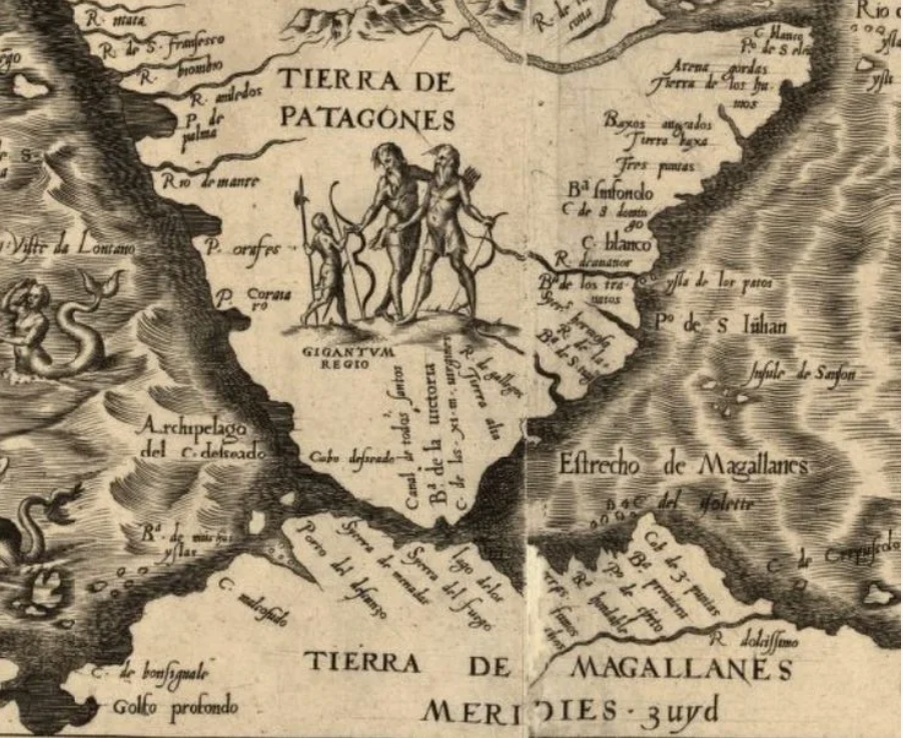
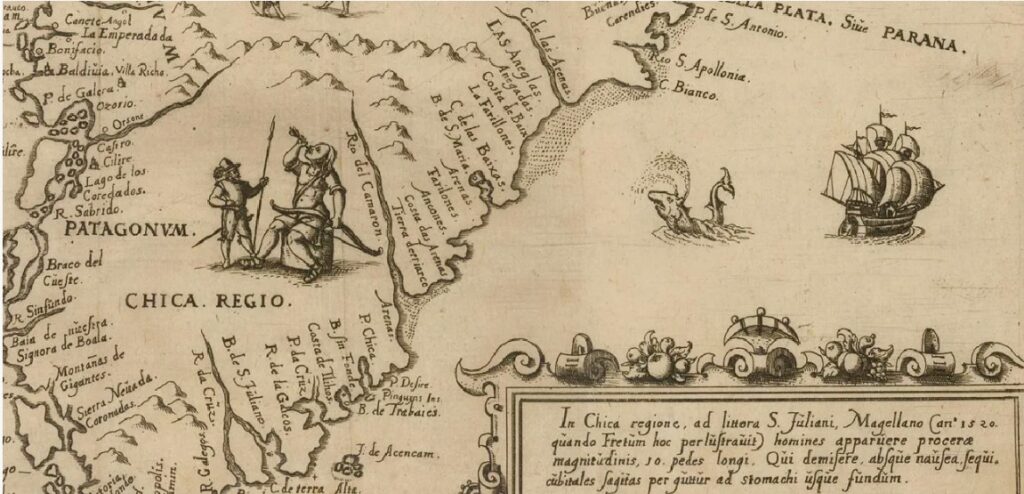
This account was far from a lone curiosity. Over the next two centuries, numerous explorers and navigators, from Sir Francis Drake to Thomas Cavendish, John Byron, and Anthony Knivet, all reported seeing these unusually tall people. Stories of men measuring between 2.5 to 3.5 meters tall (8 to 12 feet) began appearing not only in journals but also on early maps, where Patagonia was often labeled as “Regio Gigantum” or “Land of the Giants.”
The Cartographic Curiosity | Patagonia as “The Region of Giants”
Among the most fascinating pieces of evidence supporting the legend are the maps produced during the 16th and 17th centuries. For instance, the Sebastian Münster map of 1540 prominently includes references to giants inhabiting the southern reaches of South America. The Latin term “Regio Gigantum” emblazoned across the landmass wasn’t mere artistic flair; it reflected widely accepted reports from sailors and explorers who believed they had seen such beings.
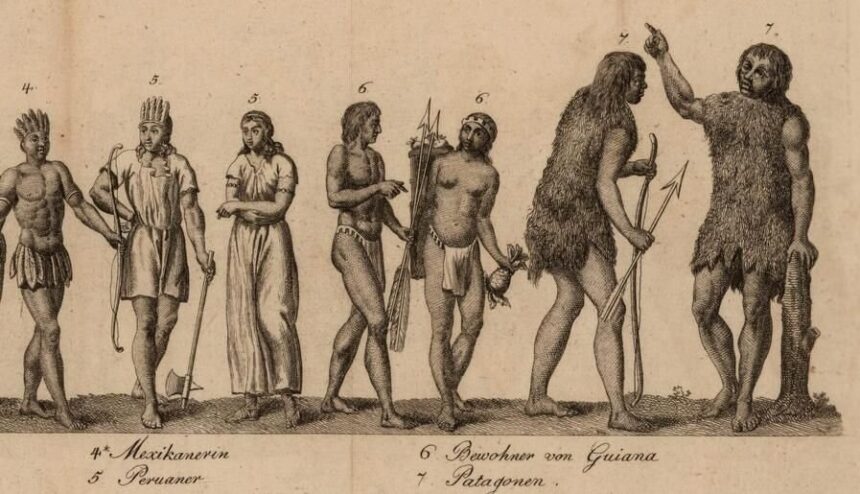
But over time, these claims began to face growing skepticism. As scientific methods evolved and exploration became more systematic in the 18th century, the image of the 12-foot-tall Patagonian began to fade. Naturalists like Alcide Dessalines d’Orbigny and Jesuit missionaries such as Thomas Falkner, who spent decades in Patagonia, acknowledged that the local indigenous peoples were tall, particularly the Tehuelche, whose average height was around 180 cm (5’11”), but certainly not giants.
Fact or Fiction | The Scientific and Anthropological Lens
So, how did the myth of the Patagonian giants persist for so long?
There are several likely explanations:
- Relative Perception – During the 16th century, the average height of European men, based on historical anthropometric research, was likely somewhat shorter than modern averages, generally estimated in the range of roughly 163 to 167 cm. In comparison, encountering the Tehuelche or other indigenous groups averaging nearly 180 cm (almost 6 feet) would have felt remarkable, especially when combined with their imposing physical presence, often enhanced by cloaks, weapons, and cultural body modifications.
- Exaggeration in Storytelling – Many early accounts were filtered through the lens of adventure, myth-making, and the desire to captivate European audiences. A sailor returning with a tale of giants was far more likely to gain fame and fortune than one who merely described tall natives.
- Mistranslations and Misinterpretations – The term “Patagon” itself might not mean “big foot” as often suggested. Some historians believe it may have come from a Spanish literary character or was a misinterpretation of indigenous words or customs.
- Natural Variation – As modern science affirms, exceptional height exists in every population. Individuals like Fyodor Makhnov, the tallest verified man in recorded history at nearly 285 cm (9 feet 3 inches), show that gigantism can occur spontaneously. Reports of unusually tall individuals in Patagonia may have been honest, if rare, observations.

A Disappearance Without a Trace?
The more sobering possibility is that the so-called “giants” were members of indigenous tribes, especially the Tehuelche, who were systematically wiped out, assimilated, or culturally erased over the centuries due to European colonization, disease, displacement, and violence.
By the 18th century, the Araucanization of Patagonia, a cultural blending of the Tehuelche with the Mapuche people from Chile, led to the gradual loss of distinct Tehuelche identity. As the original tribes faded into history, so too did the myths and exaggerations tied to them.

The result? No skeletal remains of giant humans have been discovered in Patagonia to date. No genetic studies have uncovered traces of a race of superhuman beings. But the truth may be far more nuanced. The giants were real people, tall, strong, and deeply misunderstood, whose memory lives on in legend.
Giants, Megaliths, and the Human Need for Myth
It’s worth noting that this same pattern, real, above-average human stature encountered by outsiders and gradually inflated through retelling into a full mythical giant race, recurs across other real historical and ethnographic cases worldwide, not only in Patagonia. Recognizing this recurring, well-documented pattern is useful for evaluating any future “lost race of giants” claim on its own terms, since real human height variation, combined with cultural distance and the genuine incentives storytellers have to dramatize a first encounter, reliably produces exactly this kind of legend without requiring any literal race of giants to have actually existed.
Could the Patagonian giants have built ancient megaliths? Were they remnants of an advanced civilization long lost to time? These are real questions some writers have asked, but they veer sharply into the realm of pseudoarchaeology once pursued seriously, but they reflect a broader human fascination with the mythical past, a time when the Earth was home to titans, gods, and mysteries beyond comprehension.

While no evidence connects the Patagonians to constructions like Stonehenge or the pyramids, legends of giants appear in the mythologies of almost every culture, from the Norse Jötnar, to the Nephilim of the Bible, to the Titans of Greek myth. These stories often symbolize nature’s raw power, ancient chaos, or a forgotten golden age, narratives that help societies explain the unexplainable.
Real Modern Genetic Research on the Tehuelche
It’s worth expanding on what real, modern genetic and anthropological research has established about the Tehuelche people themselves, since their genuine history deserves attention beyond the giant legend attached to it. Real archaeological and genetic studies indicate the Tehuelche descended from populations that had inhabited Patagonia for thousands of years, adapted to one of the most challenging environments humans have permanently settled, real, extreme Patagonian winds, cold, and open steppe terrain. Real 19th and 20th century anthropological measurements, conducted by researchers including the real Argentine scientist Francisco Moreno, consistently documented above-average height among Tehuelche populations relative to contemporary European averages, without ever approaching the mythical 8 to 12 foot figures early explorers reported. This real, credentialed body of anthropological and genetic research gives modern readers an accurate picture of a genuinely remarkable, resilient indigenous population, worth knowing on its own terms rather than only through the distorting lens of 16th-century travelers’ tales.
The Real Word “Patagonia” and Its Contested Origin
It’s worth expanding on the genuinely uncertain etymology of “Patagonia” itself, since real historians and linguists have proposed several different, competing explanations rather than settling on one confirmed origin. The traditional account, that “Patagon” derived from Spanish for “big foot,” referencing the natives’ footwear or actual foot size, remains widely repeated but is not definitively established by primary sources. A real, credible alternative theory proposed by historians connects the term to Patagón, a monstrous character appearing in the real popular 16th-century Spanish chivalric romance Primaleón, published in 1512, just years before Magellan’s voyage, suggesting Magellan or his crew may have applied a familiar literary monster’s name to the unfamiliar people they encountered, rather than coining an entirely new descriptive term. This real, genuinely unresolved etymological debate is worth knowing about as an example of how even foundational details of a centuries-old story can remain legitimately contested among real historians and linguists studying the primary sources.
The Cold Truth | How Climate May Explain Stature
Interestingly, evolutionary biology does offer clues about why certain populations, including the Tehuelche, may have been taller than their neighbors. According to Bergmann’s Rule, in colder climates, larger body sizes are advantageous because they conserve heat more efficiently. Patagonia, with its rugged, wind-lashed landscape and often freezing temperatures, may have naturally selected for taller, sturdier humans.
This could explain why northern Europeans, Siberians, and southern Patagonians have historically averaged greater heights compared to their counterparts in tropical zones.
The Real Scientific Debate Over Bergmann’s Rule in Humans
It’s worth adding real, important nuance to the climate-and-height explanation above, since Bergmann’s Rule’s real application to human populations remains a genuinely debated topic among physical anthropologists rather than a settled, universally accepted explanation. Real, published research on human body size variation has found that while cold-climate populations do often show patterns consistent with Bergmann’s Rule, larger body mass and often relatively shorter limbs to reduce surface-area-to-volume ratio and conserve heat, real anthropologists have also identified numerous genuine exceptions and complicating factors, including nutrition, genetic ancestry, and other environmental pressures that can outweigh or interact with pure climate adaptation. Some real researchers studying Tehuelche stature specifically have proposed that a combination of factors, including a genuinely protein-rich traditional diet built around hunting guanaco and other large game across vast hunting territories, likely contributed to their above-average height alongside any climate-driven selective pressure. This real scientific nuance is worth preserving rather than presenting Bergmann’s Rule as a single, complete explanation for Tehuelche stature.
John Byron’s Real 1764 Account and the Legend’s Peak
It’s worth expanding on the real historical figure whose account arguably brought the Patagonian giant legend to its widest 18th-century audience. John Byron, a real British naval officer and grandfather of the poet Lord Byron, commanded a real 1764 circumnavigation expedition and later published a genuine, widely read account describing encounters with unusually tall Patagonian natives. His real, published narrative, appearing at a moment of intense British public interest in exploration literature, helped reignite European fascination with the giant legend nearly two and a half centuries after Magellan’s original voyage, generating real, documented newspaper coverage and public debate in London at the time. Real historians studying the reception of Byron’s account note that skeptics and believers argued publicly in print, an early, genuine example of a viral claim generating real, contemporary public fact-checking and debate, centuries before the term existed, with subsequent, more carefully measured expeditions gradually settling the real historical record in favor of the more modest, though still genuinely above-average, actual Tehuelche height.
What Remains of the Patagonian Giants?
The tale of the Patagonian giants is one of those rare stories where myth, history, and science intertwine in a compelling mystery that still captures imaginations centuries later. The evidence for literal giants is slim, but the historical record confirms that the Tehuelche were among the tallest people in the world during the Age of Exploration.
Ultimately, the “giants” of Patagonia may not have been supernatural beings, but they were giants in another sense, towering figures who left a lasting impression on the European consciousness, symbols of a world still full of unknown wonders.
Their legacy lives on, not in bones buried beneath the Patagonian soil, but in maps, journals, and the enduring question of what if the giants really did walk the Earth?