




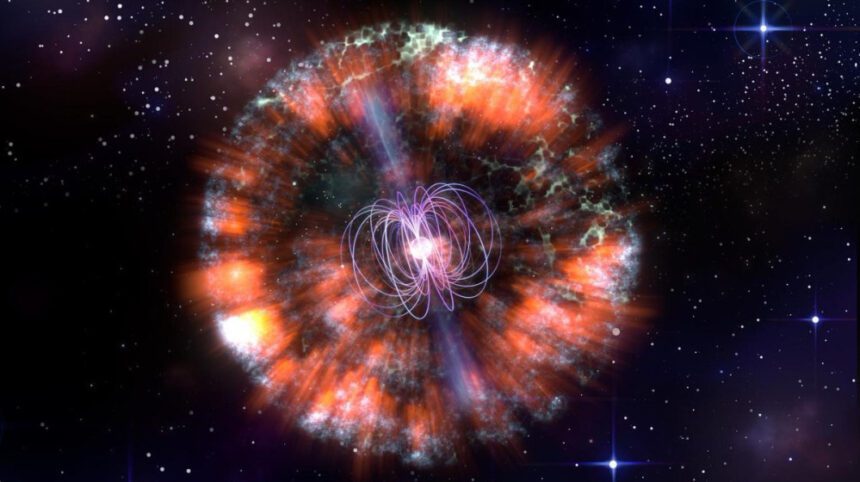
PSR B1937+21 is real. DNA has measurable vibrational modes. Pulsars really do produce extraordinarily precise signals. But there is no published evidence that this pulsar is broadcasting a pattern matching human DNA—and the claim that its surface temperature is 37°C collides almost immediately with the physics of neutron stars.
That distinction matters because fabricated scientific stories rarely begin with something completely imaginary. They usually assemble real pieces of science into a conclusion the underlying evidence never established. A genuine pulsar is given a nonexistent research program. A real molecular phenomenon is renamed as a cosmic “resonance.” A plausible-sounding percentage is attached to a comparison nobody can reproduce. A famous research institution is invoked. Then the finished story is presented as though the existence of each individual ingredient somehow proves the entire recipe. In this case, it doesn’t. The real science is extraordinary enough—and the mismatch between that science and the viral claim is where the story actually becomes interesting.
PSR B1937+21 Is Real—and That’s Where the Story Begins
PSR B1937+21 is one of the landmark objects in pulsar astronomy. Discovered in 1982 by Don Backer, Shri Kulkarni, Carl Heiles, Michael Davis, and Miller Goss, it was the first pulsar found to rotate in milliseconds, completing hundreds of rotations every second. For more than two decades it held the record as the fastest-spinning known pulsar, until PSR J1748−2446ad was discovered in 2006 with a rotation rate of roughly 716 times per second. B1937+21 remains an exceptionally important millisecond pulsar because its extraordinarily rapid and stable rotation makes it useful for precision timing experiments.
That precision is not metaphorical. A pulsar is a rotating neutron star whose electromagnetic emission is beamed in a way that can produce remarkably regular pulses as the star rotates. Millisecond pulsars can therefore behave like natural cosmic clocks, allowing astronomers to measure tiny changes in arrival times across years of observations. Pulsar timing has become a tool for testing theories of gravity, studying neutron-star physics, investigating binary systems, and—when many pulsars are monitored together—searching for the extraordinarily long-wavelength gravitational waves that ripple through the galaxy.
What the “DNA Signal” Claim Actually Requires
The viral story goes considerably further. It claims that scientists subjected the emissions of PSR B1937+21 to some form of advanced analysis and discovered a pattern corresponding to the vibrational structure of human DNA, sometimes accompanied by a spectacular numerical claim such as “99.7 percent accuracy” or a probability of roughly one occurrence in several billion. Those numbers give the story the appearance of quantitative science, but a number is not evidence merely because it contains a decimal point.
A result like that would require a reproducible methodology: precisely defined pulsar data, a clearly specified DNA reference dataset, an explicit mathematical transformation connecting the two, statistical controls for multiple comparisons, an independently testable significance calculation, and enough methodological detail for another research group to reproduce the result. No such peer-reviewed result is established in the astronomical literature for PSR B1937+21. There is no recognized body of research showing that this pulsar’s emission encodes a biological message matching human DNA at the extraordinary level claimed.
Then Comes the 37°C Problem
The most conspicuous red flag is the claim that the pulsar has a surface temperature of approximately 37°C—the temperature of a human body. A neutron star is not a small ordinary star that happens to spin quickly. It is the collapsed remnant of a massive star, compressed into an object roughly the size of a city while retaining a mass comparable to that of the Sun. Its surface and atmosphere exist under conditions of gravity, density, magnetic field strength, and radiation that have almost no analogue on Earth.
Observed neutron stars and pulsars are extraordinarily hot compared with their surroundings, particularly when young, and their thermal emission is commonly studied at X-ray and ultraviolet wavelengths. Some older neutron stars can cool dramatically over astronomical timescales, a subject examined in depth in this site’s broader coverage of neutron stars as cosmic beacons and element forges, and their thermal properties vary substantially from one object to another, so “all neutron stars have exactly X million degrees” would itself be an oversimplification. But that scientific nuance does not rescue a 37°C pulsar surface. Human body temperature is approximately 310 K. A thermally emitting surface at that temperature would peak in the infrared rather than behaving like the hot neutron-star sources astronomers actually observe. Calling such an object a normal radio pulsar while assigning it an ordinary human-scale surface temperature would require a radically different physical explanation—and the viral story provides none.
There is another reason the number is so revealing. Temperature in astrophysics is not decorative background information. It is tied to the radiation an object emits, its cooling history, its atmosphere, and its observable spectrum. If a paper really reported that a known pulsar had a surface temperature of 37°C, it would not be a minor curiosity buried inside a study about DNA. It would be an extraordinary neutron-star result demanding extraordinary observational evidence. The absence of such a result from the established literature is therefore not a trivial omission. It is exactly the kind of discrepancy that should stop the investigation before the more exotic claims even begin.
“PulsarDNA” and the Imaginary Research Trail
The story becomes still more revealing when its institutional scaffolding is examined. Names such as “PulsarDNA,” “Dmitry Ivanov,” and a supposed Russian “Mirror Project” are presented as though they belong to an established research program involving astrophysics, biology, quantum computing, or space communications. But the existence of a plausible-sounding laboratory name is not evidence that the laboratory exists, just as attaching a Russian space agency to a project does not make the project an actual mission.
A legitimate scientific claim leaves a trail. There should be researchers with identifiable institutional affiliations, papers or technical reports, conference records, datasets, mission documentation, observatory observations, grant records, or independent researchers discussing the work. The stronger the claim, the more substantial that trail should be. A claim that a known pulsar is carrying a biological signature across interstellar space would be one of the most extraordinary discoveries in modern astrophysics. It would not plausibly exist only as a paragraph circulating online without a reproducible paper behind it.
What Pulsar Timing Actually Reveals
Ironically, the real capabilities of pulsars are considerably more impressive than the fabricated ones. Because millisecond pulsars rotate with extraordinary regularity, astronomers can use their pulses as precision timing references. By comparing the arrival times of pulses over long periods, researchers can detect tiny changes caused by orbital motion, gravitational effects, or disturbances propagating through space.
This is the principle behind pulsar timing arrays. Instead of treating one pulsar as an isolated clock, researchers monitor many of them across the sky and search for correlated variations in their timing. The goal includes detecting nanohertz gravitational waves generated by enormous astrophysical systems such as pairs of supermassive black holes. In other words, pulsars really can function as instruments for detecting information carried across cosmic distances. The information is just not evidence of DNA authorship.
Pulsars Can Even Help Navigate Space
There is another genuine technology that can sound almost fictional when stripped of its context: spacecraft navigation using pulsars. Because some pulsars have exceptionally predictable timing signatures, an instrument aboard a spacecraft can in principle compare the arrival times of known pulsar signals with expected values and use the differences to estimate its position. NASA and other space agencies have investigated this concept as a possible form of autonomous deep-space navigation.
Again, the real phenomenon is more interesting precisely because it does not require a hidden biological message. Nature has produced rotating stellar remnants whose pulses are regular enough that humans can use them as navigational reference points across the Solar System. That is an actual technological relationship between biology and pulsars: human beings built instruments capable of turning an extreme astrophysical phenomenon into useful information.
DNA Really Does Have Vibrational Signatures
The fabricated story also borrows authority from a real field of molecular science. DNA is not merely a sequence of letters stored inside cells. It is a physical molecule with bonds, motions, vibrational modes, rotational behavior, and interactions with its chemical environment. Spectroscopic techniques, including infrared and Raman spectroscopy, can reveal characteristic molecular vibrations and are routinely used to investigate biological molecules.
But this is where the distinction between “both things have frequencies” and “one thing is transmitting the other” becomes essential. A molecular vibration and a pulsar’s electromagnetic pulse are not automatically connected because both can be described mathematically using frequencies, the same category error that appears in claims about humanity as avatars inside a dystopian simulation. Frequency is a universal property of oscillatory phenomena. Finding numbers that resemble one another does not establish a physical communication channel, a common origin, or intentional encoding.
The Trap of Numerical Pattern Matching
This is one of the easiest ways to manufacture the appearance of a discovery. Take two complicated datasets. Transform them into frequencies, ratios, intervals, harmonics, wavelengths, or numerical sequences. Search for similarities. With enough opportunities for comparison, apparently remarkable matches will eventually appear by chance. The scientific question is not whether a match can be found. It is whether the match was predicted in advance, survives appropriate statistical controls, and corresponds to a plausible physical mechanism.
This is especially important when the claimed probability is extraordinarily small. “One in five billion” sounds decisive until someone asks what was actually counted. One in five billion possibilities under which model? How many comparisons were attempted before the successful one was reported? Were the parameters chosen beforehand? Was the dataset independent? Was the same procedure tested against unrelated pulsars? Did another team reproduce the result? Without those answers, an impressive probability can be little more than mathematical decoration.
What the Story Gets Right—and What It Invents
The cleanest way to understand the claim is therefore to separate its ingredients. PSR B1937+21 is real. Millisecond pulsars are real. Pulsar timing is real. Neutron-star thermal emission is real. DNA vibrational spectroscopy is real. Machine learning is genuinely used in astronomy and signal analysis. Pulsars have genuinely been considered for spacecraft navigation. None of those facts establishes the next proposition: that PSR B1937+21 is broadcasting a signal structurally equivalent to human DNA.
The alleged 37°C surface temperature is an even larger warning sign because it conflicts with the physical picture of a conventional neutron star rather than merely adding an unusual interpretation to otherwise normal observations. The supposed research organization, researcher, and “Mirror Project” add another layer of institutional theater. What looks at first like a sophisticated interdisciplinary discovery therefore resolves into something much simpler: real scientific vocabulary arranged around claims for which the necessary evidence is missing, the same pattern examined in claims about a “Lucifer gene” and the final conquest of human DNA.
Where the Genuine Mystery Sits
PSR B1937+21 does not need to be a biological transmitter to be astonishing. It is the remnant of a stellar catastrophe compressed into an object only a few tens of kilometers across, rotating hundreds of times every second. Its pulses can be measured with extraordinary precision. Its behavior helps astronomers investigate matter under conditions impossible to reproduce on Earth, while the broader pulsar population has become a laboratory for gravity, dense matter, stellar evolution, gravitational waves, and even future spacecraft navigation.
That is the deeper lesson here. Science becomes weaker, not stronger, when real discoveries are dressed in fictional ones. A pulsar does not become more mysterious because somebody assigns it a DNA code. DNA does not become more profound because its frequencies are compared with an unrelated astronomical signal. And a research claim does not become credible because it contains a percentage, a Russian project name, or the words “quantum” and “machine learning.”
The pulsar is real. The DNA vibrations are real. The physics is real. What isn’t real is the bridge the story builds between them. And once that bridge is removed, what remains is not a less extraordinary universe. It is a much stranger one: a universe in which a dead star can become one of humanity’s most precise clocks, without ever needing to send us a message written in our own DNA.
The Resonance Archives