



Howard Phillips Lovecraft died in 1937 at forty-six, having spent most of his life writing stories that would eventually transform twentieth-century horror. He published primarily in pulp magazines, earned little from his fiction during his lifetime, and remained, by his own description, a philosophical materialist and atheist. That last fact matters. Lovecraft did not present Cthulhu, Nyarlathotep, or the Necronomicon as revelations of a supernatural reality. He presented them as fiction.
Yet there is another part of Lovecraft’s account of his writing that is equally well documented. Dreams mattered. In his essay Notes on Writing Weird Fiction, Lovecraft explained that the initial material for his stories could come from sights, ideas, images, literature, and dreams. He specifically acknowledged that he had sometimes literally written out a dream, while explaining that his more usual process was to take an initial mood, image, or idea and deliberately construct a story around it.
That distinction changes the question. The interesting question is not whether Lovecraft secretly believed Cthulhu was real. He didn’t. The interesting question is whether the imagery he developed from dreams, imagination, reading, and cultural material sometimes converged with structures found in much older mythological and religious traditions. It did. What that convergence means is another question entirely.

The Dreams and the Writer
Lovecraft’s correspondence provides an unusually extensive record of how he understood his own creative process. His surviving letters and essays repeatedly reveal a writer fascinated by dreams, altered imaginative states, antiquity, cosmic scale, forbidden knowledge, and the possibility that ordinary human perception represented only a small portion of reality.
But his own explanation remained literary. In Notes on Writing Weird Fiction, he described his purpose as creating an “illusion” of violating the ordinary limitations of time, space, and natural law. He explicitly distinguished between the initial impressions that inspired a story and the deliberate construction that followed.
This is important because the older version of this argument often makes Lovecraft sound like a reluctant prophet: a man who dreamed entities into existence and then discovered that ancient civilizations had already known them. The historical record does not justify that claim.
Lovecraft was an exceptionally well-read autodidact. His own essay names Edgar Allan Poe, Lord Dunsany, Arthur Machen, M. R. James, Algernon Blackwood and Walter de la Mare among the masters whose work shaped his conception of weird fiction. And the documentary trail becomes even more interesting when individual influences are examined.

Machen, Chambers and the Machinery of the Unknown
Arthur Machen’s The Great God Pan, published in 1890, offered Lovecraft a model for horror built around the possibility that ordinary reality concealed something older and more terrifying beneath it. Machen’s work was not merely similar to Lovecraft’s. Lovecraft knew it. His fiction contains identifiable debts to Machen, including parallels between The Great God Pan and The Dunwich Horror.
Robert W. Chambers provides another documented connection. The King in Yellow, published in 1895, introduced a fictional text whose contents exert a disturbing psychological influence over those who encounter it. Lovecraft read Chambers and subsequently incorporated elements of that mythology, including references to the Yellow Sign and related names and places, into his own fiction.
This matters because it establishes something much more powerful than speculation. Lovecraft really was absorbing pre-existing mythic and occult-looking structures and transforming them into something new. There is therefore no need to invoke paranormal transmission merely to explain why his fiction contains ancient-looking ideas. But that does not make every later comparison meaningless. It makes the comparison more precise.
Cthulhu and the Deep-Water Pattern
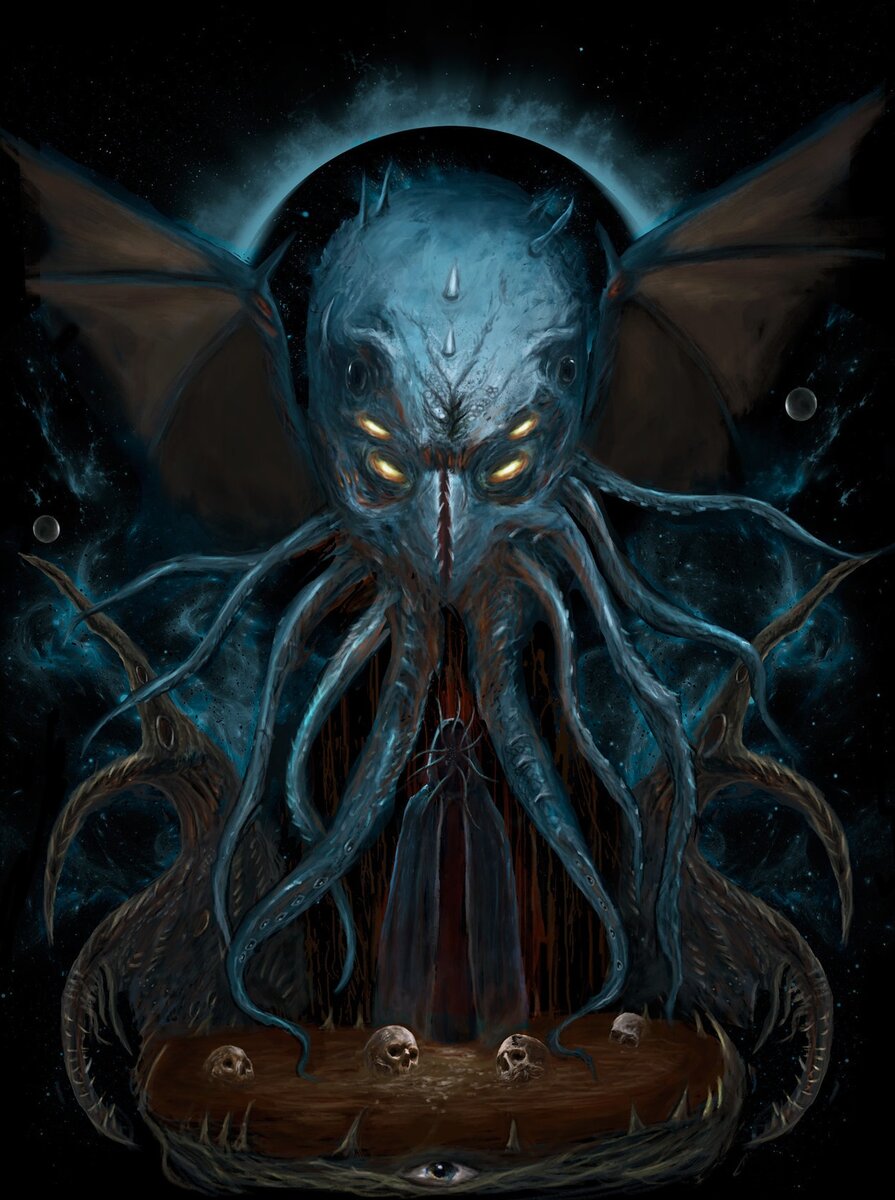
Cthulhu is one of the most recognizable figures in modern mythology. In The Call of Cthulhu, he lies dormant in the sunken city of R’lyeh, beneath the Pacific Ocean, while his influence reaches human beings through dreams. The image is extraordinarily effective because it combines several ancient human intuitions at once: the unknown is below us, the ancient is sleeping, the boundary between worlds can be crossed through dreams, and something vastly older than humanity may still be present beneath the visible world. Those motifs unquestionably have ancient precedents.
But this is where the article needs restraint. The existence of older water-associated gods and beings does not establish that Lovecraft was reproducing their knowledge. Nor does similarity between Cthulhu and any one ancient tradition establish direct transmission. Water is one of humanity’s oldest symbols of the unknown, simultaneously a source of life, a boundary, a place humans cannot naturally inhabit, and a physical environment containing forms of life radically different from our own. A civilization independently imagining an intelligence beneath the sea is therefore not surprising.
The resemblance is real. The causal connection is not established. That distinction is precisely what makes the comparison worth keeping.
The Elder Things and the Ancient-Visitor Pattern
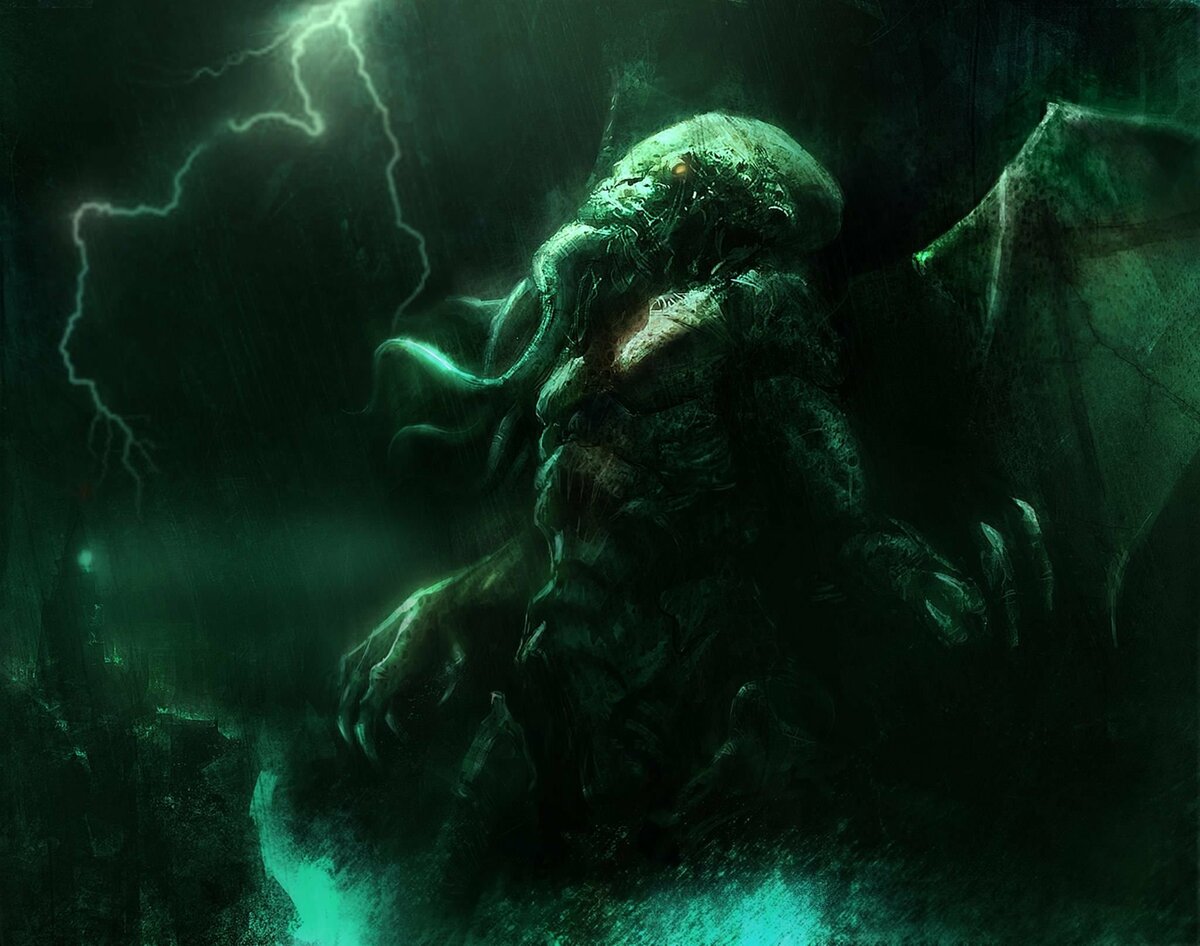
Lovecraft’s At the Mountains of Madness introduced another idea that would become enormously influential: intelligent beings existed on Earth long before humanity, established civilizations, manipulated biological development, and left behind physical traces of their presence. The resemblance to later ancient-astronaut narratives is obvious. But chronology matters. The idea that superior beings existed before humanity and influenced human development was already circulating in mythology, occult literature, speculative fiction and popular culture before Lovecraft. The same broad structure appears repeatedly: an older intelligence, intervention in Earth history, humanity as a later development, traces left behind.
That makes the resemblance between Lovecraft and later ancient-astronaut writers interesting. It does not make it paranormal. And it certainly does not establish that Lovecraft independently received the same information as the authors of ancient Mesopotamian texts. The stronger conclusion is more modest: Lovecraft was participating in a very old human question, are we actually the first intelligence to matter on Earth? He gave that question a modern scientific-horror vocabulary.
Dagon and the Ancient Name
Dagon provides an even clearer example of how Lovecraft worked. Dagon was not invented by Lovecraft. The ancient Near Eastern deity appears in sources extending back thousands of years and is associated particularly with West Semitic religious traditions. Later traditions sometimes interpreted his name and imagery through associations with fish, although the precise nature of the ancient deity remains a matter of scholarly discussion.
Lovecraft took the name and transformed it. His Dagon became part of an oceanic mythology populated by nonhuman beings and human hybrids. This is not evidence that Lovecraft had accessed an ancient religious transmission. It is evidence of something much more demonstrable: Lovecraft mined ancient names, mythological associations and cultural memories and rebuilt them inside an entirely new cosmology.
That distinction is crucial. The fact that a modern writer uses an ancient name does not mean the ancient entity has returned. Sometimes a writer is simply doing exactly what writers have always done: taking old symbols and making them strange again.
The Deep Ones and the Hybrid Idea
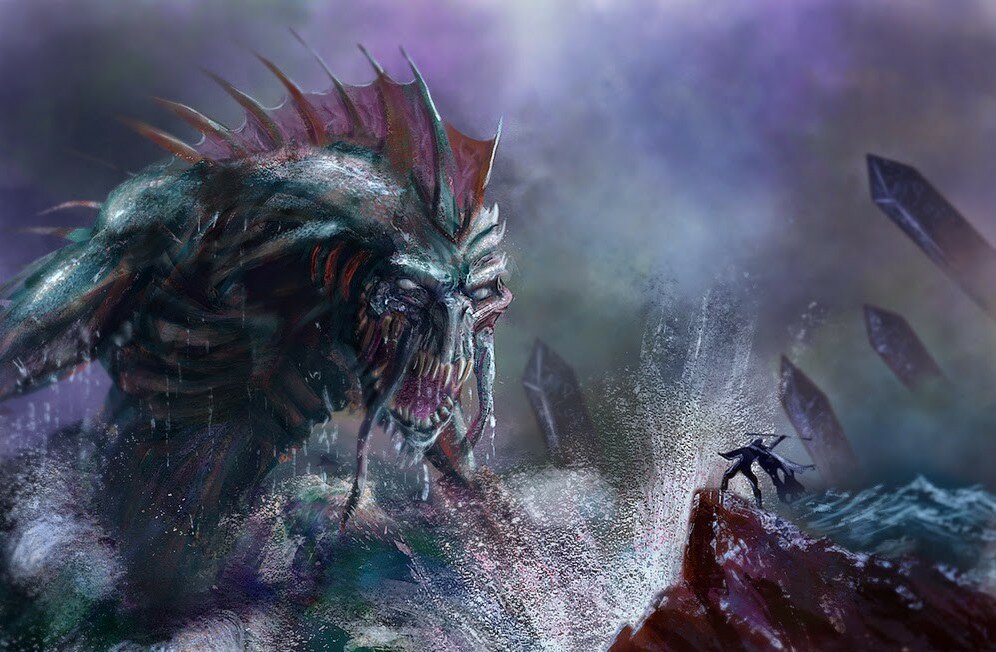
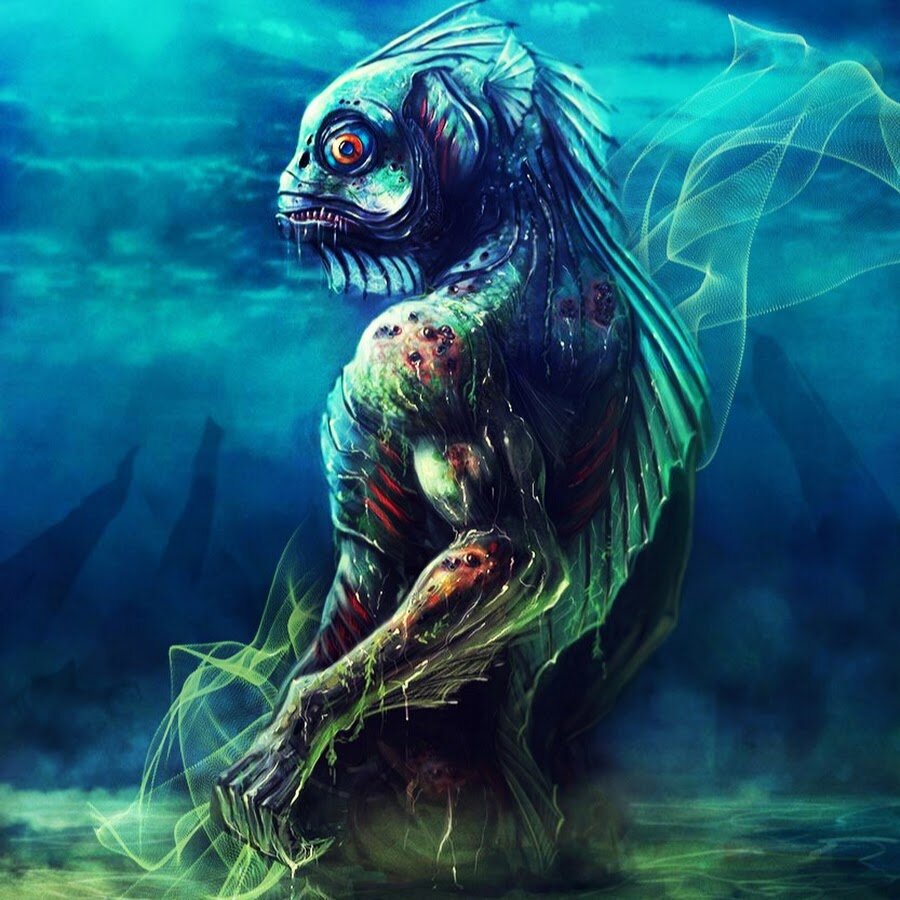
The Deep Ones are more interesting. In The Shadow Over Innsmouth, Lovecraft imagined an apparently ordinary coastal community whose inhabitants maintained a hidden relationship with an underwater civilization. Human and nonhuman bloodlines could merge, producing descendants whose appearance gradually transformed. That basic idea has parallels in numerous mythological traditions: human beings descended from gods, human women bearing children of supernatural fathers, serpent peoples intermarrying with humans, hidden divine bloodlines, ancient beings returning through descendants. These patterns are extraordinarily widespread. South Asian Naga traditions provide one example of traditions involving serpent beings and relationships with human lineages.
But again, similarity is not provenance. A hidden hybrid ancestry is such a powerful narrative device that it can arise independently. It explains the ancestry of a community. It makes the familiar secretly strange. And it creates an explanation for why some people are supposedly different from everyone around them. Lovecraft did not need access to a prehistoric transmission system to discover the idea. Human mythology had already discovered it thousands of times.
Nyarlathotep and the Deceiver
Nyarlathotep is more philosophically revealing. Unlike many of Lovecraft’s entities, Nyarlathotep actively interacts with humanity. He communicates, assumes recognizable forms, manipulates people and operates as an intermediary between incomprehensible cosmic forces and the human world. That creates an obvious comparison with religious traditions containing deceptive intermediaries, false gods, trickster beings, archons, messengers and spirits. The Gnostic Demiurge is an especially tempting comparison.
But the similarity should not be exaggerated. The Demiurge belongs to a complex religious cosmology concerned with creation, divine emanation, ignorance and liberation. Nyarlathotep belongs to Lovecraft’s fictional universe. They are not the same entity. What they share is something more abstract: the idea that the apparent structure of reality may be mediated by an intelligence whose motives are not aligned with human understanding. That idea is ancient. It is also psychologically powerful. And it appears independently in theology, mythology, philosophy and horror fiction. The convergence is therefore real. The explanation remains open.
Azathoth and the Horror of Meaninglessness
Azathoth may be the clearest expression of Lovecraft’s actual philosophy. The entity sits at the center of his fictional cosmos as a symbol of primordial chaos and mindless cosmic indifference. This is where attempts to convert Lovecraft into a hidden Gnostic become especially problematic. Gnosticism generally begins from the intuition that the visible world is defective in relation to a higher divine reality. Lovecraft begins somewhere almost opposite. There may be no higher benevolent reality. There may be no cosmic purpose. There may be no intelligence organizing existence for human benefit. There may simply be an enormous universe in which humanity is incidental.
Lovecraft’s horror therefore does not require an evil creator. Indifference is enough. That is one of the reasons his work remains philosophically powerful. The frightening possibility is not necessarily that something wants to control humanity. It is that nothing cares.
The Necronomicon Was Fiction. The Tradition Behind It Wasn’t.
The Necronomicon is one of Lovecraft’s most successful inventions. He attributed it to the fictional Arab poet Abdul Alhazred and surrounded it with a deliberately constructed history of translations, editions, disappearances and forbidden scholarship. The book does not exist as the ancient manuscript Lovecraft described. Lovecraft knew that.
But the idea of such a book belongs to a real tradition. Historical grimoires really did exist. Texts such as the Key of Solomon, the Book of Abramelin and the Goetia belong to a genuine Western magical literature involving spirits, ritual procedures, cosmological hierarchies and warnings concerning the improper use of occult knowledge.
Lovecraft therefore did not invent the concept of a dangerous book containing forbidden knowledge. He invented his forbidden book. That is a very different claim, and it is one of the most revealing things about his method. He took the architecture of real esoteric literature and transformed it into fiction.

Then the Occultists Came Looking
The most intriguing part of the story happened after Lovecraft’s death. Later occultists did not merely enjoy his fiction. Some began interpreting it as something more. Kenneth Grant became the most influential example. Beginning with The Magical Revival in 1972 and continuing through his Typhonian writings, Grant developed an esoteric interpretation of Lovecraft in which the entities of the Cthulhu Mythos could be understood as manifestations or descriptions of forces encountered through occult practice.
That interpretation is historically real. It is also chronologically important. Grant was interpreting Lovecraft. Lovecraft was not describing Grant’s system. And there is a profound irony here. Lovecraft, the atheist materialist, created a fictional mythology that later occultists incorporated into genuine occult practice. The fictional mythology acquired a religious afterlife that its creator did not intend. That phenomenon deserves to be taken seriously in its own right.
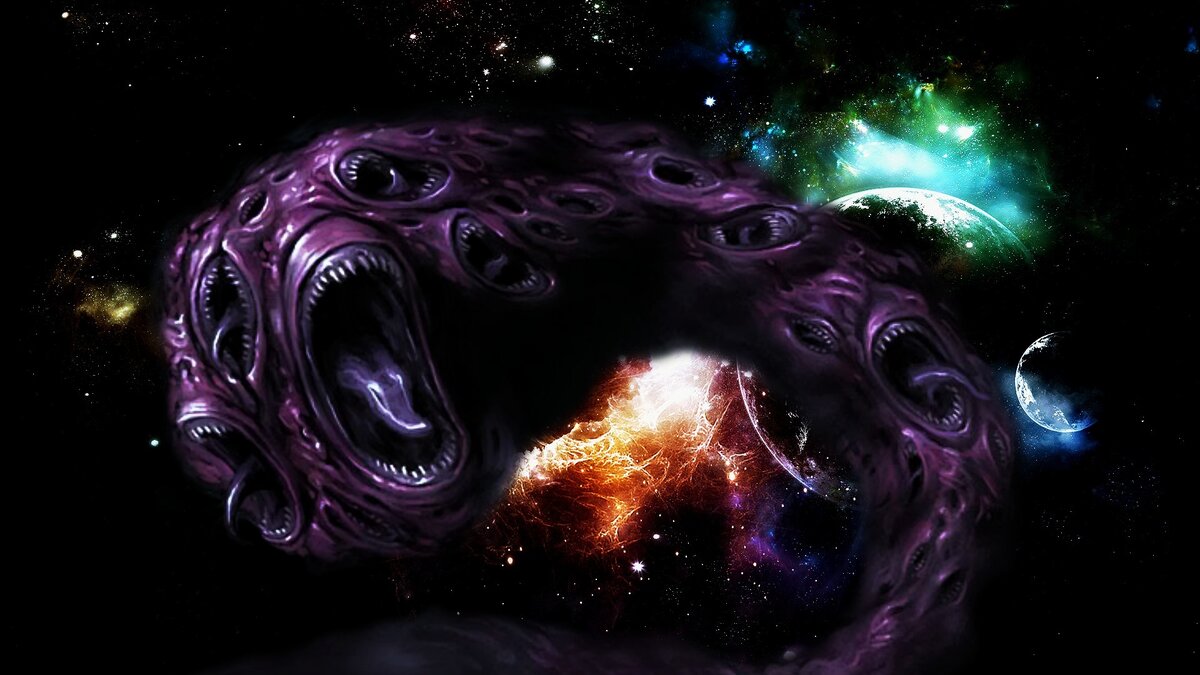
So What Did Lovecraft Actually Receive?
This is where the evidence becomes most interesting. Lovecraft really did experience dreams that influenced his fiction. He really did describe dreams and dream imagery as part of his creative process. He really did construct a mythology whose imagery sometimes resembles much older religious, mythological and esoteric traditions. He really did draw from identifiable literary predecessors. And he really did reject the conclusion that his fiction represented literal supernatural revelation. All four facts can be true simultaneously.
That leaves a more difficult question than the original claim. Why can the human imagination generate images that resemble one another across enormous distances of time and culture? There are several possible answers: shared psychology, common environmental experience, recurring symbolic structures, cultural transmission, literary inheritance, coincidence, or, for those willing to entertain a more radical possibility, some form of information access that current models of cognition do not adequately explain. The evidence presented here does not distinguish those possibilities decisively.
And that is precisely why Lovecraft belongs in an archive concerned with anomalous ideas. Not because he secretly proved the existence of Cthulhu. He did not. Not because his dreams demonstrate paranormal transmission. They do not. But because his case presents a fascinating boundary between dream, imagination, mythology, cultural memory and apparent convergence.

The Strange Afterlife of a Materialist
Lovecraft spent his life insisting that the universe did not need to be meaningful to be terrifying. He wanted his readers to confront the possibility that humanity was not central to reality. His fiction was therefore not an occult revelation disguised as horror. It was horror produced from a philosophical position.
Yet something unexpected happened. The mythology he created became real as culture. Cthulhu entered games, art, music, occult practice and popular mythology. The Necronomicon became the subject of genuine searches by people who knew perfectly well that Lovecraft had invented it. Occultists such as Kenneth Grant interpreted his fictional entities through their own esoteric systems. And generations of readers began using Lovecraft’s invented cosmology as a language for discussing something the author himself had intended to make frightening: the possibility that human beings do not understand the reality they inhabit.
That is perhaps the deepest convergence in the entire story. Not that Lovecraft discovered an ancient secret. But that a twentieth-century atheist created a mythology that later generations found capable of expressing questions that religious and esoteric traditions had been asking for thousands of years.
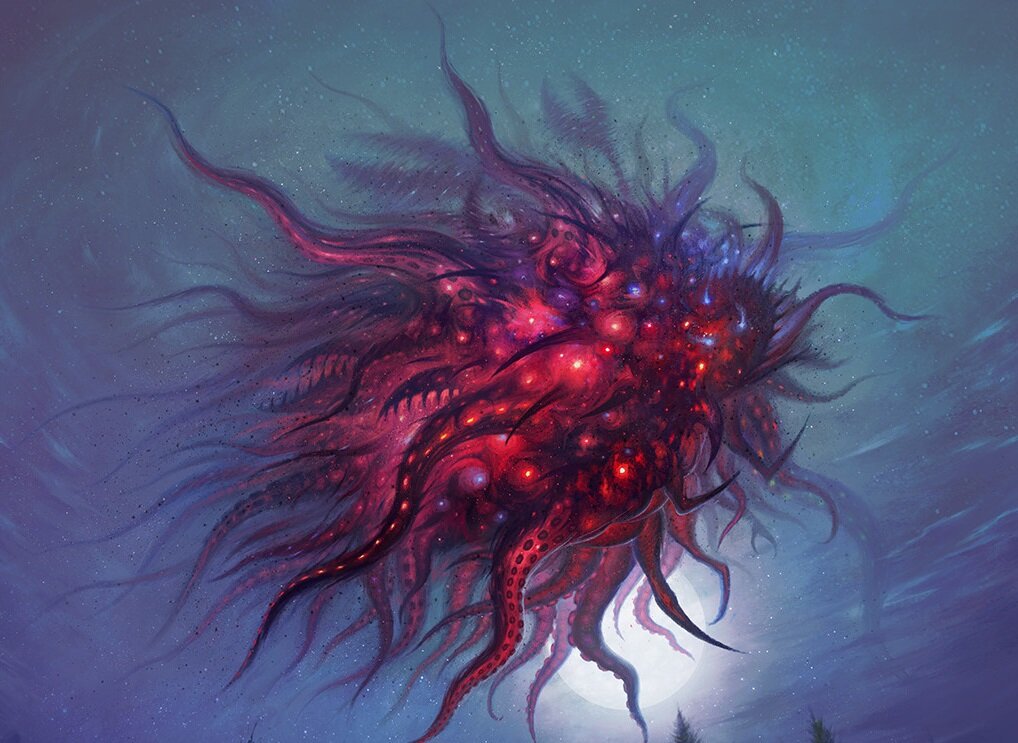
The Dreams Happened. The Explanation Wasn’t Paranormal
Lovecraft did not provide evidence that his dreams were transmissions from ancient civilizations, supernatural entities or hidden dimensions. His own writings argue against that interpretation. The correspondences between his fiction and older traditions are nevertheless real and worth examining. Some are readily explained by documented literary influence. Others arise from broad mythological patterns that recur across cultures. Some are genuinely striking. None, by themselves, establishes paranormal transmission.
That conclusion is not a failure of the investigation. It is what the evidence permits. And perhaps the most interesting question is therefore not: did Lovecraft dream of something that was already out there? It is: why do human beings, separated by centuries and continents, so often dream in the same symbolic language? That question remains open. And unlike the Necronomicon, the question is real.
Lovecraft’s dream, whatever its true source, keeps producing the same question centuries later.