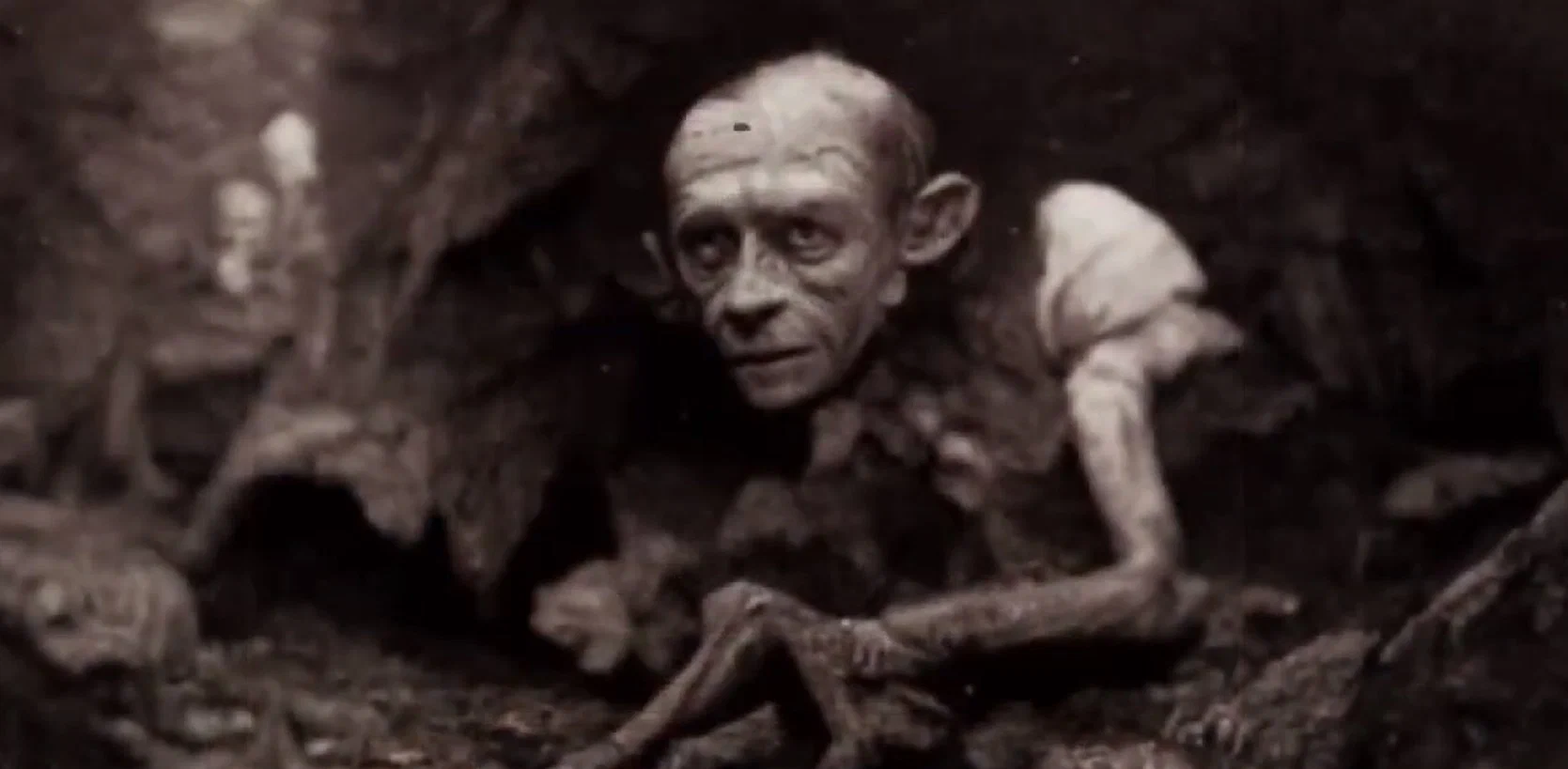




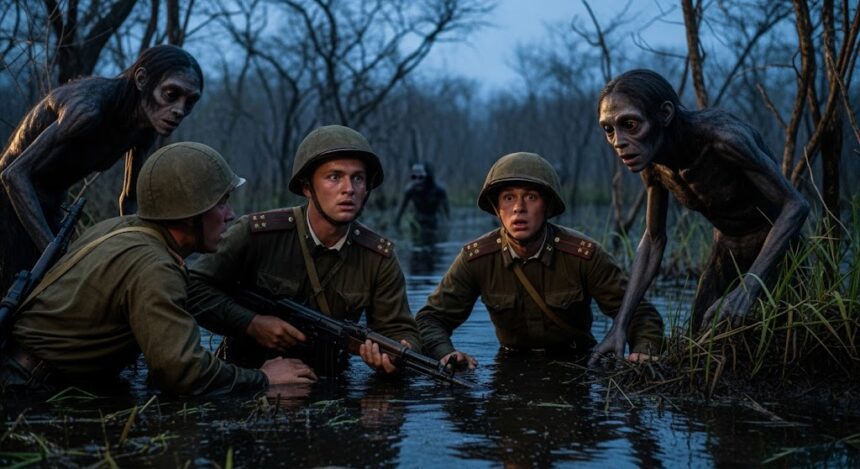
The Soviet military really was in Mozambique. The civil war really was catastrophic. Villages really were attacked at night, people really did disappear into forests and swamps, and Cold War intelligence operations really did leave enormous gaps in what outsiders could independently verify. What has never emerged, however, is the evidence for the creatures placed inside that history: no identified Soviet unit, no named commander, no surviving specimen, no pathology report, no military archive, and no peer-reviewed biological study documenting the tall, mud-covered humanoids said to have been captured near a Soviet garrison.
That distinction matters because the story is built from unusually effective ingredients. It takes a real war, a real foreign military presence, a genuinely remote landscape, a real tradition of unexplained humanoid sightings in parts of Africa, and a real biological phenomenon in which fungi can alter animal behavior—and assembles them into something that sounds like a declassified military case file. The result is compelling precisely because so many of its ingredients are real. But when the claim is followed back to the evidence, the chain stops. What remains is not a suppressed zoological discovery. It is a modern cryptid narrative sitting on top of a very real and very dark piece of Cold War history.
The Soviet Presence in Mozambique Was Real
After Mozambique gained independence from Portugal in 1975, FRELIMO built a socialist state and developed a close relationship with the Soviet bloc. During the civil war that followed, Moscow supplied FRELIMO with substantial military assistance, including tanks, artillery, aircraft, air-defense systems, training, and military advisers. Soviet involvement was significant enough that RENAMO routinely portrayed the Mozambican government as dependent on Moscow, while the historical record also shows an important limit to the relationship: Mozambique sought Soviet equipment and advisers but resisted the establishment of a permanent Soviet military base. This is precisely the kind of real history that gives later stories their atmosphere of secrecy. There really were foreign advisers, unfamiliar equipment, military installations, intelligence networks, and enormous stretches of territory in which outsiders could have difficulty determining exactly what had happened.
But the real history also gives us something the creature story does not: names, institutions, dates, weapons systems, diplomatic records, military decisions, and people whose movements can be traced through independent sources. That difference is crucial, and it applies just as directly to claims about Cold War military experimentation programs elsewhere. Secrecy can explain why a document might be difficult to find. It cannot, by itself, substitute for the document. Once a story claims that Soviet soldiers captured multiple unknown humanoids, performed postmortems, discovered an unusual infection, and considered the possibility of biological engineering, the evidentiary burden becomes enormous. A claim that spectacular would leave a much larger footprint than a story repeated years later on paranormal forums.
The Creature Story Has No Documentary Spine
The narrative itself is remarkably specific. Villagers supposedly reported attacks by tall figures covered in mud and emitting a foul smell. Soviet soldiers supposedly followed tracks into wetlands, encountered the creatures, killed several, and recovered bodies. The alleged examination then escalates the story from a strange-animal encounter into something much larger: unfamiliar anatomy, an aggressive fungal infection in the brain, and speculation that the creatures might have been engineered rather than naturally occurring.
Specificity is not evidence. In fact, it makes the absence of evidence more significant. There is no identifiable military unit attached to the episode, no commander whose service record can be checked, no named Soviet physician or biologist who supposedly performed the examination, no hospital or laboratory, no specimen accession number, no photograph with an independently established provenance, no tissue sample, no autopsy report, and no contemporary newspaper investigation that can be traced back to the event. The story therefore has the surface characteristics of a historical report without the documentary structure that normally allows a historical report to be tested.
But Mozambique Already Had Its Own “Little People” Tradition
This is where the story becomes more interesting rather than less. East and Central Africa have a genuine body of folklore and early twentieth-century reports concerning small, hairy, humanlike beings. One of the best-known traditions is the Agogwe. Captain William Hichens described seeing two small, brown, furry upright creatures during a hunting expedition in what was then Tanganyika, publishing the account in Discovery in 1937. The following year, Cuthbert Burgoyne wrote to the same magazine claiming that he had seen two small humanlike figures near the coast of what is now Mozambique. These accounts are historical documents in the sense that the reports themselves can be traced. They are not zoological proof that an unknown hominin survived in Africa.
That distinction is exactly the one cryptozoological stories tend to erase. A nineteenth- or twentieth-century witness report can be completely genuine as a historical source while still being wrong about what was seen. A person can sincerely report an encounter without having correctly identified the animal, and an oral tradition can preserve a striking description without functioning as a biological species account. The Agogwe tradition therefore gives us something important: a real cultural and historical background for stories about hairy humanoids in Africa. What it does not give us is a Soviet autopsy report from Mozambique.
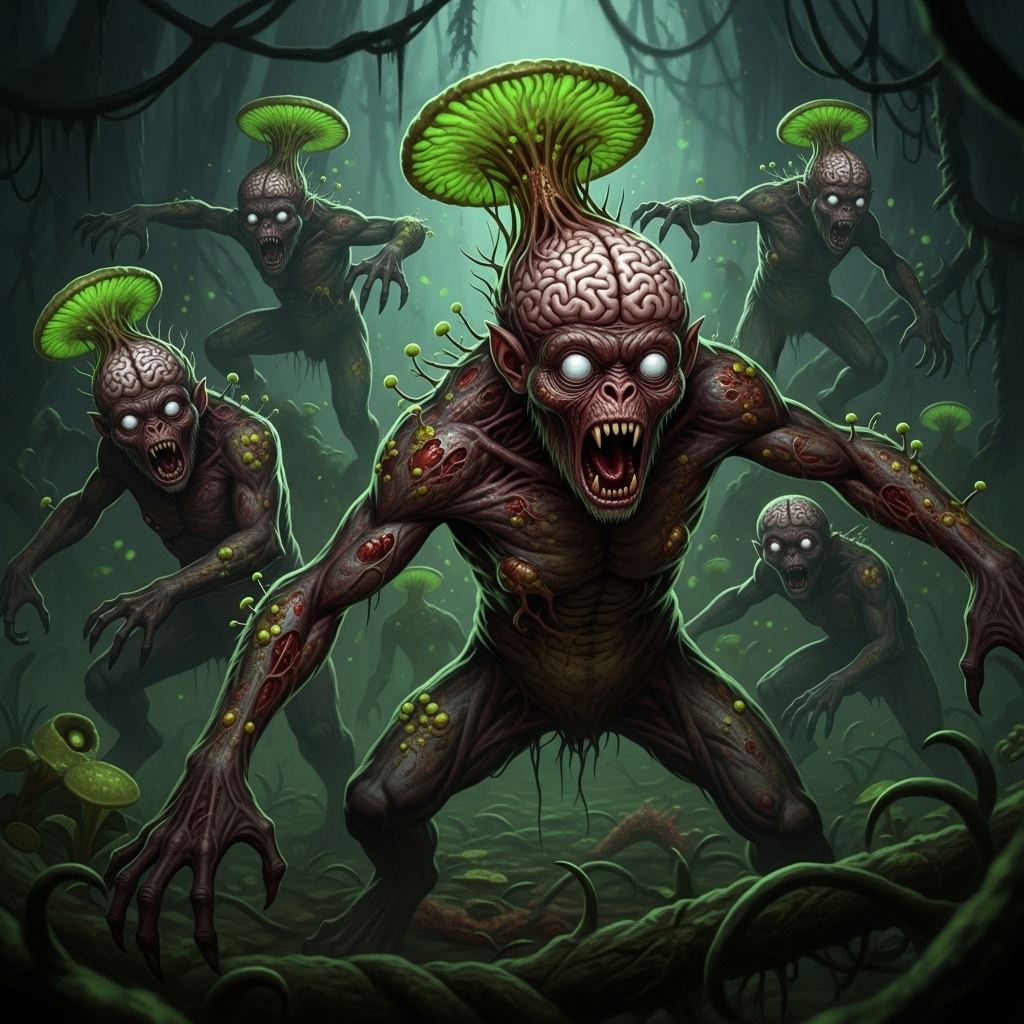
The Fungal Detail Is Real Biology Used as Fiction
The fungal component of the story is especially effective because nature has already produced something disturbingly close to it. Species in the genus Ophiocordyceps infect insects and can manipulate aspects of host behavior in ways that help the fungus reproduce. The phenomenon has become one of the most famous examples of parasite-induced behavioral manipulation in popular science, and it has naturally migrated into horror, science fiction, and speculative biology.
But an insect-manipulating fungus is not evidence for a fungus that can transform an unknown humanoid into an aggressive predator. Nor does the existence of behavioral manipulation in nature make a mysterious infection in an alleged Soviet specimen scientifically plausible by default. The story is doing something rhetorically powerful here: it takes a genuine biological phenomenon, removes it from its actual evolutionary context, and uses it as a bridge between an unexplained creature and a much larger theory of engineering. The biological fact is real. The leap built on top of it is not.
The War Was Far More Horrifying Than the Monster
The historical setting does not need supernatural enhancement. Mozambique’s civil war began in the late 1970s and lasted until the 1992 peace agreement, becoming one of the defining conflicts of southern Africa’s Cold War. FRELIMO fought RENAMO, while the conflict was repeatedly shaped by external intervention and regional power politics. RENAMO received major backing from Rhodesia and later apartheid South Africa, while FRELIMO relied heavily on the Soviet bloc and other foreign partners. The human cost was enormous: more than a million people were killed or affected through direct violence and war-related conditions, millions were displaced, and rural communities were repeatedly subjected to attacks, forced movement, destruction, and deprivation.
That history matters when evaluating a story about nocturnal attacks on isolated villages. In a war zone, the distinction between something frightening and something unexplained can become dangerously thin. Armed men moving through forests at night, soldiers operating under exhaustion, displaced populations, unfamiliar wildlife, explosions, disease, malnutrition, rumors, and incomplete information can produce testimony that later becomes difficult to reconstruct. None of this proves that every strange report was mistaken. It means the historical environment was already capable of producing extraordinary experiences without requiring an undiscovered species.
The Soviet Union Really Did Investigate Wild-Man Reports
There is another reason the Mozambique story sounds plausible to readers familiar with Soviet history: the Soviet Union really did have researchers interested in wild-man reports. Boris Porshnev and Marie-Jeanne Koffmann became prominent figures in Soviet investigations of the Central Asian and Caucasian “Almas” tradition, the supposed wild man of Mongolia and surrounding regions. Expeditions were conducted, witnesses were interviewed, and the subject was taken more seriously by some Soviet researchers than it was in many Western scientific circles at the time.
But the outcome is just as important as the investigation itself. No authenticated Almas specimen emerged from that work. No confirmed surviving population of relict hominins was established. The existence of a historical research program into a cryptid therefore proves something quite modest: Soviet researchers were willing to investigate extraordinary claims. It does not establish that every later story about Soviet monster investigations is genuine. If anything, the real history provides a useful control case. When the Soviet wild-man investigations are documented, we can identify the researchers, the regions, the expeditions, and the hypotheses. The Mozambique story has none of that documentary density.
Ebu Gogo Is a Different Mystery Entirely
The comparison with Ebu Gogo is nevertheless worth keeping, because it leads to one of the genuinely fascinating intersections between folklore and paleoanthropology. Among the Nage people of Flores, Indonesia, anthropologist Gregory Forth documented stories of Ebu Gogo—small, hairy, humanlike beings described as living in caves and remembered as having disappeared from the region. Crucially, Forth’s fieldwork documenting these traditions predates the public announcement of Homo floresiensis, which means the folklore cannot simply be dismissed as a modern reaction to the famous “hobbit” fossils.
Then archaeology produced something extraordinary. Excavations at Liang Bua revealed Homo floresiensis, a previously unknown species of small-bodied hominin. The original 2004 description reported an adult stature of roughly one metre and a highly unusual anatomy, while subsequent dating established a Late Pleistocene presence on Flores. Researchers have discussed the possibility that Ebu Gogo traditions preserve some distant cultural memory of encounters with an extinct hominin, but that remains a hypothesis, not an established explanation for the folklore. The case is valuable precisely because the evidence runs in both directions: anthropology documented the tradition, archaeology independently discovered a real extinct hominin, and scholars can then ask whether the two are connected.
That Is What Real Cryptozoology Looks Like When It Gets Interesting
A genuine mystery does not become more interesting when every gap is filled with a secret military experiment. It becomes more interesting when the gaps are left visible. Africa contains an enormous biological diversity that remains incompletely documented, and human history across the continent is far more complicated than any simple list of known species suggests. The discovery of previously unknown species is not remotely impossible, a point worth remembering across every persistent cryptid tradition found around the world. What is difficult is proving that one exists after the fact.
That proof has a recognizable architecture. There should be physical material, preserved specimens or scientifically usable remains, a documented collection history, anatomical analysis, independent examination, and eventually genetic or other molecular evidence where appropriate. The strongest cryptozoological cases become biology only when they cross that boundary. Until then, they remain reports, traditions, anecdotes, or hypotheses. Calling them “real” before the evidence arrives reverses the scientific process.
What the Bigfoot Evidence Teaches Us
The modern history of Bigfoot and Yeti claims illustrates the same problem. In 2014, a team led by geneticist Bryan Sykes examined 30 hair samples attributed to anomalous primates after rigorous decontamination and mitochondrial sequencing. The samples overwhelmingly came from known animals rather than an unknown primate. Two Himalayan samples produced an unusual result, showing closest genetic affinity to a Pleistocene polar bear, although that finding itself later became the subject of scientific discussion over how the sequences should be interpreted. The important point is methodological: once physical evidence becomes available, it can be tested.
That is the standard the Mozambique creatures never reach. The problem is not that nobody has proved they are fake. The problem is that the story has not produced the kind of physical evidence from which a biological claim could even begin to be evaluated. A photograph can be ambiguous. A footprint can be contaminated. A witness can be mistaken. A body is different. A tissue sample is different. A museum specimen with a chain of custody is different again. The further a claim moves toward extraordinary biology, the more important those distinctions become.
Why Cold War Monster Stories Are So Difficult to Kill
The Cold War is an almost perfect setting for an invented cryptid story because the real period was saturated with secrecy. Governments concealed military capabilities. Intelligence services operated through intermediaries. Foreign advisers worked inside allied states. Records were classified. Remote regions were poorly documented. And ordinary people often encountered events whose causes were difficult to identify.
That creates a powerful narrative shortcut: whenever evidence is missing, secrecy becomes the explanation for why the evidence is missing. The unnamed commander cannot be located because the operation was classified. The specimen cannot be found because it was destroyed. The laboratory report does not exist because the Soviet archives remain incomplete. The witness cannot be interviewed because he died decades ago. Every missing piece therefore becomes evidence of concealment instead of evidence of uncertainty. Once a story reaches that point, it becomes almost impossible to falsify from inside the story itself.
The Creature Is the Least Interesting Part
There is a temptation to end here by saying the Mozambique creatures were “debunked,” but that would grant the story more evidentiary status than it deserves. A better conclusion is narrower and harder: the alleged Soviet creature incident has not been established as a historical event. Its surrounding ingredients are real—the Soviet relationship with FRELIMO, the Mozambican Civil War, African wild-man traditions, the Agogwe reports, fungal behavioral manipulation, Soviet interest in the Almas, and the genuine scientific discovery of Homo floresiensis. The narrative becomes fictional precisely where those separate histories are fused into a single secret operation.
And that is why the real history is more valuable than the monster. Mozambique does not need an undiscovered humanoid to make its Cold War story extraordinary. The Soviet Union really did send military advisers and equipment into a country devastated by war. RENAMO really did attack rural communities. Foreign powers really did turn Mozambique into part of a wider regional struggle. Scientists really did discover a previously unknown human species on another island, and anthropologists really did document traditions that may—or may not—preserve memories of vanished populations.
The evidence leaves us with something more interesting than a classified autopsy. It leaves us with a boundary. On one side are wars, fossils, folklore, military archives, biological phenomena, and eyewitness reports that can be investigated independently. On the other is a story in which all of those things suddenly become one hidden explanation. The first side is history. The second is mythology wearing history’s uniform.
And until someone produces the specimen, the report, the archive, or the evidence, the Mozambique creatures belong to the story—not to the historical record.