



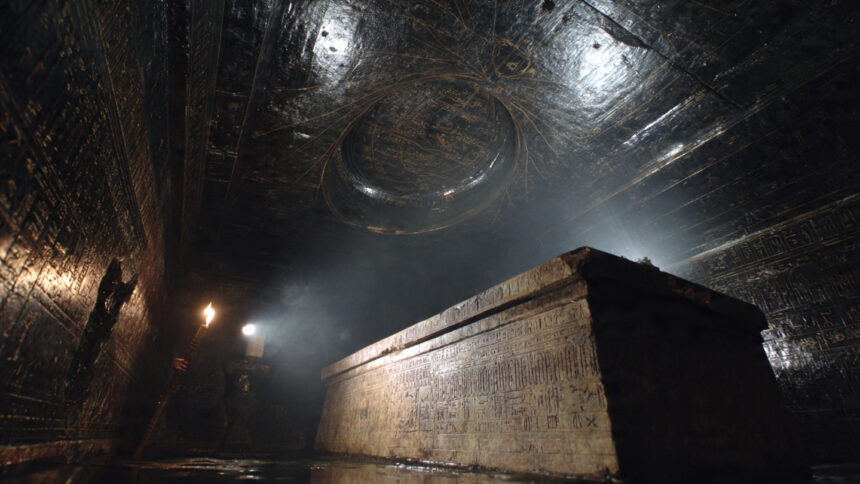
The King’s Chamber has fascinated engineers for centuries. Its granite blocks, extraordinary precision, and unusual acoustics remain among the most studied features of the Great Pyramid. Every few years a new claim appears suggesting the chamber was more than a tomb. Most collapse under scrutiny.
The reasons people keep making them are far more interesting than the claims themselves.
What Ibn Battuta Actually Wrote
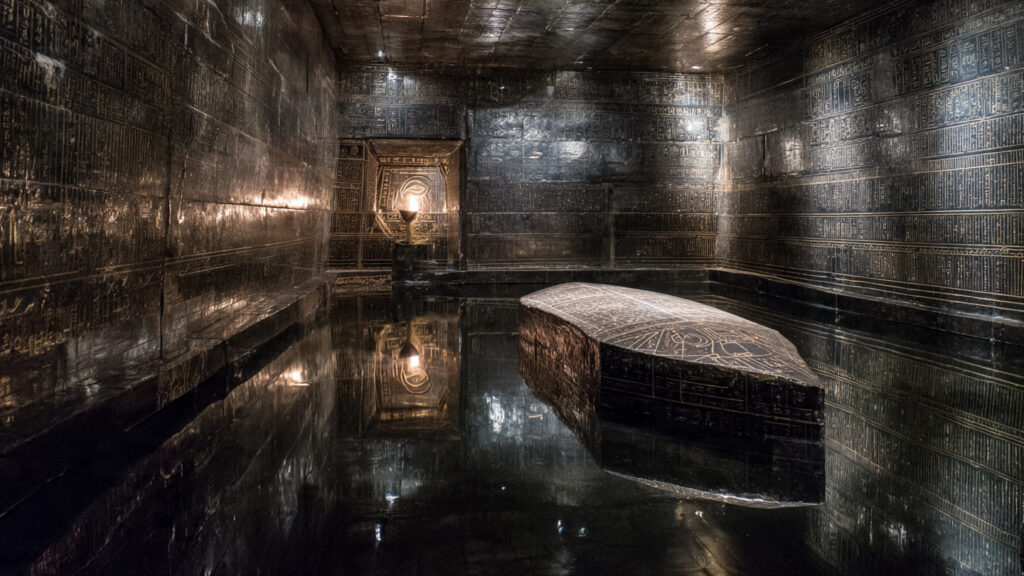
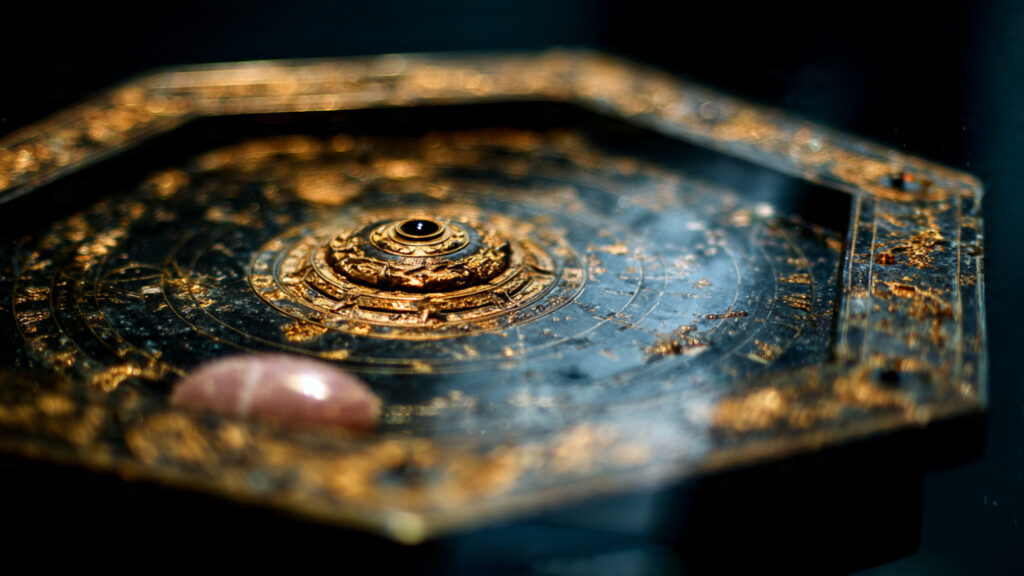
The precise wording matters here, since it directly contradicts the elaborate account attributed to him. Ibn Battuta, a documented 14th-century Moroccan scholar born in Tangier, documented roughly 30 years of travel across Africa, Asia, and Europe in his Rihla. His published description of the Giza pyramids reads: “built by solid hewn stones, of colossal height, circular, broad at the base, narrow at the summit… no doors; no one knows how they were built,” constructed for “the burial of the royal corpses.” That’s the complete, documented account, brief, plainly stated, and openly admitting he didn’t know their construction method. No tomb robber named Maqsoud, no concealed black-walled hall, no pink stone artifact with gold-filled inscriptions appears anywhere in his documented writing. Historians studying the Rihla have separately noted that portions of Ibn Battuta’s broader travelogue, including a claimed journey to Bulgar in modern Russia, appear to be based on earlier geographic writings rather than his own direct experience, a documented scholarly caution about taking every detail in his account at face value. Even accounting for that caution, nothing in the surviving text resembles the elaborate chamber described here.
The Documented Precision of the King’s Chamber
The chamber’s precision deserves accurate credit, because the engineering achievement needs no exaggeration. The King’s Chamber is genuinely lined with Aswan granite, quarried roughly 800 kilometers south of Giza and transported at enormous logistical cost, documented evidence of the resources a fourth-dynasty state could mobilize. The precision of the stonework is documented and has been measured directly by Egyptologists and engineers studying the structure. Quartz-bearing granite genuinely exhibits piezoelectricity, a well-established property where mechanical stress generates a small electric charge, extensively used in modern technology from watches to sonar. That’s documented materials science and documented ancient engineering. Neither fact, on its own or combined, describes a component built to function as a radio receiver, and no published, peer-reviewed engineering or materials science study has proposed that it does.
Why People Think It Behaves Unusually
The chamber’s genuine acoustic properties deserve honest attention, since they’re the real seed these claims keep growing from. Researchers studying the King’s Chamber have documented real resonance effects, the room’s dimensions and hard granite surfaces produce measurable acoustic reflections and standing waves that acousticians have studied directly, distinct from ordinary room acoustics because of the material and geometry involved. Piezoelectricity in quartz-bearing stone is genuine physics, and granite’s crystalline structure genuinely does respond to mechanical stress in measurable ways. None of that documented behavior implies signal reception, storage, or transmission, capabilities that would require components, wiring, and power sources nothing in the structure contains. The actual gap between “this room has unusual acoustics” and “this room is a machine” is exactly where these claims consistently jump without support, and it’s worth naming clearly why the jump keeps happening: real acoustic phenomena are strange enough to feel engineered even when they’re simply what dense, precisely cut stone does.
Where the Orion Correlation Theory Actually Comes From
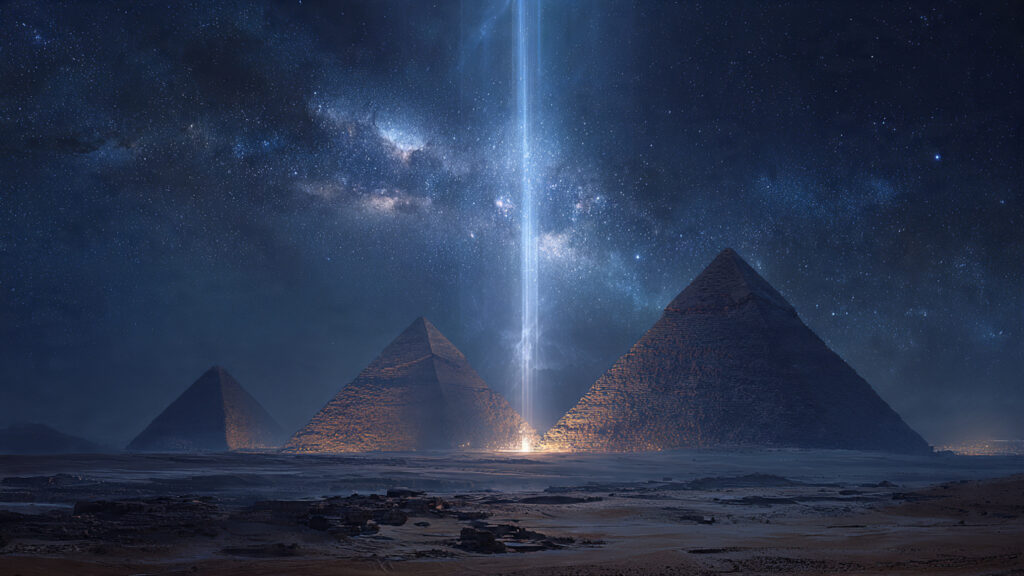
The Orion theory deserves precise, honest sourcing rather than treatment as settled fact. Robert Bauval, a Belgian construction engineer without formal Egyptological training, first proposed the Orion Correlation Theory in a 1989 article in the academic journal Discussions in Egyptology, arguing the three main Giza pyramids’ layout mirrors the three stars of Orion’s Belt as they appeared around 10,500 BCE. He expanded the idea in his 1994 book The Orion Mystery, co-written with Adrian Gilbert. The theory is explicitly and consistently classified as a fringe theory within professional Egyptology, disputed on multiple grounds by archaeologists and astronomers, and Bauval himself has appeared repeatedly on the television series Ancient Aliens, a documented association worth knowing when weighing the theory’s standing in the field. That’s a genuine intellectual history, a specific author, a specific date, a specific disputed status, not an anonymous, decades-long scientific consensus the establishment has suppressed.
What Has No Verifiable Source
The absence of sourcing needs to be addressed plainly. No named observatory, university, or Egyptian antiquities authority has published a report describing an acoustic event in the King’s Chamber, a coincident Orion-sector radio pulse, gravimetric anomalies, or a multi-institution subsurface scan revealing a tunnel network beneath Giza. Documented ground-penetrating radar and muon tomography research on the Giza plateau does exist, conducted by named research teams and published in peer-reviewed journals. The ScanPyramids project, led by physicist Kunihiro Morishima, published a 2017 paper in Nature reporting a genuine 30-meter void above the Grand Gallery, the first major internal structure found in the Great Pyramid since the nineteenth century, followed by a 2023 paper in Nature Communications precisely characterizing a second void, the North Face Corridor, measured at 9 meters long, 2 meters wide, and 2 meters tall. Both findings carry named physicists, specific dates, specific dimensions, and peer review, findings that get accurately reported with named scientists and specific measurements attached. A claim this dramatic, if genuine, would carry exactly that kind of attribution. Its complete absence here is itself informative.
The Stone Was Already Remarkable
For more than four thousand years the Great Pyramid has accumulated explanations almost as quickly as it accumulated myths. Engineers see extraordinary stonework. Physicists see unusual acoustics. Egyptologists see the product of an astonishing Old Kingdom state. Others see messages, machines, or memories. The granite has never announced which interpretation is correct. It has only continued doing what it has always done: remaining precisely where its builders left it, inviting every generation to project its newest technology onto humanity’s oldest monument.
The Sphinx, nearby, has its own real history of restricted access following an anomalous 1993 survey.