



For about six weeks in late 2025, a genuine astronomical anomaly went unexplained. By early 2026, it had a conventional answer. This piece covers both halves of that story, not just the interesting middle part.
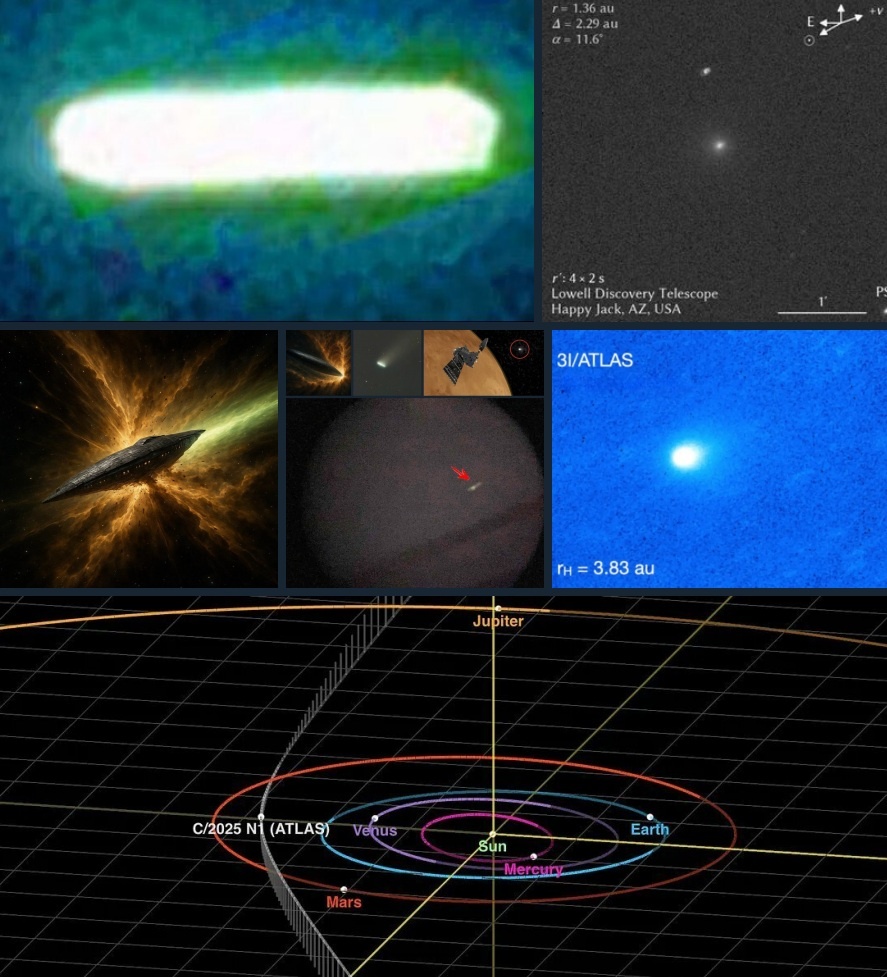
3I/ATLAS is real: the third confirmed interstellar object to pass through the solar system, after 1I/’Oumuamua in 2017 and 2I/Borisov in 2019, discovered on July 1, 2025 by the ATLAS survey. Its hyperbolic, unbound trajectory confirms it originated outside the solar system. It reached perihelion, its closest approach to the Sun, on October 29, 2025, and passed Earth at a safe distance of 1.8 AU on December 19, 2025.
The Real Anomaly
Around perihelion, Davide Farnocchia, a navigation engineer at NASA’s Jet Propulsion Laboratory, measured a real deviation using data from the Atacama Large Millimeter Array: 3I/ATLAS was about four arcseconds off from where a purely gravity-driven trajectory predicted it should be. This is a genuine non-gravitational acceleration, and it is a real, published, scientifically interesting finding, not a fabrication.
Harvard astrophysicist Avi Loeb, a real, credentialed scientist known for taking interstellar-technology hypotheses seriously as one possibility among several, calculated what a gas-driven “rocket effect” explanation would require: roughly a sixth of the object’s mass evaporating to produce that much thrust. He predicted this should be visible as “a large plume of gas surrounding 3I/ATLAS during the upcoming months of November and December 2025,” and said explicitly that if no such plume appeared, the acceleration “might be regarded as a technological signature.”
This is worth stating plainly because it’s an honest, falsifiable scientific prediction, exactly the kind of claim that can be checked against later evidence, which is what happened next.
What the Blue Color Actually Was
Observers also reported the comet’s coma appeared unusually blue rather than the reddish color typical of dust-scattered sunlight. Loeb offered two explanations at the time, and it’s worth reporting both rather than only the dramatic one: a hot engine or artificial light source, or, in his own words, “simply be a signature of ionized carbon monoxide for a natural comet.” He presented these as open possibilities, not a conclusion favoring either one.
The International Asteroid Warning Network Campaign
Between November 27, 2025 and January 27, 2026, the International Asteroid Warning Network ran a real, publicly announced observing campaign specifically targeting 3I/ATLAS, coordinated with the UN’s planetary defense structure. This was explicitly the test that would settle the question: astronomers worldwide pooled observations to check for the gas cloud Loeb’s calculations predicted a natural explanation would require.
What Was Actually Found
This is where the story needs to be updated rather than left hanging at its most dramatic moment. In the months following the IAWN campaign, 3I/ATLAS developed exactly the features Loeb’s prediction said a natural comet would show. The European Space Agency, using data from its JUICE and Juno spacecraft, confirmed the object has a distinct coma along with both a dust tail and an ion tail, standard cometary features. By April 2026, ESA reported the tail extends approximately 5 million kilometers from the nucleus, well within the range typical of active comets. The object’s coma also showed a Sun-facing dust plume consistent with sunlit-side ice sublimation, a pattern seen in other distant comets like C/2014 UN271.
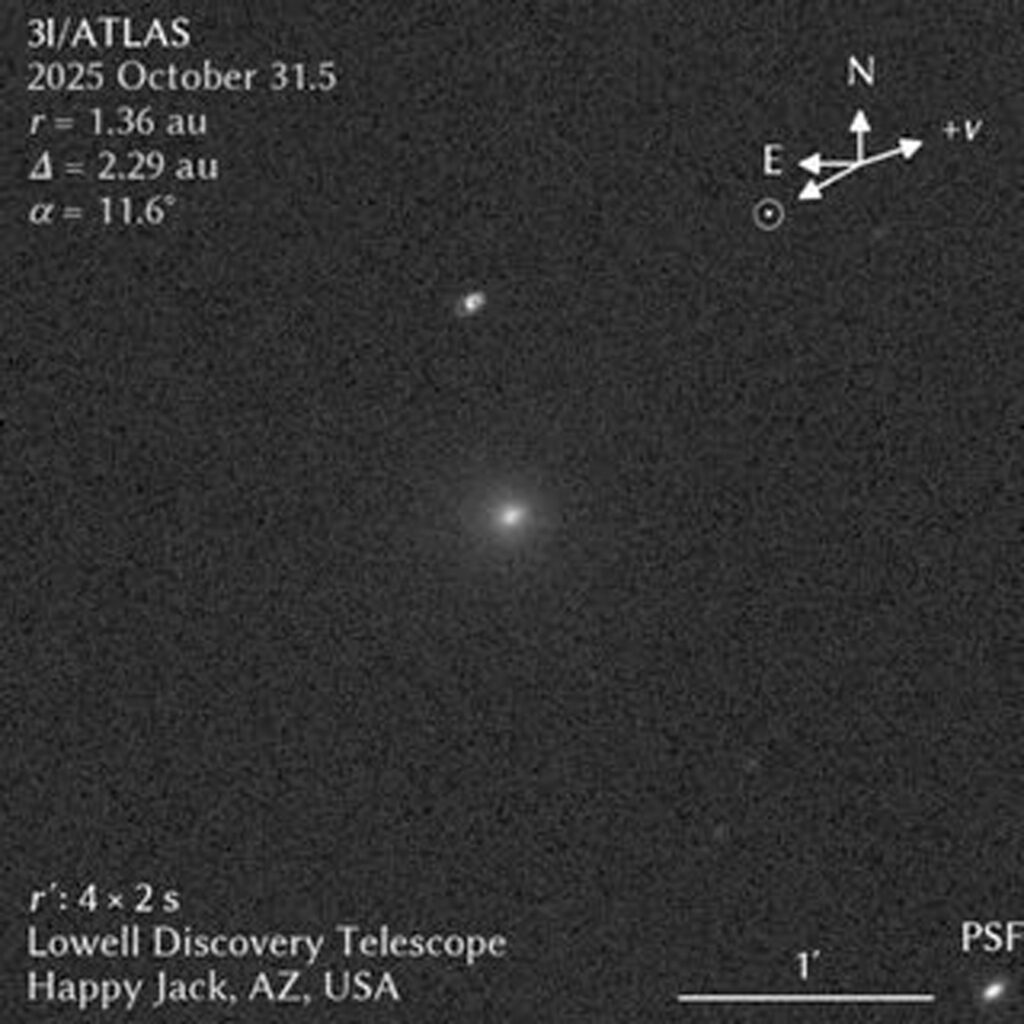
In other words, the gas cloud Loeb said would resolve the question in favor of a natural explanation was, in fact, subsequently detected. Current tracking describes 3I/ATLAS showing “textbook comet behavior,” an icy nucleus producing gas and dust, growing a coma and two tails exactly as an active comet would. It passed near Jupiter on March 16, 2026, posed no danger to Earth at any point, and continued outward on its hyperbolic escape trajectory as expected.
Why the Anomaly Happened at All
The genuinely interesting scientific story here isn’t a cover-up, it’s an object whose gas and dust production simply wasn’t fully visible from Earth-based instruments during the exact weeks the object was closest to the Sun and hardest to observe against solar glare, before more complete data from a longer observing baseline and dedicated spacecraft resolved the picture. The four-arcsecond deviation Farnocchia measured was real. The initial absence of an obviously visible plume in the earliest images was also real. Both are consistent with a natural comet whose full activity simply took subsequent weeks of better-positioned observation to confirm, exactly the kind of measurement gap that legitimate science is built to close over time rather than a permanent unanswered question.
Loeb’s actual scientific conduct throughout is worth crediting honestly: he made a specific, falsifiable prediction, stated clearly what evidence would rule his more exotic hypothesis out, and the evidence that arrived did exactly that. That’s genuine science working as intended, whatever the more dramatic retellings of this story chose to emphasize instead.