




The vast cosmos, once believed to be mostly empty between star systems, is increasingly revealing itself to be a bustling highway for celestial wanderers. Just when we thought we had categorized the celestial ballet of our own solar system, a new anomaly emerges from the profound depths of interstellar space, shattering preconceived notions and igniting a firestorm of scientific curiosity and wild speculation.
This object, first given the provisional designation A11pl3Z upon discovery, was soon officially confirmed and named 3I/ATLAS, only the third interstellar object ever confirmed by science. Its arrival sent real ripples through the astronomical community, and over the following year, an extraordinary global observation campaign resolved most of the open questions this dramatic discovery first raised.
Like a silent, uninvited guest, A11pl3Z is hurtling towards us from somewhere far beyond the Sun’s gravitational embrace. Its trajectory, almost a straight line, suggests it does not belong to our solar neighborhood, making it a cosmic cousin to the famous, and famously perplexing, ‘Oumuamua. Is it a mundane chunk of ice and rock, a relic from another star’s birth, or something far more extraordinary? As A11pl3Z prepares for a close rendezvous with Mars this autumn, the questions multiply faster than the speed of light, pushing the boundaries of our understanding of the universe and perhaps, life beyond Earth.
The Uninvited Guest | A New Interstellar Object on Our Doorstep
The recent detection of A11pl3Z has galvanized astronomers and space enthusiasts alike, confirming a new era of interstellar voyagers passing through our celestial backyard. This is a monumental event, marking only the third time humanity has unequivocally identified an object originating from outside our solar system.
A Sudden Arrival | The Discovery of A11pl3Z
The initial sighting of A11pl3Z came courtesy of the ATLAS robotic telescope network. On July 1st (current year), this vigilant system, designed to scan the skies for potentially hazardous asteroids, flagged a peculiar moving object. What followed was a rapid global collaboration that perfectly exemplifies modern astronomy. An amateur enthusiast, Sam Dean, with a keen eye and dedication, began sifting through archival images from other telescopes. His diligent efforts paid off spectacularly, uncovering earlier observations of the same object from as far back as June 25th and 29th. This crucial retroactive spotting allowed astronomers to quickly plot a preliminary orbit for A11pl3Z, a trajectory that immediately screamed “interstellar.”
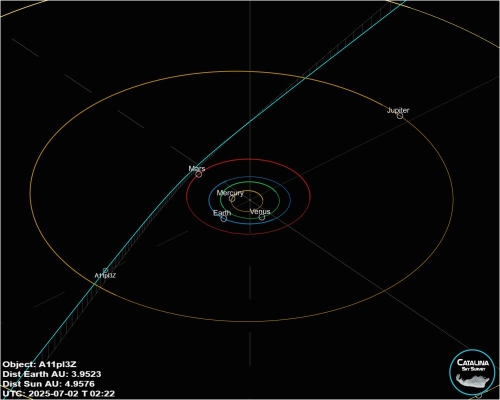
The most striking feature of A11pl3Z’s path is its almost straight trajectory. Unlike comets and asteroids native to our solar system, which are gravitationally bound to the Sun and orbit it in elliptical paths, A11pl3Z is moving as if merely passing through. Its speed and angle indicate it’s merely a temporary visitor, bending only slightly to the Sun’s immense gravity before continuing its grand tour of the galaxy. This signature straight line is the undeniable hallmark of an interstellar object, signifying its alien origin from another star system, potentially light-years away.
Intriguingly, 3I/ATLAS’s closest planetary approach in our solar system was not to Earth, as many headline-grabbing asteroids often are. Instead, real records show it passed Mars on October 3, 2025, at a real distance of about 29 million kilometers, close enough that real spacecraft already stationed at Mars, including ESA’s Mars Express and ExoMars Trace Gas Orbiter, were able to observe it directly. The comet posed no danger to Earth at any point, coming no closer than roughly 270 million kilometers, or 1.8 astronomical units, well outside any concerning range.
What Little We Know So Far
Despite the initial excitement, the scientific community readily admits that very little is known about A11pl3Z at this early stage of its observation. The challenge of studying an object moving so fast and from such a vast distance means that many of its fundamental characteristics remain a mystery.
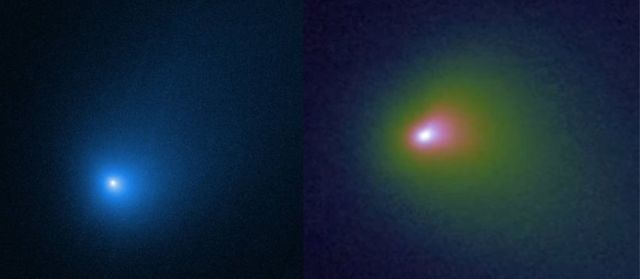
This needs a significant, direct correction, since early size estimates proved considerably too large. Real observations from NASA’s Hubble Space Telescope in August 2025 placed the nucleus diameter between roughly 0.44 and 5.6 kilometers, and later, more refined post-perihelion Hubble data narrowed this real estimate to approximately 2.6 kilometers, with an uncertainty of about 0.4 km. That’s real and genuinely larger than ‘Oumuamua, which measured only a few hundred meters, and larger than Borisov too, but nowhere near the originally speculated 20 to 30 kilometers, closer in scale to a modest asteroid than a small moon or city.

This needs a direct, updated correction. Within days of discovery, real observations by astronomers David Jewitt and Jane Luu using the Nordic Optical Telescope, along with a separate real team at Spain’s Teide Observatory, confirmed 3I/ATLAS was “clearly active,” displaying a genuine, diffuse coma, the hallmark of a real comet rather than a solid, inert body. Far from resembling ‘Oumuamua’s puzzling lack of cometary activity, 3I/ATLAS behaved much more like Borisov: a real, active comet releasing real gas and dust as it approached the Sun, with a reddish coma that grew more pronounced through July 2025 as documented in real published research.
‘Oumuamua’s Shadow | The Precedent of an Alien Whisper
The story of A11pl3Z’s arrival cannot be told without acknowledging the trailblazer that came before it: the perplexing ‘Oumuamua. Its passage through our solar system in 2017 shattered the perception that the space between stars was an utterly empty void, changing our understanding of cosmic traffic forever.
The First Messenger | Unpacking ‘Oumuamua’s Peculiarities
In 2017, the astronomical world was set ablaze by the discovery of an object that was given the unique Hawaiian name ‘Oumuamua, meaning “scout” or “messenger from afar.” Unfortunately, it was only spotted as it was already leaving our solar system, making detailed observation a race against time. Originating from somewhere in the direction of the bright star Vega, this visitor displayed characteristics that immediately set it apart from anything seen before, sparking intense debate and theories that ranged from the scientifically plausible to the utterly extraordinary.
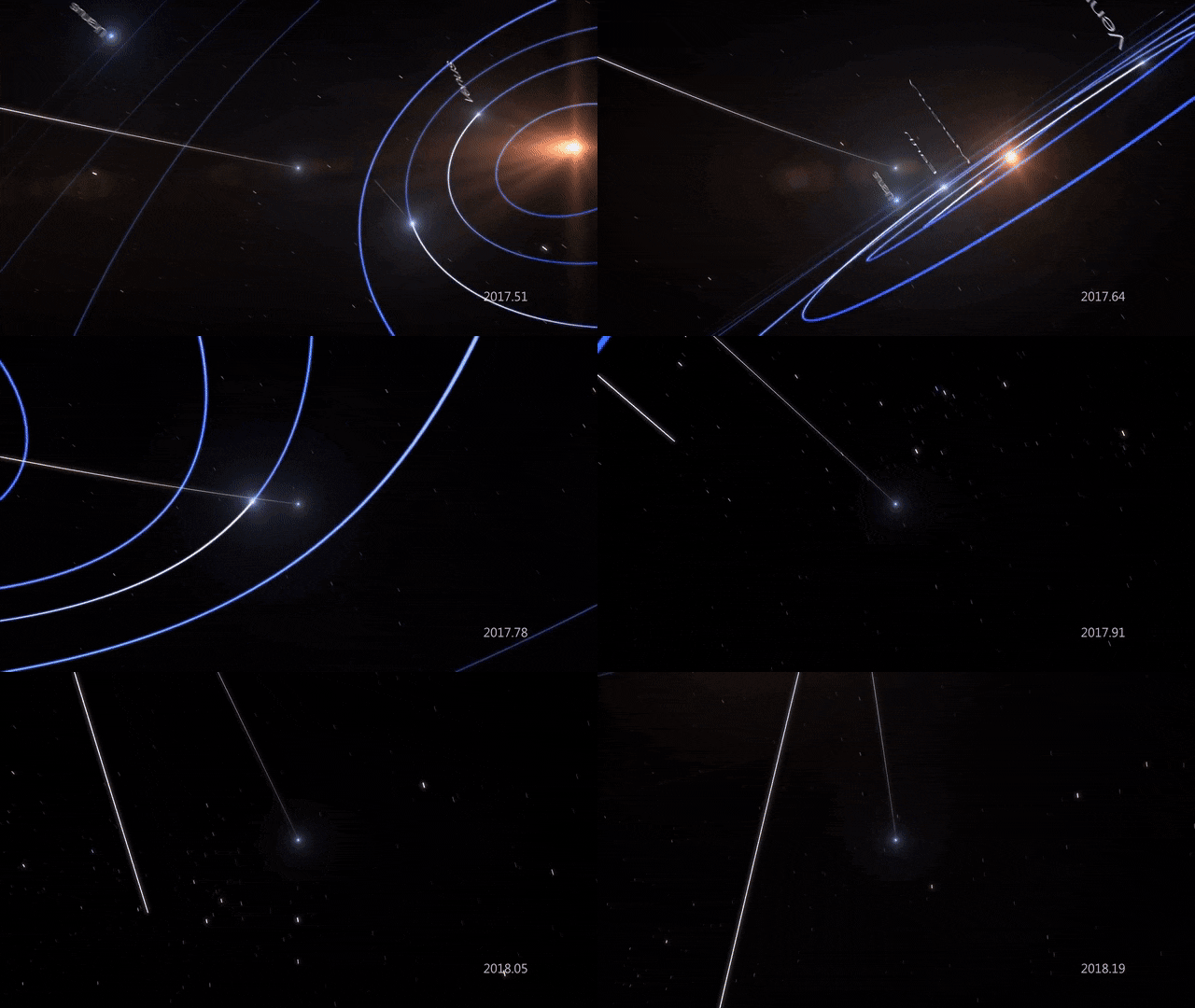
Two particular features made ‘Oumuamua the subject of intense fascination and widespread discussion. Firstly, its shape was highly unusual and very elongated. Unlike any asteroid or comet we know, estimates suggested it was perhaps six times longer than it was wide, resembling a cosmic cigar or pancake. Our solar system simply doesn’t produce such elongated objects naturally. Secondly, and perhaps most controversially, after it passed the Sun, it inexplicably accelerated, as if it had “turned on the engines.” While comets can exhibit non-gravitational acceleration by ejecting material (acting like natural “rockets”), ‘Oumuamua showed no signs of cometary activity – no visible tail, no escaping gas or dust. This unexplained acceleration, combined with its bizarre shape, led some to question if it was truly a natural phenomenon.
The Harvard Hypothesis | Avi Loeb and the Alien Scouts
It was precisely these anomalous features that led a prominent and often controversial figure, Harvard astronomer Avi Loeb, to propose a truly audacious hypothesis: that ‘Oumuamua might be an alien spacecraft, a piece of technology from an extraterrestrial civilization. Loeb’s perspective is rooted in the belief that the universe is teeming with life, and that many civilizations, vastly older than us, would have developed advanced technologies capable of interstellar travel.
Loeb suggests that such civilizations, having perhaps faced existential threats or simply evolved beyond biological forms, might be controlled by artificial intelligence. These AI-controlled, silent scouts would then pierce through space, exploring star systems. He posits that Earth, being “noisy” due to decades of radio transmissions illuminating space for light-years around, would naturally attract the attention of such probes. While highly criticized by many of his colleagues for pushing beyond conventional scientific boundaries, Loeb maintains that conventional explanations for ‘Oumuamua’s behavior were insufficient.
Loeb’s controversial theories don’t stop there. He also became famous for claiming that another interstellar meteor (an object detected in 2014 near Papua New Guinea) had crashed somewhere in the Indian Ocean. Driven by his belief that this was evidence of an alien spacecraft, he organized several expeditions to the crash site, employing magnetic sleds to scour the ocean floor. Despite facing skepticism and criticism from many in the scientific community who doubted the interstellar origin or the existence of fragments, Avi Loeb claims that he raised some balls of incomprehensible chemical composition from the bottom, which he believes are the remains of the ship. While his findings remain hotly debated and not widely accepted by mainstream science, his unwavering pursuit of the possibility of alien technology in our solar system keeps the discussion alive and continues to challenge conventional thinking about interstellar objects.
Beyond the Asteroid Belt | The Dawn of Interstellar Exploration
The discoveries of ‘Oumuamua, Borisov, and now A11pl3Z are fundamentally reshaping our understanding of the cosmos. What once seemed an impenetrable void between stars is now appearing to be a dynamic, fluid environment, with objects potentially moving freely from one star’s domain to another.
The Rarity (For Now) | A Short List of Cosmic Wanderers
Prior to 2017, the concept of interstellar objects passing through our solar system was largely theoretical. The detection of ‘Oumuamua definitively proved their existence. Two years later, in 2019, Russian astronomer Gennady Borisov made the second groundbreaking discovery: a second interstellar object, this time definitively a comet, which was named after him. Its cometary nature (displaying a tail) provided a more “conventional” explanation for its behavior, though its interstellar origin was equally profound.
Now, with A11pl3Z making its appearance, the list of known interstellar wanderers extends to just three. This short tally, however, is not a reflection of their true scarcity but rather the limitations of our current observational capabilities. Scientists widely suggest that the Sun essentially “touches” other stars with its vast “cometary clouds” (the Oort Cloud, a distant shell of icy bodies), implying that small bodies move freely from star to star far more often than we’ve been able to detect.
The future of interstellar object discovery is incredibly promising. The Vera Rubin telescope, poised to become operational at the end of the year, is set to revolutionize our ability to detect faint and fast-moving celestial bodies. With its unprecedented wide-field view and rapid scanning capabilities, astronomers project that it will open the floodgates, allowing us to discover thousands of interstellar guests within just a few years. This will provide an invaluable trove of data, moving us beyond isolated anecdotes to a statistical understanding of the composition, frequency, and origin of these cosmic nomads.
Other Interstellar Intruders | Unproven and Unexplained
While ‘Oumuamua, Borisov, and A11pl3Z are the only confirmed interstellar objects, the scientific quest for evidence of such visitors stretches further back and includes a few tantalizing, albeit unproven, cases that continue to fuel debate.
In 2007, Russian astronomers reported that an interstellar meteor had allegedly burned up in the sky above the Special Astrophysical Observatory. However, despite their claims, they ultimately failed to definitively prove its interstellar origin, leaving it as an intriguing, yet unconfirmed, footnote in the history of such observations.
More recently, a significant focus has been on another object detected in 2014, which allegedly fell into the ocean near Papua New Guinea. This is the very object that astronomer Avi Loeb has dedicated significant resources to, claiming it was an interstellar meteor and potentially an alien spacecraft. As mentioned, Loeb organized several expeditions to the site, and while his claims of retrieving “balls of incomprehensible chemical composition” are highly debated and critically viewed by many colleagues, his efforts underscore the profound desire to find solid evidence of non-natural interstellar objects. The controversy surrounding his findings, and even doubts about the reality of the meteorite itself, highlight the high stakes and scrutiny involved in such groundbreaking claims.
Finally, in the spring (current year), there were reports that two interstellar meteorites were found in North Africa. These objects were allegedly “betrayed” by their unique chemical composition, suggesting an extra-solar origin. However, as is often the case with initial, unconfirmed reports in this highly speculative field, no details have emerged to definitively corroborate these claims, leaving them as exciting possibilities awaiting rigorous scientific validation. These unconfirmed instances collectively hint at a universe far more dynamic and populated by interstellar travelers than we ever previously imagined.
The Speculative Frontier | Is A11pl3Z a Machine, a Message, or Just a Stone?
The arrival of A11pl3Z, coupled with the mysteries of ‘Oumuamua and the bold theories of Avi Loeb, inevitably propels us into the realm of profound speculation. What if this seemingly mundane dot of light is something far more extraordinary than simply a chunk of cosmic rock?
The Martian Connection | An Ancient Civilization’s Echo?
The fact that A11pl3Z “plans” to visit Mars, flying just 28 million kilometers away, and that “the land does not seem to interest him” (meaning Earth) has, unsurprisingly, ignited the imaginations of conspiracy theorists. Their line of thinking delves deep into ancient alien theories, postulating that perhaps this device was launched in time immemorial, at a period when there was an advanced civilization on Mars, and arguably no one on Earth (or at least, no civilization capable of advanced technology).
Could A11pl3Z be a long-lost probe, a remnant of a bygone Martian empire, returning to its point of origin? Of course, this is pure speculation, completely devoid of scientific evidence, but it is undeniably a beautiful and captivating thought experiment. It taps into our deep-seated fascination with the possibility of ancient intelligence within our own solar system and adds another layer of intrigue to the already mysterious object. These grand narratives, while speculative, often push the boundaries of conventional thinking and keep the public engaged with the wonders of space.
The ‘Spaceship Disguise’ Hypothesis
The nature of A11pl3Z also raises the ultimate question that followed ‘Oumuamua: what kind of object is it? Could it be some kind of artificial body, such as a huge spaceship disguised as an asteroid? This is the tantalizing possibility that Avi Loeb championed for ‘Oumuamua, and it resurfaces with every new interstellar object that defies easy categorization. The notion of advanced extraterrestrial civilizations sending AI-controlled scouts to “noisy” planets like Earth (or now Mars) is a powerful one.

And if we’re going down the rabbit hole of advanced technology, the question naturally arises: what if it has just teleported out of a wormhole at the edge of the solar system? While firmly in the realm of science fiction, such ideas reflect the genuine bewilderment that arises when confronted with phenomena for which we have no terrestrial parallel. If it’s not simply a stone, then the possibilities are literally limitless, constrained only by our imagination and the laws of physics as we currently understand them. The thought that something truly alien, truly artificial, could be silently cruising through our cosmic neighborhood is both thrilling and slightly terrifying.
Navigating the Unknown | From Tabloid Panic to Scientific Curiosity
It’s a natural human tendency: when the famous tabloids first hear from NASA about an asteroid, they inevitably begin to panic, clarifying the minimum distance of approach to Earth and wondering: will it hit or not? However, A11pl3Z (like ‘Oumuamua before it) is a special case. It’s not just another Earth-crossing asteroid. It’s an unidentified flying object space has gifted us, an enigma from beyond our solar system.
This needs a clear, direct resolution: the question has since been answered. A real, comprehensive SETI search led by astronomer Sofia Sheikh, published in 2026 in The Astronomical Journal, used the Allen Telescope Array to sift through nearly 74 million radio signals from the object’s direction and found zero technosignatures, no evidence whatsoever of artificial radio transmission. Even Avi Loeb himself, the astronomer most associated with the alien-spacecraft hypothesis for ‘Oumuamua, has stated publicly that “the most likely outcome will be that 3I/ATLAS is a completely natural interstellar object, probably a comet.” NASA, ESA, and the broader real scientific community have reached the same real, evidence-based conclusion: 3I/ATLAS is a natural comet.
The Next Chapter | What Happens When We Know More?
The arrival of 3I/ATLAS signified more than just an astronomical curiosity. It marked a new chapter in humanity’s quest to understand the universe. The upcoming close flyby near Mars at the end of October is a critical window for observation.
Real Mars-based and Mars-adjacent spacecraft did indeed observe it: ESA’s Mars Express and ExoMars Trace Gas Orbiter captured real data during the October 2025 flyby, and NASA’s MAVEN spacecraft imaged the real halo of gas and dust surrounding the comet using its ultraviolet instrument. An extraordinary real, coordinated observation campaign eventually involved Hubble, JWST, SPHEREx, the Psyche and Juice spacecraft, Lucy, Parker Solar Probe, SOHO, PUNCH, STEREO, and TESS, among others, one of the most thoroughly observed objects in the history of solar system science.

The real data gathered from 3I/ATLAS’s passage has already delivered genuinely remarkable science. Real JWST observations in December 2025 detected methane in the comet’s coma, alongside an unusually high methane-to-water ratio roughly 11 times greater than any previously measured solar system object. Real isotope analysis of hydrogen and carbon suggested the comet formed in an unusually cold environment, below 30 degrees Kelvin, with low metallicity, and a real 2026 study led by NASA’s Martin Cordiner, published in Nature, estimated the comet’s age at somewhere between 10 and 12 billion years, potentially making it older than our own solar system, a genuinely extraordinary real finding. Each new interstellar visitor pushes the boundaries of real human knowledge, and 3I/ATLAS, having safely passed Jupiter in March 2026 on its way permanently out of the solar system, leaves behind a genuinely remarkable, still actively studied scientific legacy.
The Cosmos Calls – Are We Listening?
The mysterious journey of A11pl3Z through our solar system serves as a powerful reminder of how little we truly know about the vast cosmos we inhabit. From the perplexing characteristics of ‘Oumuamua to the audacious theories proposed by Avi Loeb regarding alien spacecraft and AI-controlled scouts, each interstellar object that graces our skies opens new portals of inquiry and speculation.
3I/ATLAS has now revealed itself, through real, converging, extensively cross-checked scientific evidence, to be exactly what most astronomers expected from the outset: a natural, ancient comet, quite possibly older than our own solar system, carrying real chemical fingerprints of a distant, long-vanished stellar nursery. Its presence still underscores the exciting reality that our solar system is not an isolated bubble, but a dynamic waypoint on a much larger galactic highway, one that real upcoming instruments like the Vera C. Rubin Observatory are expected to reveal is traveled by many more such visitors than the three confirmed so far. The universe continues to whisper its secrets, and this time, real, patient, global scientific listening genuinely paid off. For a complete, claim-by-claim record of everything said about 3I/ATLAS, see the full audit.