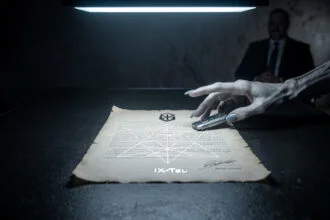





The document that caused the problem was called the Estimate of the Situation.
In 1948, the analysts at the Air Technical Intelligence Center who had been working on Project Sign, the Air Force’s first systematic UFO investigation, produced a formal intelligence assessment and sent it through the command chain. The document concluded that the unidentified aerial phenomena being reported in increasing numbers across the United States were of extraterrestrial origin. The analysts had examined the evidence available to them, including the testimony of credentialed military and civilian pilots, the radar tracking data from multiple independent installations, and the performance characteristics of the observed objects that exceeded the capabilities of any aircraft in the American or Soviet inventory.
General Hoyt Vandenberg, Chief of Staff of the United States Air Force, read the document and rejected its conclusion. He ordered all copies destroyed. The Air Force subsequently denied that the document had ever existed.
Captain Edward J. Ruppelt, who later directed Project Blue Book, confirmed the document’s existence in his 1956 book The Report on Unidentified Flying Objects. Dr. J. Allen Hynek, who worked as a scientific consultant on both Project Sign and Project Blue Book and who began his tenure as a committed skeptic, confirmed it independently.
Both men confirmed a document the Air Force denied existed. Both men were former employees of the program that destroyed it.
This is the institutional history that Project Blue Book’s television adaptation did not cover.
The Chiles-Whitted Problem
On the night of July 24, 1948, Clarence Chiles and John Whitted were flying a Douglas DC-3 passenger aircraft on Eastern Airlines Flight 576 between Houston and Atlanta when an object passed within approximately 700 feet of their aircraft near Montgomery, Alabama.
Both men were experienced commercial pilots with thousands of flight hours. Both described the same object independently: torpedo-shaped, approximately 100 feet in length, with two rows of windows emitting a bright interior light, a blue-white exhaust flame at the rear, and no visible wings or conventional propulsion surfaces. It passed at a speed they estimated between 500 and 700 miles per hour in level flight, banked sharply upward, and disappeared. A passenger in the DC-3 reported seeing a brilliant light flash past the window. The aircraft’s instruments registered disturbance at the moment of closest approach.

Chiles and Whitted were the kind of witnesses that an investigation takes seriously. Professional aviators trained to accurately observe and report aerial phenomena, with no history of unusual claims and no motivation to fabricate an account that complicated their professional lives. They made independent drawings of what they had seen. The drawings were consistent with each other.
The analysts at ATIC who examined the Chiles-Whitted case found it among the most compelling evidence in the accumulating record. The Estimate of the Situation was built in part on cases of this quality. Their conclusion that the technology represented in the report exceeded Soviet or American capabilities and required an extraterrestrial explanation was based on evidence like this: credentialed professionals, independent corroboration, physical instrument effects, and performance characteristics that no known aircraft could produce.
General Vandenberg’s response was to destroy the document containing that conclusion.
The Air Force’s subsequent explanation for the Chiles-Whitted encounter, published years later, classified it as a meteor. A meteor with rows of windows that flew in level flight and banked sharply upward.
Project Grudge and the Known Answer
The institutional successor to Project Sign was not designed to investigate. It was designed to conclude.
Project Grudge operated from 1948 to 1951 with a mandate whose actual operational content Captain Ruppelt described with precision in his book: investigations were rarely conducted because the conclusion was already determined. Any sighting that resisted conventional explanation received a conventional explanation regardless of whether the explanation was consistent with the evidence. The program’s function was to generate documentation showing that UFO sightings had been investigated and explained, not to determine whether the explanations were accurate.

The collapse of this approach began at Fort Monmouth, New Jersey, in September 1951. Radar operators tracked an object performing maneuvers at speeds and altitudes exceeding the capability of any known aircraft. The tracking was independent of visual observation. Multiple operators confirmed the return. The performance data required either a technical explanation that Project Grudge’s analysts could not produce or another dismissal that was evidently not going to hold.
When General Charles P. Cabell, Director of Air Force Intelligence, was briefed on how Project Grudge had been handling cases of this quality, his response was recorded by multiple people present. He ordered the project dissolved. He specified that its replacement needed to actually investigate rather than merely document dismissals.
Project Blue Book was the replacement.
The 22% and What It Cost
Captain Edward J. Ruppelt took command of Project Blue Book in 1951 with a mandate to conduct genuine investigation. He created standardized reporting forms, established liaison with university scientific departments, and brought rigorous methodology to a program that had spent three years producing predetermined conclusions.
The results of his investigation, applied to 3,200 reports through a systematic analytical process, produced a number that the Air Force had not anticipated making public.
Twenty-two percent remained unexplained.
Seven hundred reports out of 3,200 examined by a systematic scientific process conducted by the Air Force’s own intelligence analysts could not be attributed to any conventional explanation: weather phenomena, aircraft misidentification, astronomical events, psychological causes, or hoax. Seven hundred reports represented genuine anomalies in the air that the United States Air Force could not explain.

The result was published. It shocked the skeptics. It established the reality of the unexplained phenomenon as a statistical fact rather than an anecdotal impression. It made Project Blue Book’s continuation as a genuine investigation operationally necessary and politically dangerous simultaneously.
In January 1953, six months after the 22% result was published, the CIA convened the Robertson Panel.
The Robertson Panel and the Conversion
The panel, chaired by physicist H.P. Robertson and staffed with scientists from major American research institutions, reviewed the accumulated UAP evidence over four days and twelve hours of meetings. Its classified report, declassified decades later and covered in the CIA memo piece on this site, recommended that Blue Book be converted from an investigative program into a public relations program specifically designed to reduce public interest in UFO phenomena.
The mechanisms: media debunking, surveillance of civilian UFO organizations, and the systematic reassignment of unexplained cases to conventional categories using the minimum evidence required to justify the reassignment.

Ruppelt was still running Blue Book when the Robertson Panel recommendations were implemented. He left within months. The program he had built as a genuine scientific investigation was converted, in the period following his departure, into the debunking machine that Project Grudge had been and that the Robertson Panel had specified it should become.
Major Robert J. Friend attempted to restore genuine investigative function when he took over the program in 1958. He received minimal budget, minimal cooperation from Air Force command, and achieved minimal results. The program ran in name until 1969 as the public face of an Air Force commitment to investigating the phenomenon that it had privately concluded should not be publicly investigated.
Hynek’s Transformation
Dr. J. Allen Hynek arrived at Project Sign as a scientific consultant whose published position on UFOs was contemptuous dismissal. He was a professional astronomer from Ohio State University whose disciplinary training made him confident that witness reports of anomalous aerial phenomena could be attributed to misidentification of conventional astronomical and atmospheric events. He spent the first years of his consultancy providing exactly those attributions.

His March 1966 explanation for the sightings reported by dozens of witnesses around Dexter and Hillsdale, Michigan, became the most publicly humiliating moment in Project Blue Book’s history. Hynek attributed the sightings to swamp gas. The explanation was ridiculed immediately and comprehensively. It became a cultural reference point for government dismissiveness toward witness testimony. It also forced Hynek to examine publicly, for the first time, the gap between the explanation he had been expected to provide and the quality of the evidence he had been examining privately for sixteen years.
He subsequently stated that he had personally reviewed Blue Book cases during his tenure whose evidence was more compelling than any public statement from the project had acknowledged. He founded the Center for UFO Studies in 1973. He wrote multiple books arguing that the phenomenon was real and represented something beyond conventional explanation. He served as the technical advisor for Steven Spielberg’s Close Encounters of the Third Kind in 1977 and appeared in the film in a cameo.
Hynek’s trajectory from contemptuous skeptic to passionate advocate is the internal record of what examining the Blue Book evidence at close range over sixteen years produced in a credentialed scientist who began the process convinced that there was nothing there.

The thing that changed him was the evidence. The evidence was in the files. The public conclusions from those files were different from what the evidence supported.
The Final Statistics
Project Blue Book’s official closure in December 1969 followed the Condon Report, a University of Colorado study commissioned by the Air Force whose director Edward Condon concluded before his team’s investigation was complete that the results would not justify continued study. Internal memos from the Colorado project, obtained through FOIA requests, show Condon indicating his intended conclusion before the investigation had examined its primary evidence. The methodological integrity of the report was challenged by members of Condon’s own team, two of whom were removed from the project after their internal criticisms became known.
Blue Book’s final statistics show 12,618 total reports investigated over twenty-two years. Of these, 701 were classified as permanently unknown, meaning the Air Force’s analysts could not assign them to any conventional category despite extended analysis.
The official closure statement declared that no evidence had been found indicating that unidentified sightings represented extraterrestrial technology or any threat to national security. The statement was issued simultaneously with the release of 701 permanently unexplained cases whose existence demonstrated that 5.5% of every aerial phenomenon reported to the United States Air Force over twenty-two years could not be explained by the Air Force’s own analysts using the Air Force’s own methodology.
A program that classified 701 cases as permanently unexplained was officially concluded to have found nothing worth continuing to investigate.

The Estimate of the Situation had been destroyed in 1948. The Robertson Panel had converted the investigation into a debunking program in 1953. Blue Book had run that debunking program for sixteen more years under the cover of scientific investigation. When the cover had degraded enough that its continuation was no longer serving its management function, it was closed.
The 701 permanently unexplained cases are in the National Archives. They have been there since declassification. The FOIA requests filed to access the complete unredacted records of those cases have not produced complete unredacted records.
What the analysts found in those 701 cases that they could not explain with any available conventional explanation has been in a filing system for fifty years.
The program was closed because the public had stopped believing its explanations. The cases the program could not explain were not resolved by closing the program.
They are still unexplained. They are still there.