



The New York Times published the story on March 28, 1947.
The headline was specific: American aviator reports huge Chinese pyramid in remote mountains of southwest Sian. The aviator was Colonel Maurice Sheahan, director of Trans World Airlines Far East Asian operations, who had been flying over a valley near the Qinling Mountains approximately 40 miles from Xi’an in Shaanxi province when he observed a pyramid-shaped structure below him that he described as appearing to dwarf those of Egypt.
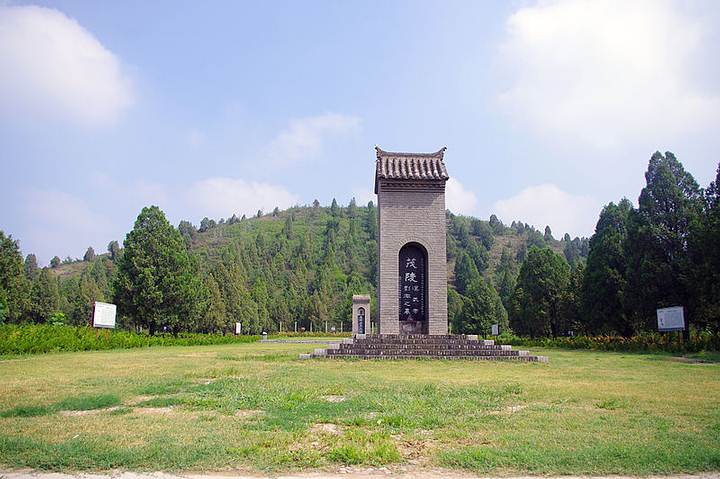
Two days later the Times published a photograph. The photograph was later identified as showing the Maoling mausoleum, the recorded tomb of Emperor Wu of Han located approximately 40 kilometers northwest of Xi’an, built between 139 and 87 BCE and standing approximately 50 meters high.
The identification solved the photograph. It did not solve the sighting.
Sheahan placed the pyramid southwest of Xi’an, in the direction of the Qinling Mountains. Maoling is northwest of Xi’an, in an isolated plain. The directions are not the same direction. Whether Sheahan misremembered his orientation, whether the Times published the wrong photograph, or whether the structure Sheahan observed was not the structure the photograph shows, is the question that the recorded geographic discrepancy raises without the available evidence resolving.
It was also not the first time someone had reported a large pyramid in this region.
Three Sightings Across Thirty-Five Years
The Xi’an white pyramid tradition has three recorded sightings spanning the period from 1912 to 1947 whose independent character and geographic specificity give the tradition more evidentiary weight than single-source legends typically carry.
Fred Meyer Schroder was an American traveler and merchant whose journal account of an 1912 expedition through Shaanxi province is the earliest known record of the large pyramid sighting. Traveling with a Buddhist monk named Bogdó as his guide, Schroder reported seeing a group of pyramids in the distance, dominated by a central structure he estimated at approximately 300 meters high and 500 meters per side. At these dimensions the structure’s volume would exceed the Great Pyramid of Giza by approximately a factor of ten.
Schroder’s own reaction is preserved in his journal: it was even rarer than if we had found them in the jungle. But these pyramids were partially exposed to the eyes of the world and yet totally unknown to the Western world.
His guide Bogdó told him that the structures were at least 3,000 years old and that information about them was preserved in ancient monastic records and local legends. Whether any monastery archive in the Xi’an region preserves records describing a major ancient pyramid is a question that the Chinese academic literature has not addressed in the accessible English-language record.
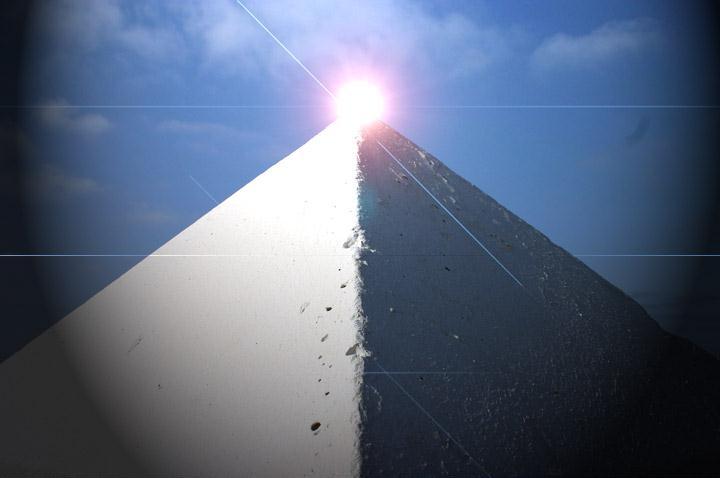
James Gaussman was a US Army Air Force pilot whose 1945 sighting occurred while flying from China to Assam, India. His account is preserved in his own report: I was flying around a mountain and its valley. Directly below us was a gigantic white pyramid. It looked like something out of a fantasy novel. It was covered in a shiny white material, it could have been metal or some form of stone. It was white on all sides. What was most curious was its top, crowned with a large piece that looked like a precious gem.
Gaussman’s account’s most distinctive elements, the white surface material and the gem-like crown, are the details that distinguish the structure he described from the known burial mounds of the region, none of which show white surface material or a crown element. Whether these features reflect genuine construction elements from a structure whose surface has since deteriorated, represent elaboration of a genuine sighting, or describe a different optical phenomenon whose cause produced the appearance of a white-surfaced structure in the mountain light, is the question the description raises.
Maurice Sheahan’s 1947 account, published in the Times, described a structure with a perfect pyramidal shape at approximately 300 meters height and 450 meters width, southwest of Xi’an in the Qinling Mountain direction. His description of a structure seeming to dwarf those of Egypt, combined with the perfect pyramidal shape he noted as distinct from the flat-topped Maoling mausoleum’s profile, is the recorded account that the Times photograph’s Maoling identification does not fully address.
Three independent observers, separated by thirty-five years, reporting large pyramid structures in the same general region of Shaanxi province with consistent dimensional estimates, is not the standard profile of a single fabricated legend.
What the Shaanxi Region Actually Contains
The Shaanxi province context for the white pyramid question is the recorded archaeological reality that the sightings are embedded in.

Shaanxi province is the location of the most significant concentration of imperial burial monuments in Chinese history. The mausoleum of Qin Shi Huang, the First Emperor of China who unified the country in 221 BCE, is located approximately 35 kilometers east of Xi’an and is recognized as one of the largest burial complexes in the ancient world. Its known contents, including the Terracotta Army discovered in 1974, represent a fraction of what the sealed burial chamber itself, whose interior has been surveyed by ground-penetrating radar but never opened, is believed to contain.
The Chinese government’s stated policy of not excavating Qin Shi Huang’s primary burial chamber is based on stated preservation concerns about the chamber’s reported mercury content, whose Chinese historical sources describe as artificial rivers and seas of mercury surrounding the burial structure, and about the inadequacy of current conservation technology to preserve the organic materials expected inside. Whether this policy reflects genuine conservation caution or institutional reluctance to expose burial contents that might challenge historical narratives, is the question that the policy’s application to a structure of unprecedented historical significance raises.
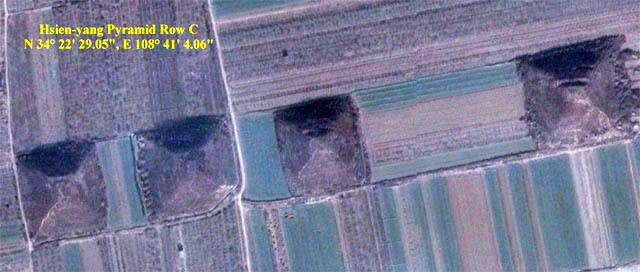
The dozens of imperial and pre-imperial burial mounds visible in satellite imagery across Shaanxi province include structures whose pyramidal profiles from the air closely resemble the sighting descriptions in the Xi’an white pyramid accounts. Whether any of these known mounds corresponds to the structure described by Schroder, Gaussman, and Sheahan, or whether the structure they described is either buried under sufficient soil and vegetation to be invisible to current satellite survey or is located in the Qinling Mountain terrain where satellite identification of architectural features requires dedicated survey rather than incidental observation, is the question that the geographic distribution of the known mounds partially addresses.
The Qinling Mountains themselves present a survey challenge. Their terrain combines dense vegetation, significant snow cover in winter months, and sufficient elevation variation to obscure even major architectural features from satellite imagery at standard resolution. The LIDAR survey methodology that identified the Aguada Fénix complex in Mesoamerica’s dense jungle has not been systematically applied to the Qinling Mountain region at the resolution required to identify potential buried pyramidal structures.
The White Surface and the Crown
Gaussman’s description of a white surface material and a gem-like crown is the most anomalous element of the three accounts and the one that most directly connects the Xi’an white pyramid tradition to the library’s broader ancient technology framework.
The Great Pyramid of Giza was originally clad in white Tura limestone whose highly polished surface would have reflected sunlight to a degree that ancient accounts describe as visible from a significant distance. The original cladding has been almost entirely removed for building material over the centuries. Whether Gaussman’s white surface material represents a similar original cladding preserved on a less-plundered structure in a more remote location is the hypothesis that the parallel suggests.

The crown element, described as a large piece that looked like a precious gem, has no direct parallel in the known East Asian pyramid tradition but has parallels in the capstone traditions of ancient pyramid construction globally. The benben stone that Egyptian tradition describes as the original capstone of the pyramids, associated with solar light capture and reflection, and the recorded use of polished metallic or crystalline capstones in multiple ancient pyramid traditions, provide the comparative context in which Gaussman’s crown description is most interesting.
Whether the structure Gaussman observed preserved both a white cladding and a genuine capstone element while the surrounding smaller mounds showed neither, which would make it anomalous within the regional burial mound tradition, or whether his account reflects optical effects of mountain light on a conventional mound structure, is the question that the record alone cannot resolve.
The Monastic Archive Question
Schroder’s guide Bogdó’s claim that information about the pyramids was preserved in ancient monastic records is the element of the tradition whose follow-up research has been least visible in the accessible literature.
The Xi’an region has well established associations with major Buddhist and Taoist monastic institutions whose archive traditions span more than a millennium. Whether any of these institutions preserve records describing major architectural features in the surrounding landscape is a question that systematic archive survey would address. Whether Chinese institutional access to these archives has been made available to researchers specifically investigating the white pyramid question is not established in the accessible English-language literature.
The transmission pathway Bogdó described, local legend combined with ancient monastic records, is the standard form in which oral traditions about major but no longer visible cultural features are preserved in Buddhist monastic culture. The monastery at Dunhuang whose sealed cave library, discovered in 1900, preserved manuscripts spanning the fourth through eleventh centuries, established that major Chinese monastic institutions maintained archive traditions of sufficient longevity to preserve information about landscape features from pre-Tang dynasty periods.

Whether a similar archive tradition in the Xi’an region preserves records of the structure that Schroder, Gaussman, and Sheahan described is the research question that the existing recorded sightings motivate and that the current literature has not addressed.
What the Absence of Confirmation Establishes
The absence of confirmed identification of the Xi’an white pyramid in the decades since the Sheahan Times report is the primary argument for the structure’s non-existence. The region has been surveyed by satellite, mapped by aerial photography, and studied by Chinese archaeologists whose institutional access to the area exceeds that of any foreign researcher.
Whether this absence reflects genuine non-existence of a major undiscovered pyramid in the region, the correct identification of the sightings with known burial mounds whose correspondence to the accounts is imprecise due to memory, distance estimation, and orientation error, or the limitations of current survey methodology applied to the Qinling Mountain terrain where the Gaussman and Sheahan sightings were specifically located, is the question that the recorded geographic discrepancy with the Maoling identification keeps genuinely open.
The Aguada Fénix complex in Tabasco, Mexico, the largest Maya monument ever recorded, was invisible to conventional survey and was identified only through LIDAR. The Great Sphinx’s geological water erosion and the implications for its construction date were visible in the recorded weathering patterns for decades before John Anthony West and Robert Schoch brought them to academic attention.

The absence of identification is not the same as confirmed absence in archaeological research. It is a statement about the current state of investigation rather than a statement about what exists.
Three independent observers reported the same structure over thirty-five years. The geographic discrepancy with the identified mound remains unresolved. The Qinling Mountain terrain has not been subjected to dedicated LIDAR survey. The monastic archive question has not been investigated in the accessible literature.
The white pyramid of Xi’an has not been found. That much is certain.
Whether it has not been found because it does not exist, or because no one has yet looked in exactly the right place with exactly the right instrument, is the question that three independent historical accounts of a major structure in a location have left specifically open.