




Something remarkable happened to a particular family of ideas over the course of Western history. They did not remain unchanged, and they did not pass from one institution to the next as a single secret doctrine. What survived was something more elusive: a recurring conviction that ordinary human experience does not exhaust reality, that knowledge of this deeper order has sometimes been treated as dangerous or unsuitable for unrestricted distribution, and that certain forms of initiation, philosophy, contemplation or symbolic study might allow a person to perceive what ordinary perception conceals.
The history of that idea is documented. The stronger claim, that one uninterrupted organization secretly carried the same knowledge from the temples of antiquity through Alexandria, Gnosticism, Hermeticism, the Renaissance, the Rosicrucians and Freemasonry into the modern world, is much harder to establish. The surviving record shows something more complicated and, in its own way, more fascinating: traditions borrowed from one another, disappeared and returned, changed vocabulary, absorbed new philosophies and repeatedly reformulated the same fundamental questions about consciousness, matter, knowledge and the nature of reality.
Manly P. Hall’s The Secret Teachings of All Ages, published in 1928, is one of the great attempts to map that territory. Hall assembled material concerning the mystery religions, Hermeticism, Neoplatonism, Kabbalah, alchemy, Rosicrucianism, Freemasonry and other esoteric traditions into a single enormous synthesis. The book is not a neutral modern history, and Hall sometimes treated relationships between traditions more confidently than the surviving evidence permits, but the book remains important precisely because it reveals how twentieth-century esoteric thought understood the continuities between these older systems.
The question, therefore, is not whether Hall proved that an ancient secret was passed intact through two thousand years of history. He did not. The more interesting question is why so many different intellectual traditions repeatedly returned to remarkably similar problems: whether material reality is fundamental, whether consciousness has a deeper status than conventional materialism assumes, whether human beings possess forms of knowledge inaccessible to ordinary perception, and whether transformation of consciousness can reveal something about reality that abstract reasoning alone cannot reach.
Alexandria and the Great Convergence
When Alexander the Great founded Alexandria in 331 BCE, the city eventually became one of the ancient Mediterranean world’s great centers of intellectual exchange. Egyptian religious traditions, Greek philosophy, Jewish thought and later currents associated with Hermeticism and other schools encountered one another in an environment where ideas could be translated, compared and transformed. It would be misleading to imagine a single conference at which the ancient religions suddenly discovered that they all believed the same thing. What happened was slower and more human: intellectual traditions met, borrowed concepts from one another, resisted one another and produced new syntheses.

Philo of Alexandria provides one of the clearest examples. Writing in the first century CE, he interpreted Jewish scripture through the philosophical language of Hellenistic thought, giving the Logos a central role as an intermediary between God and the created world. His work did not simply reproduce Plato or Judaism. It was an attempt to make two intellectual worlds speak to one another, and its influence would extend into later Christian theology.
Plotinus, writing several centuries later, developed what became the philosophical system known as Neoplatonism. His metaphysics placed the One at the summit of reality, with Intellect and Soul emerging in a hierarchy of reality and the material world occupying the lowest level of that hierarchy. Human beings, in this account, could turn inward through contemplation and participate in a return toward their source. Whatever one thinks of the metaphysics, the philosophical problem is unmistakable: perhaps consciousness is not merely an accidental by-product of matter, but participates in a deeper order of reality.
That idea would become extraordinarily influential, but it would never remain identical to itself. Later religious movements interpreted it through their own theological systems, and one of the most dramatic examples came from the diverse collection of traditions now grouped under the broad label of Gnosticism.
The Gnostic Challenge
The discovery of the Nag Hammadi codices in Egypt in 1945 transformed modern scholarship’s ability to study several early Christian and Gnostic movements from their own surviving texts rather than primarily through the descriptions of their opponents. The manuscripts, copied in the fourth century and containing works composed considerably earlier, preserve a striking variety of cosmologies, creation stories, dialogues and teachings. They do not constitute a single Gnostic Bible, nor do they describe one uniform doctrine, but several of them portray the material cosmos as radically different from the highest divine reality.
Marcion, a contemporary of these currents, took a related but distinct position within the same broader Gnostic-adjacent ferment.
In texts such as the Apocryphon of John, the Demiurge occupies an important role as a creator figure who is ignorant of the higher divine reality, while Archons appear as powers associated with the lower cosmic order. The human predicament is consequently understood not simply as moral failure but as ignorance of one’s true origin. The answer is gnosis: knowledge, but not merely information. It is a form of recognition or awakening through which the individual comes to understand a reality that ordinary existence conceals.
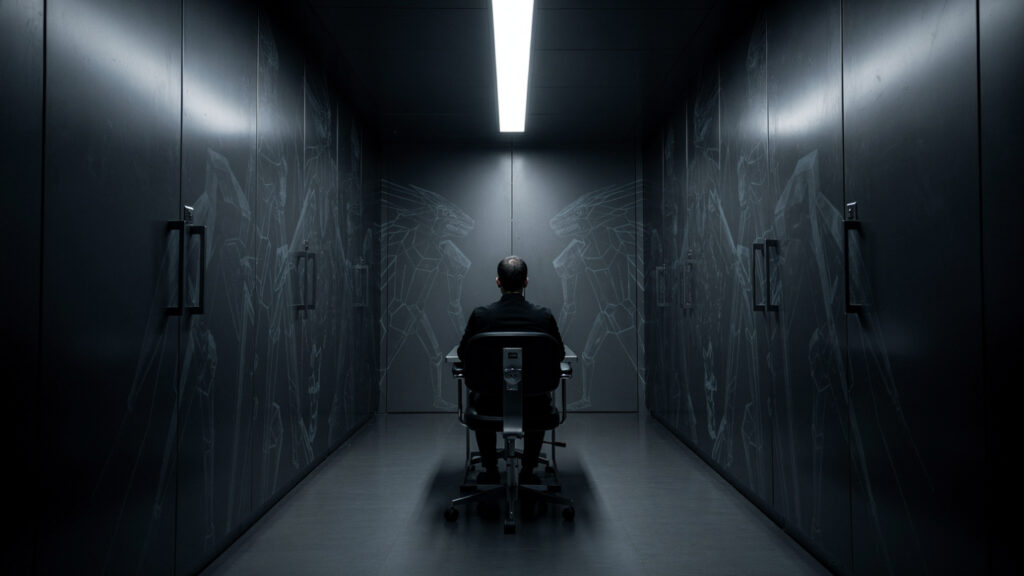
That distinction matters because the modern version of the Gnostic story is often simplified into a claim that ancient people already knew that physical reality was literally a prison controlled by non-human beings. The historical texts are more complicated than that. They contain cosmologies that can certainly be read in those terms, but they are religious and philosophical texts, not observational reports establishing the existence of Archons as independently measurable entities.
Yet the underlying question survived: if ordinary perception gives us only a partial picture of reality, what would it mean to become conscious of what lies beyond that picture? That question would continue travelling long after the ancient institutions that first expressed it had disappeared.
The Chain Was Not One Chain
The transition from antiquity into medieval and Renaissance Europe is where accounts of a continuous secret tradition become especially tempting, because there really were periods in which texts, philosophical systems and symbolic traditions were preserved, translated and rediscovered across cultural boundaries. But influence is not the same thing as uninterrupted institutional transmission, and intellectual resemblance is not proof of a hidden organization connecting every stage.
Greek philosophical material survived in the Byzantine world and was also translated and developed within the Islamic intellectual tradition. Hermetic works circulated in different forms, and the Renaissance produced a remarkable revival of interest in texts attributed to Hermes Trismegistus. In 1463, Marsilio Ficino interrupted his translation of Plato at the request of Cosimo de’ Medici to translate the Corpus Hermeticum, one part of the broader Hermetic tradition this library has traced elsewhere. The importance of this episode is not that Ficino received a secret package from an ancient priesthood. It is that ideas associated with ancient Egyptian wisdom, Platonism and divine knowledge suddenly became extraordinarily influential within Renaissance intellectual culture.
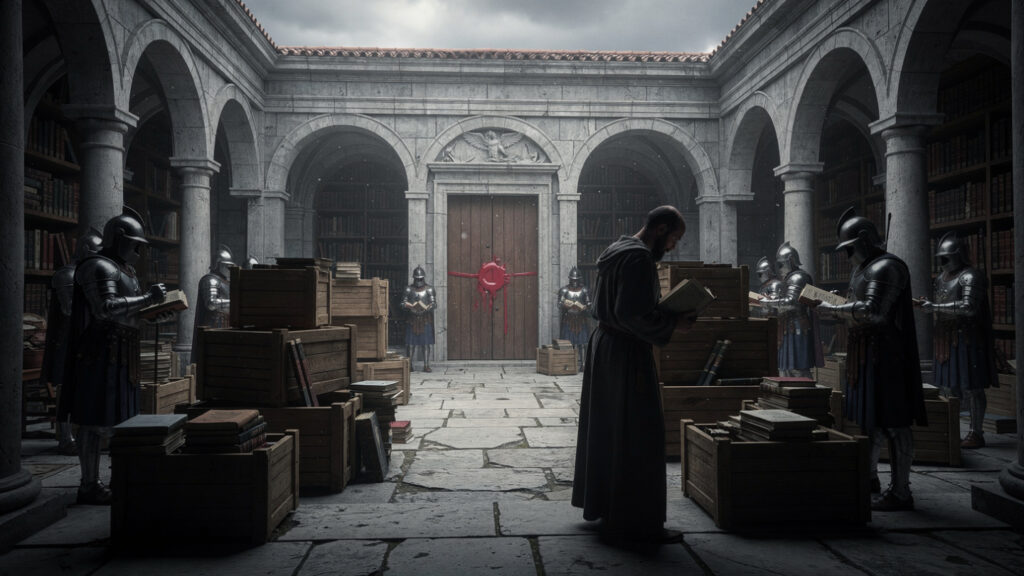
The history becomes still more interesting when later movements begin presenting themselves as custodians or rediscoverers of ancient wisdom. The Rosicrucian manifestos of the early seventeenth century announced a mysterious brotherhood possessing an ancient wisdom capable of transforming society. Whether the brotherhood existed in the literal form described by the manifestos remains a historical question; the cultural phenomenon created by the documents themselves is not. European intellectuals read them, argued over them and searched for the supposed fraternity.
Freemasonry emerged in a different historical context, from the lodge culture of the early eighteenth century, and incorporated an elaborate symbolic and initiatory structure. Later writers, including Albert Pike, gave that symbolism philosophical interpretations that drew upon a wide range of traditions. The result was not necessarily a preserved ancient doctrine in disguise. It was something subtler: an early modern institution constructing meaning through symbols that had accumulated associations from many different philosophical and religious sources.
That is why the historical record is more interesting than the simple conspiracy version. There is continuity, but it is the continuity of ideas, symbols, questions and reinterpretations. There are real institutions, real books and real lines of influence, but the surviving evidence does not justify turning them into a single two-thousand-year organization with one unchanged message.
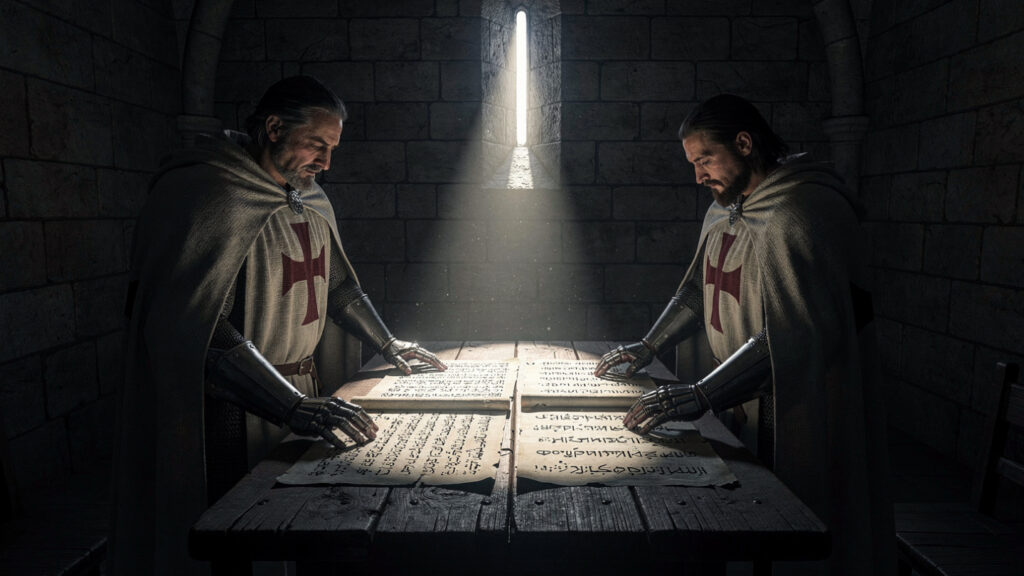
What Survived Was an Idea
Across these transformations, however, a recognizable family of ideas keeps returning. Reality may have a deeper structure than ordinary perception reveals. Human consciousness may possess capacities that conventional culture does not fully understand. Knowledge may require transformation of the knower rather than merely accumulation of information. Symbols may encode philosophical ideas that cannot be reduced to their literal surface meaning. And liberation may depend upon seeing through assumptions that ordinarily appear self-evident.
These propositions are not equivalent, and the traditions that expressed them often disagreed profoundly about what the deeper reality actually was. A Neoplatonist, a Gnostic, a Hermetic philosopher and a Freemason were not simply describing the same universe under different names. But the recurrence of the questions is historically significant even when the answers differ.
This is where modern discussions of physics sometimes enter the story.
When Physics Enters the Story
Modern theoretical physics contains ideas that can sound surprisingly familiar to readers of ancient metaphysics, but the resemblance has to be handled carefully. The holographic principle, for example, emerged from twentieth-century work on black-hole entropy and quantum gravity. In broad terms, it suggests that the information describing a volume of space may be encoded on a lower-dimensional boundary. Modern holography is a technical physical framework, not a scientific confirmation of the ancient claim that the material world is an illusion or prison.
There have nevertheless been serious attempts to test holographic cosmological models observationally. A 2017 study involving researchers from the University of Southampton, the University of Waterloo, the Perimeter Institute and Italian institutions examined patterns in the cosmic microwave background and reported evidence compatible with a holographic model. The result was important enough to be published in Physical Review Letters, but “compatible with a holographic model” is not the same statement as “physics has established that reality is a hologram.” The distinction is not pedantic. It is the difference between a scientific hypothesis receiving observational support and a metaphysical conclusion being proven.

Other modern claims have been drawn into the same conversation, including research into biophoton emission, theories of higher dimensions and philosophical interpretations of consciousness. Some of this research is legitimate science; some of the conclusions drawn from it are much more speculative. The mistake is not exploring the comparison. The mistake is treating the comparison itself as evidence that the ancient and modern frameworks are describing the same underlying reality.
There is a genuine intellectual question here. Why do humans repeatedly produce models in which the visible world is not the whole story? The answer could be cultural inheritance, because ideas really do travel from one generation to another. It could be convergent reasoning, because certain philosophical problems naturally lead different thinkers toward similar possibilities. It could reflect common features of human cognition. Or it could be that some of these traditions are responding, in very different ways, to aspects of reality that remain poorly understood.
Ronald Bernard and the Modern Version
The modern story becomes more controversial when historical traditions are connected to claims about living institutions. Ronald Bernard, a Dutch financier, became widely known after a series of interviews in which he described his experience within international finance and made much more extraordinary claims about the beliefs and practices of people he said occupied the upper levels of the financial system.
His financial background may establish that he worked within the industry he describes, but it cannot by itself establish the truth of every claim he subsequently made about his former associates. His statements about elite religious or Luciferian practices therefore belong to a different evidentiary category from the historical documents discussed earlier. They are testimony: a person describing what he says he witnessed or was told. They are not independent confirmation of the worldview he describes.
That distinction does not require dismissing Bernard. It requires listening to the claim at the level at which it exists. His testimony is part of the modern history of the idea, just as the Rosicrucian manifestos are part of the history of the idea. Neither document, by itself, establishes the metaphysical reality of the system it describes.
There is also an important difference between discovering that powerful people have believed in an esoteric system and discovering that the system is true. Human beings have organized governments, religions, financial institutions and secret societies around ideas that were sincerely held and sometimes extraordinarily consequential without those ideas necessarily corresponding to an independently demonstrable metaphysical reality.
What the Tradition Actually Tells Us
The temptation in a story like this is to make one of two equally premature moves. The first is to look at the continuity of the ideas and conclude that the hidden system must therefore be real. The second is to look at the speculative elements and conclude that the entire history is meaningless. Neither conclusion follows.
The historical record tells us something genuinely remarkable. Human beings have repeatedly created traditions in which ordinary reality is treated as incomplete, consciousness is given a privileged role, knowledge is associated with transformation, and symbols are treated as vehicles for truths that cannot be reduced to their literal meanings. Those traditions influenced one another, borrowed from one another and reinvented themselves across centuries. The recurrence is real even where the proposed metaphysics remain unverified.

That leaves a much harder question than the claim of a hidden cabal.
Why does the idea keep coming back? It appears in very different forms: in the ancient mystery traditions, in Platonic philosophy, in Gnostic cosmologies, in Hermetic texts, in Renaissance magic, in Rosicrucian symbolism, in Masonic initiation, in modern theories of consciousness and even in contemporary interpretations of physics. The vocabulary changes dramatically. The underlying impulse does not.
Perhaps this is what happens when human beings confront the limits of ordinary knowledge. We invent metaphors for what lies beyond them. Perhaps the same philosophical problems repeatedly generate similar answers. Perhaps traditions really do preserve fragments of insights whose original context has been lost. Or perhaps there is something about consciousness itself that makes certain questions unavoidable, regardless of the civilization asking them. We do not have the evidence to choose among those explanations with certainty.
But we have enough evidence to say something else with confidence: the history of the idea is real. The books exist. The manuscripts exist. The philosophical systems exist. The initiatory traditions existed. The Renaissance translations happened. The Rosicrucian manifestos were published. Freemasonry developed its symbolic architecture. Modern physics really has produced theories in which information and the structure of reality are stranger than everyday intuition suggests. None of those facts proves the metaphysical conclusions that have subsequently been attached to them. They do, however, explain why the question has survived for so long.
The old traditions were asking whether the world we experience is the whole of reality. Modern science is still asking, in very different language, what reality is made of. Those are not the same investigation. But they are not entirely unrelated questions either.
The mystery is therefore not that a secret organization has been proven to control humanity for two thousand years. The mystery is that an idea about hidden reality has survived almost every transformation of Western intellectual history, repeatedly disappearing, reappearing and changing its vocabulary without ever quite disappearing. Whether that persistence reflects cultural inheritance, psychological recurrence, philosophical convergence, or contact with something genuinely deeper remains an open question. And that is precisely where the story becomes worth investigating.