




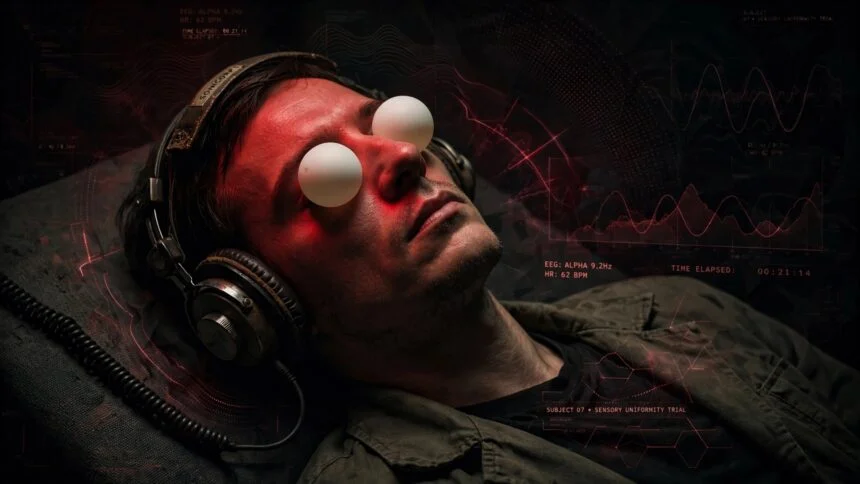
Cut two ping-pong balls in half. Tape them over closed eyes. Shine a dim red light at the face. Put on headphones playing white noise. Place the subject in a comfortable chair for half an hour. That is, physically, almost the entire apparatus behind one of parapsychology’s most persistent experiments, a procedure that has produced more than fifty years of argument over a result that repeatedly looks interesting in aggregate, repeatedly attracts methodological criticism, and has never achieved the clean independent replication that would make the argument disappear.
The strange thing about the Ganzfeld controversy is not that one side says telepathy exists and the other says it does not. The stranger fact is that, at one crucial moment, the two sides agreed that the accumulated data contained a statistically significant anomaly. What they could not agree on was what the anomaly meant.

The Experiment Was Borrowed From Perception Research
The word ganzfeld is German for “whole field” or “entire field,” and the technique did not originate in parapsychology. Gestalt psychologist Wolfgang Metzger developed the experimental setup in the early 1930s while studying visual perception under conditions of extreme sensory uniformity. When the normal visual field is stripped of edges, contrast, and recognizable objects, perception can become unstable: the brain begins generating patterns where there is little external structure to work with.
Four decades later, parapsychologist Charles Honorton borrowed that perceptual technique for a completely different question. Working at Maimonides Medical Center in the early 1970s on ESP and dreaming, Honorton proposed that if telepathic information existed, it might be extraordinarily weak and easily buried beneath ordinary sensory noise. A sensory-reduction procedure, he reasoned, might make such a signal easier to detect.

The first full Ganzfeld ESP study, conducted by Honorton and Sharon Harper, was published in 1974. The basic protocol became remarkably consistent. A receiver entered the Ganzfeld state while a separate sender, isolated elsewhere, concentrated on a randomly selected target, usually a photograph or short film clip. Afterward, the receiver was shown several possible targets and asked to identify which one the sender had been viewing. With four choices, pure chance predicts a 25 percent hit rate.
The First Argument Wasn’t About Telepathy. It Was About the Data.
By 1982, Honorton believed the accumulated Ganzfeld literature had become strong enough to support the existence of psi. Psychologist Ray Hyman, one of parapsychology’s most persistent methodological critics, disagreed.
In 1985, the two men independently published statistical analyses of the same body of experiments. Hyman identified a troubling pattern: successful studies appeared disproportionately associated with weaknesses in three areas, target randomization, judging procedures, and documentation of experimental controls. His interpretation was straightforward. If the positive results clustered around methodological weaknesses, those weaknesses might be producing the apparent effect.

Honorton’s side responded with a statistical criticism of its own. Statistician David Saunders pointed out that Hyman had selected those three methodological flaws from a larger set of nine possibilities. There are 84 different ways to choose three items from nine. If many possible combinations can be tested, one combination can appear unusually predictive simply by chance. Hyman’s analysis, Saunders argued, had not adequately accounted for that selection process.
Then the Two Opponents Did Something Almost Nobody Expected
Instead of continuing indefinitely through competing statistical papers, Hyman and Honorton sat down together. After four drafts, they published what became known as the 1986 Joint Communiqué. Its importance has little to do with whether telepathy exists. It matters because two researchers who fundamentally disagreed about the interpretation of the evidence reached a surprisingly precise agreement about the evidence itself.
They agreed that the existing database contained an overall statistically significant effect that could not reasonably be attributed to selective reporting or multiple analysis. They still disagreed about whether that effect constituted evidence for psi. And they agreed that the final verdict should await experiments conducted by a broader range of investigators under more stringent conditions.

The proposed solution was methodological rather than philosophical: improve randomization, improve documentation, automate vulnerable portions of the procedure, and, most importantly, see whether researchers outside Honorton’s own laboratory could reproduce the effect.
Honorton Built the Experiment the Critics Had Asked For
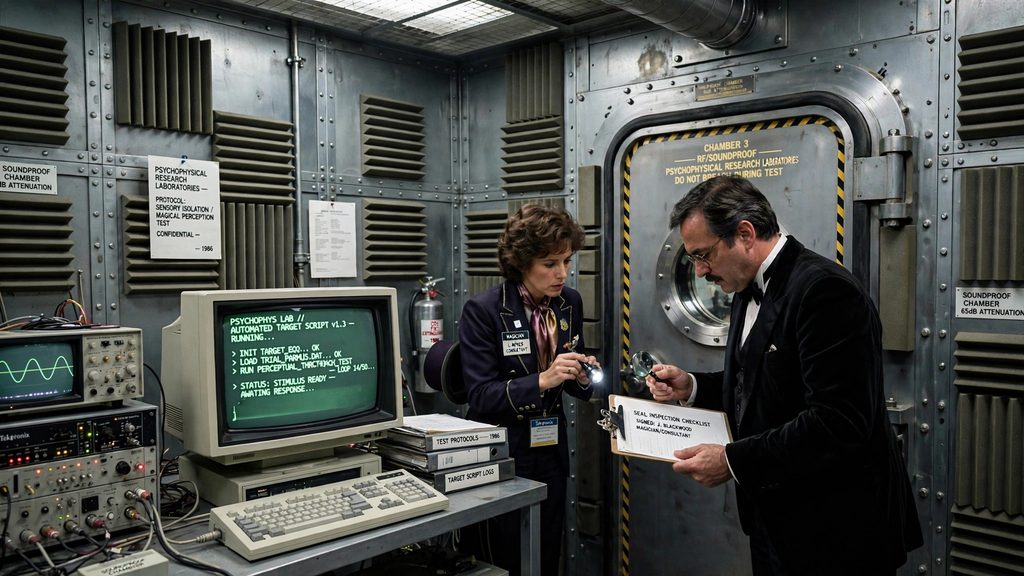
Beginning in 1983 at his Psychophysical Research Laboratories, Honorton developed what became known as the autoganzfeld series. The procedure was designed specifically to eliminate the kinds of weaknesses the Joint Communiqué had identified.
Target selection was computer controlled. Recording was automated. The receiver was placed in a soundproofed, electromagnetically shielded steel-walled room. Two professional mentalist magicians, Ford Kross and Daryl Bem, examined the physical security of the setup and reported it provided strong protection against deliberate deception by participants. The purpose was not to make the experiment mystical. It was to make ordinary information transfer increasingly difficult.
The series continued until September 1989. Across 354 trials, receivers produced 122 direct hits, a 34 percent hit rate against the 25 percent chance expectation. Honorton’s team calculated that, assuming a true hit rate of exactly 25 percent, the observed result would have a probability of roughly one in 45,000.
On the surface, that looks dramatic. But statistical improbability is not the same thing as identifying the mechanism that produced a result.
The Replication Problem Had Not Actually Been Solved
Ray Hyman’s objection moved accordingly. He did not simply argue that the autoganzfeld numbers were insignificant. He argued that the experimental architecture still had a fundamental weakness: nearly the entire series came from one laboratory operating under one research director, a concern researcher Adrian Parker had raised about the broader ganzfeld literature as early as 1978 and which had never been fully resolved.
Even though eight different experimenters participated, Hyman regarded the series as one large body of work produced within a single institutional environment. That distinction matters enormously in science. Repeating an experiment many times is not necessarily the same thing as having many independent laboratories reproduce it. The difference is subtle but profound. A result can be highly repeatable under one set of researchers, equipment, procedures, assumptions, and institutional habits while still failing when those conditions change.
Then Someone Proposed a Much More Ordinary Explanation
In 1996, researchers Richard Wiseman, Matthew Smith, and Diana Kornbrot examined the physical design of the Psychophysical Research Laboratories and proposed a specific alternative explanation: acoustic leakage.
The hypothesis did not require fraud, conscious signaling, or deliberate deception. The concern was much more mundane. If sounds from the sender’s room could reach the experimenter conducting the judging procedure, even occasionally, then information about the target might theoretically influence the process without anyone consciously realizing it. A cough. A chair moving. A reaction to a striking film clip. A sound that seemed meaningless at the time.

The researchers’ point was not that such leakage had been demonstrated. It was that the physical controls did not make the possibility impossible, and the reported effect was small enough that only a low frequency of leakage would theoretically be required to generate it.
Across 354 trials, chance alone would predict roughly 88 hits. The experiment recorded 122. The entire statistical anomaly therefore consisted of approximately 34 additional hits above expectation. Spread across the trials, that is roughly one excess hit for every eight experiments. That calculation does not prove acoustic leakage occurred. It establishes something narrower and more useful: a mundane mechanism operating only occasionally could, in principle, be large enough to account for the entire observed effect.
Researchers associated with the original PRL work subsequently disputed the leakage interpretation, arguing that the actual room design and experimental procedures made the proposed pathway implausible. The disagreement remained unresolved. And that unresolved exchange illustrates one of the hardest problems in experimental science: once a study is over, it can be surprisingly difficult to determine whether an obscure physical detail that was never considered important at the time might have mattered after all.
The Result Reached One of Psychology’s Most Prestigious Journals
The controversy became considerably more visible in 1994, when Daryl Bem and Charles Honorton published a joint meta-analysis in Psychological Bulletin, one of the major journals of psychological science.
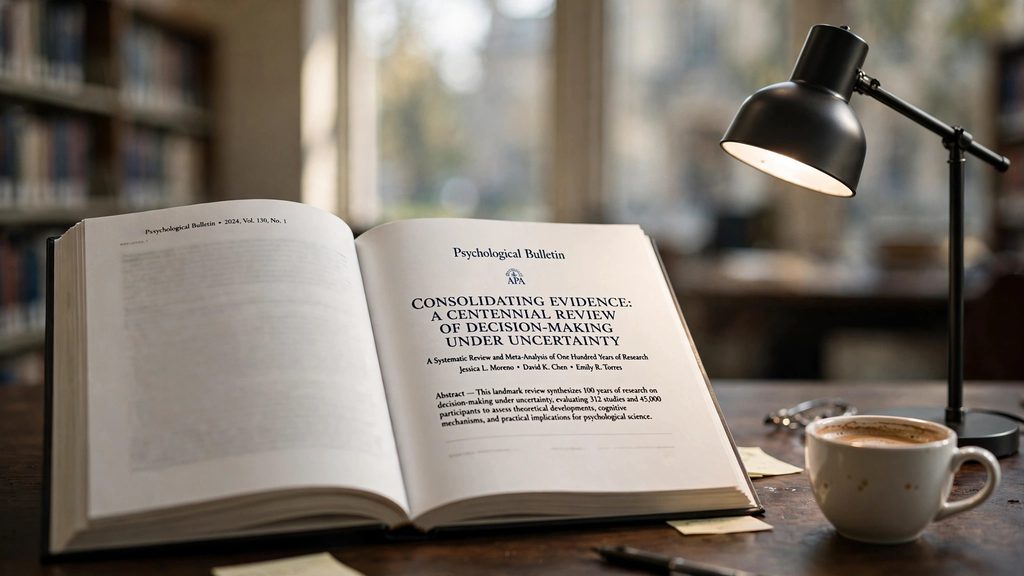
The paper, titled Does Psi Exist? Replicable Evidence for an Anomalous Process of Information Transfer, argued that the accumulated Ganzfeld evidence represented a statistically significant effect worthy of serious scientific attention. Its publication mattered partly because the paper appeared outside the specialist parapsychology literature. Ganzfeld research had crossed into a mainstream psychological venue.
For advocates, this was an important milestone. The claim was no longer merely that a collection of fringe experiments had produced strange numbers. A mainstream journal had published an analysis arguing that the anomaly deserved consideration.
Five Years Later, the Independent Replication Did Not Hold
Then came the experiment that the Joint Communiqué had effectively demanded.
In 1999, Julie Milton and Richard Wiseman published another meta-analysis in Psychological Bulletin, examining 30 Ganzfeld and autoganzfeld studies conducted after 1986 across seven independent laboratories. The studies were selected to reflect the more stringent standards that had emerged from the earlier methodological debate.
The result did not reproduce Bem and Honorton’s finding. Bem and Honorton had reported an effect size of 0.162, with a Stouffer Z of 2.52. Milton and Wiseman’s newer dataset produced an effect size of only 0.013 and a Z of 0.70, statistically indistinguishable from chance.
That is the point at which the story should have become simple. It didn’t.
The Effect Came Back When the Database Got Bigger
Parapsychologists Lance Storm and Suitbert Ertel challenged the Milton-Wiseman conclusion, arguing that the 30-study dataset represented too narrow a selection of the available Ganzfeld literature. When they expanded the database to 79 combined Ganzfeld and autoganzfeld studies, the aggregate result again reached statistical significance.
And there the argument arrived at its most frustrating form. A smaller, independently assembled dataset did not reproduce the effect. A broader pooled database produced a statistically significant result again. The disagreement therefore moved one level deeper: which studies should count as part of the evidential base in the first place?
That question is not a technical footnote. In a literature where the effect is small, changing which experiments enter the meta-analysis can materially change the conclusion. Whether the broader pooling is methodologically justified, or whether it risks reintroducing the very selection problems that earlier researchers had tried to eliminate, remains contested.
The Same Critic Was Still Arguing About It Twenty-Four Years Later
The debate did not end with Storm and Ertel’s rebuttal, and it has not ended since. In 2010, Storm, along with researchers Patrizio Tressoldi and Lorenzo Di Risio, published a fresh meta-analysis in Psychological Bulletin covering free-response studies from 1992 through 2008. A homogeneous set of 29 ganzfeld studies from that period produced a mean effect size of 0.142, with a Stouffer Z of 5.48, again statistically significant.
Ray Hyman, by then in his eighties and still the field’s most persistent methodological critic, responded directly in the same journal with a paper titled “Meta-Analysis That Conceals More Than It Reveals.” His argument echoed the same structural concern he had raised decades earlier: that combining databases whose effect sizes are not significantly different from each other, and setting aside outlier studies along the way, can manufacture an appearance of consistency that individual experiments do not actually support. Storm, Tressoldi, and Di Risio published a reply in the same issue, titled “A Meta-Analysis With Nothing to Hide,” standing by their inclusion criteria and disputing that anything had been concealed.
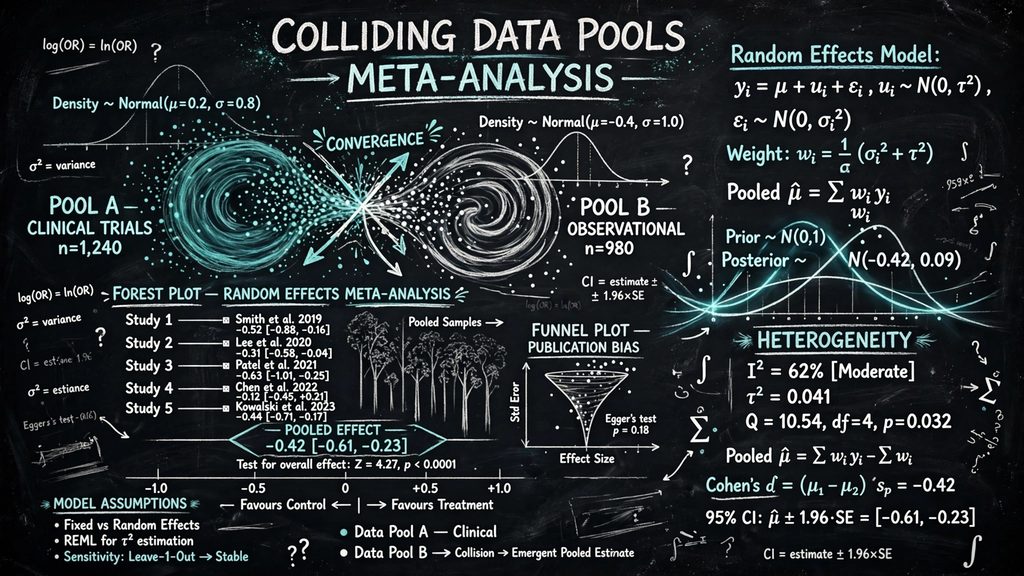
The same two positions from the 1985 Hyman-Honorton exchange were still being argued, by one of the same people, a quarter of a century later, in the same journal that had published Bem and Honorton’s landmark 1994 paper.
The pattern continued past that. A follow-up analysis covering studies published between 2009 and 2018 found nine new ganzfeld studies with a mean effect size of 0.119, again statistically significant on its own, and again not significantly different from the effect size reported in the 2010 database, meaning the newest data neither confirmed nor overturned what came before. More recent work has moved toward pre-registration, publishing the study’s methodology and analysis plan before data collection begins, specifically to close off the kind of after-the-fact selection concerns that have shadowed the ganzfeld literature since Hyman’s original 1985 critique. That more rigorous standard is itself a direct, if belated, legacy of the 1986 Joint Communiqué’s original demand for stricter methodology.
What the Ganzfeld Experiments Actually Prove
They do not prove telepathy. They also do not reduce to a single sentence saying that “scientists debunked telepathy.”
What the Ganzfeld literature actually provides is something more interesting: a decades-long case study in what happens when an anomalous experimental result repeatedly survives one kind of criticism but fails to survive another.
The statistical argument became stronger. The controls became tighter. The experiment was automated. The results reached mainstream publication. Independent laboratories were brought in. Alternative mechanisms were proposed. Those mechanisms were challenged. Broader meta-analyses were conducted. And the field continued to disagree.
The most revealing moment may still be the 1986 Joint Communiqué. Hyman and Honorton did not pretend that disagreement had disappeared. They did something more scientifically useful: they identified exactly what remained unknown and specified what kind of evidence could resolve it.
Honorton then built a stronger experiment. That experiment produced a striking result. Independent laboratories subsequently failed to reproduce that result cleanly. And yet the anomaly never entirely vanished from the literature.
The Most Interesting Result Is the One That Refuses to Become a Conclusion
That is why Ganzfeld research has survived for so long.
If the experiments had produced nothing but chance, the story would have ended. If independent laboratories had repeatedly produced the same effect under preregistered, tightly controlled conditions, the scientific conversation would have changed dramatically in the other direction. Instead, the literature occupies an uncomfortable middle ground: enough statistical structure to keep the question alive, enough methodological vulnerability to prevent the answer from becoming secure, and enough disagreement over study selection to ensure that different meta-analyses can still produce different pictures.
That is not evidence that telepathy exists. It is evidence of something narrower, but perhaps more valuable: how difficult it can be to turn an intriguing anomaly into reliable knowledge.

The Ganzfeld apparatus has barely changed since the 1970s. Half a ping-pong ball over each eye. Red light. White noise. A receiver waiting in sensory uniformity while another person concentrates on a randomly selected image somewhere else.
After more than fifty years, the remarkable part is not that the experiment has proved the existence of a hidden psychic channel. It is that the channel has never quite disappeared either, not in 1999, not in 2010, and not in the pre-registered studies still being run today.