


For the first twenty-five years after its rediscovery, Göbekli Tepe was described as a monument built by people who left no home behind: hunter-gatherers who gathered periodically on a hilltop in southeastern Turkey, raised rings of carved stone pillars weighing up to ten tons, then walked away, generation after generation, without ever settling there. That picture has been substantially revised since 2019. It hasn’t made the mystery smaller. It’s made it stranger.
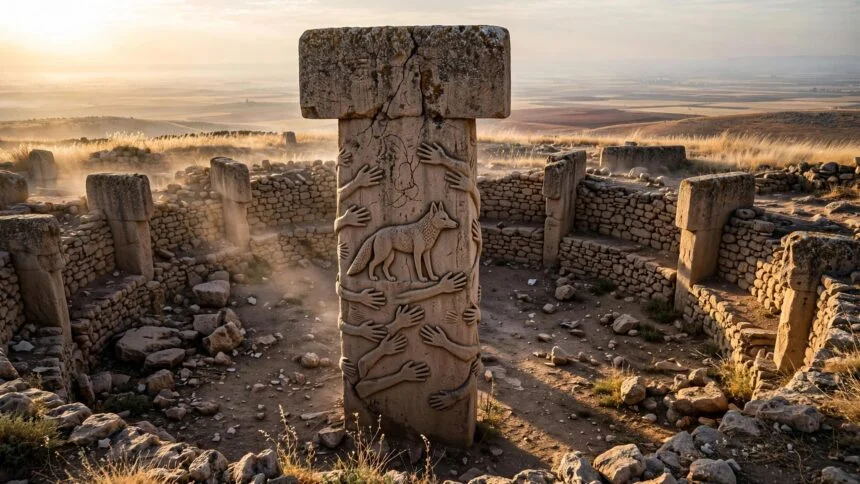
The site itself is not in dispute. On a limestone ridge in what’s now Şanlıurfa Province, radiocarbon dating places the earliest enclosures at roughly 9500 BCE, more than 11,000 years ago, some six thousand years before the first stones went up at Stonehenge. The people who built it had no metal tools, no pottery, no domesticated plants or animals, and no wheel. They quarried T-shaped limestone pillars, some standing over five meters tall and weighing as much as ten tons, carved them with foxes, boars, snakes, cranes, vultures, and abstracted human arms and hands, and set them upright in precise circular enclosures. Then, sometime around 8000 BCE, the enclosures were deliberately filled back in, buried under their own rubble, and the site went quiet. The whole documented span of activity runs about 1,500 years, not the thousand sometimes cited, but even at that scale, the question of who did this, and why, has never been fully settled.
The Claim That Needs Updating
The specific claim that no settlement was ever found near Göbekli Tepe was the accurate scholarly position for roughly the first two decades of excavation, and it’s still widely repeated today, but it’s no longer accurate. Klaus Schmidt, the German archaeologist who began excavating the site in 1995 and led the project until his death in 2014, interpreted it as a purely ritual site, a mountain shrine visited episodically by dispersed hunter-gatherer bands with no one living there permanently. That interpretation shaped how the site was written about for a generation, including a widely read 2011 National Geographic feature that helped popularize Göbekli Tepe as the “birth of religion,” built by people with no fixed address.
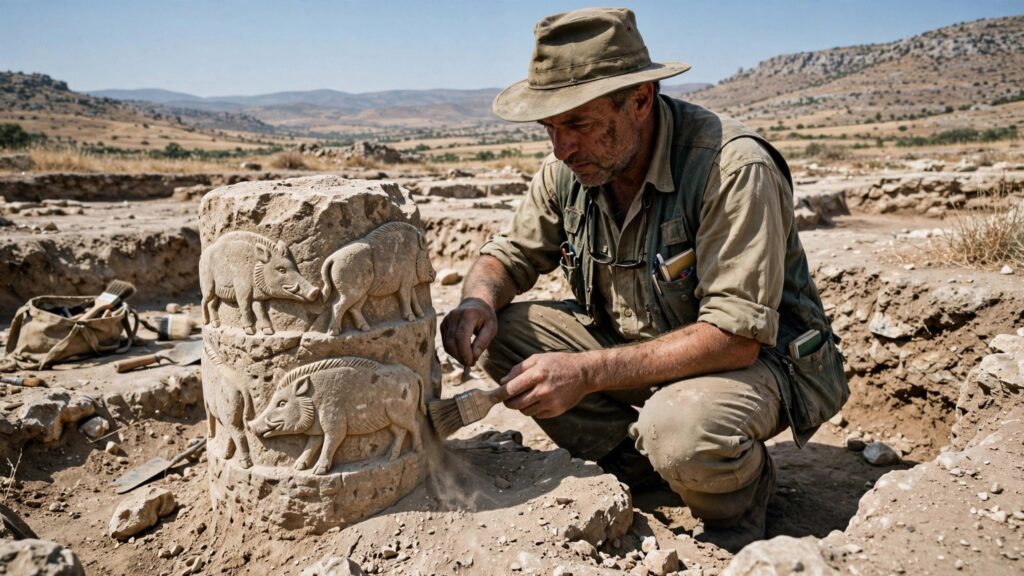
Since Schmidt’s death, excavations under Lee Clare of the German Archaeological Institute have turned up something the original interpretation didn’t have room for: middens, fireplaces, hearths, and stone tools that, in Clare’s own words to Archaeology magazine, came out of the ground “all smelling very domestic.” Researcher Laura Dietrich went back through thousands of grindstones, mortars, and carved stone vessels excavated over the years and set aside as unremarkable, including vessels large enough to process roughly forty gallons of beer or porridge at once, and found evidence of large-scale food processing that looked like ordinary household activity, not just feast preparation. The team also uncovered a rock-cut cistern nearly eight meters across and carved channels apparently used to collect rainwater, infrastructure built for people staying put, not passing through.
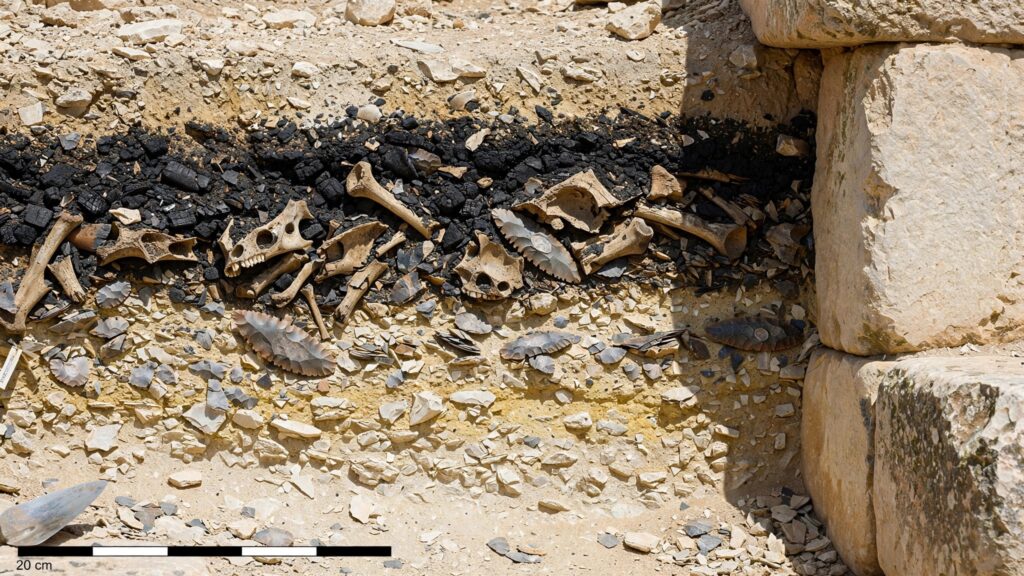
The German Archaeological Institute’s own current project page now states plainly that Göbekli Tepe “should thus be interpreted as a settlement site with a pronounced ritual component,” reversing the site’s defining characteristic for its first twenty years of fame.
Why the Correction Doesn’t Solve the Mystery
Here’s the part worth sitting with: even now that a resident population has been confirmed at the site, the actual construction mystery hasn’t gone away, because the people documented living at Göbekli Tepe don’t obviously add up to the labor force the monuments required. Schmidt’s own long-standing estimate was that raising, carving, and burying rings of seven-to-ten-ton pillars would have needed hundreds of workers laboring together, all of whom needed to be fed and housed during the effort. A 2016 analysis by the Göbekli Tepe Research Project team, working from ethnographic comparisons, noted that typical hunter-gatherer group sizes of the era run 25 to 50 people, occasionally somewhat higher for more settled groups, and concluded flatly that a group of that size was “definitely too small” to explain the scale of work visible at the site. Some researchers, including complexity scientist Peter Turchin, have argued the society capable of supporting that construction effort, quarrying stone from sites up to 700 meters away, carving it with only flint tools, and feeding the crews the entire time, had to number in the thousands at minimum, drawn from well beyond whatever resident population lived directly on the hill.
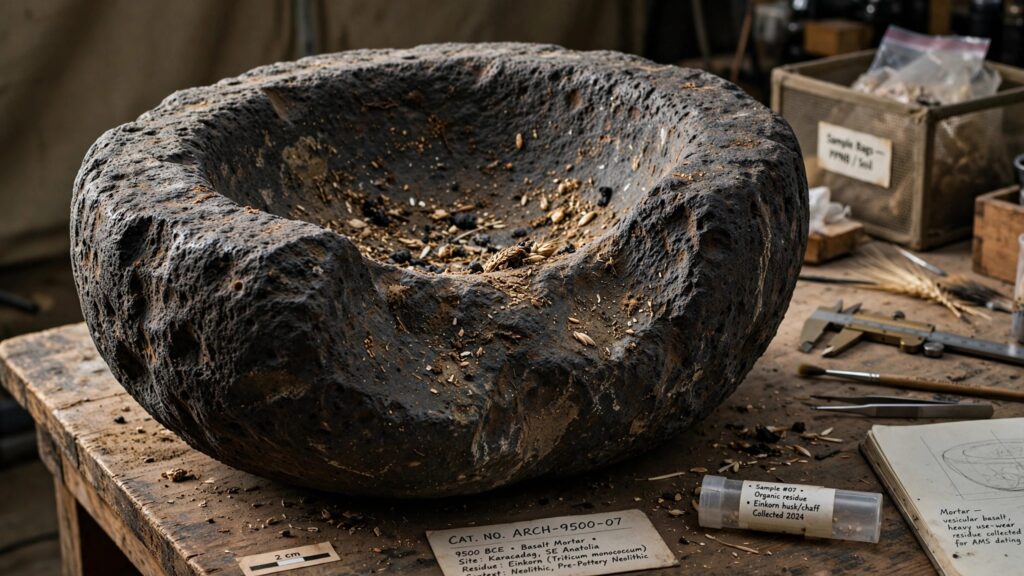
The feeding side of that logistics problem has its own hard evidence behind it. Zooarchaeological analysis of the animal bones recovered from the site found that gazelle alone accounts for more than sixty percent of the total, alongside wild boar, sheep, red deer, aurochs, and roughly a dozen bird species, every single specimen from a wild, undomesticated animal. Cut marks and splintered bone consistent with on-site butchering and roasting point to feasting on a scale well beyond ordinary household meals. Separately, more than 7,000 grinding tools, more than any other known site from the period, combined with plant residue analysis confirming wild einkorn and barley processing, show intensive wild-grain management happening at a volume that some researchers now argue was itself a direct pressure point pushing toward the domestication of cereals, rather than domestication coming first and monumental building following after, the reverse of the sequence archaeologists assumed for most of the twentieth century.
The Documented Fact of the Burial
The deliberate backfilling is not speculative. It’s one of the best-documented aspects of the entire site, laid out in detail by the German Archaeological Institute’s own excavation team. The fill inside the enclosures is compositionally distinct from natural sediment: limestone rubble from the same quarries used to build the pillars, mixed with large quantities of animal bone, flint debris, and tools, deposited rapidly rather than accumulating gradually the way windblown or waterborne sediment would. Before the filling began, the buildings were apparently cleaned out. If the enclosures had roofs, and it remains unclear whether they did, the roofing material was fully dismantled first, since excavators have found no trace of it anywhere in the fill.
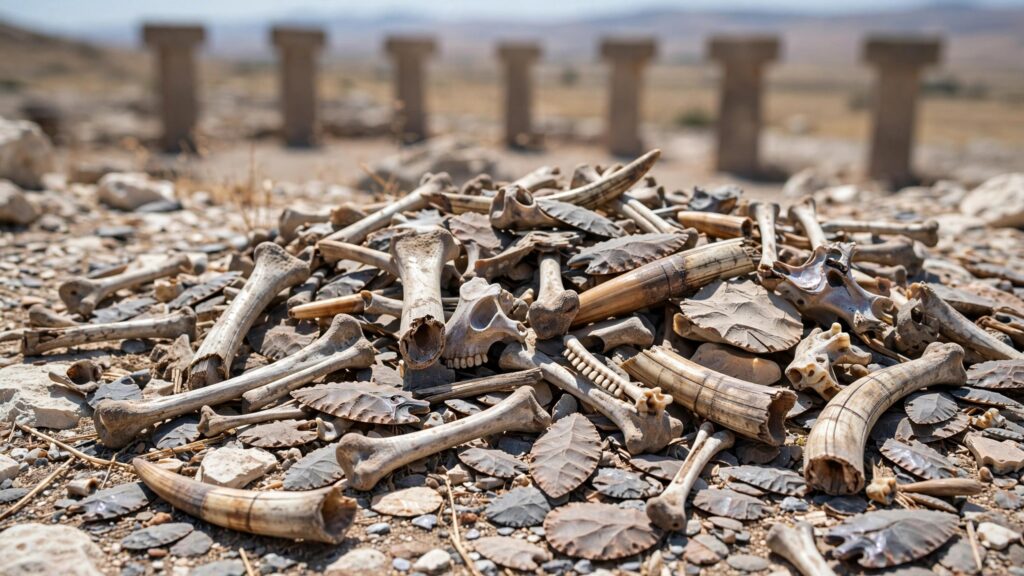
The most specific evidence for intentionality is what got placed inside the fill on purpose. Excavators recovered 135 pieces of stone sculpture from the site, the large majority depicting animals, with 43 human or human-like figures among them. Of those human figures, only 9 survive complete. The rest are broken, and the pattern of breakage is not random: heads survive in disproportionately high numbers compared to the larger, heavier torsos they came from, and in only one case have excavators found fragments that fit back together. During backfilling, a selected group of these fragments, disproportionately heads, was deliberately placed into the fill, concentrated near the central pillars rather than scattered throughout. The animal bone in the fill is itself consistent with feasting refuse, leading several researchers to propose that the burial event, like the construction it closed out, may have been accompanied by communal feasting rather than carried out quietly.
What Nobody Has Actually Established
What remains genuinely open, even accounting for the settlement evidence, is why. Schmidt’s own working theory was ritual decommissioning, that each enclosure served its purpose and was then deliberately closed the way a life might be formally ended, a reading he arrived at partly through comparison with much later sites like Çatalhöyük, where similar treatment of human heads and figures recurs in a fuller cultural context. That remains the most widely cited explanation, but it is an interpretation of physical evidence, not a documented statement of intent from the people who did it, since Göbekli Tepe’s builders left no writing of any kind. Competing proposals, that the burial marked a broader cosmological ending, a social transformation as the surrounding world shifted toward agriculture, or simply a practical decision to preserve structures already considered complete, remain live possibilities precisely because no single piece of evidence forces a choice between them.
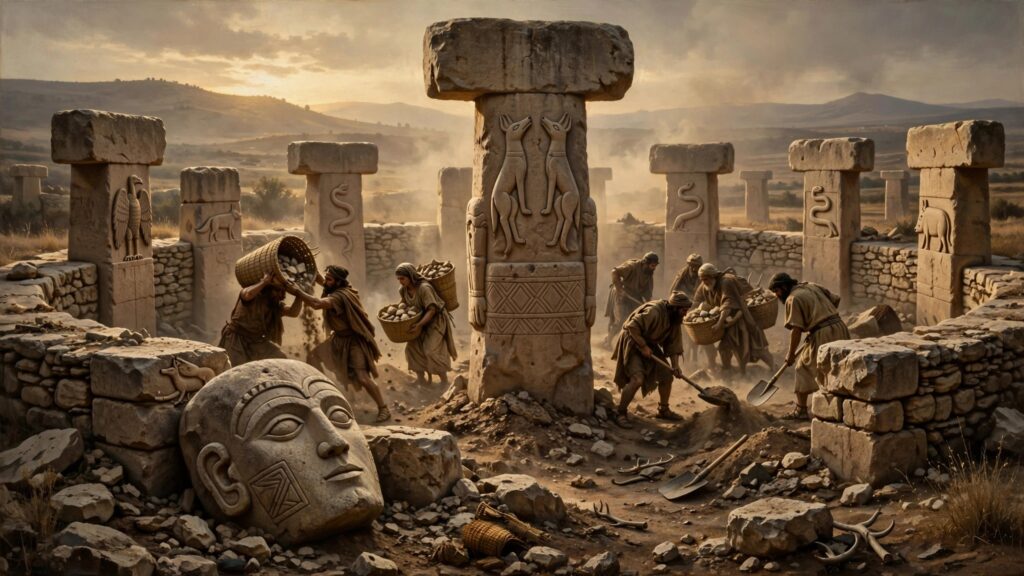
The same gap applies to who specifically organized the work. Restricted access to at least some enclosures, along with a near-total absence of everyday domestic items like bone awls and points that show up routinely at ordinary settlements of the period, suggests some form of hierarchy or specialized ritual role governed at least part of what happened on the hill, but the archaeological record has no names, no burials clearly identifiable as belonging to organizers or leaders, and no inscriptions to consult. Lee Clare has more recently argued, based on continued analysis of the site’s chronology and the broader climate record, that Göbekli Tepe may represent something closer to a last, intensified expression of a hunter-gatherer world already beginning to disappear, rather than the confident opening act of a new agricultural age the site was popularly cast as for its first twenty years of fame.
Why the Corrected Version Is the More Interesting One
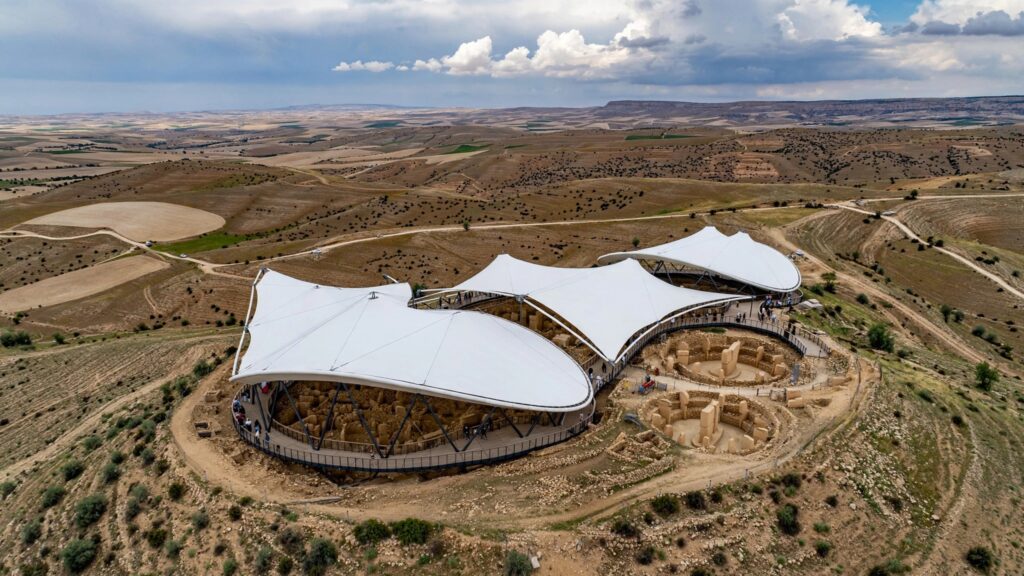
None of this needs an invented pre-history to be worth taking seriously. Confirmed residents on the hilltop, cisterns, hearths, tens of thousands of processed wild grains, and forty-gallon vessels of porridge or beer don’t explain away the mystery of who built Göbekli Tepe. They sharpen it. The people documented living at the site were almost certainly not, on their own, the full labor force that quarried and raised ten-ton pillars using only flint tools and human muscle. Somebody organized a mobilization of workers, feasting, and food processing on a scale that current evidence suggests drew in far more people than lived there year-round, sustained that effort across roughly a millennium and a half using nothing but wild resources, and then, deliberately, methodically, and by every indication on purpose, buried the results and let the practice end. Less than five percent of the site has been excavated. Whatever answer eventually closes that gap is still mostly still in the ground.