



The Shiva statue at CERN is real. Jack Parsons was real. The strange rituals, the rocket science, the occult diaries and the laboratory explosion are all real too. The Mandela Effect is real in the less glamorous sense that human beings can independently develop remarkably similar false memories. What does not survive the same scrutiny is the story that ties these things together into a hidden cosmic machine: a 19,000-kilometre structure beneath the oceans, an obscure researcher called Edward Alexander “Maggador,” a mysterious force called “gavvah,” and the Large Hadron Collider supposedly functioning as some kind of artificial gateway. The deeper you follow the evidence, the more interesting the story becomes, not because the conspiracy survives, but because the documented reality is already stranger than the machinery invented around it.
That distinction matters. There is a particular kind of modern mystery in which a real object is placed beside a real person, a real psychological phenomenon is added to the pile, and then a speculative connection is quietly promoted until the whole arrangement begins to look like evidence. CERN’s Nataraja statue becomes a coded admission. Shared false memories become proof that reality has shifted. Jack Parsons becomes the missing scientist-magician who understood the mechanism. A claim about an impossible structure under the ocean supplies the missing architecture. Eventually the question is no longer whether each individual piece is documented. It becomes whether the pieces “feel” connected. That is precisely where an investigation has to slow down.
The Shiva Statue at CERN Really Is What People Say It Is
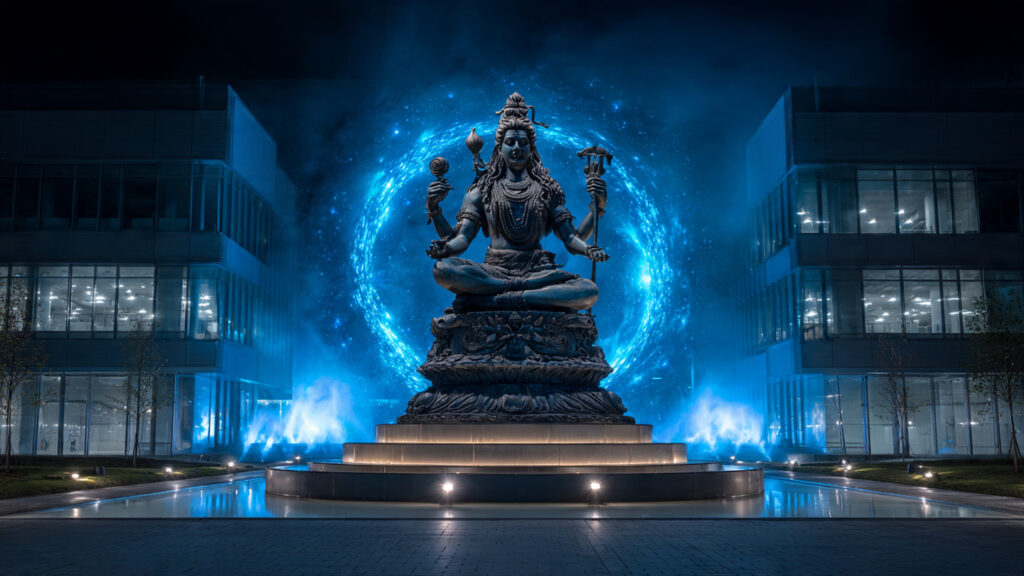
Start with the object that looks most suspicious if you encounter it without context: a two-metre bronze statue of Shiva Nataraja standing at CERN, the European laboratory devoted to particle physics. It sounds almost designed for a conspiracy story. The god is depicted performing the cosmic dance; CERN smashes particles together at extraordinary energies; and beside the statue is a plaque describing the ancient dance as a metaphor for the cosmic dance of modern physics. The difference between the documented story and the internet version is crucial, however. CERN’s own historical records state that the statue was unveiled on June 18, 2004, and was a gift from India celebrating the country’s long scientific collaboration with CERN, which dates back to the 1960s. It was unveiled by CERN Director-General Robert Aymar alongside India’s ambassador to the WTO in Geneva, K. M. Chandrasekhar, and Atomic Energy Commission chairman Anil Kakodkar. This isn’t a discovered secret. It is an announced diplomatic gesture.
The symbolism is real too. The Nataraja image represents Shiva’s cosmic dance of creation, preservation and destruction, and the accompanying explanation explicitly connects that imagery with the patterns observed in particle physics. Fritjof Capra’s famous formulation of the metaphor is inscribed on the plaque, linking ancient Indian artistic representations of Shiva’s dance with modern physicists using advanced technology to investigate patterns in nature. Capra had written about the relationship between the Nataraja image and modern physics decades earlier. In other words, someone did not secretly notice that CERN had accidentally placed an occult symbol beside a particle accelerator and then build a theory around the coincidence. The metaphor was the point from the beginning.
And that is actually more interesting than the conspiracy. CERN did not hide the symbolism. India did not hide the reason for the gift. The physicists did not claim that Hindu theology had been experimentally demonstrated inside the Large Hadron Collider. A civilization gave a scientific institution a religiously significant work of art and explicitly used it as a metaphor for the dynamism of the physical universe. That is culture speaking to science, not evidence that the laboratory is secretly operating a ritual machine.

Then There Is the Mandela Effect, and the Memory Problem Is Stranger Than the Myth
The Mandela Effect begins with something equally real, but much closer to home: people can remember things that did not happen, and sometimes large numbers of people can converge on remarkably similar errors. The name itself came from the internet after people began reporting a shared false memory that Nelson Mandela had died in prison decades before his actual death. From there, the term became a catch-all for collectively shared discrepancies involving movie lines, logos, names, historical details and cultural artifacts. The important scientific qualification is that psychologists did not need to discover a mysterious new force called the Mandela Effect in order to explain what was happening. The underlying processes, false memory, misinformation, source-monitoring errors, associative memory and social reinforcement, have been studied experimentally for decades.
The Deese-Roediger-McDermott paradigm is one of the clearest demonstrations of how easily memory can manufacture something that feels authentic. Participants hear or study lists of related words, but a strongly associated word is deliberately omitted. People frequently report remembering the missing word anyway. Other experiments have shown that misleading information introduced after an event can become incorporated into later recollection, sometimes with increasing confidence after repeated retrieval. That last point is particularly uncomfortable because confidence is not a reliable guarantee of accuracy. A person can become more certain of a memory precisely because the memory has been repeatedly reconstructed.
This does not mean every strange shared memory has been completely explained. Human memory is complicated, and the exact route by which a particular cultural error spreads can be difficult to reconstruct after years of repetition. But the scientific lesson is already powerful enough: brains do not store ordinary memories as flawless digital recordings. They reconstruct them. People share cultural environments. They encounter the same advertisements, jokes, films, typography, summaries and mistakes. One person misremembers a detail, another encounters the same distorted version, and the error can acquire social reinforcement until thousands of people sincerely experience it as something they personally remember.
That is not reality breaking. It is reality being filtered through human beings.
Jack Parsons Does Not Need a Conspiracy to Become Extraordinary
Then there is Jack Parsons, where the documented record becomes almost absurdly strange without any help from a conspiracy theorist. Born Marvel Whiteside Parsons in 1914, he was a largely self-taught chemist and rocket enthusiast who became one of the important figures in the early development of American rocketry. He worked with the Caltech rocket group that developed jet-assisted takeoff technology, helped pioneer castable composite solid propellants, and was among the founders of Aerojet. The same rocket-research group evolved into the Jet Propulsion Laboratory. Parsons was not a fictional occult scientist invented by later writers. His technical work is part of the documented history of American rocketry.
But Parsons also belonged to the world of Aleister Crowley’s Thelema. He joined the Ordo Templi Orientis’s Agape Lodge in California and became its leader in 1942. That double life was not something invented decades later to make a rocket engineer sound mysterious. Parsons was openly involved in occult practice while simultaneously participating in serious wartime rocket research. His associates knew about it. His employers knew about it. His correspondence survives. And the tension between those worlds eventually became professionally consequential.
In 1944, Parsons and Frank Malina were removed from the leadership structure surrounding the rocket enterprise as Aerojet was being reorganized and sold. Accounts of Parsons’s departure emphasize both the reputational problem created by his occult associations and concerns about his approach to laboratory safety. The latter matters because the mythology often turns Parsons into a flawless secret genius persecuted solely for knowing too much. The historical record is messier. He was exceptionally talented, but he could also be reckless. His colleagues were not necessarily choosing between “genius” and “idiot”; they were dealing with a brilliant chemist whose working methods could create genuine danger.
The Babalon Working Was Real. The Myth Around It Is Something Else.
Parsons’s most famous occult episode came in 1946, when he conducted what became known as the Babalon Working. Over a series of rituals from January through March, he attempted to invoke Babalon, a figure from Thelemic occultism, into physical manifestation. L. Ron Hubbard, then a close associate of Parsons and later founder of Scientology, participated as a scribe. Parsons kept records of the operation, and surviving writings and correspondence provide an unusually direct window into what he believed he was doing.
There is an important correction to the mythology here. Hubbard did not simply perform the ritual and disappear with Marjorie Cameron, the woman later identified by Parsons with the result of the working. Parsons met Cameron after the initial rituals, and he came to regard her as the incarnation or elemental presence he had been attempting to invoke. His relationship with Hubbard, meanwhile, deteriorated over money and personal betrayal. Hubbard became involved with Sara Northrup, Parsons’s former partner, and Parsons accused him of taking money that belonged to him. The episode became one of the formative scandals in the strange prehistory of Scientology. It is already bizarre enough without combining people and events that occurred at different points in the story.
This is where Parsons becomes genuinely fascinating. He was not a secret sorcerer pretending to be an engineer. He was a rocket engineer who sincerely practiced occultism. He could write about propulsion technology and ceremonial magic in the same lifetime because, to him, those subjects were not necessarily contradictory. The temptation is to transform that contradiction into evidence that he possessed some suppressed knowledge about the structure of reality. The surviving evidence supports something subtler and, in a way, more revealing: Parsons himself believed that science, consciousness, magic and the future of humanity belonged in the same conversation.
His death only intensified the mythology. On June 17, 1952, Parsons was killed in an explosion in his home laboratory in Pasadena while working with explosives. Authorities treated the death as accidental, with fulminate of mercury repeatedly identified in accounts of the investigation. Questions and alternative theories have persisted ever since, partly because the circumstances were extraordinary and partly because Parsons’s life made almost any sinister explanation feel narratively plausible. But no demonstrated evidence turns those suspicions into a proven assassination. The honest historical position is simultaneously more modest and more unsettling: Parsons died in an unexplained-to-everyone’s-satisfaction laboratory disaster, and the surviving record does not establish that a secret organization killed him.
The Cornerstone Is Where the Evidence Changes Character
Now the investigation reaches the part that cannot be treated in the same way as the CERN statue, the psychology experiments or Parsons’s diaries. The “Cornerstone” story describes an enormous artificial structure allegedly extending roughly 19,000 kilometres across the ocean floor, accompanied by references to a researcher called Edward Alexander “Maggador” and an esoteric term rendered as “gavvah.” These claims are sometimes presented as though they belong to the same evidentiary category as the documented history of CERN or Parsons. They do not.
The problem is not that an extraordinary claim is automatically false. The problem is the absence of an identifiable evidentiary chain. There is no established scientific publication, geological survey, institutional archive, identifiable researcher record or independently verifiable dataset that establishes such an artificial ocean-spanning structure. The same problem applies to “Edward Alexander Maggador”: without a recoverable publication, institution, archive, correspondence trail or independent biographical record, the name cannot be treated as a verified researcher simply because it appears in a circulating account. “Gavvah” presents the same problem. A mysterious word is not evidence merely because it sounds as though it belongs to an ancient esoteric vocabulary.
That distinction is one of the most important habits in investigating fringe history. A claim does not become stronger because it is surrounded by ten other extraordinary claims. Each link has to carry its own weight. If a person existed, there should be some trace. If a geological structure of planetary scale exists, there should be geological evidence. If a scientific discovery occurred, there should be a paper, a measurement, a laboratory record, an institution, a witness whose identity can be checked, or at minimum a chain of independent documentation. When every supporting component leads back to the same unverified narrative, the apparent web of evidence may actually be a single strand reflected in several mirrors.
And Then the LHC Gets Turned Into a Gateway
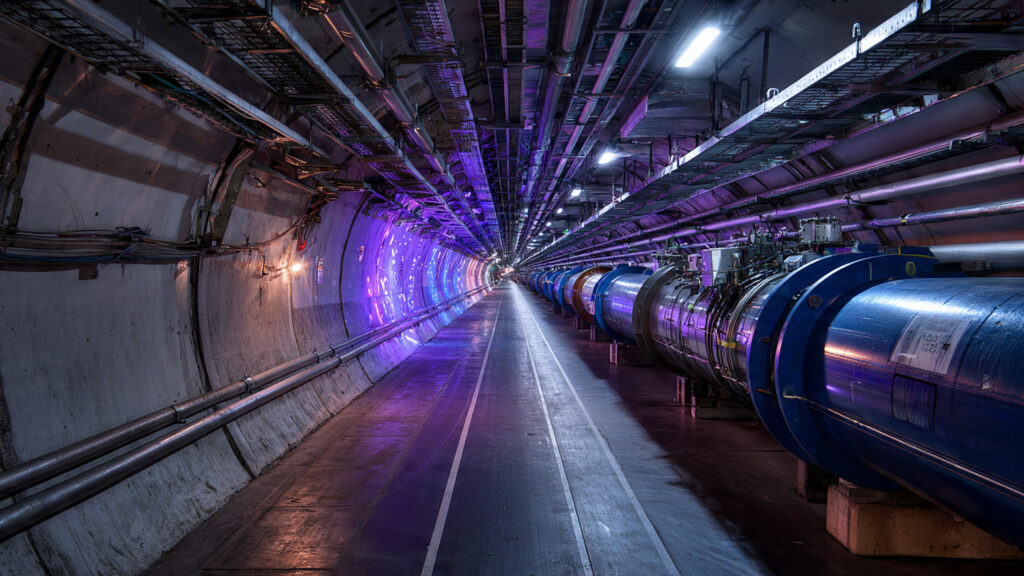
The Large Hadron Collider is where the story finally acquires the visual language of science fiction. It is a gigantic circular machine beneath the European countryside, built to accelerate particles to extraordinary energies and collide them so that physicists can study the fundamental structure of matter. If someone wants to transform it into an artificial portal, the imagery is almost irresistible: enormous magnets, underground tunnels, invisible particles, impossible energies, ancient symbols and the possibility of things emerging from the collision point that were not there before.
But the actual physics is stranger in a different way. Some speculative theories have entertained the possibility that microscopic black holes could appear at collider energies under particular extensions of known physics. That is not the same thing as saying the Standard Model predicts that CERN creates black holes. CERN’s safety analyses explicitly examined the hypothetical possibility and concluded that such objects would not pose a danger. The argument is strengthened by nature itself: cosmic rays have been striking Earth and other astronomical bodies at energies exceeding those reached by the LHC for billions of years, without turning planets or stars into consuming black holes.
There is therefore no scientific basis for describing the LHC as a portal into another realm. More importantly, there is no need to make that claim in order to appreciate what the machine actually does. The collider allows human beings to interrogate matter at scales and energies that would otherwise remain inaccessible. It has discovered new particles, tested theoretical predictions and contributed to a century-long attempt to understand what the universe is made of. The real machine is already an instrument for asking questions about reality at a depth that would have sounded magical to almost every previous generation.
The Real Connection Is Not a Secret. It Is a Human One
Put the pieces back together without forcing them to become one story and something genuinely interesting appears. The Shiva statue is a real diplomatic gift from India, deliberately chosen because the image of Shiva’s cosmic dance offered a powerful metaphor for the dynamism of modern physics. The Mandela Effect is a popular name for a family of real memory phenomena in which people can become sincerely and sometimes collectively convinced of things that did not occur. Jack Parsons was a real rocket pioneer whose technical achievements helped shape American rocketry while his private life carried him deep into the occult. The Babalon Working happened. Parsons kept records. Hubbard was there. Cameron was there afterward. Parsons died in an explosion. These things do not need to be connected by a hidden machine.
In fact, forcing them together makes each individual story less interesting. The CERN statue becomes a clue instead of a fascinating collision between Indian religious imagery and twentieth-century particle physics. The Mandela Effect becomes evidence of alternate timelines instead of an unsettling demonstration that subjective certainty can diverge from historical reality. Parsons becomes a cipher instead of a complicated human being who genuinely believed he could stand with one foot in rocket science and the other in ceremonial magic.

Parsons Died Testing Rocket Fuel, Not Summoning Anything
There is an irony at the center of the entire story. The conspiracy becomes less convincing precisely when the investigation becomes more interesting.
Because the real world already contains a statue of an ancient cosmic dancer standing outside one of humanity’s most powerful particle laboratories. It already contains a self-taught rocket chemist who helped build the foundations of modern rocketry while conducting occult rituals in his home. It already contains a human memory system capable of making people confidently remember events that never happened. It already contains machines that probe the smallest structures we can experimentally reach and questions about the universe that remain genuinely unanswered.
None of that proves that CERN is a gateway. None of it proves that reality has been rewritten. None of it establishes a hidden ocean-spanning machine or a vanished researcher whose work unlocked it. But it does establish something considerably more defensible: human beings repeatedly build symbolic bridges between the things they understand and the things they cannot yet explain. Sometimes those bridges become religion. Sometimes they become physics. Sometimes they become conspiracy theories.
The difficult part is knowing which side of the bridge the evidence is standing on.
And that may be the genuinely strange lesson here. We do not need an artificial gate between worlds to make reality feel uncanny. We already live inside one.