



3I/ATLAS already passed Earth in December 2025. It did not alter the planet’s rotation, shift its axis, trigger a pandemic, or produce any observable catastrophe, and no identifiable mainstream scientific or biblical-scholarly source provides evidence that it will somehow begin a mass-death event in 2028. The object was real. Its interstellar origin is real. Its chemistry is extraordinary. Its passage through the inner Solar System was one of the most unusual astronomical events of the decade. What is not established is the apocalyptic timetable now being attached to it.
That distinction matters because the prediction being circulated is built from several different kinds of material that do not automatically belong together: a genuine interstellar comet, ancient biblical passages, medieval end-times traditions, claims about prehistoric catastrophes, and modern interpretations of disease and planetary change. Some of those sources are historically real. Some are legitimate scientific subjects. Some are matters of religious interpretation. But none of that establishes a causal chain from 3I/ATLAS to a predicted wave of mass death beginning in 2028. The most important fact is also the simplest: the comet has already passed the point at which it supposedly posed an imminent danger to Earth, and the observations made during and after that passage do not show the mechanism required by the prediction.
First, the Object Really Was Extraordinary
3I/ATLAS, formally designated C/2025 N1, is the third confirmed interstellar object observed passing through our Solar System. Its hyperbolic trajectory shows that it did not originate as a normal long-period comet gravitationally bound to the Sun. NASA records its closest approach to Earth on December 19, 2025, at approximately 1.8 astronomical units, or about 270 million kilometers, roughly 170 million miles, and explicitly states that it posed no threat to Earth. Its speed was extraordinary as well, reaching about 246,000 kilometers per hour near perihelion, but speed is not evidence of destructive intent or an exotic mechanism. It is exactly the sort of measurement expected from an interstellar object moving through the Solar System on an unbound trajectory.
What makes 3I/ATLAS genuinely fascinating is what later observations revealed about its chemistry. A June 2026 Nature study led by Martin Cordiner and colleagues found an exceptionally high deuterium-to-hydrogen ratio in its water and unusual carbon-isotope ratios, unlike those measured in Solar System material. The authors concluded that these signatures are consistent with formation at temperatures of roughly 30 kelvin or below in a relatively metal-poor environment. Their galactic-chemical-evolution modelling suggests that the material may have been accreted as long ago as approximately 12 billion years. That is an extraordinary scientific result, but it should be described correctly: the study provides evidence about the age and environment of the material from which the comet formed, not a literal measurement proving that the entire object has existed unchanged for 12 billion years.
In other words, the real story is already stranger than the apocalypse story. We are looking at material that may preserve chemical information from a planetary system vastly older than our own. Astronomers can study it precisely because it is not a hypothetical object in an ancient manuscript, it is an observable body whose trajectory, spectrum and chemistry can be measured. That is the standard the 2028 prediction has to meet. If an extraordinary claim is going to turn a real interstellar comet into a forecast of planetary catastrophe, the evidence connecting those two things has to be equally extraordinary.
There Is No Comet-to-Pandemic Mechanism in the Evidence
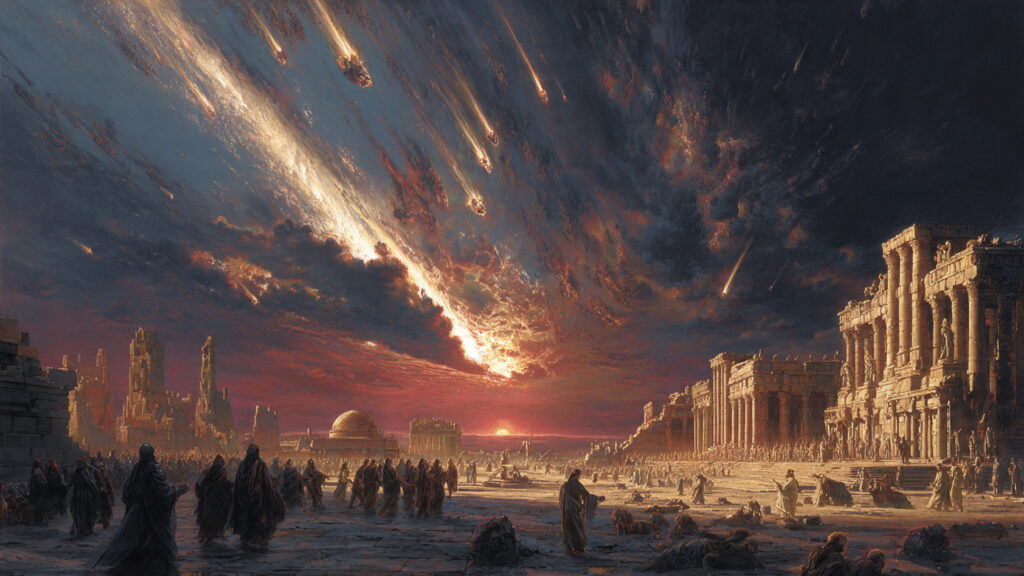
One branch of the prediction attempts to connect cometary passages with pandemics or major disease events. But the existence of historical coincidence is not evidence of biological causation. Viruses spread through biological transmission networks: hosts, animals, human contact, environmental conditions, mutation and ecological opportunity. A comet passing hundreds of millions of kilometres from Earth does not automatically acquire a pathway into that system. No established epidemiological evidence shows that 3I/ATLAS caused, initiated or is scheduled to cause a human pandemic.
That does not mean every question about pandemic origins has been settled. It means something narrower and more important: uncertainty about one biological event cannot be converted into evidence for an unrelated astronomical cause. The scientific question is always what mechanism connects A to B. If a claim says a comet caused or will cause disease, it must identify the physical route, demonstrate that the route exists, and show observations consistent with it. Simply placing a comet and a disease outbreak on the same historical timeline does none of those things.
The “747 BC Orbital Shock” Changes the Biblical Story
The biblical passage sometimes recruited into this narrative is real, but the modern reconstruction needs to be separated from what the text actually says. In 2 Kings 20 and Isaiah 38, the king is Hezekiah, not Ahaz. Ahaz is associated with the sundial or “steps of Ahaz” mentioned in the account, Hezekiah is the king who receives the sign. The text describes a shadow moving backward as a sign accompanying Hezekiah’s recovery. It does not describe a comet named ATLAS, an interstellar object, or a documented global disturbance of Earth’s rotational axis. Modern scholarship also treats the textual relationship between the Kings and Isaiah versions as a complicated literary and textual-history question, rather than a straightforward astronomical report.
That does not require dismissing the religious meaning of the passage. A theological reading can understand the event as a miracle. A historical-critical scholar can study how the story developed and was transmitted. An astronomer can ask whether any natural phenomenon might have produced an unusual shadow. Those are different questions. What cannot legitimately be done without additional evidence is take the biblical narrative, reinterpret its shadow as a planetary-axis event, identify that supposed event with a particular prehistoric or ancient comet, and then use the reconstructed chain as a prediction about an interstellar comet discovered in 2025.
There is an especially important reason to resist the orbital-shock interpretation: a change in Earth’s rotation or orientation is not the sort of event that can remain invisible once modern measurement begins. Earth’s orientation in space is monitored continuously using an international network of astronomical and geodetic observations. NASA’s own tracking of 3I/ATLAS shows a predicted hyperbolic trajectory and no close approach capable of producing the planetary disturbance being claimed. The comet was approximately 270 million kilometres away at its closest approach to Earth.

Revelation’s Fourth Seal Is Not a 2028 Countdown
The fourth seal of Revelation is one of the most powerful pieces of apocalyptic literature in the Christian Bible. Revelation 6 describes the pale horse whose rider is named Death, accompanied by Hades, with authority to kill by sword, famine, pestilence and wild beasts. The imagery is unquestionably catastrophic. But catastrophic imagery is not the same thing as an astronomical timetable. Scholarly interpretations of the passage have examined its relationship to Jewish apocalyptic traditions, the Hebrew Bible, the Roman-era world in which Revelation emerged, and the literary structure of the book. There is no established scholarly method by which the fourth seal can be converted into a date in 2028 or linked to 3I/ATLAS.
Even the sequence itself complicates the modern claim. Revelation contains several cycles of seals, trumpets and bowls, with overlapping images of judgment, destruction and divine intervention. Scholars disagree about how individual symbols should be identified and how the book’s chronology should be understood. That disagreement is not a weakness in the text, it is part of the long history of interpreting apocalyptic literature. What it does mean is that anyone claiming to have extracted a precise modern astronomical schedule from those symbols carries the burden of showing exactly how the interpretation was derived and why alternative readings should be rejected.
Medieval Doomsday Signs Are History, Not Astronomical Instrumentation
Medieval European traditions about signs preceding the end of the world are real and historically valuable. Lists of portents, earthquakes, storms, darkness, strange celestial phenomena and other warnings circulated through Christian literature for centuries. They reveal how people in earlier societies interpreted uncertainty and catastrophe. But a manuscript recording a religious expectation is not automatically an observational dataset from which a modern astronomer can reconstruct an orbit. Treating medieval apocalyptic folklore as though it were an ancient scientific catalogue changes the nature of the source.
This distinction matters because old texts often contain precisely the kind of flexible imagery that can be attached to later events. A darkened sky can become an eclipse, a star can become a comet, a judgment can become a pandemic, and a sequence of symbolic numbers can become a calendar. Once the reinterpretation has been made, the modern event appears to confirm the old text. But the interpretive direction has actually run the other way: the modern event supplied the meaning.

3I/ATLAS Is Not a Kreutz Sungrazer
Another historical collision involves the Kreutz sungrazers. This is a genuine family of comets whose members pass extremely close to the Sun and are believed to share a common parent body. The family includes spectacular historical comets and thousands of smaller fragments detected by solar-observing spacecraft. But 3I/ATLAS is not a member of the Kreutz family. Its defining orbital characteristic is that it is interstellar: its trajectory is hyperbolic and traces back to a source outside the Solar System. Similar-looking words such as “comet,” “fragment,” and “sungrazer” do not make two objects members of the same dynamical population.
This is a recurring problem in catastrophe narratives: genuine scientific categories are placed side by side until their differences disappear. Once every unusual comet becomes part of an imagined “family,” a historical comet can be used as evidence for another object that shares only the most superficial description. But orbital dynamics is precisely the field in which these distinctions matter. NASA’s observations place 3I/ATLAS on a predicted hyperbolic path, with only small non-gravitational perturbations compatible with ordinary cometary outgassing.
Plato Did Not Leave an Astronomical Warning Label
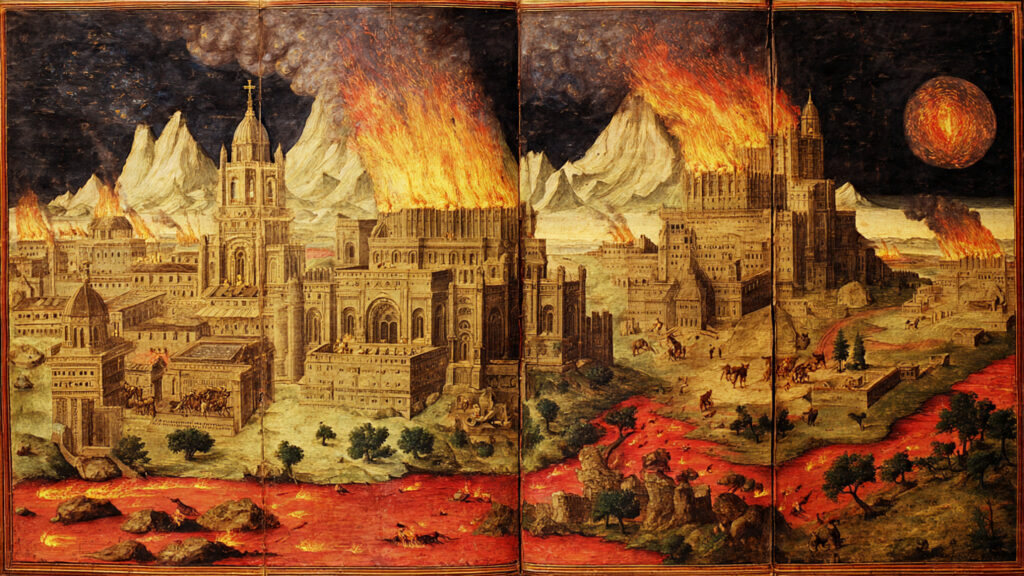
Plato’s Timaeus is another genuine ancient source frequently recruited into modern catastrophe narratives. The dialogue contains a discussion of recurring destruction and renewal, including the idea that civilizations can be devastated by catastrophes and later rebuilt. That makes it fascinating intellectual history. It does not, however, turn Plato into an astronomer who predicted 3I/ATLAS.
The difference between philosophical cosmology and observational astronomy is fundamental. Plato was writing within an ancient philosophical framework concerned with the structure of the cosmos, the nature of change and the relationship between human societies and larger cycles. Modern astronomy determines the trajectory of a comet by observation, mathematics and repeated measurement. Those two forms of knowledge can be compared historically, but one cannot simply be converted into the other because a modern reader notices a thematic resemblance.
The Lomonosov Evidence Does Not Bridge the Gap
Claims about geological evidence for repeated cometary catastrophes are a separate question again. The existence of unusual deposits, abrupt environmental changes or evidence of ancient disasters does not by itself establish that a particular interstellar comet caused them. Geological events require dating, stratigraphic context, geochemical signatures and independent corroboration. To connect a specific ancient event to a specific astronomical object requires another level of evidence entirely: a plausible celestial source, a compatible chronology, a demonstrable physical mechanism and evidence that distinguishes that explanation from terrestrial alternatives.
That is why an ancient geological layer cannot simply be placed next to 3I/ATLAS and treated as part of the same chain. The comet discovered in 2025 has a measurable orbit. Ancient geological events have measurable ages and physical signatures. The scientific task is to demonstrate a connection between those datasets, not to assume one because both involve catastrophe.

The Most Important Test Came in December 2025
The decisive part of this story is not hidden in an ancient manuscript. It happened in real time. On December 19, 2025, 3I/ATLAS reached its closest point to Earth at about 270 million kilometres. NASA had predicted the encounter in advance and continued tracking the object through its passage. The comet did not strike Earth. It did not approach remotely close enough to do so. Its trajectory remained consistent with an interstellar hyperbolic path, and NASA reports that the small deviations observed were compatible with normal cometary outgassing.
That does not prove that nothing whatsoever could happen in 2028. Science almost never proves a universal negative about every imaginable future event. It establishes something more useful: there is no demonstrated physical pathway from 3I/ATLAS’s 2025 passage to a scheduled mass-death event in 2028. The comet has continued away from the Sun, and observations made during its passage have produced increasingly detailed information about its chemistry and origin. None of those measurements has revealed an astronomical mechanism capable of generating the catastrophe being predicted.
And the Alien-Signal Question Was Tested Too
There is one additional reason the 3I/ATLAS story deserves precision rather than ridicule. Because the object is interstellar and scientifically unusual, astronomers have actively searched it for signs of technology. Breakthrough Listen conducted a dedicated observation with the Green Bank Telescope on December 18, 2025, covering 1-12 GHz, and reported no candidate signals down to the 100-milliwatt level. A nondetection does not prove that an object is incapable of containing technology, but it does mean that one major observational avenue produced no credible technosignature.
That is the appropriate scientific posture: investigate the extraordinary possibility without pretending that the investigation has already produced the answer. 3I/ATLAS can be unusual, ancient, chemically different from Solar System comets and still be entirely natural. In fact, the latest isotope measurements make the natural scientific story more interesting, not less: the comet may preserve material from a very different and extremely ancient planetary environment.
Why Ancient Texts Keep Getting Reattached to New Events
The pattern behind the 2028 prediction is older than 3I/ATLAS. A dramatic celestial event appears, an old text is located, a symbolic passage is detached from its original context, and a modern chronology is built around the resulting resemblance. The same basic process has appeared repeatedly in modern history: comets have been treated as omens, eclipses as warnings, planetary alignments as portents, and ancient calendars as countdown mechanisms. The specific mythology changes, but the architecture remains remarkably stable.
The reason is understandable. Ancient texts provide authority. Astronomy provides mystery. Catastrophe provides urgency. When the three are combined, uncertainty becomes a story with a beginning, a mechanism and an ending. But a compelling narrative is not automatically a predictive model. The more dramatic the proposed outcome, global death, planetary displacement, civilization-ending impact, the more important it becomes to ask what was actually measured, what was inferred, and what was added later.
What the Evidence Actually Says
It says that 3I/ATLAS was a genuine interstellar comet. It says the object passed through the inner Solar System on a hyperbolic trajectory and came no closer than about 270 million kilometres to Earth. It says its unusual isotopic composition may preserve evidence from a very cold, relatively metal-poor environment and may point to material that formed in the early history of the Galaxy. It says dedicated searches for technosignatures have so far produced no credible detection. And it says nothing in the observed passage provides a physical basis for turning 3I/ATLAS into a scheduled 2028 mass-death event.
The biblical material tells us something different. Isaiah and 2 Kings preserve a story about Hezekiah and a reversed shadow. Revelation preserves a highly charged vision of judgment, including the Four Horsemen and the rider called Death. Medieval Christianity preserved elaborate traditions about signs preceding the end of the world. Plato preserved philosophical reflections on cycles of catastrophe and renewal. Those sources are real, historically important and worth studying. But none becomes an astronomical database simply because a modern comet gives readers a reason to reopen them.
And that is the line this prediction crosses. It takes genuine astronomy, genuine scripture, genuine ancient philosophy and genuine historical catastrophe traditions, then inserts a connection that the underlying sources do not establish. Once that connection is accepted, every coincidence becomes confirmation and every missing piece becomes an invitation to search for another ancient clue. The result can look like an enormous body of evidence while actually consisting of many unrelated fragments arranged around a conclusion that was chosen first.
3I/ATLAS did not need to become an apocalypse to become one of the most remarkable objects humanity has ever observed. It came from another planetary system. It crossed ours. It carried chemical information that may reach back to an extraordinarily ancient chapter of Galactic history. Humanity watched it pass, measured it from Earth and space, searched it for artificial signals, and then watched it continue outward again.
The comet has already done the thing that matters most: it showed us something we had never seen before. The 2028 prediction adds a catastrophe that the observations do not require. The ancient texts add a prophetic timetable they were never demonstrated to contain. And the evidence, once the layers are separated, becomes much less frightening and considerably more interesting.
3I/ATLAS has left the Solar System behind. What remains is not a countdown to mass death, but a piece of another world carrying clues about a much older universe. The apocalypse was added to the story. The interstellar visitor was real.