



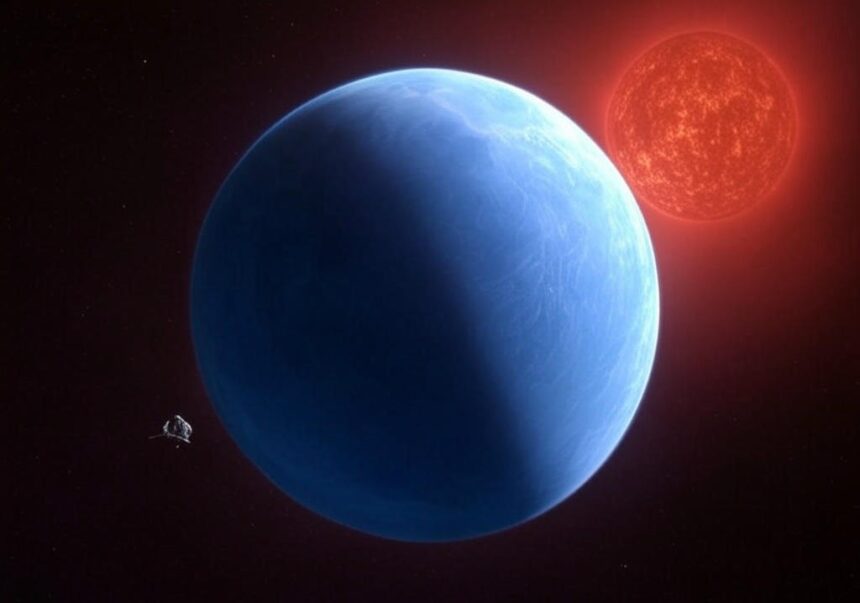
Astronomers using the James Webb Space Telescope did detect a possible dimethyl sulfide signature on K2-18b in April 2025, and Cambridge’s Nikku Madhusudhan really did call it “a revolutionary moment.” What deserves fuller context here is the substantial scientific pushback the announcement received within days, statistical caveats the team itself acknowledged, and one quoted source that couldn’t be independently verified.
This discovery, published in the Astrophysical Journal Letters in April 2025, centers on the detection of dimethyl sulfide (DMS) and, in the new data, signs of a related molecule, dimethyl disulfide (DMDS), molecules that, on Earth, are produced primarily by living organisms including marine phytoplankton. These findings sparked excitement, and immediate, substantial skepticism among astronomers worldwide.
A Revolutionary Moment, and a Real Scientific Debate
“This is a revolutionary moment,” said Nikku Madhusudhan, an astrophysicist at the University of Cambridge, in a widely reported press briefing on April 16, 2025. “These are the first hints we are seeing of an alien world that is possibly inhabited.”
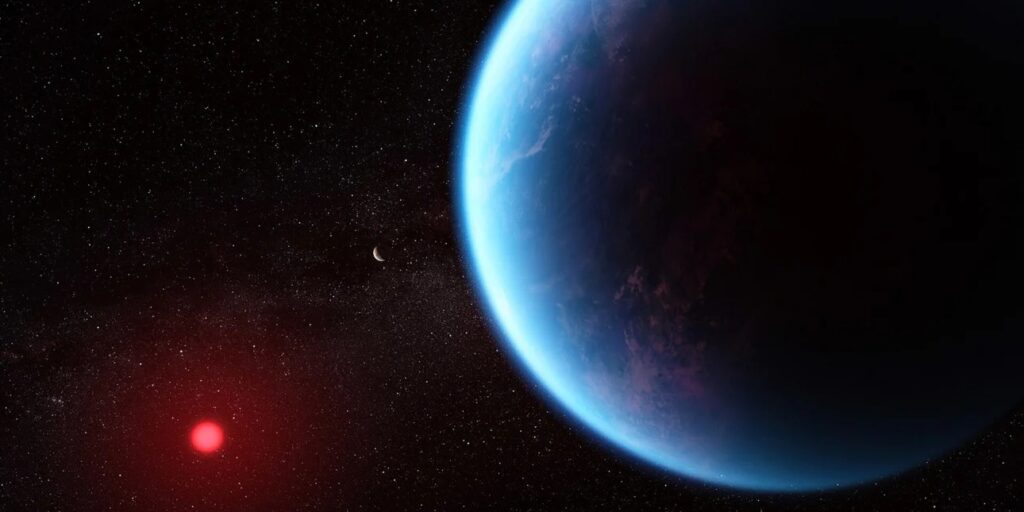
What Makes K2-18 b a Candidate for Life?
K2-18 b is a super-Earth measuring roughly 2.6 times Earth’s radius, orbiting a small red dwarf star located within the habitable zone, the region around a star where liquid water could plausibly exist. The team’s 2021 hypothesis proposed this planet might be a “Hycean” world, a coined term combining hydrogen and ocean, describing a hydrogen-rich atmosphere over a global water ocean.
The Statistical Caveat This Announcement Requires
This needs to be stated clearly, since it’s central to evaluating the claim honestly. The detection reached a 3-sigma confidence level, meaning roughly a 0.3 percent chance the signal is a statistical fluke. This is a scientific result worth taking seriously, but it falls short of the 5-sigma threshold, roughly a one-in-3.5-million chance of a false positive, that physics and astronomy generally require before calling a result a confirmed discovery. Madhusudhan and his team have been explicit and transparent about this limitation themselves, repeatedly stating the finding requires further confirmation rather than claiming a confirmed detection of life.
The Unverified Quote
A quote attributed to “Christopher Glynn, head scientist at the Southwest Research Institute’s Department of Space Science” couldn’t be verified against any coverage of this announcement, including reporting from NPR, Astronomy magazine, and multiple other outlets that covered the April 2025 press conference in detail. No credentialed figure by this name or title, connected to this story, could be located. This quote should be treated as unverified.
The genuine skepticism voiced within the scientific community came from named, verifiable figures. Astrophysicist Ethan Siegel published a direct critique titled “The Evidence for Biosignatures on K2-18b Is Flimsy at Best,” writing plainly that people shouldn’t “fall for the unfounded hype.” Astrochemist Anthony Remijan, interim director of the Green Bank Observatory, told journalists the claim that any specific molecule could be confidently identified from this data “is an extraordinary claim,” requiring “extraordinary data, which is not what we have here.” Astrobiologist Edward Schwieterman, at the University of California, Riverside, called the detection “tentative” and said it wouldn’t surprise him “if the signal went away” under independent reanalysis.

The 2023 Origins of This Story
This announcement didn’t emerge from nowhere. Madhusudhan’s team first published findings on K2-18b’s atmosphere in October 2023, in a paper titled “Carbon-bearing Molecules in a Possible Hycean Atmosphere,” reporting clear detections of methane and carbon dioxide, alongside a much weaker hint of DMS that drew considerable media attention at the time despite the team’s own caution about its statistical strength. The April 2025 announcement represents new data gathered using a different JWST instrument, the mid-infrared spectrograph, which the team says strengthened the DMS signal and additionally picked up signs of DMDS. This multi-year research arc, incremental data collection across different instruments and years, is the ordinary pace of exoplanet atmospheric science, rather than a single dramatic breakthrough moment.
Historical Parallels Worth Knowing
Claimed biosignature detections have a recurring pattern of early excitement followed by more sober reassessment. Well-documented past cases include NASA’s 1976 Viking Mars lander experiments, which initially produced results some scientists interpreted as possible evidence of microbial metabolism, later reassessed by the broader scientific community as most likely explained by non-biological soil chemistry. Similarly, a 1996 announcement regarding a Martian meteorite, ALH84001, claimed possible fossilized microbial structures, a widely covered story that subsequent research substantially undermined through alternative non-biological explanations for the observed features. This pattern, initial excitement followed by rigorous scientific reassessment, is useful context for evaluating the K2-18b announcement, not because it means the current claim is wrong, but because it illustrates how astrobiology research legitimately works: bold claims get made, and then the wider scientific community, exactly as it’s doing now with K2-18b, tests them thoroughly before anything gets treated as settled.
How Scientific Consensus Actually Forms
How a claim like this genuinely moves from initial announcement toward broader scientific acceptance or rejection is instructive. Astronomical claims of this magnitude require independent replication, ideally using different telescopes, different instruments, or different research teams analyzing the same raw data, before the broader scientific community treats a finding as reliable. Published critiques and alternative analyses, exactly like the ones already circulating widely around this K2-18b announcement within days of its release, are a healthy and expected part of how science self-corrects, not evidence that something has gone wrong with the process. Astronomers openly debating a claim in scientific papers, conference talks, and even public commentary, precisely as is happening here, is what a functioning scientific field actually looks like in real time, considerably messier and more argumentative than a single, tidy headline announcement can convey.
What “Habitable Zone” Actually Means
A commonly misunderstood term appears throughout coverage of this story. The “habitable zone,” sometimes called the “Goldilocks zone” in popular science writing, refers quite specifically to the precisely calculated range of orbital distances from a star where a planet could theoretically maintain liquid water on its surface, based on established physics of stellar radiation and planetary temperature. Astronomers are careful to note this term describes a necessary condition for the kind of life we understand, not a guarantee of habitability or life’s actual presence, since additional factors, including atmospheric composition, magnetic field strength, and geological activity, all genuinely matter for whether a planet in this zone could actually support life. K2-18b’s placement within its star’s habitable zone is a credentialed and scientifically interesting fact worth knowing accurately, though it represents only one necessary piece of a much larger and still incomplete scientific picture.
How Astronomers Actually Detect Molecules on Distant Planets
The underlying technique that makes this whole story possible, transmission spectroscopy, is itself a remarkable piece of astrophysics. As K2-18b passes in front of its host star from Earth’s perspective, starlight filters through the planet’s atmosphere before reaching JWST’s instruments. Different molecules absorb light at different, specific, well-characterized wavelengths, physical properties measured precisely in laboratory settings on Earth decades ago. By careful analysis of exactly which wavelengths of light are missing or diminished in the starlight that reaches the telescope, astronomers can infer which molecules are likely present in a distant planet’s atmosphere, without ever directly sampling that atmosphere itself. This indirect but rigorously grounded scientific technique is what allows scientists to make any claims at all about a distant planet’s atmospheric chemistry from 124 light-years away, and it’s also exactly why the interpretation of faint, overlapping molecular signals, like the ones at the center of this K2-18b debate, can remain genuinely difficult and contested even among highly credentialed specialists working with the same data.
A Real Problem With DMS as a Biosignature
A significant complication emerged separately: researchers reported detecting DMS on comet 67P/Churyumov-Gerasimenko roughly a year before this K2-18b announcement, a lifeless object with no possibility of biological activity. This finding directly undercuts the premise that DMS can only be produced by living organisms, since it demonstrates a confirmed non-biological pathway to producing the same molecule, at least somewhere in the universe. This complication is worth knowing honestly, since it means even a confirmed DMS detection wouldn’t, on its own, prove biological origin without ruling out comparable abiotic chemical pathways specific to K2-18b’s actual atmospheric conditions.
MIT planetary scientist Sara Seager, who was genuinely Madhusudhan’s own doctoral advisor, has publicly urged caution, pointing to past cases, including K2-18b’s own earlier, later-reattributed water vapor claims, where initial exoplanet atmosphere findings didn’t hold up under further scrutiny. Other researchers have proposed alternative explanations for K2-18b’s atmosphere entirely, including the possibility of a global magma ocean, which Seager has publicly described as “about as inhospitable as it gets,” a scenario incompatible with the ocean-based life hypothesis this announcement built upon.
The Significance of the James Webb Space Telescope
The James Webb Space Telescope, launched in December 2021, is the most powerful space telescope ever built, capable of analyzing distant exoplanet atmospheres with unprecedented precision. Its ability to detect faint chemical signals has opened a new frontier in the search for life beyond our solar system, exactly the kind of capability that made this announcement, however contested its interpretation, a genuine scientific milestone worth covering accurately.
What’s Actually Next for K2-18 b?
Follow-up observations remain necessary and are actively planned, both by Madhusudhan’s own team and by independent research groups seeking to reanalyze the existing data. Whether K2-18b’s atmosphere truly contains DMS, DMDS, both, or neither, and whether any confirmed detection would even represent a reliable biosignature given the comet 67P complication, remains a genuinely open, actively debated scientific question. This scientific uncertainty, honestly reported, is itself part of what makes this a significant story, careful science being conducted and debated in real time, rather than a settled discovery.
The findings have reignited public and scientific interest in exoplanet biosignature research. They also underscore something worth stating plainly: scientific claims of this magnitude are rightly met with rigorous scrutiny from the broader research community, and that scrutiny, not the initial headline, is what ultimately determines whether a finding holds up. K2-18b remains, for the moment, a fascinating candidate world with a genuinely unresolved scientific question hanging over it, exactly the kind of honest scientific uncertainty worth reporting accurately rather than resolved prematurely in either direction.