




Ezekiel was a priest deported to Babylon in 597 BCE during the first Babylonian exile. In the fifth year of his exile, beside the river Chebar in Babylon, he saw something that he spent the rest of his documented prophetic career attempting to describe accurately.
The vision is in the first chapter of the Book of Ezekiel and it is the most detailed description of non-human entities in the Hebrew biblical canon. Ezekiel was not writing mythology or theological allegory. He was a trained priest applying the most precise descriptive vocabulary available to him to describe something he had actually seen, and his precision is evident in the way he hedges his language when his vocabulary fails: he does not say the beings were wheels. He says the appearance of the wheels was like chrysolite. He does not say the fire was fire. He says the fire had the appearance of flashing lightning. He is describing something that exceeded his available categories and he is being careful about it.
Four beings. Each with four faces: a human face at the front, a lion’s face at the right, an ox’s face at the left, an eagle’s face at the back. Four wings each. Straight legs with calf’s feet that gleamed like burnished bronze. Human hands beneath the wings. They moved without turning, in whatever direction the spirit wanted to go they went, and they moved as one. Beside each being was a wheel whose appearance was like a wheel intersecting a wheel, with rims covered with eyes all around.
Above the beings was an expanse, described as awesome ice, and above the expanse was the likeness of a throne, and above the throne was a figure with the appearance of a man, surrounded by something like fire from the waist up and from the waist down, and the whole surrounded by a radiance like a rainbow. Ezekiel fell face down. Then he heard a voice.
This vision, occurring in the sixth century BCE in Babylonian exile, is the foundational document of Jewish mysticism’s Merkabah movement, the chariot, and is one of the primary sources from which the angelic hierarchy recorded across Christian, Jewish, and Islamic belief was subsequently developed.
The Systematizer
The hierarchical organization of angelic ranks that the source presents, nine orders in three triads from Seraphim at the apex to Angels at the base, was formalized by a writer who identified himself as Dionysius the Areopagite, the Athenian convert mentioned in Acts 17:34 as one of Paul’s hearers at the Areopagus. Modern scholarship has established that the texts bearing this name were composed significantly later, probably in the late fifth or early sixth century CE, making their author Pseudo-Dionysius.
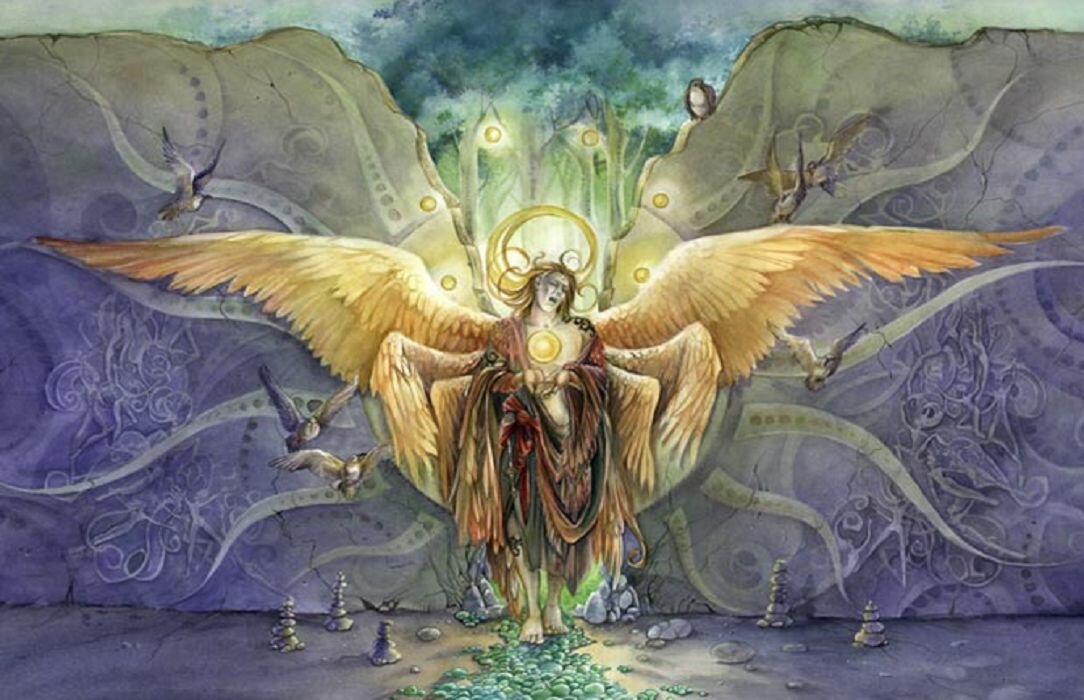
Pseudo-Dionysius wrote two major texts on the subject: The Celestial Hierarchy and The Ecclesiastical Hierarchy, both preserved and extensively cited across medieval Christian theology. His Celestial Hierarchy is the foundational document for the nine-rank system the source describes.
The intellectual framework Pseudo-Dionysius was working within was not primarily biblical. It was Neoplatonic. His sources include the philosopher Proclus, who died in 485 CE and whose system of emanating divine intelligences organized in hierarchical triads provided the organizational template that Pseudo-Dionysius applied to the biblical angelology. The three triads of three ranks each, organized from most proximate to the divine to most proximate to the material world, reflects Proclus’s triadological structure almost exactly.
Whether this is a problem or a feature depends on how you read the intellectual history. Pseudo-Dionysius was doing what the Gnostic Transmission piece in this library documents as characteristic of the Alexandrian-Neoplatonic synthesis: integrating the esoteric knowledge of ancient philosophy with the vocabulary and narrative framework of Christian belief. The result was a hierarchical taxonomy of non-human intelligences that drew simultaneously on biblical revelation, Jewish mysticism, and Greek metaphysical analysis.
The identifications he made between biblical entities and Neoplatonic intelligences are not arbitrary. They are the product of serious comparative analysis across multiple textual sources and they preserve ancient material even where the systematization imposes a later organizational structure on older content.
The Seraphim in Isaiah
The Seraphim appear in the Hebrew Bible in Isaiah 6, where Isaiah sees a vision of the divine throne room that is in some ways more viscerally direct than Ezekiel’s chariot vision.
Isaiah sees the Lord sitting on a high throne, with the train of his robe filling the temple. Above the throne stand Seraphim. Each has six wings: two covering the face, two covering the feet, two used for flying. They call to each other, saying Holy, holy, holy is the Lord of hosts, the whole earth is full of his glory, and the doorposts shake from their voices and the house fills with smoke.
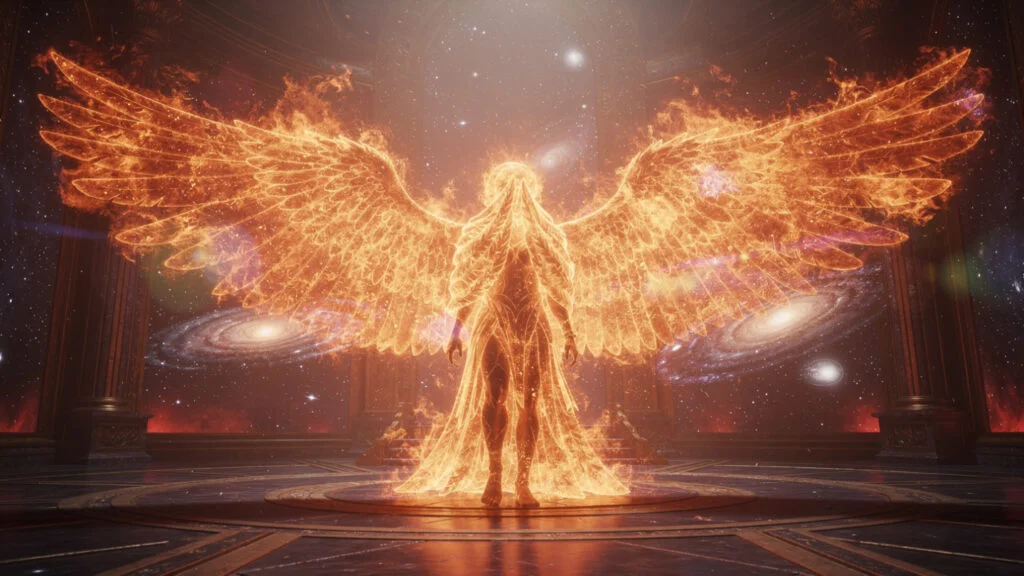
Isaiah’s immediate response is the most theologically honest in the prophetic literature: Woe is me, for I am ruined. He does not say he has seen God and been blessed. He says he has seen something in whose presence his own inadequacy becomes immediately and overwhelmingly apparent.
One of the Seraphim takes a live coal from the altar with tongs and touches it to Isaiah’s lips, saying that his iniquity is taken away and his sin atoned for. Then Isaiah hears the voice asking who shall go, and he responds.
The characteristics of the Seraphim that Isaiah records are different from what subsequent theology has made of them. The name Seraph in Hebrew means burning one or fiery serpent, and the same root appears in the bronze serpent Moses makes in Numbers 21, and in the fiery serpents of Numbers 21:6 that attack the Israelites. The linguistic connection between the Seraphim of the divine throne room and the serpent material recorded in the Naga and Inner Earth pieces of this library is preserved in the Hebrew etymology even when it is lost in the subsequent angelology that makes the Seraphim into beautiful human-appearing beings with multiple wings.
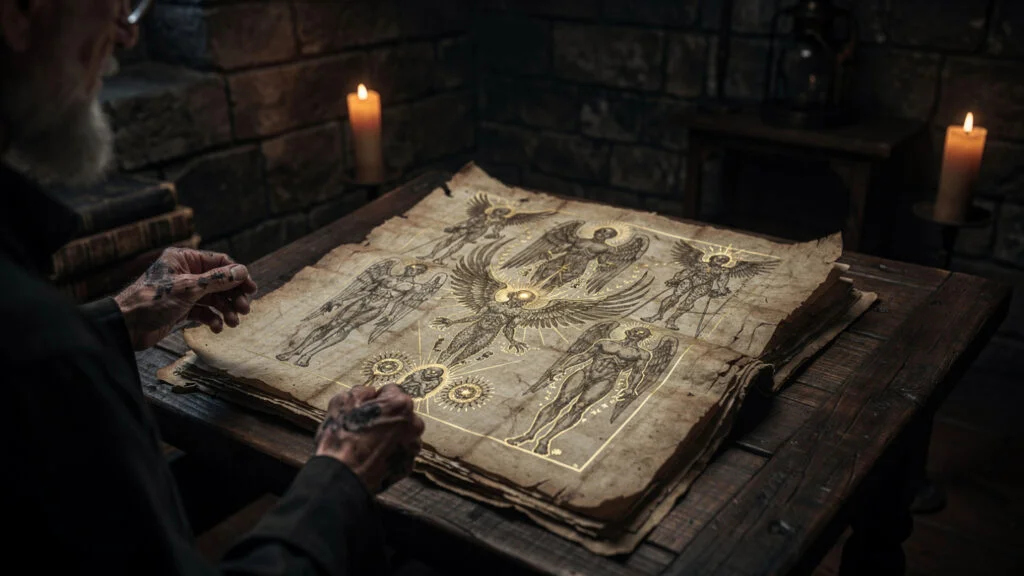
The six-winged Seraphim, two wings covering the face in what appears to be a protective response to the direct vision of the divine, two wings covering the feet in what appears to be a gesture of humility or concealment, and two wings for movement, are beings whose physical description suggests functional reasons for each of the three wing pairs rather than a decorative multiplication of the standard angel iconography.
Ezekiel’s Chariot and the Living Beings
The four living beings of Ezekiel’s chariot vision, the Chayot in Hebrew, are not immediately categorized as angels in the original text. Ezekiel describes them as living beings and their characteristics, the four faces, the four wings, the wheel-within-wheel structure that accompanies them, and their movement as a single integrated system guided by a single spirit, are more reminiscent of Merkabah mysticism’s descriptions of the divine chariot vehicle than of the winged human-appearing beings of popular angel iconography.

The connection between Ezekiel’s Chayot and the Cherubim of the Ark of the Covenant is explicit in Ezekiel 10, where Ezekiel identifies the living beings he saw in chapter 1 with the Cherubim. This identification is theologically significant: the Cherubim that stood over the Ark of the Covenant in the Holy of Holies, whose wings overshadowed the mercy seat from which God spoke to Moses, are the same beings that Ezekiel saw in the wheel-within-wheel chariot structure beside the river Chebar.
The Ark piece in this library develops the physical properties of the Ark, its capacitor architecture, the electromagnetic effects attributed to it, and the communication function it served as the medium through which the divine voice spoke. The Cherubim whose wings formed the space above the mercy seat were the beings whose presence was associated with this communication. Whether their role as the antenna structure for the Ark’s transmitter function is physical or theological or both is the question that the convergence of the Ark’s documented electromagnetic properties and the Cherubim’s position above the mercy seat raises.
The Watchers
The Book of Enoch, a Jewish text composed in stages between the third century BCE and the first century CE and preserved primarily in an Ethiopic translation, describes a class of angelic beings called the Watchers, Ir in Aramaic, whose role is specifically that of the observing angels whose long period of watching humanity eventually produced the transgression documented in Genesis 6.
The Watchers are described in the Book of Enoch as a subset of the angelic hierarchy whose function was observation and whose failure was the decision of two hundred of their number to descend to Earth, take human women as partners, and transmit knowledge to humanity that they had not been authorized to transmit.
The Watchers piece in this library develops the content of what was transmitted, including metallurgy, the cutting of roots for medicine, astronomy, astrology, the making of weapons, and practices whose effects on the human population are described as corrupting.
The Watchers in the Book of Enoch are angels of a rank, described as the sons of God of Genesis 6:2 and as beings who stood before God to transmit his commands to humanity. Their transgression produces the Nephilim, the hybrid offspring of their unions with human women, and their punishment produces the flood and the subsequent restructuring of the divine-human relationship.

Whether the Watchers of the Book of Enoch are the same beings as the Ir or Princes described in Daniel, the protecting angels of nations, or the Authorities of the Christian hierarchy whose function includes protecting peoples and nations, is a question that the convergence of terminology and function across these belief systems suggests deserves examination rather than being treated as mere terminological coincidence.
The Watchers were watching from above. When they stopped watching and came down, everything changed.
The Neoplatonic Structure and Its Ancient Sources
Pseudo-Dionysius’s hierarchical organization drew on Proclus’s triadic structure, but Proclus himself was drawing on a line of thought that extended back through Plotinus, Porphyry, and Iamblichus to Platonic engagement with the divine intermediary beings documented in Plato’s Symposium and Timaeus.
The Platonic framework describes the cosmos as organized through a series of intermediate beings between the ultimate divine principle and the material world. These intermediaries are necessary because the absolute divine cannot directly contact the material without the contact destroying what it touches. The intermediaries step down the divine energy and order through successive levels, each level more material than the one above it, until the material world is reached.
Whether this is theology or physics depends on the framework you bring to it. The Gnostic Transmission piece in this library documents the way that Neoplatonic philosophy was transmitting genuine ancient knowledge about the structure of reality in philosophical vocabulary. The angelic hierarchy, in this reading, is not primarily about supernatural beings in a religious sense. It is a map of the organizational levels through which consciousness operates between its most unified state, the Seraphim’s immediate proximity to the divine unity, and its most differentiated state, the individual human consciousness that the Angels are closest to.
Whether this map is accurate depends on whether non-dual consciousness practices, the Aghori’s direct encounter with the dissolution of the self-other boundary, the near-death experiencer’s reported recognition that individual consciousness is a configuration of a larger consciousness, and the remote viewer’s access to information outside the range of individual sensory experience, are describing real features of consciousness architecture or expressing culturally conditioned responses to altered states.
The hierarchy provides a vocabulary for the levels between the individual consciousness and the universal consciousness. Whether those levels are populated by beings with functions and names, as angelology maintains, or whether they are organizational principles of consciousness personified for pedagogical and devotional purposes, is a question these belief systems themselves do not uniformly agree on.
The Cross-Cultural Taxonomy
The nine-rank hierarchy as Pseudo-Dionysius systematized it is specifically Christian in its theological expression, but the underlying structure appears across independent belief systems in ways that suggest the hierarchy is describing something real about the organization of non-human intelligence rather than simply encoding a theological position.

Jewish Kabbalistic belief’s ten Sefirot, the emanations of the divine through which the Ein Sof, the infinite divine, creates and sustains the cosmos, maps onto the Pseudo-Dionysian hierarchy with a precision that independent development from completely different sources would not be expected to produce. The Sefirot from Kether at the apex to Malkuth at the base describe the same progression from unity to differentiation, from pure divine consciousness to material manifestation, that the Pseudo-Dionysian hierarchy describes from Seraphim to Angels.
Islamic belief’s Mala’ika, angels, includes the four archangels of the divine throne, Jibril who transmits revelation, Mikail who governs rain and sustenance, Israfil who will blow the trumpet at the end of time, and Azrael the angel of death, whose functions parallel the Christian archangels with enough similarity to suggest common ancient sources and enough difference to establish independent development.
Vedic belief’s Deva hierarchy, from the highest divine beings to the Gandharvas and Apsaras who occupy positions closer to the human world, provides a non-Abrahamic parallel that the cross-cultural consistency argument treats as significant.
Whether these independent belief systems are describing the same organizational structure of non-human intelligence from different cultural perspectives, or whether the structural similarity reflects the universal human tendency to organize the supernatural in hierarchical terms borrowed from earthly political structures, is the interpretive question that the functional consistency across them, angels transmitting messages, archangels commanding armies of light, beings of fire at the divine apex, makes more interesting than a simple structural convergence would suggest.
What the Hierarchy Describes
The angelic hierarchy, read through the framework this library has built, is one of the most extensively cross-referenced taxonomies of non-human intelligence in the available record.
At its apex: beings of fire whose proximity to the divine source produces a beauty and power that Isaiah responded to with immediate terror. Beings whose six-wing structure reflects functional requirements for operating in the direct presence of the divine unity. The Seraphim in Isaiah’s temple are not decorative. They are functional. Their presence at the apex of the hierarchy connects to what is recorded in the Gnostic Transmission piece about the innermost divine fire, whose contact with ordinary consciousness produces the transformation every mystical practice’s most advanced practitioners seek.
At its middle: beings responsible for the physical operations of the cosmos. Forces that can change the laws of physics. Dominions that manage the functioning of the universe through free will. Powers that work miracles. Whether these ranks describe what the contact literature’s most advanced non-human intelligences do when they interact with physical reality, the electromagnetic manipulation recorded in the Nimitz and Tehran pieces, the gravitational effects recorded in the Lazar and Pais pieces, and the consciousness effects recorded in the NDE and Stargate pieces, is a question that the functional descriptions of the middle hierarchy raise without settling.
At its base: beings whose role is the management of human affairs. Guardian angels assigned to individuals. Archangels commanding in the cosmic conflict between organizing and destructive principles. Princes of nations managing the collective destiny of peoples.
The Watchers watched from this level before they descended. Their descent produced what the Book of Enoch, the Nephilim and Watchers pieces in this library, and the Sumerian creation narrative all describe from different evidentiary directions: the direct intervention of non-human intelligence in human biological and civilizational development.
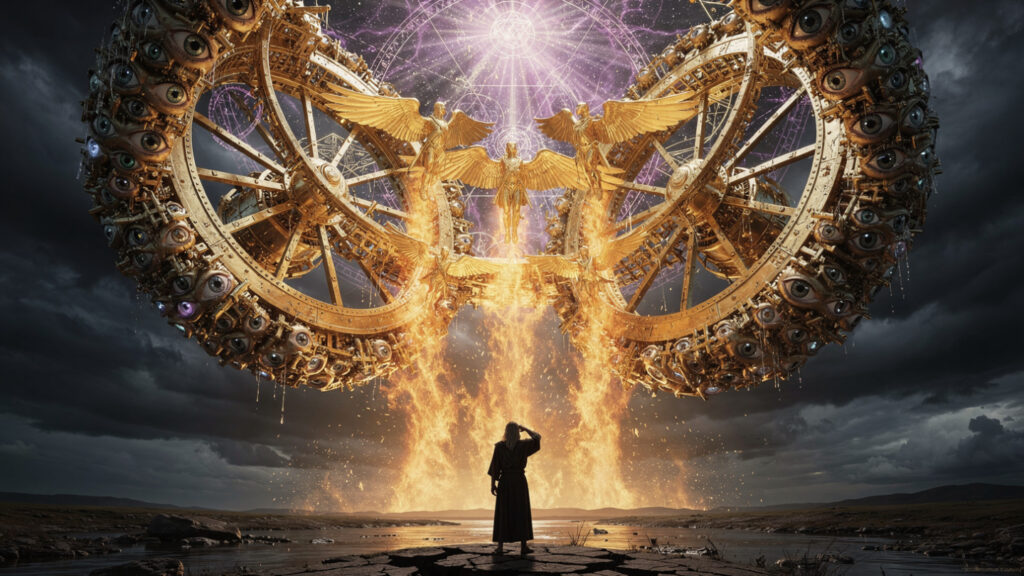
The hierarchy maps the organizational structure of what intervenes. It does not explain why. Ezekiel fell on his face when he saw the chariot. Isaiah said woe to him. Both responses were preserved as equally appropriate.
The beings described in the hierarchy are specific. Their functions are specific. Their positions in the organizational structure connecting the divine unity to the material world are specific.
Whether they are theological constructs or actual entities is the question that the cross-cultural convergence and the contact literature’s consistent phenomenology make more difficult to dismiss than the secular framework has been comfortable acknowledging.