




In 1767, a Russian military commander sent a secret report to the highest governing body of the Russian Orthodox Church describing something that sounded impossible: shepherds in the Chegem mountains had opened a stone chamber containing treasure, a book, an old man and a young woman. When they tried to steal a ring from the girl’s hand, a voice warned them to stop. They ignored it. Then people began dying. Within roughly two months, according to the report, about twenty people were dead. The Russian authorities did not simply dismiss the story. They sent an investigator. They ordered the site inspected. They asked for a Georgian monk to be dispatched to the region. And then, somewhere between the mountains of Kabarda and the archives of imperial Russia, the investigation disappears.
This is not a modern internet legend pretending to be an eighteenth-century document. A report numbered 26, dated April 3, 1767, really was sent by Nikolai Potapov, the Kizlyar commandant, to the Most Holy Governing Synod in St. Petersburg. The surviving archival tradition preserves its essential story, including the testimony attributed to local informants, the deaths, the investigation ordered by Potapov and the request for the Georgian abbot Gregory. The document was marked “secret,” and later scholars identified it in the archival materials concerning Russian relations with the Caucasus. What the document does not do is prove that the dead were supernatural, that the voice came from the crypt, or even that every detail of the villagers’ account was true. What it gives us is something rarer: a contemporary government record showing that somebody in 1767 considered the story important enough to investigate.
The distinction changes everything. We are not looking at proof of a haunted tomb. We are looking at a nineteenth- or twentieth-century retelling of an eighteenth-century report, or, more precisely, at the report itself, and asking what can actually be extracted from it before the legend begins filling in the blanks.

April 3, 1767
Nikolai Potapov was not a folklorist wandering through the Caucasus collecting ghost stories. He was the Russian commandant at Kizlyar, a military official operating on one of the empire’s most complicated frontiers. His report went to the Most Holy Governing Synod, the institution that had governed the Russian Orthodox Church since Peter the Great abolished the patriarchate and created the Synod in 1721. By the eighteenth century, this was not an independent church authority in the modern sense: the Synod existed within the imperial administrative structure and was supervised by the state. A strange report from the Caucasus could therefore become simultaneously a religious question, an administrative problem and a matter of frontier intelligence.
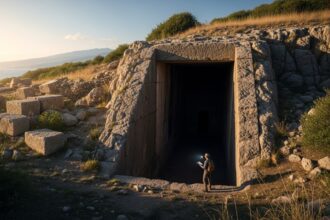
The report describes an incident in the Chegem Gorge, in what is now Kabardino-Balkaria. A shepherd supposedly fell into or discovered an underground opening while grazing sheep in the mountains. Inside was a constructed stone chamber. And inside that chamber, according to the first version of the story, were two astonishing figures.
An old man sat with a book before him.
A young woman sat nearby.
In front of her was a vessel containing gold and silver objects. She wore a gold ring.
The shepherd returned with companions. They entered the chamber and began removing the treasure. When they tried to take the girl’s ring, something happened that transformed an act of grave robbery into the story preserved in Potapov’s report.
A voice warned them not to take it.
They took it anyway.
The treasure was carried back to the settlement. Then, according to the report, a voice began to be heard in the village at night, demanding that what had been taken be returned. The villagers eventually brought the objects back to the underground chamber. But by then the story had acquired its final and most terrifying element.
On the fourth night, Potapov’s report says, the shepherds and members of their families died.
Other villagers began dying afterward.
Potapov ordered an investigation.
Captain Kireev Went Looking for the Cause
The second layer of the story comes from the investigation conducted by Captain, or, in the Russian record, rotmistr, Kireev. Potapov sent him to the area with a special commission to find out why an “unusual death” had struck the Chegem population.
Kireev did not claim that he personally witnessed the original discovery. Instead, his report recorded what two local informants told him: the landowner Kasai Atazukin and a Chegem resident named Barak Beshtov. That distinction is essential. The archival document is primary evidence for the fact that Russian officials recorded and investigated the story. It is not primary evidence that the supernatural events occurred exactly as described.
The account Kireev received was nevertheless extraordinarily specific. Shepherds had supposedly found a stone chamber underground. Inside were treasure, several gold and silver crosses and two bodies: a male figure dressed in monastic clothing and a female body apparently belonging to a young woman. The treasure was taken. When the thieves attempted to remove a ring from the girl’s hand, they heard an extraordinary voice forbidding them to continue.
Then came the deaths.
Kireev’s informants said that people began dying one after another, including wives and children, until approximately twenty people had died over about two months. The remaining villagers became frightened, returned the objects to the chamber and performed religious observances. The deaths then stopped, according to the testimony.
That last detail is exactly the kind of coincidence from which legends grow. But it is also exactly the kind of coincidence that an investigator in 1767 could have interpreted through the categories available to him. A disease outbreak, a contaminated environment, exposure to something inside an enclosed chamber, coincidence, or a genuinely unexplained cluster of deaths could all have produced the same sequence of events. The report does not contain the medical evidence needed to distinguish among them.
The Most Important Detail May Be the One Nobody Notices
The two versions of the story do not fit perfectly together.
In the initial description, the shepherd apparently encountered an old man and a girl who were still sitting there. The old man had a book. The girl was alive enough to speak when the thieves reached for her ring.
But when Kireev’s inquiry is reported later, the occupants have become two incorrupt bodies: a man in monastic clothing and a female body, apparently that of a girl.
That is not a minor translation issue. It is the hinge of the entire mystery.
Were the first witnesses describing bodies that merely looked alive because they had been unusually well preserved? Did the original report use language that later retellings made more dramatic? Did the story combine two different accounts? Did a living voice come from somewhere else in the chamber? Or did the entire narrative acquire supernatural details as it passed from eyewitnesses to local informants to military officials?
The surviving record does not tell us.
Why the Word “Incorrupt” Matters
The word “incorrupt” has acquired enormous supernatural weight in later retellings, but eighteenth-century readers would have understood it within a specific Christian vocabulary. In Orthodox tradition, incorruptibility refers to the unusual preservation of a body after death. Such preservation could be associated with saints and relics, but incorruptibility by itself was not a sufficient condition for establishing sainthood. Natural preservation and intentional preservation were also distinguishable from what believers regarded as miraculous incorruption.
So the appearance of the word in Kireev’s account does not mean that the Russian Church declared the bodies miraculous. It means that the bodies were reported as unusually preserved and described using a word with an established religious meaning.
That is actually more interesting.
The officials were not merely being told that someone had discovered two old corpses. They were being told that there were apparently preserved human remains associated with a strange underground structure, Christian objects and an unexplained outbreak of deaths. In the Russian imperial frontier of 1767, that was enough to justify looking into the matter.
The Synod Did Not Declare a Miracle
This is another place where the modern version of the story tends to outrun the archive.
The Holy Synod received the report. It was circulated through the imperial bureaucracy. A decree followed in May concerning the requested assistance, and the Georgian Abbot Gregory was involved in the proposed investigation. The surviving administrative trail therefore demonstrates official interest.
It does not demonstrate that the Synod authenticated the bodies.
It does not demonstrate that the voice was supernatural.
And it does not demonstrate that the deaths were caused by removing the ring.
The institutional context makes the document more significant, not less. Peter the Great’s 1721 church reforms had made the Holy Synod the governing institution of the Russian Church while placing it firmly within the imperial state structure. A strange event in the Caucasus was therefore entering a bureaucratic system accustomed to investigating matters that crossed religious, political and administrative boundaries.
The Investigator Was Not Sent Empty-Handed
Potapov’s response was remarkably practical. He ordered Colonel Kopitowski and Peter Davidov, a clerk associated with the Ossetian mission who had experience in the region, to inspect the location. The instruction was effectively to go there, find the place, investigate what had been reported and disturb nothing.
Potapov also requested the presence of Abbot Gregory, a Georgian cleric associated with the Ossetian spiritual commission. The request is important because Gregory was not simply being summoned as an exorcist in some later paranormal retelling. He was already a functioning part of the imperial missionary apparatus. His involvement placed the investigation inside the machinery Russia was already using to manage religion and missionary work in the North Caucasus.
That is why the Chegem story cannot be separated from the political geography of the eighteenth-century Caucasus. Russia was expanding and consolidating its influence in the region. Missionary activity was underway. Local elites and communities were negotiating their relationship with the empire. Reports from the mountains were not arriving in an empty wilderness; they were entering a frontier bureaucracy that had very practical reasons for knowing what was happening there.
Then the Paper Trail Stops
This is where the story becomes genuinely frustrating.
The request was made. Investigators were assigned. A missionary was sought. The site was supposed to be examined.
But the surviving documentary trail does not provide us with a definitive follow-up report describing what Kopitowski or Davidov actually found.
That absence has generated decades of speculation. Perhaps the chamber was found and the story quietly suppressed. Perhaps the bodies were removed. Perhaps the treasure disappeared into private hands. Perhaps the investigators discovered an ordinary medieval burial chamber and the extraordinary elements were abandoned. Perhaps the investigation simply failed to produce anything worth preserving in the central bureaucracy.
There is no evidence strong enough to choose among those explanations.
And that is precisely where an honest mystery should stop.
But the Mountains Really Are Full of Crypts
The disappearance of the investigation does not mean the landscape itself is imaginary. Far from it.
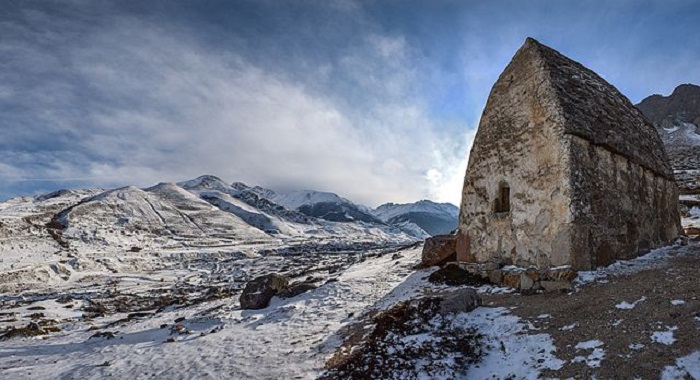
Near the Balkar village of Eltyubyu, also known as Upper Chegem, stands the real Fardyk-Keshene necropolis, often translated as the “City of the Dead.” It contains a group of stone funerary structures dating across several centuries. Archaeological descriptions distinguish different architectural forms, including older rectangular structures with gabled roofs and later polygonal mausoleums. The site belongs to the genuine funerary and architectural history of the Upper Chegem region, independent of the 1767 story.
That distinction is critical because modern retellings sometimes perform a kind of geographic sleight of hand. A documented eighteenth-century report mentions a crypt somewhere in the Chegem region. A real medieval necropolis survives in Upper Chegem. The two facts are then quietly fused until the surviving crypts are presented as though archaeology has identified them as the chamber described by Potapov.
It has not.
There is no demonstrated chain connecting one surviving Fardyk-Keshene structure to Potapov’s 1767 chamber. The crypts prove that sophisticated funerary architecture existed in the region. They do not prove that one of them contained the particular man, girl, treasure and book described in the report.
And yet the real archaeology makes the story more plausible in one limited sense: eighteenth-century shepherds in the Chegem mountains genuinely could encounter old stone burial structures whose contents and history were poorly understood. The landscape was not invented to create the legend. The tombs are real.
The Dead of Eltyubyu Have Names
Modern scholarship has begun replacing some of the romantic fog around the necropolis with something much more concrete. A 2025 study by Muslim Barazbiev and Aslan Bogatyrev examined Arabic inscriptions on tombstones in the Upper Chegem cemetery and used them to reconstruct biographical information about members of Balkar aristocratic families. The inscriptions connect the cemetery to identifiable families and to the historical Chegem society rather than to an anonymous civilization of mysterious giants or supernatural guardians.
That matters because the actual cemetery is not less mysterious when people are given names. It is more historical.
The stones belonged to people who lived, married, governed, died and were remembered. Their descendants and communities remained part of the same mountain world in which the 1767 report was produced. The crypts were not monuments from nowhere. They were part of a living landscape of aristocratic burial, local power and religious change.
Christian Tombs, Muslim Tombs and a Mountain History That Was Never Simple
The architecture of Fardyk-Keshene reflects the complicated religious history of the region. Earlier mausoleum forms are associated with the Christian period of the medieval North Caucasus, while later structures reflect the Muslim Balkar world. Some interpretations also point to older architectural traditions and possible cultural influences that cannot simply be reduced to one religion or one ethnic identity.
That layered history provides a mundane explanation for one feature of the 1767 account that later generations found extraordinary: the presence of Christian objects in an old mountain crypt. Gold and silver crosses in a Caucasian burial structure are not, by themselves, evidence of an impossible civilization. The North Caucasus was connected to Christian traditions long before the eighteenth century, and its funerary landscape preserved traces of those earlier periods.
The mystery is therefore not why an old Christian burial could exist in Chegem.
The mystery is what happened inside the particular chamber described in 1767.
What About the Twenty Deaths?
This may be the most important part of the story because it offers the possibility of a completely non-supernatural explanation. The report describes an apparent outbreak of illness that killed numerous people over approximately two months. In the language of the period it becomes an “infection” or “contagion.” There is no surviving clinical description that would allow a modern physician to diagnose it confidently.
The timing is suggestive but not decisive. People entered an enclosed underground chamber, removed objects, returned to their settlement and subsequently died. But that sequence does not establish causation. The deaths could have been caused by an infectious disease already circulating in the community. They could have resulted from environmental exposure. They could have been unrelated to the crypt entirely. The connection between the treasure and the deaths may have been imposed afterward because the sequence appeared meaningful.
There is an even more revealing detail: the deaths reportedly stopped after the villagers returned the objects and performed religious rites. That is exactly the kind of event that can reinforce a causal belief without actually proving one. If the disease had already begun declining naturally, returning the treasure would still have appeared to “work.”
But we should not swing too far in the other direction either. The lack of a modern diagnosis does not prove that the villagers imagined the outbreak. The deaths were serious enough to reach the attention of the Russian commandant, and Kireev was sent to investigate them. The historical fact is the outbreak and the official inquiry. The cause remains unknown.
The Giant Skeletons and the “Chronal Zone”
Later stories have added further layers to Chegem: enormous skeletons supposedly discovered near the crypts, claims of bodies more than two meters tall and even reports that researchers found a strange “chronal zone” in which clocks behaved differently.
These claims should not be allowed to contaminate the much stronger historical case. They belong to modern folklore and sensational reporting, not to the 1767 archival evidence. No credible archaeological record has established a population of giant humans at Fardyk-Keshene, and a newspaper story about anomalous clocks is not equivalent to a reproducible physical experiment.
The temptation to add such claims is understandable. Once a place becomes associated with mysterious tombs, every unexplained detail begins looking like another piece of the same puzzle. But that is precisely how a genuine historical mystery becomes impossible to investigate.
The more spectacular the claim, the more exact the evidence needs to be.
So Who Were the Man and the Girl?
This is the question the archive refuses to answer.
If the report is substantially accurate, there was a chamber containing unusually preserved human remains and objects associated with an older Christian tradition. If the first account is literal, the occupants appeared alive to the shepherds. If Kireev’s account is the more reliable description, the figures were already dead and preserved. If the voice was real, the report does not identify its source. If it was not real, the document still records that people believed they heard it. If the deaths came from disease, the archive does not tell us which disease. If they were unrelated to the chamber, the coincidence was extraordinary enough to become the central explanation of the outbreak.
And if the chamber was later located by the investigators, the surviving record we have does not tell us what they found.
That is the point at which almost every modern retelling takes one of two wrong turns. The believer says: therefore the bodies were supernatural. The skeptic says: therefore the entire story was invented.
Neither conclusion follows from the evidence.
What the 1767 Report Actually Proves
It proves that Potapov sent a report to the Holy Synod on April 3, 1767.
It proves that the Russian authorities recorded a report of a strange chamber, treasure and unusual deaths in the Chegem region.
It preserves a second account obtained by Kireev from named local informants.
It records that an investigation was ordered.
It records a request for Abbot Gregory’s assistance.
It shows that the story was important enough to move through the imperial administrative and ecclesiastical apparatus.
It does not prove that the bodies were saints.
It does not prove that the voice came from the dead.
It does not prove that the treasure was cursed.
It does not establish that the surviving crypts at Eltyubyu are the crypt described by Potapov.
And it does not tell us what happened after the investigators were sent.
Four Facts Survive. The Investigators Don’t.
That last absence is what makes the Chegem story endure.
We have the commander’s report.
We have the testimony reported by the investigator.
We have the names of local informants.
We have the request for an inspection.
We have the request for a missionary.
And then we have silence.
The surviving Fardyk-Keshene crypts cannot fill that silence. Archaeology can tell us that medieval and early-modern communities built substantial funerary structures in Upper Chegem. Epigraphy can identify the people buried there. Architecture can reconstruct the changing religious and social history of the region. None of it can tell us whether one particular chamber in 1767 contained the objects described in Potapov’s report.
That is not a failure of archaeology.
It is the boundary of the evidence.
And boundaries are where the most interesting mysteries begin.
Somewhere in the Chegem mountains in 1767, people really did tell Russian officials that they had found an extraordinary burial chamber. People really did die. A military investigator really was sent to ask why. A report really did travel from the Caucasus to St. Petersburg. The imperial government really did ask for further investigation. And centuries later, the mountains still contain the stone crypts that remind us just how much history can disappear without leaving an answer.
Perhaps the voice was nothing more than fear inside a dark chamber.
Perhaps the deaths were disease.
Perhaps the first witnesses misunderstood what they saw.
Perhaps somewhere beneath the layers of retelling there really was an extraordinary discovery that the surviving bureaucracy simply failed to preserve.
We cannot choose between those possibilities from the surviving record.
But we can say one thing with unusual confidence.
The strangest part of the Chegem story is not that someone claimed to find a tomb containing the dead.
It is that, in 1767, the Russian Empire believed the claim was serious enough to send people looking for it, and the final report never came back to us.
The crypts remain.
The dead have names.
The report survives.
The investigators disappear from the story.
And somewhere between those four facts is the part of Chegem we still cannot explain.