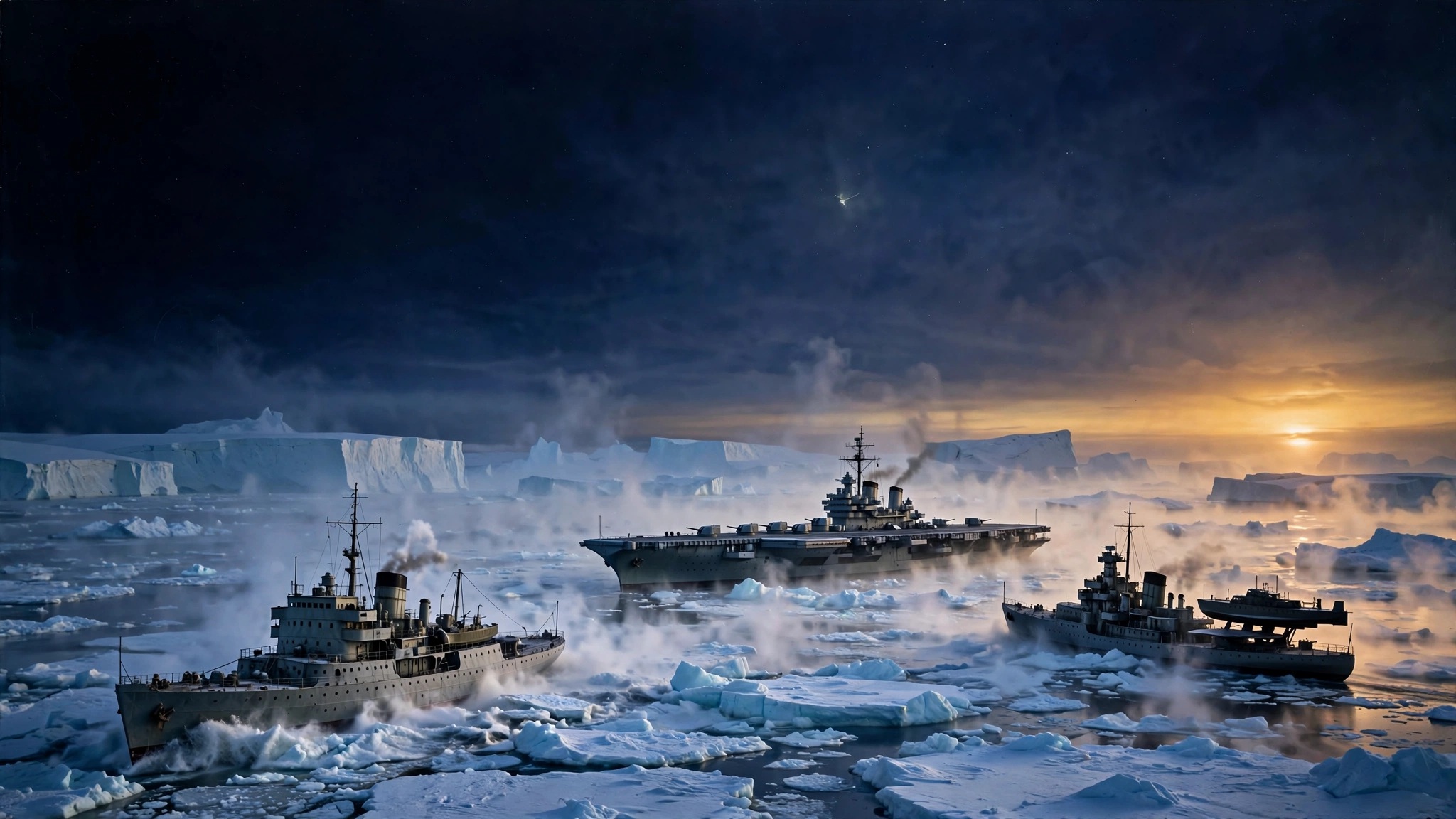
In December 1946 the largest expedition ever sent to Antarctica sailed south from Norfolk, Virginia. Operation Highjump carried 4,700 men, thirteen ships and thirty-three aircraft, and at its head stood Rear Admiral Richard E. Byrd, the most famous polar explorer alive. By early March 1947 the fleet was heading home, and almost every detail of what happened in between has since been rewritten.
In the version told online, Byrd went south to destroy a hidden Nazi base, met flying discs that outran his aircraft, lost ships and men, and fled after a few weeks instead of the eight months planned. Later he spoke of a land beyond the pole and kept a secret diary of a warm world inside the Earth. Decades on, a Canadian polar explorer named Graham Lewis is said to have revealed in a 2013 interview that a classified joint American and Canadian mission of 1976 met grey-skinned beings beneath the ice, the true hosts of Antarctica.
- The Largest Expedition Antarctica Has Ever Seen
- Sixty-Eight Days and Eight Months
- What Byrd Told El Mercurio
- The Diary Byrd Never Kept
- Swastikas on the Ice
- Lights Over the Ice
- The Explorer Who Left No Trace
- The Shape Under Wilkes Land
- Enoch’s Seven Mountains
- A Continent Set Aside
- Operation Highjump and the Ice That Still Waits
- The Verdict | Debunked
- Quick Answers About Operation Highjump
The Operation Highjump legend has a backbone of fact and a body of invention. This file follows the fleet into the ice, and then follows every story that came back out.
The Largest Expedition Antarctica Has Ever Seen
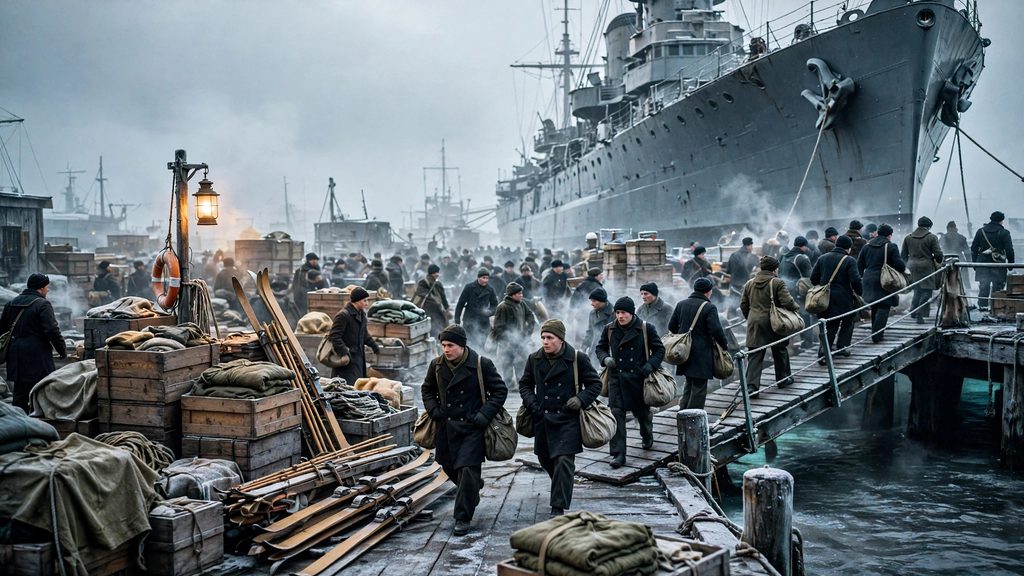
Its official name was the United States Navy Antarctic Developments Program, and it ran as Task Force 68 under Rear Admiral Richard H. Cruzen, with Byrd as officer in charge. The aims were set out in plain terms. The Navy wanted to train men and test ships, aircraft and equipment in extreme cold, to build a base called Little America IV, to map as much of the coast as possible from the air and to strengthen American influence on a continent that several nations were trying to claim.
The fleet sailed in three groups. The central group, with the aircraft carrier Philippine Sea and the icebreakers, pushed through the pack ice of the Ross Sea and reached the Bay of Whales on 15 January 1947, where Little America IV went up on the ice shelf. An eastern and a western group circled the continent, launching flying boats to photograph a coastline no one had ever seen. Six twin-engined R4D transports, helped by rockets, took off from the deck of the Philippine Sea with skis fitted beneath their wheels and flew to the base. In mid-February Byrd himself flew over the South Pole.
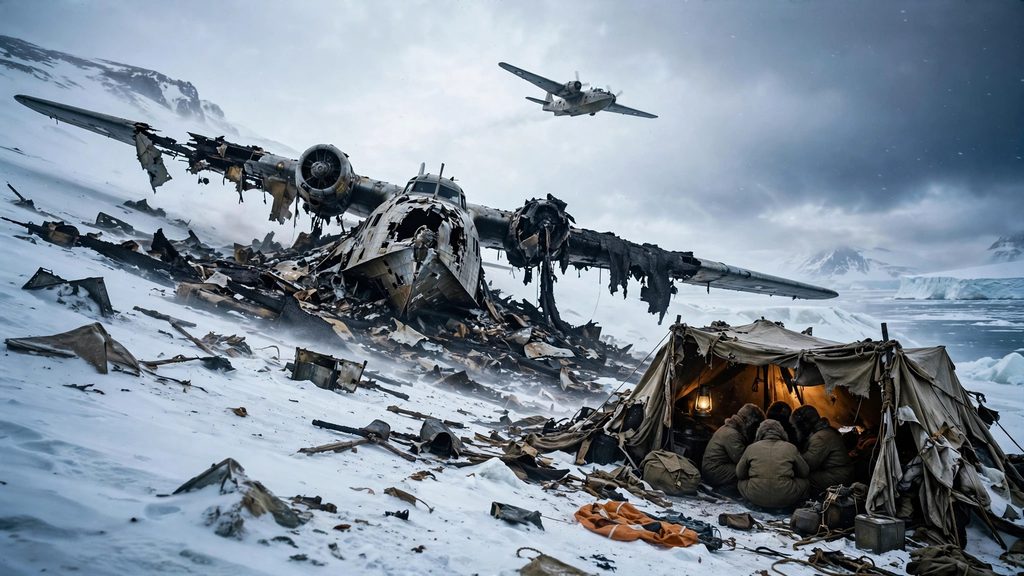
The cost was paid in lives. On 30 December 1946 a Martin PBM Mariner flying boat called George 1 crashed on Thurston Island during a whiteout. Ensign Maxwell Lopez and radiomen Wendell Henderson and Frederick Williams died. The six survivors waited thirteen days in the wreck before they were found and rescued. On 21 January 1947 a sailor named Vance Woodall was killed in an accident while unloading supplies on the Ross Ice Shelf. By the end of February the weather had closed in, and the task force turned north.
Sixty-Eight Days and Eight Months
The heart of the legend is a number. Highjump, it says, was planned for six to eight months and ended after a few weeks, so something must have driven it out. The figure of six to eight months does circulate in early estimates, but it cannot describe the work on the ice, because no expedition of the time could fly or sail freely in Antarctica outside the austral summer, roughly late November to early March.
Highjump’s own operational record fits that window exactly. The ships reached the pack ice in late December, the base was built in mid-January, the flights ran through mid-February, and by late February flying was possible only on a handful of days. Little America IV was a summer camp, never meant to hold a crew through the polar night. A fleet that left at the end of February was not cut short. It finished the only season it had.
What remained was the follow-up. In the next austral summer, from 1947 to 1948, the Navy sent a smaller expedition, Operation Windmill, to check Highjump’s aerial photographs against landmarks on the ground. A fleet that had fled something would hardly have hurried back.
- Dec 1938
The German Schwabenland expedition photographs Queen Maud Land. No base is built.
- 1943
Britain’s secret Operation Tabarin sets up bases on the Antarctic Peninsula.
- Dec 1946
Task Force 68 sails from Norfolk with 4,700 men, 13 ships and 33 aircraft.
- 30 Dec 1946
The flying boat George 1 crashes on Thurston Island. Three men die.
- 15 Jan 1947
The central group reaches the Bay of Whales and builds Little America IV.
- Mid Feb 1947
Byrd flies over the South Pole. The weather begins to close in.
- Feb 1947
Byrd flies beyond the North Pole into a hollow Earth, in the later diary.
- 5 Mar 1947
El Mercurio publishes Byrd’s warning about attacks over the poles.
- 1947 to 1948
Operation Windmill returns to check Highjump’s aerial photographs.
- 1959
Twelve nations sign the Antarctic Treaty in Washington.
- 1959 and 1964
Giannini and Bernard turn Byrd’s land beyond the pole into an inner world.
- 1970s
Ernst Zündel spreads the idea of Nazi flying saucers based in Antarctica.
- 1976
A secret mission meets the hosts of Antarctica, in the Graham Lewis story.
- 2006
Von Frese and Potts report the mass beneath Wilkes Land.
What Byrd Told El Mercurio
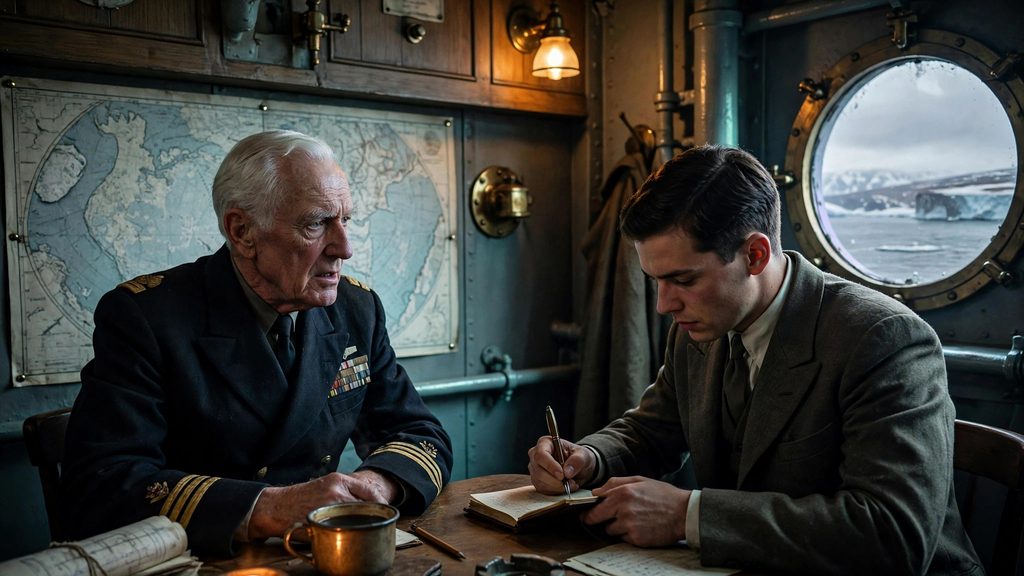
One piece of the legend rests on Byrd’s own words. On 5 March 1947, aboard the expedition’s flagship Mount Olympus, he spoke to Lee van Atta of the International News Service, and the interview was published in the Chilean newspaper El Mercurio. Byrd warned that the United States could no longer count on distance and the polar ice to protect it. In the event of a new war, he said, the country could be attacked by aircraft flying over one or both poles, and the time had ended when Americans could take refuge in their isolation.
In 1947 the meaning was plain. The Soviet Union was building long-range bombers, and the shortest route between Moscow and the American heartland ran over the Arctic. In the retellings, though, the warning became a confession that Byrd had met an enemy at the South Pole, flying machines that could travel from pole to pole at incredible speeds. That phrase, so often quoted, has never been traced to the published interview.
The Diary Byrd Never Kept
The other text tied to Byrd is a diary describing a flight beyond the North Pole in February 1947, into a warm valley inside a hollow Earth, where mammoths grazed and a master race warned him about atomic weapons. It surfaced decades after Byrd’s death in 1957, and it describes a flight that his logbooks place nowhere near the Arctic, since that February he was in Antarctica with Highjump.

The diary grew out of an older tradition. In 1959 a writer named Amadeo Giannini published Worlds Beyond the Poles, and in 1964 Raymond Bernard’s The Hollow Earth took Byrd’s habit of speaking about the vast unknown land beyond the pole as proof of an entrance to the inner world. Byrd meant unexplored territory on the map. His readers chose another meaning. The diary’s true author has never been identified, and the story of the hollow Earth is taken apart in full in the hollow Earth file.
Swastikas on the Ice
The Nazi half of the legend starts with a voyage that took place. In December 1938 the German ship Schwabenland sailed for Antarctica under Captain Alfred Ritscher. Two catapult-launched flying boats photographed a wide stretch of the coast of Queen Maud Land and dropped metal darts stamped with swastikas to mark a German claim, which Berlin named New Swabia. The expedition was home by April 1939 and built no base.
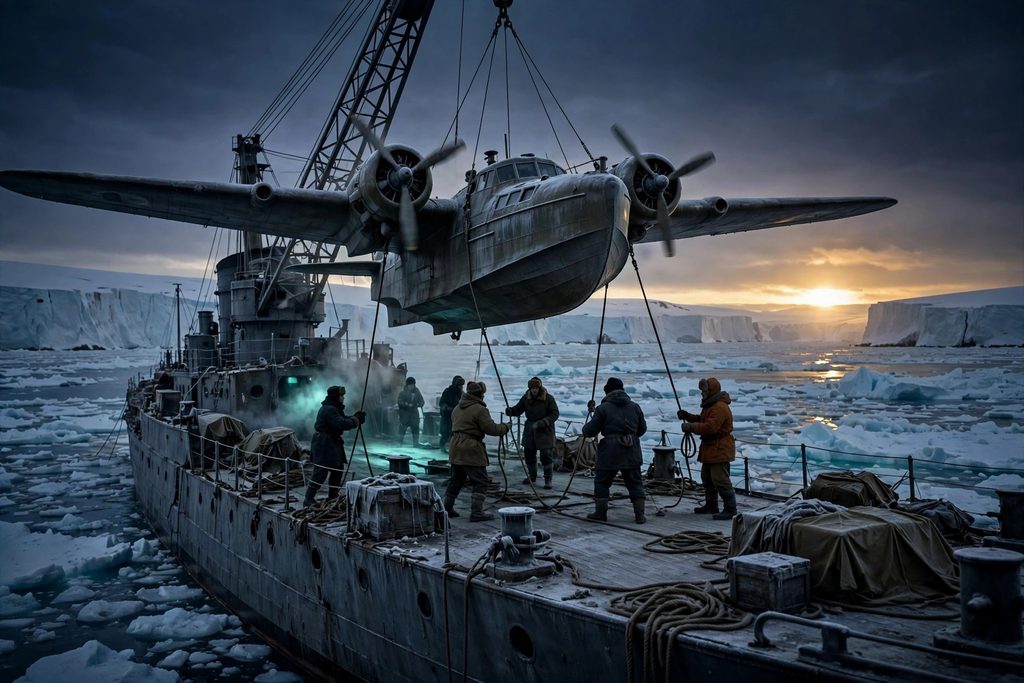
The British, not the Germans, sent a secret wartime mission south. Operation Tabarin, launched in 1943, set up British bases on the Antarctic Peninsula to watch for enemy raiders and secure a territorial claim, and it is the ancestor of the British Antarctic Survey. German submarines did prowl the South Atlantic, and two of them, U-530 and U-977, surrendered in Argentina months after the war ended, which fed rumours that they had carried someone or something to the south.
From these pieces postwar writers built Base 211, a hidden German city under the ice. In the 1970s the neo-Nazi publisher Ernst Zündel spread the idea of Nazi flying saucers based in Antarctica, and later versions grew to a quarter of a million Germans living beneath the ice. The escape routes that did exist, the ratlines that carried war criminals to South America, moved hundreds of people, not hundreds of thousands, and their paper trail runs through Rome and Buenos Aires, not the Antarctic. The full history of the legend is traced in New Swabia, and the story that Hitler himself reached Argentina is weighed in Hitler in South America.
Lights Over the Ice
The legend’s flying discs borrow their shape from a wartime mystery. In 1944 and 1945 Allied aircrews over Europe and the Pacific reported balls of light that kept pace with their planes, which they called foo fighters. Allied intelligence looked into the reports and found no enemy weapon behind them. No report from Highjump itself describes anything of the kind, and the stories of discs attacking Byrd’s fleet appear only in later books.
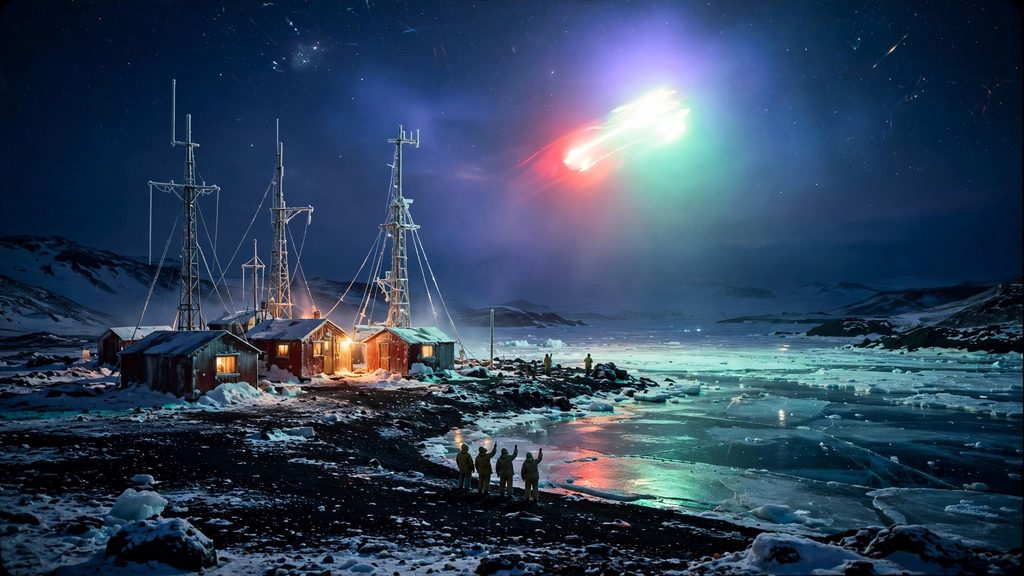
Antarctica does have its own recorded sightings. In July 1965 personnel at the Argentine, Chilean and British stations on Deception Island reported a bright, colour-changing object moving across the sky, and the Argentine navy issued a statement about it. The case is still discussed, and it shows how sightings near the pole look when they do occur, with named stations, dates and official statements. It is the kind of record Highjump’s flying saucers never produced.
The Explorer Who Left No Trace
Graham Lewis arrives with the same weight of detail and none of the record. He is described as a Canadian polar explorer with thirteen expeditions over fifteen years, who told an interviewer in 2013 of a classified joint mission of 1976 and of grey-skinned hosts who lived beneath the ice. No expedition roster, polar archive, news report or published interview from 2013 contains his name in this role, and no 1976 mission of that description appears in American or Canadian records.
The usual reply is that the mission was classified. But secrecy leaves its own traces. Antarctic work requires ships, aircraft, fuel, permits and pay, and every one of those leaves a record somewhere, even when the purpose is hidden. Operations once secret, from Tabarin to the Cold War spy flights, surfaced later because many people and many institutions took part. A story with a single unlocatable witness and no colleagues, payments or rosters is not a hidden operation. It is a story.
Lewis also belongs to a crowd. Since 2014 Corey Goode has described secret space programs and ancient beings under the Antarctic ice, and other names have come and gone with similar accounts. Their claims have never come with physical evidence that outside researchers could examine. The Pentagon’s UAP office asks for sensor data, radar tracks and several witnesses before it calls a case unexplained, and sworn testimony to Congress carries legal consequences for lying. The tale of the hosts of Antarctica meets none of those tests.

The Shape Under Wilkes Land
Beneath the ice of Wilkes Land in East Antarctica lies something that scientists themselves cannot fully explain. In 1962 the geologist Richard Schmidt suggested a giant impact crater there, using gravity and seismic data from an American traverse, and the geophysicist John Weihaupt developed the idea in 1976. In 2006 Ralph von Frese and Laramie Potts of Ohio State University used gravity measurements from NASA’s GRACE satellites to identify a mass concentration about 300 kilometres wide inside a ring-shaped structure some 480 kilometres across.
They proposed that a huge impact had formed it, perhaps 250 million years ago, at about the time of the Permian extinction, the greatest dying in the planet’s history. Other researchers have searched rocks of that age in Antarctica for impact debris and found none, and some geologists favour a mantle plume or ancient volcanic activity instead. No one has drilled to the bedrock, so the question stays open. It is a mystery of geology, buried under ice and still being argued, which is exactly why the legend borrows it.

Enoch’s Seven Mountains
Some versions add an older text. In the Book of Enoch the patriarch is carried to the ends of the Earth and sees seven mountains of magnificent stones, three toward the east and three toward the south, with one between them reaching to heaven like a throne. Beyond them lies a place of fire and an abyss where fallen stars and the rebellious Watchers are bound until their time is complete. Writers have proposed that Enoch saw Antarctica, with Mount Vinson in the Ellsworth range as the central peak.
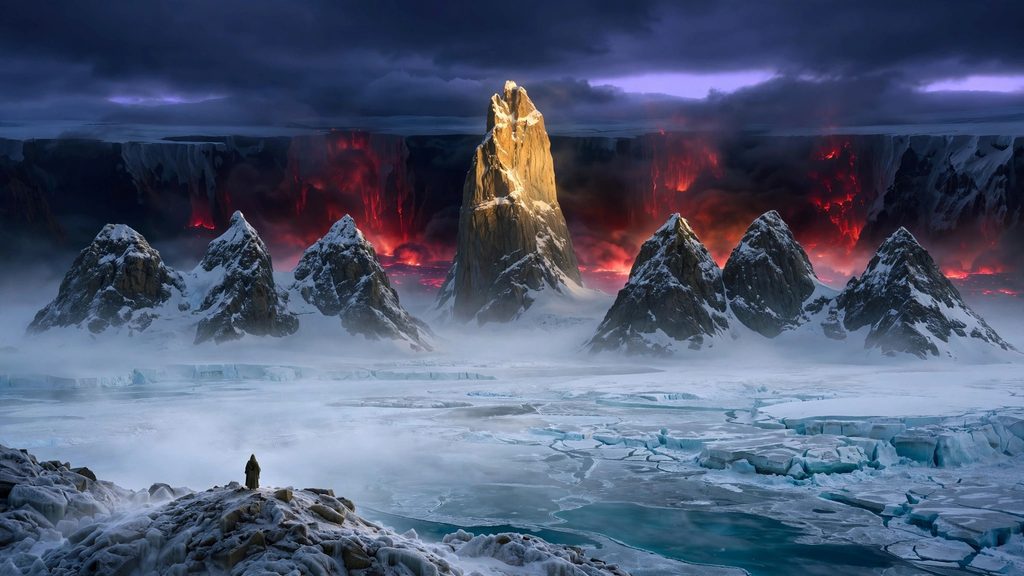
The match depends on choosing which mountains to count and which way to face, and no study has shown that the Ellsworth range fits the text. To make a temperate land of the frozen pole, the theory turns to Charles Hapgood, whose 1958 book Earth’s Shifting Crust, with a foreword by Albert Einstein, proposed that the crust had slid over the mantle and moved Antarctica south. Plate tectonics and polar records in the rocks have since left little room for a shift of that size in human times. The Watchers themselves are met in the Book of Enoch, and the map once said to show an ice-free Antarctica is traced in the Piri Reis map.
A Continent Set Aside
The final move of the legend is to read the Antarctic Treaty as a cover-up. Signed in Washington on 1 December 1959 by twelve nations and in force from 1961, it set the continent aside for peaceful science. It bans military bases and weapons tests, freezes the territorial claims of seven countries without erasing them, and allows any member to inspect any station at any time. More than fifty nations have since joined.
The treaty grew out of the International Geophysical Year of 1957 and 1958, when scientists from a dozen countries worked across the continent at the height of the Cold War, and out of fear that Antarctica would become another front between Washington and Moscow. A continent open to inspection by rival powers is a poor place to hide anything. Its secrets are of another kind, ice cores holding the air of eight hundred thousand years, more than a hundred volcanoes beneath the western ice sheet and lakes sealed under kilometres of ice, the largest of them followed in Lake Vostok.
Operation Highjump and the Ice That Still Waits
Strip away the discs and the diary and Operation Highjump remains a story of daring. Thousands of men sailed into the least known place on Earth, a carrier launched planes on skis, six survivors waited thirteen days in a wreck on Thurston Island, and the aerial cameras brought back a coastline no human had seen. Its admiral came home warning of bombers over the pole, and within a decade the nations of the world agreed to leave the continent to science.
What lies under the ice is still largely unknown. The shape beneath Wilkes Land has not been sampled, the lakes are only beginning to be explored, and the ice keeps records older than any written text. The Watchers of Enoch were bound until their time was complete, and the text leaves the hour unnamed. The ice keeps its own hours. Every summer it gives back a little more of what it has kept.
The Verdict | Debunked
Operation Highjump ran from December 1946 to early March 1947 with 4,700 men, thirteen ships and thirty-three aircraft. It built Little America IV, photographed long stretches of the coast, lost four men in two accidents, and ended with the Antarctic summer. Byrd did warn in March 1947 that the poles no longer protected America, and the gravity anomaly beneath Wilkes Land remains open to debate.
The story that Highjump fought a Nazi base or flying discs and fled early, that Byrd kept a diary of a hollow Earth, and that a Canadian explorer named Graham Lewis met the hidden hosts of Antarctica in 1976, cannot be traced to any record of the time. The timeline matches the season, the diary describes a flight that never happened, the Nazi base exists only in postwar books, and Graham Lewis has no trail at all. Debunked, from the ship’s logs to the admiral’s own words.
- Claim tested
- Operation Highjump was cut short after weeks by a clash with a hidden Nazi base or flying discs, Byrd recorded a hollow Earth in a secret diary, and a Canadian explorer named Graham Lewis met beings beneath the ice on a classified 1976 mission.
- Oldest record
- Off the ladder · Unsourced
Postwar hollow Earth books from 1959 and 1964, a diary that surfaced decades after Byrd’s death, and an untraced 2013 interview. - The record supports
- That Highjump ran from December 1946 to early March 1947, lost four men, built Little America IV, and that Byrd warned of attack over the poles in El Mercurio.
- It does not support
- A battle, an early retreat, a Nazi base, an authentic diary, or any Graham Lewis or 1976 mission.
- Explanations weighed
- An Antarctic summer expedition, a Cold War warning and a gravity anomaly, joined to Nazi and hollow Earth legends that grew after the war.
- What would change it
- Highjump logs or reports describing combat, an authenticated Byrd diary, or any record of Graham Lewis and his mission.
The polar career of Richard Byrd and the warm sea said to lie beyond the ice wall are followed in Scott and Byrd, and the volcanoes sleeping beneath the western ice are counted in Antarctica’s 138 volcanoes. Himmler’s institute of race and ancestry is opened up in the Ahnenerbe, and the Soviet Arctic that drew a twin legend of lost ruins under the ice is explored in Novaya Zemlya. The sky’s long record of strange lights is gathered in the long history of UFOs, and a tale written openly as fiction about something sealed beneath the same coast waits in the Black Sarcophagi. The Atlas marks the Bay of Whales where Little America IV stood. Under the Archive Standard, a ship’s log outranks a diary with no author, and Operation Highjump now sits with the debunked files of the Verdict Index.
Quick Answers About Operation Highjump
What was Operation Highjump?
A United States Navy expedition to Antarctica from December 1946 to March 1947, led by Admiral Richard Byrd, with 4,700 men, 13 ships and 33 aircraft. It built a base, trained crews and mapped the coast from the air.
Why did Operation Highjump end early?
It did not end early. Antarctic flying and shipping were only possible in the austral summer, and the fleet left at the end of February 1947 as the season closed, after completing its main work.
Did Admiral Byrd find a Nazi base in Antarctica?
No record supports it. Germany’s 1938 to 1939 Schwabenland expedition photographed Queen Maud Land but built no base, and the idea of a hidden Nazi city under the ice appears only in postwar books.
Is Admiral Byrd’s secret diary authentic?
No. The diary describes a February 1947 flight beyond the North Pole, when Byrd was in Antarctica with Highjump. It surfaced decades after his death and its author has never been identified.
Who is Graham Lewis?
A Canadian polar explorer said to have described a secret 1976 Antarctic mission and grey-skinned beings beneath the ice. No expedition record, archive or interview containing him has been found.