On 21 July 1983, at a cluster of huts on the high Antarctic plateau, thermometers recorded the coldest natural temperature ever measured on Earth, minus 89.2 degrees Celsius. The place is Vostok Station, founded by the Soviet Union in 1957 near the southern geomagnetic pole, more than 3,400 metres above sea level and about 1,300 kilometres from the geographic South Pole. In winter the sun does not rise for months. The air is so thin and dry that newcomers gasp for breath.
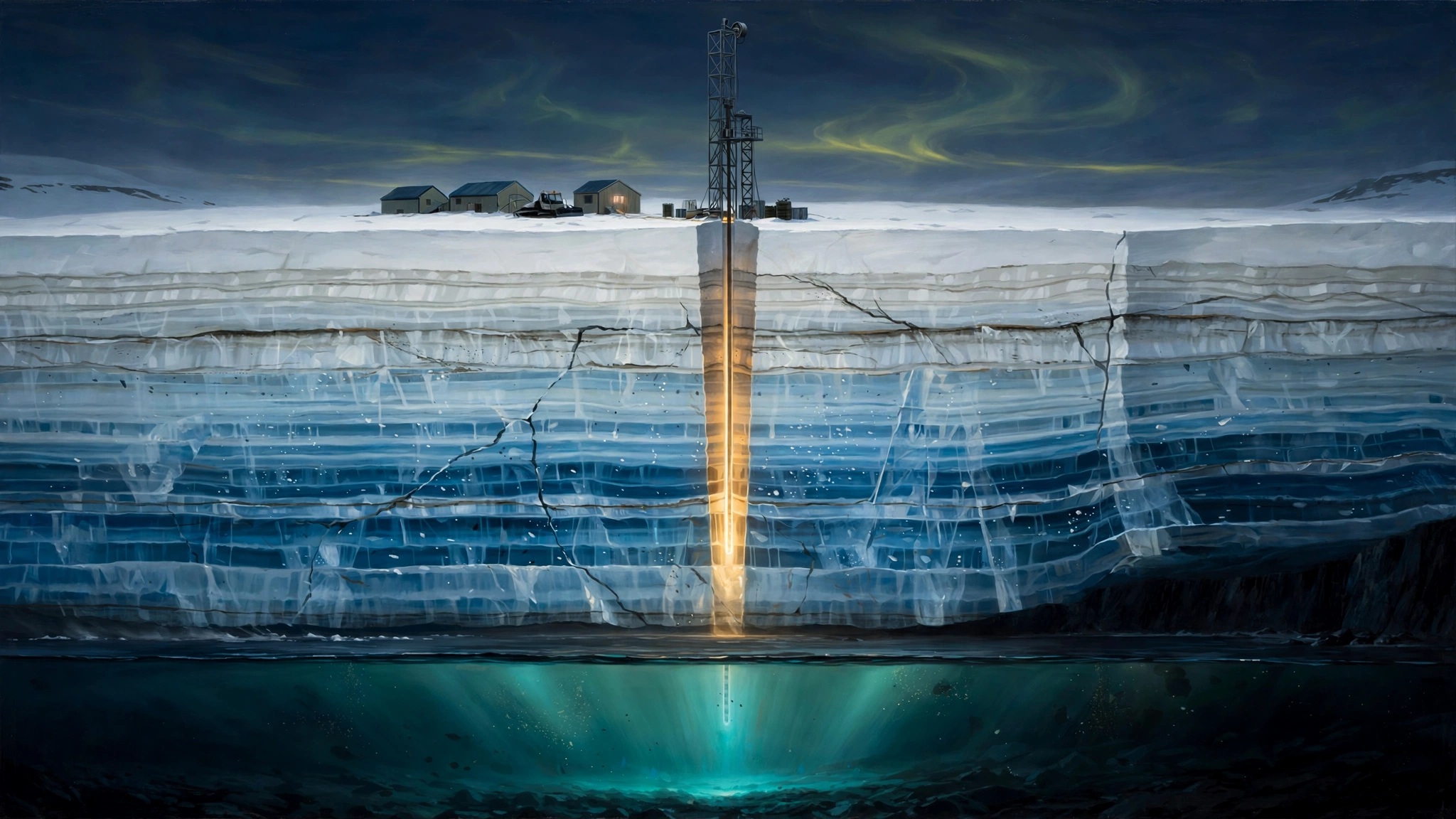
Almost four kilometres beneath the floors of those huts, in total darkness, lies a lake. It is around 250 kilometres long and 50 kilometres wide, holds some 5,400 cubic kilometres of liquid water, and in places is close to a kilometre deep. Nobody has ever seen it. The weight of the ice above presses down on it with a force of more than 300 times the pressure of the atmosphere, and the water stays liquid only because that same ice blanket traps the heat rising from the Earth below.
Lake Vostok is one of the largest lakes on the planet, and for most of the twentieth century no one knew it existed. In the years since its discovery it has been called a time capsule, a window to alien oceans, and the site of a mysterious communication blackout. Some of those descriptions hold. One of them is a misunderstanding that went around the world in a week.
The Lake Nobody Could See
The idea of liquid water under the Antarctic ice is older than the station. In the late nineteenth century the Russian geographer and anarchist Peter Kropotkin suggested that the pressure of a thick ice sheet could melt its own base. In 1959 and 1964 the Soviet geographer Andrey Kapitsa sent seismic soundings down through the ice near Vostok and recorded puzzling echoes, and in 1967 the physicist Igor Zotikov argued that water could exist beneath the ice sheet.
The first real glimpse came from the air. In the early 1970s British, American and Danish scientists flew radar surveys over the plateau, and their ice-penetrating radar returned a strange flat, bright reflection beneath the ice near the station, the signature of water. In the early 1990s British scientists led by J. P. Ridley turned the European ERS-1 satellite’s altimeter on the ice surface above the station and found an unusually flat area, the ice floating on something liquid below. On 20 June 1996 a joint Russian and British team led by Kapitsa announced in Nature the full extent of the lake. Its surface lies about 500 metres below sea level, its floor covered by sediment perhaps 70 metres thick.

The lake turned out to be a world of its own. Its water, at about minus 3 degrees Celsius, stays liquid because of the immense pressure. It has tides, the surface rising and falling by about a centimetre. There is an island near its centre. And because air trapped in the ice is released as the ice sheet melts into the lake, the water is thought to be supersaturated with oxygen and nitrogen, holding perhaps fifty times more dissolved gas than an ordinary lake on the surface, a chemistry no surface ecosystem shares.
How Old Is the Water?
The figure attached to Lake Vostok in almost every article is fifteen million years. It is not wrong, but it describes the ice more than the water.
The East Antarctic ice sheet settled over the region in the Miocene, and estimates for how long the lake has been sealed beneath it range from about 15 to 25 million years. In all that time no light, air or surface water has reached it directly. But the lake is not a closed jar. Ice sheets move, and the ice sliding over Lake Vostok melts into the water at the northern end, where the ice is thickest and the pressure greatest, and the lake water freezes back onto the underside of the ice at the southern end. That refrozen layer, called accretion ice, is carried slowly away with the moving ice sheet. Scientists estimate that the lake’s water is replaced on average every 13,300 years or so.
That changes the picture without erasing the mystery. The water now in the lake is perhaps tens of thousands of years old, not millions. But the basin itself has been sealed in darkness for millions of years, and any life that lived there could have been isolated from the rest of the biosphere for a stretch of time far longer than our species has existed.
Drilling Toward the Dark
Vostok Station has been drilling into the ice for decades, at first for its climate record. In 1998 a Russian, French and American team brought up an ice core 3,623 metres long, stopping about 100 metres above the lake to avoid contaminating it. The air bubbles trapped in that core recorded the Earth’s climate across some 400,000 years, through four full cycles of ice ages and warm periods, and the results, published in 1999, became one of the cornerstones of modern climate science.
Then the target changed. To keep the borehole from closing under the pressure of the ice, it had to be filled with fluid, about 60 tonnes of kerosene and Freon over the years. Scientists outside Russia worried openly that the drilling would pollute an untouched lake. The Russian team developed a plan to stop just short of the water, let the lake’s own pressure push water up into the hole, and allow it to freeze there, sealing the lake and leaving a plug of frozen lake water to sample later.
On 5 February 2012, near the end of the short summer season, the drill reached a depth of about 3,769 metres and broke into the lake. What happened next became the story’s most famous episode. On 6 February the Russian news agency RIA Novosti reported the breakthrough, quoting an unnamed source. Western journals could not reach the drilling team to check it, and some outlets reported that the Russians had “fallen silent” and had not been heard from for five days. Within days the Arctic and Antarctic Research Institute in St Petersburg confirmed the breakthrough, and its director of the Antarctic programme, Valery Lukin, explained that data from the sensors was still being analysed.

The silence was a gap in news, not an event at the lake. Vostok in February is a remote outpost at the end of its season, preparing for the last flights out, with limited and expensive links to the outside world. As planned, the lake water had surged up into the borehole and frozen, and the team reported that roughly 1,500 litres of drilling fluid had been pushed back up into holding tanks. There was no mystery at the bottom of the hole. There was simply a team with no reason to talk to the international press while it packed up for the winter.
The real drama came later. In January 2013 the team brought up the first core of refrozen lake water from the borehole. In January 2015 it broke through again and collected about a litre of water, which rose more than 500 metres up the hole, far higher than the 30 to 40 metres predicted. Later that year work was suspended for lack of funding, and in 2017 the Russian team reported that its samples were too contaminated to give reliable chemical or biological results. A new wintering complex for the station, ordered in 2019, began arriving in pieces in 2021. The lake itself remains, for now, essentially unsampled.
What Was Found in the Ice
Almost everything known about possible life in Lake Vostok comes not from the lake but from the accretion ice, the lake water frozen onto the underside of the ice sheet and brought up in ice cores. Microbes were first reported in that ice in 1999.
The Russian microbiologist Sergey Bulat, of the Petersburg Nuclear Physics Institute, found traces of a bacterium called Hydrogenophilus thermoluteolus in the deep ice, a species known from hot springs, and suggested that it might point to warm hydrothermal water somewhere on the lake floor. The idea was striking, a deep biosphere fed by heat from the Earth, and it has never been shown to be right. Hydrogenophilus is a living surface species, and it may have entered the ice through the drilling. After the 2012 breakthrough, a Russian study of the frozen lake water identified 255 species of contaminating microbes and one bacterium that matched nothing known, which another Russian scientist, Vladimir Korolev, suggested could simply be an organism living on the kerosene.
In 2013 a team led by Scott Rogers at Bowling Green State University in Ohio published the most ambitious analysis yet, sequencing genetic material from accretion ice cores. They reported 3,507 unique gene sequences, about 94 percent from bacteria and 6 percent from more complex organisms, including traces resembling microbes that live in the guts of fish and molluscs, a small crustacean and organisms associated with deep-sea vents. The concentrations were tiny, one to 100 cells per millilitre. “If it does have life, it’s interesting life, but it’s not highly concentrated life,” Rogers said. Other microbiologists, among them David Pearce and Bulat himself, argued that much of the DNA could have come from drilling contamination. Rogers rejected that, and the argument has never been settled.
Whether anything lives in Lake Vostok is, after half a century of work, still an open question. The answer is waiting in water that no one has yet sampled cleanly.
Life Under Other Lakes
Lake Vostok is not alone. Radar and satellite surveys have since found hundreds of lakes beneath the Antarctic ice, and the newest maps of the bedrock under the ice sheet reveal mountain ranges, deep troughs and plains hidden under kilometres of ice. Many of the lakes are linked. Satellites have watched some of them suddenly drain and others fill, water moving between them along rivers under the ice, a hidden hydrology no one suspected a generation ago. Beneath West Antarctica, where scientists have identified 138 volcanoes under the ice, heat from below adds meltwater to the system, a story told in our file on Antarctica’s hidden volcanoes.
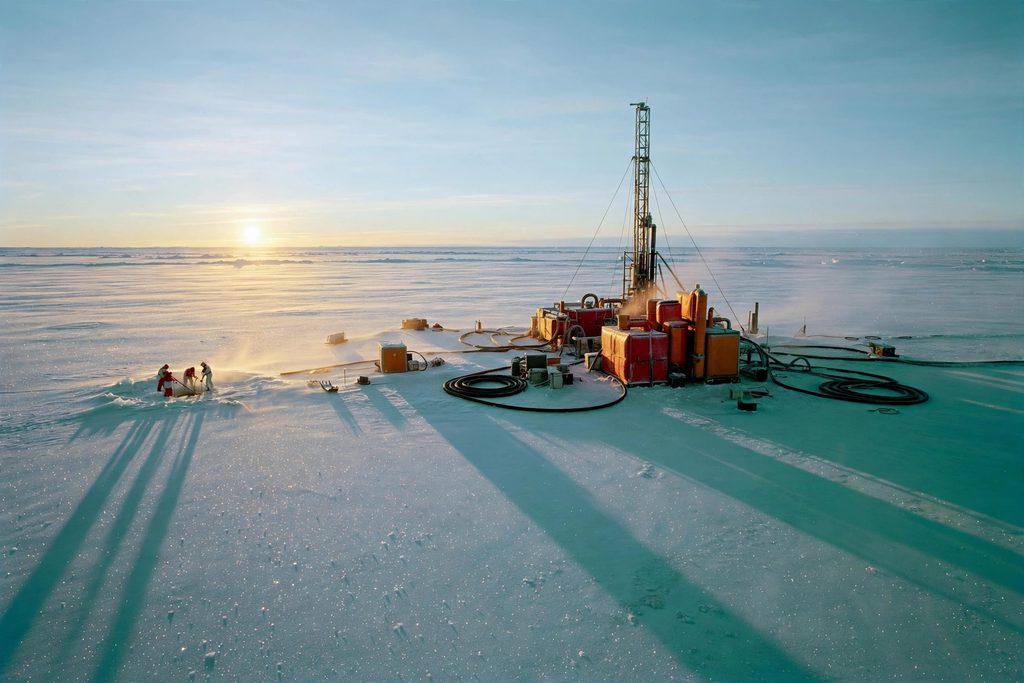
The strongest evidence for life in these hidden waters came from a lake far smaller and younger than Vostok. In January 2013 an American team drilled through about 800 metres of ice into Subglacial Lake Whillans in West Antarctica, using hot water that had been filtered, treated with ultraviolet light and disinfected with hydrogen peroxide to keep it clean. In 2014, in Nature, Brent Christner and his colleagues reported that the lake water held about 130,000 microbial cells per millilitre, a density comparable to many surface lakes, and genetic traces of 3,931 kinds of microbes, living without sunlight by drawing energy from minerals in the rock beneath. Life under the Antarctic ice exists. The question for Vostok is whether its own deeper, older, colder waters host it too.
The Europa Question
Part of what makes Lake Vostok matter is that it is not the strangest hidden ocean in the solar system. Jupiter’s moon Europa is covered by a shell of ice many kilometres thick, and measurements of its magnetic field by NASA’s Galileo spacecraft, which orbited Jupiter from 1995 to 2003, pointed to a salty liquid ocean beneath, kept warm by the tidal flexing of Jupiter’s gravity. Saturn’s moon Enceladus sprays plumes of water from cracks near its south pole, which the Cassini spacecraft flew through and sampled.
Lake Vostok and its neighbours are the nearest thing on Earth to those worlds, dark, cold water sealed under ice and fed only by heat and chemistry from below. The engineering of reaching them without contaminating them is a rehearsal for the even harder task of one day reaching an alien ocean. NASA’s Europa Clipper launched in October 2024 and is due to reach Jupiter in 2030, joining the European Space Agency’s Juice mission, to study Europa’s ice shell and ocean from orbit. Any future lander will face a version of the Vostok problem, how to look for life without carrying Earth’s along with it.
The Dinosaur That Was Never There
Some retellings add a dinosaur. In 2011 palaeontologists did describe the first remains of a titanosaur, one of the giant long-necked sauropods, from Antarctica, and the find stood up. It came from James Ross Island, near the tip of the Antarctic Peninsula, thousands of kilometres from Vostok, from rocks about 70 million years old.
At that time Antarctica was a different place. It was still joined to South America and Australia, covered in forests, and home to dinosaurs, early mammals and great flightless birds. Around 34 million years ago the opening of the Drake Passage between Antarctica and South America allowed a cold current to circle the continent, and the great ice sheets began to grow. The forests and their animals vanished long before the ice closed over Lake Vostok. Whatever might live in the lake today, it will be microbial, and nothing larger has any way to survive there.
The Fear of What Comes Up
Science fiction has a ready-made plot for Lake Vostok, an ancient organism released from the ice. The scientists who worked on the lake worried about the opposite. The danger they took seriously was that drilling would introduce surface microbes into a pristine lake, irreversibly, making it impossible ever to know what was there before.
Organisms adapted to Vostok’s conditions, crushing pressure, near-freezing water, permanent darkness and a strange gas-rich chemistry, are the least likely of all microbes to thrive in warm, sunlit air at normal pressure. Extremophiles are specialists. That is no guarantee about every conceivable organism, which is why sample handling follows careful protocols, but nothing found so far in Vostok’s ice has raised any concern about risk to the surface world.
What the Ice Still Holds
Lake Vostok’s floor has never been touched by any instrument. Beneath the water, the sediment on its bed may hold a record reaching back to a time before the ice, pollen and dust from an Antarctica that still had forests and rivers. The lake may hold life adapted to conditions found nowhere else on Earth, or it may be sterile, its oxygen-rich water too harsh for anything to survive. Either answer would teach us something.
The ice has kept the secret for millions of years, and it is in no hurry. Above it, at the coldest inhabited place on the planet, a small crew still winters through months of darkness, sitting on top of one of the last unexplored places on Earth. Other hidden ecosystems have already surprised us, like the microbes that survived for tens of thousands of years inside the giant crystals of Naica in Mexico. The ice cores of Antarctica have their own share of invented wonders, gold threads and nanochips among them, set out in our file on what the ice cores hold, and none of them is as strange as the lake.
The Verdict | Unresolved
Lake Vostok is real, vast and sealed beneath almost four kilometres of ice, and its basin has been cut off from the surface for millions of years, though its water renews itself over tens of thousands. The five-day “blackout” of 2012 was a gap in news coverage, not an event at the lake. The microbes reported from its accretion ice remain disputed, because drilling fluid has contaminated every sample so far. Life has been found beneath the Antarctic ice elsewhere, but not yet, beyond doubt, in Lake Vostok itself. Whether anything lives in it is still unknown. The verdict is Unresolved.
For how this verdict sits beside the rest of the archive, see the Verdict Index.