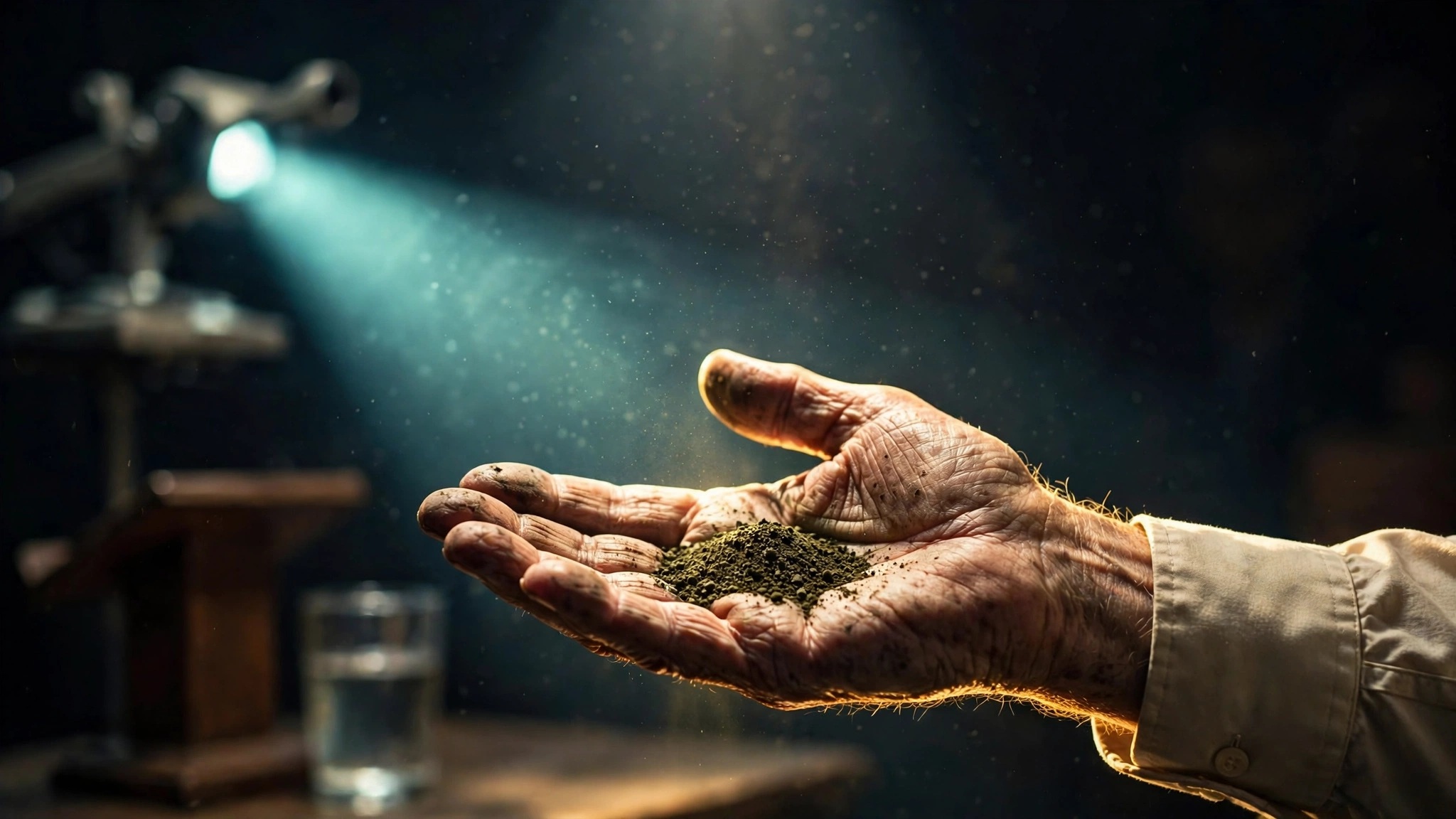
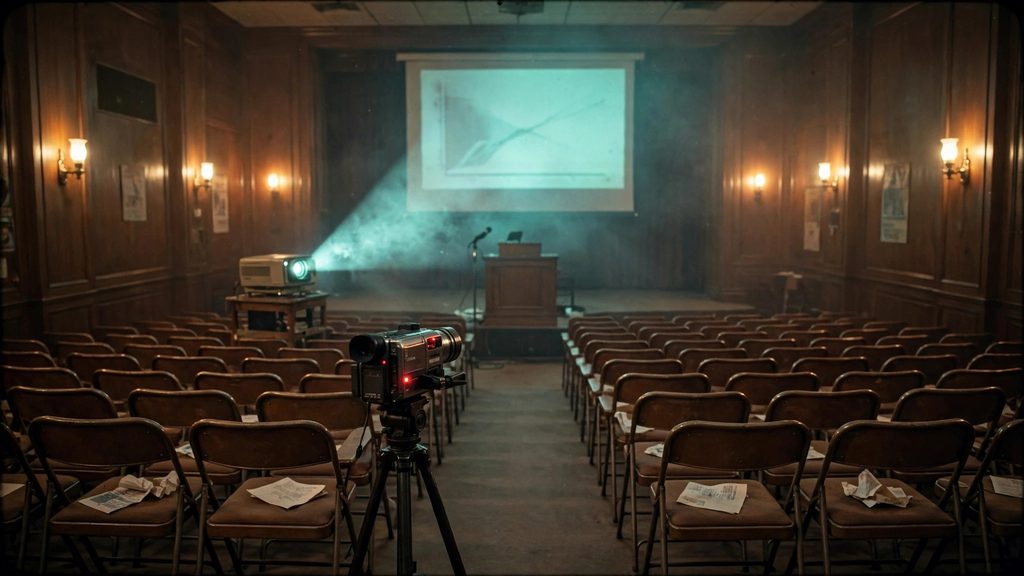
On a Friday evening in October 1985, in a lecture hall in Utah County, a man of fifty-nine held up a small bottle of dark powder and told the audience what it was. Uranium oxide, the stuff that comes out of a uranium mill before it is turned into reactor fuel. He tipped some into his palm, put it on his tongue and swallowed. Then he went on talking. A reporter from the Oregonian, watching him do the same thing that year, wrote down his description of the powder. It was, he said, “just another form of sun-tan.”
His name was Galen Winsor, and he had spent more than thirty years inside the American nuclear industry, much of it handling plutonium. A year later a man named Ben Williams filmed one of his lectures, and the recording, called The Nuclear Scare Scam, has never stopped circulating. In it Winsor says he carried plutonium in his pockets, swam in a pool of spent reactor fuel and drank a glass of its water every day. In the version that travels on social media, he is a famous physicist who ate uranium on live television and lived to a ripe old age without a day of illness.
Some of that is on the record. Some of it is not. And the argument he was making, that the fear of low-dose radiation had outrun the science, is still being fought out in Washington forty years later.
Who Was Galen Winsor?
Galen Hulet Winsor (1926 to 2008) was an American nuclear chemist who worked at the Hanford plutonium site in Washington State for General Electric from 1950 and later on the design of commercial plants to reprocess spent nuclear fuel. In the mid-1980s he toured the United States giving lectures in which he ate uranium oxide in front of the audience and argued that the dangers of radiation had been exaggerated. He was not a physicist and the lectures were not live television. He died on 19 July 2008, at the age of 82, and the cause of his death was never made public.
The Resonance Archive · The Winsor File
The Man Who Ate Uranium, Measured
What the lectures and the viral clip say about Galen Winsor, set claim by claim against the newspapers, the science and his own words.
5 Debunked2 Disputed1 Documented1 Unresolved
Each row is set out in full below.
From a Small Utah Town to the Plutonium Works
Winsor was born on 4 June 1926 in Peterson, a small town in Morgan County, Utah. He finished high school in 1944, served in the US Navy at the end of the Second World War, and studied chemistry at Brigham Young University. In 1947 he married LaDene Mikkelsen in the Salt Lake Temple, and in 1950 the couple moved to Richland, Washington, the government town built for the workers of Hanford.
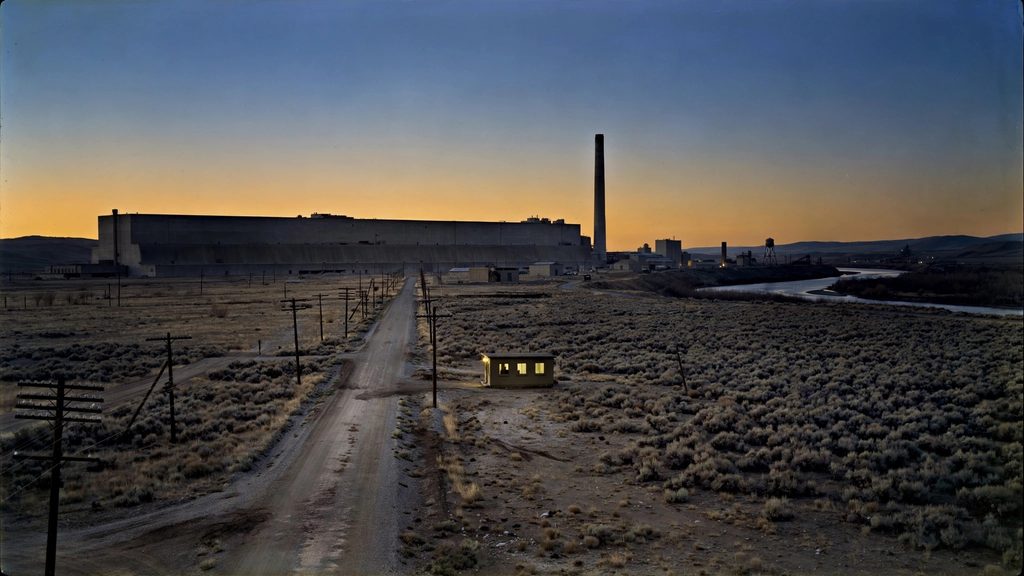
Hanford was where the United States made the plutonium for its bombs, starting with the core of the weapon dropped on Nagasaki, and from 1946 to 1965 it was run for the government by General Electric. Winsor joined GE as a nuclear chemist and, by his obituary’s account, helped build and run the processes that dissolved irradiated uranium fuel and drew the plutonium out of it. It was some of the most dangerous chemistry in the world, carried out behind thick concrete walls by operators working remote handling equipment, and it left behind the most contaminated nuclear site in the United States.
He worked for GE for about fifteen years. His career then followed the industry’s plans for a civilian future. He worked on the design of a commercial reprocessing plant from GE’s offices in San Jose, California, on the company’s plant in Illinois, and at a uranium ore facility in Nucla, Colorado. In October 1976 he joined United Nuclear and moved back to Richland.
The Plant That Never Ran
The plant in Illinois was the centre of his grievance. In the 1960s the American nuclear industry expected to recycle its spent fuel, separating the uranium and plutonium that were left in it and turning them into new fuel. GE built a reprocessing plant for that purpose near Morris, Illinois, southwest of Chicago, called the Midwest Fuel Recovery Plant. In his lecture Winsor said he had designed its sampling and analytical system and had expected to run it. “In 1973,” he said, “they said, ’Forget it, friends. You don’t get to run it.’”
In Winsor’s telling, the plant was stopped because cheap recycled fuel threatened the people who profited from scarcity. The record tells a less sinister story. GE used a new process at Morris, and in testing the plant would not work without extensive modification. In the mid-1970s the company declared it inoperable and withdrew its application to run it. In April 1977, President Jimmy Carter deferred all commercial reprocessing in the United States indefinitely, citing the risk that separated plutonium could spread nuclear weapons. Ronald Reagan lifted the ban in 1981, but no American company ever reprocessed commercial fuel again.
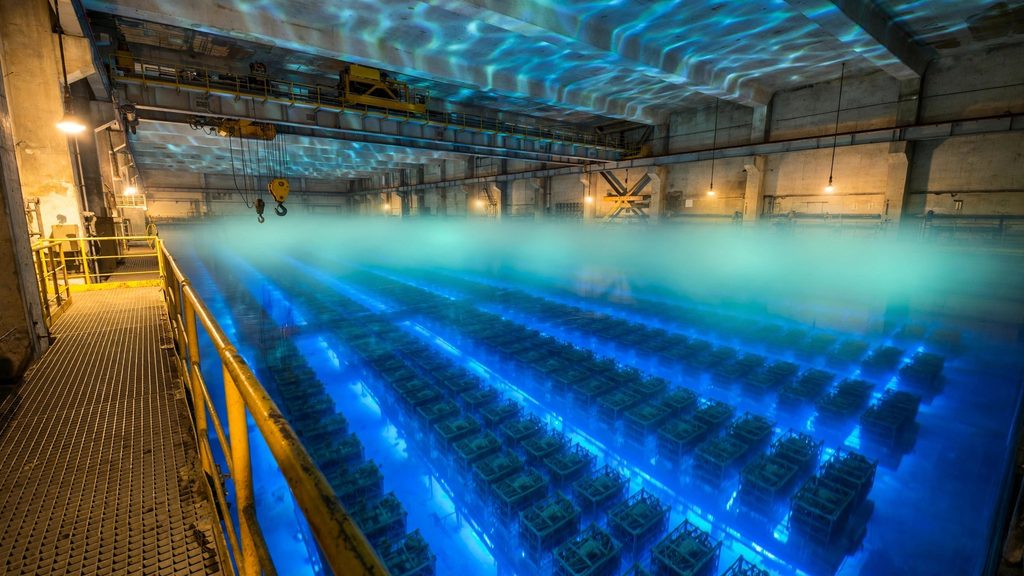
Morris became something else instead. Its pool, built to hold spent fuel waiting to be reprocessed, became a storage pool, and it still holds about 772 tons of spent fuel from power reactors, none of it added since 1989. It is the only licensed facility in the United States that stores spent fuel under water away from a reactor, and in 2022 the Nuclear Regulatory Commission renewed its licence to 2042. The plant Winsor wanted to run became, in effect, the fuel store he had told his audiences it could be.
The Pool
The most famous of Winsor’s claims comes from that kind of pool. Spent fuel rods come out of a reactor intensely radioactive and hot, and they are kept for years under deep water, which cools them and absorbs their radiation. A person floating on the surface of such a pool is shielded by many feet of water. Winsor said he swam in one. “This kid from Nevada,” he said of himself, “never could pass up a warm swimming hole.” Then he said he began drinking it. “I went to drinking a glass of it a day.”
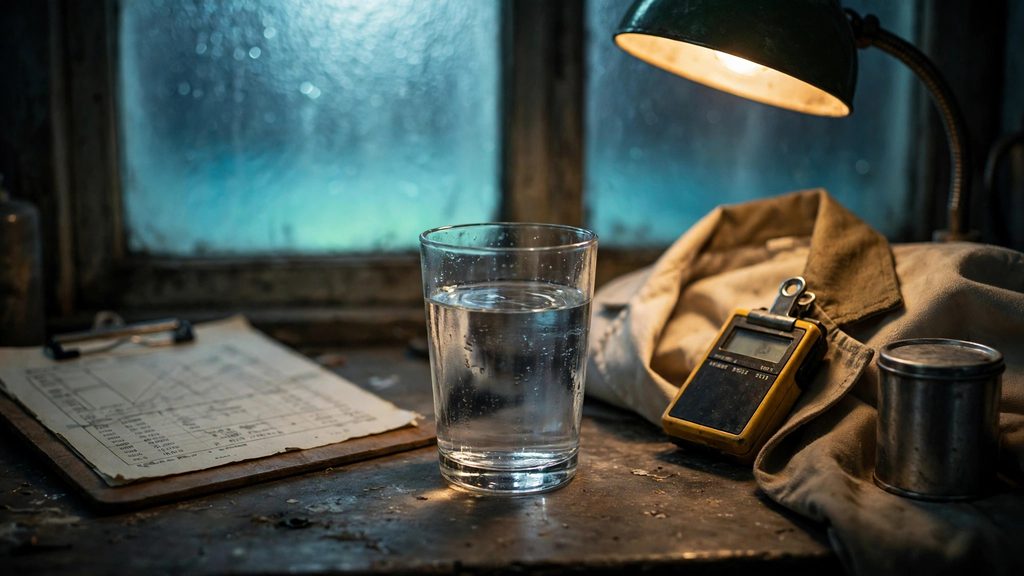
What he said next is cut from most of the clips. In December 1974, he told his audience, he was put through a whole-body scan, and the counters found two things. One was “a plutonium lung burden.” The other was cesium-137, one of the main radioactive products of fission, which dissolves in water. “That cesium-137 had a ferociously high level,” he said, “even exceeded the NRC’s limit, and I had been drinking it?” He told the story as proof that the limits meant nothing, because he felt fine. It is also the clearest evidence that the pool water was not clean.
The Uranium on His Tongue
The uranium oxide he ate on stage was a different matter, and here Winsor was closer to the science than his critics usually allow. The oxide he used, U3O8, does not dissolve in water or body fluids, and most of it passes straight through the gut. The Daily Herald of Provo reported on 27 October 1985 that he had eaten uranium oxide at a lecture sponsored by the Utah County Speakers Bureau and the John Birch Society. That year Nancy Kerner, a radiation control official in Washington State, told the Oregonian that what he was doing was “troubling but, technically speaking, quite legal.” The radiation dose to his gut, she estimated, was probably a few millirem. She called it irresponsible.
Uranium’s main danger to the body is not its radiation at all. The US Agency for Toxic Substances and Disease Registry says the health effects of natural uranium come from its chemistry, as a heavy metal that can damage the kidneys. Soluble uranium compounds are the most harmful. A spoonful of insoluble oxide, swallowed now and then, was a stunt with a small risk. It was not the proof he presented it as, that the whole system of radiation protection was a fraud.
Plutonium in His Pockets
Winsor told his audiences that at Hanford he had handled plutonium with his bare hands, without coveralls, and that he had carried half a critical mass in each pocket to show that the metal could be moved around safely. That last claim was about criticality, the chain reaction that can start when enough plutonium comes together in one place. Kept apart, the two halves could not start one. It said nothing about the danger that matters most to the people who work with it.
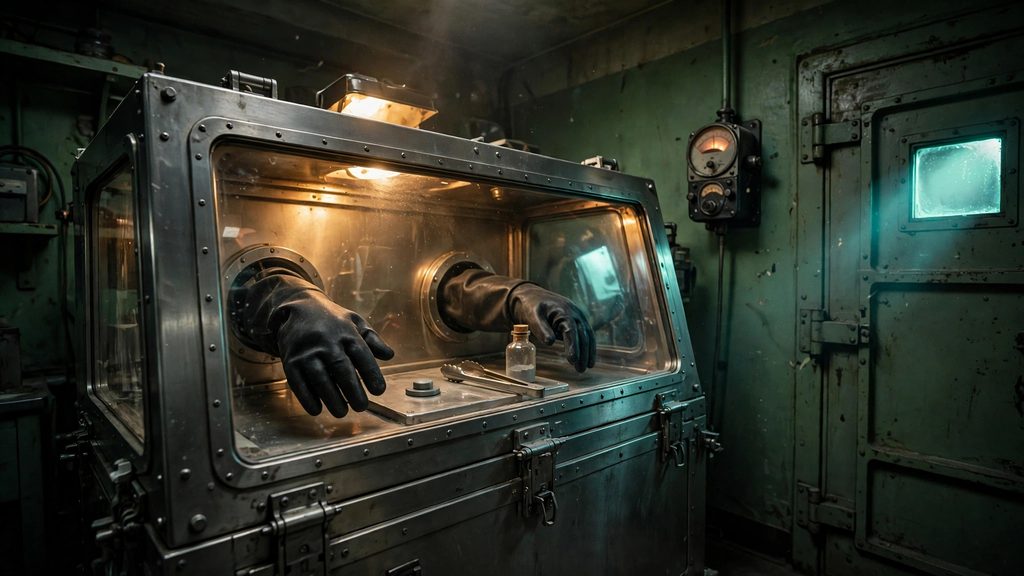
Plutonium gives off alpha particles, which cannot get through skin, so a lump held in the hand does little harm. Swallowed, it is poorly absorbed. Germany’s federal radiation agency gives a rough figure of 0.05 percent taken up from food. Breathed in as fine dust, it is far more dangerous, lodging in the lungs and moving to the bones and liver, where it can stay for decades and raise the risk of cancer. Winsor’s own scan, by his own account, had found plutonium in his lungs.
He was not the only scientist to take on the popular image of plutonium as the deadliest substance on Earth. When the consumer advocate Ralph Nader called it “the most toxic substance known to mankind,” the physicist Bernard Cohen of the University of Pittsburgh offered to eat as much plutonium oxide on camera as Nader would eat of caffeine. Nader did not take the offer. Both men were arguing over the right thing, how a dose gets into the body. Neither stunt could tell anyone what happens to thousands of workers breathing in small amounts over a working life.
The Argument That Outlived Him
Behind the performances was a serious argument, and it has not gone away. Since the 1950s, radiation protection has rested on the linear no-threshold model, the assumption that every dose of radiation, however small, carries some extra risk of cancer in proportion to its size. At high doses the link between radiation and cancer is beyond doubt. At very low doses the extra risk is so small that it is almost impossible to measure against the background of ordinary cancer, which strikes roughly four in ten Americans in their lifetimes. Winsor believed the model was a fiction used to frighten the public, and the American rule that exposures be kept “as low as reasonably achievable,” known as ALARA, was the part of it he hated most.
In 2015 three groups of scientists and physicians petitioned the Nuclear Regulatory Commission to abandon the linear model in favour of hormesis, the idea that small doses of radiation may even be good for the body. In August 2021 the NRC turned all three petitions down, citing the scientific bodies that still back the model and finding hormesis unsupported. In May 2025 an executive order directed the agency to reconsider the model and ALARA. In July 2026 the NRC published a proposed rule that would remove ALARA from its regulations, the change Winsor demanded, while keeping the existing dose limits and reaffirming that the linear model is the best available. Forty years after he swallowed uranium in Utah, the question at the centre of his lectures is still open.
What He Got Wrong
Winsor’s lectures ranged far beyond his own experience, and some of what he told his audiences was simply wrong. He said the core of the Three Mile Island reactor had not melted in the accident of March 1979. About half of it had. He described limits on radiation exposure as inventions designed to protect an industry and the people who ran it, but offered no evidence beyond his own account of being overruled, and the stories he told of his own persecution have nothing behind them but his word. The men and women who worked at Hanford in the same years told a different story too. In 2000 Congress created a compensation program for nuclear weapons workers, and many former Hanford employees have been paid under it for cancers linked to radiation.
The retellings have added errors of their own. Winsor was a chemist, not a physicist, and no record shows that he ever ate uranium on live television. The clip comes from a filmed lecture.
How Galen Winsor Died
Galen Winsor died on 19 July 2008, six weeks after his eighty-second birthday. His funeral was held in Richland on 24 July, and he was buried at Sunset Memorial Gardens. His obituary says that he had kept promoting nuclear energy after he retired, and it does not give a cause of death. Posts that say he died at 85 have the age wrong, and posts that say he died of natural causes are guessing.

His long life is often offered as the final proof that he was right. It proves less than it seems to. One man who handled radioactive material and lived to 82 says nothing about the risk to thousands of others, any more than a lifelong smoker who reaches ninety proves that tobacco is harmless. What his life does show is narrower and stranger. A man who knew the plutonium plants from the inside spent his retirement trying to persuade the public that they had been lied to, and the question he kept asking, how much harm a very small dose does, is one the experts still cannot settle.
The wider story of the bomb and the plants that made it is told in our file on the Manhattan Project, and the government experiments that used American cities and soldiers without their consent are gathered in our secret government programs case files.
Quick Answers About Galen Winsor
What happened to Galen Winsor? He retired from the nuclear industry, kept lecturing and promoting nuclear energy, and died on 19 July 2008 at the age of 82. He is buried in Richland, Washington.
How did Galen Winsor die? The cause of his death has never been made public. His obituary does not give one.
Did Galen Winsor eat uranium on live TV? He ate uranium oxide at public lectures in 1985, as local newspapers reported. The clip that circulates comes from a lecture filmed in 1986, and no live broadcast has been found.
Was Galen Winsor a physicist? No. He held a chemistry degree from Brigham Young University and worked as a nuclear chemist.
Did he drink water from a spent fuel pool? He said he did, every day for a time. He also said a scan later found cesium-137 in his body above the official limit.
The Verdict | Disputed
Galen Winsor was a nuclear chemist who handled plutonium at Hanford, worked on the failed reprocessing plant at Morris and ate uranium oxide in front of audiences in 1985. Swallowing small amounts of insoluble uranium oxide carries little risk, and swallowed plutonium is poorly absorbed, so part of his showmanship rested on sound chemistry. His larger claims fail. Plutonium is dangerous when breathed in, his own scan found plutonium and cesium in his body, the Morris plant failed its tests, and the Three Mile Island core did melt. Whether very low doses of radiation carry any risk at all remains open, and American regulators were still arguing over it in 2026. As proof that the nuclear scare was a scam, Galen Winsor’s case is disputed.
For how this verdict sits beside the rest of the archive, see the Verdict Index.