



Chandrayaan-3 really did find something remarkable beneath the southern lunar sky. It detected sulfur directly in lunar soil, measured the Moon’s near-surface temperature down to ten centimeters, recorded the local plasma environment, detected seismic vibrations, and produced the first detailed in-situ elemental measurements from the Moon’s southern high latitudes. Later analysis went further: the chemistry suggests that material from the Moon’s primitive mantle may have been excavated by the enormous South Pole–Aitken basin impact billions of years ago. None of that is evidence of an ancient civilization. No Chandrayaan-3 instrument reported tunnels, domes, artificial ruins, buried cities, or manufactured metal structures. The genuine discovery is older, stranger, and geological: the rover reached a piece of the Moon’s deep history that had never been sampled directly before.
That distinction matters because the real Chandrayaan-3 story has become considerably more interesting since the landing. The mission did not merely find an element and go home. Its instruments turned a small patch of lunar regolith into a laboratory for reconstructing how the Moon formed, how its crust differentiated, how ancient impacts excavated material from its interior, and why temperature and plasma behave so differently near the poles. The evidence is public, the instruments are named, the datasets have been released, and the major results have entered peer-reviewed literature. That is precisely what makes the invented ruins unnecessary.
The Landing Was Historic, But the Geography Needs Precision
On August 23, 2023, India’s Chandrayaan-3 lander Vikram successfully touched down at approximately 69.37 degrees south latitude and 32.32 degrees east longitude. ISRO named the landing location Shiv Shakti Point. It was the first successful landing in the Moon’s southern high-latitude region and made India the first nation to achieve a controlled soft landing in this part of the lunar environment. The distinction between “south pole” and “near the south pole” is not cosmetic: the spacecraft did not land at the geographic pole, but in the southern highlands, a scientifically valuable region chosen precisely because of its latitude, geology, illumination conditions, and relationship to the enormous South Pole–Aitken basin.
Vikram carried four scientific payloads, while its six-wheeled Pragyan rover carried two instruments devoted to surface chemistry. Pragyan’s Alpha Particle X-ray Spectrometer, or APXS, measured elemental abundances, while its Laser-Induced Breakdown Spectroscope, or LIBS, analyzed the composition of nearby rocks and soil. Vikram carried ChaSTE for thermal measurements, ILSA for seismic activity, and RAMBHA-LP for the near-surface plasma environment. The mission was designed for roughly one lunar day, about fourteen Earth days, and during that brief window the spacecraft and rover collected an unusually dense set of measurements from a region that had never before been examined directly at the surface.
The Sulfur Discovery Was Real, and It Became More Interesting Later
On August 28, 2023, ISRO announced that LIBS had made an unambiguous in-situ detection of sulfur near the lunar south polar region. That was important because earlier orbital instruments had not been able to make the same kind of direct measurement at the surface there. LIBS identified aluminum, sulfur, calcium, iron, chromium and titanium, followed by manganese, silicon and oxygen in subsequent measurements, while the mission team continued investigating hydrogen. APXS independently detected sulfur as a minor element alongside major constituents such as aluminum, silicon, calcium and iron.
The later science was more consequential than the original headline. Peer-reviewed APXS work published in Nature in 2024 found that the landing-site material was predominantly ferroan anorthosite, consistent with the lunar magma-ocean model, while the measured chemistry also indicated mixing with more mafic material. Then, in 2025, Rishitosh K. Sinha, Santosh V. Vadawale and colleagues published “Primitive lunar mantle materials at the Chandrayaan-3 landing site” in Communications Earth & Environment, analyzing the unusual concentrations of sulfur, sodium and potassium in much greater detail. They found sulfur enrichment of roughly 300–500 parts per million relative to comparable highland soils and argued that the pattern could be explained by primitive mantle material excavated by the South Pole–Aitken impact about 4.3 billion years ago and subsequently redistributed by later impacts.
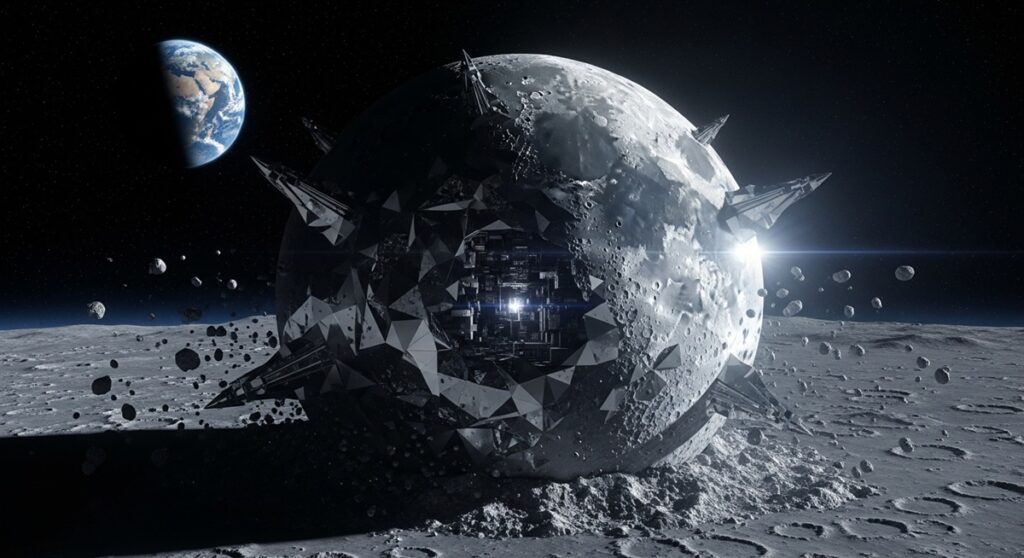
That is a much stronger scientific story than “India found sulfur.” The proposed explanation reaches backward into the Moon’s earliest geological history. The South Pole–Aitken basin is one of the oldest and largest impact structures in the Solar System, and its formation excavated enormous quantities of material from deep within the lunar crust and, most likely, its early mantle, a very different origin story from speculative claims that the Moon itself was artificially placed in orbit around Earth. If the interpretation holds, Chandrayaan-3 may have landed in a place where fragments of that ancient interior became accessible at the surface. The mystery is not who built something there. It is what the Moon itself was made of before the surface became the Moon we recognize today.
The Moon’s “Ruins” Were Never Part of the Scientific Record
This is where the viral version of the story has to be separated completely from the mission record. Chandrayaan-3 did not report tunnel-like cavities beneath the landing site. It did not identify dome-shaped structures. It did not detect walls, chambers, roads, buildings, machinery, manufactured alloys, inscriptions or anything else that would constitute archaeological evidence. Its principal surface instruments were designed to measure elemental composition, thermal properties, seismic activity and plasma, not to excavate an underground city. No ISRO mission announcement, peer-reviewed Chandrayaan-3 result, or published planetary-science paper has established an ancient artificial complex at Shiv Shakti Point.
That does not mean the Moon is geologically simple. Quite the opposite. Lunar regolith is continually modified by impacts, ejecta blankets, thermal cycling, radiation, micrometeorites and the violent history of the crust. A strange-looking image or an unusual spectral signature can therefore be genuinely interesting without being artificial. The scientific question is not whether a shape looks like a tunnel or whether a mineral seems unusual in isolation. It is whether independent measurements demonstrate geometry, composition, context and origin that cannot reasonably be explained by known lunar processes. Nothing in the Chandrayaan-3 record has crossed that threshold.
The Thermal Experiment Found Something Almost as Strange
One of Chandrayaan-3’s most useful discoveries came from an instrument that had nothing to do with chemistry. ChaSTE, the Chandra’s Surface Thermophysical Experiment aboard Vikram, inserted a thermal probe into the upper ten centimeters of lunar soil and produced the first in-situ temperature profile from a high-latitude lunar site. The measurements revealed just how strongly the Moon’s surface responds to local geometry. At the measurement location, the surface could become dramatically warmer than expected because the lander sat on a sunward-facing slope, while temperatures dropped rapidly with depth because the upper regolith acts as an exceptionally effective thermal blanket.
Published analysis, appearing as “Higher surface temperatures near south polar region of the Moon measured by ChaSTE experiment on-board Chandrayaan-3” by K. Durga Prasad and colleagues in Communications Earth & Environment, found peak modeled surface temperatures around 355 kelvin at the measurement location, with the unusual value explained by the local slope. The study also showed why this matters for future exploration: at high latitudes, a few degrees of terrain orientation can produce substantial differences in illumination and thermal behavior, and certain poleward-facing slopes may provide environments favorable to shallow water-ice accumulation. In other words, Chandrayaan-3 did not discover a hidden lunar building. It discovered that the geometry of a few meters of lunar terrain can alter the thermal environment enough to matter for where future explorers should look for resources.
Vikram Also Measured the Moon’s Invisible Environment
The lander was listening as well as measuring. ILSA, the Instrument for Lunar Seismic Activity, recorded vibrations generated by the rover and other surface activity and detected an event on August 26, 2023 that ISRO initially described as seemingly natural and worthy of further investigation. The experiment was designed to measure natural quakes, impacts and other ground vibrations and to help constrain the structure of the lunar crust and mantle. It was not a detector for artificial underground structures, and the existence of an unexplained seismic event is not evidence of one.
RAMBHA-LP produced another first: direct measurements of the near-surface lunar plasma environment at southern high latitude. Later analysis reported electron densities of roughly 380–600 electrons per cubic centimeter near the landing site. The result matters because the Moon’s surface is constantly interacting with solar ultraviolet radiation, solar-wind particles and, periodically, charged particles associated with Earth’s magnetotail. That creates a dynamic electrical environment immediately above the regolith, another invisible lunar system that Chandrayaan-3 could measure directly for the first time in this region.
The Real South-Pole Mystery Is Water, Not Architecture
The scientific reason so many missions care about the lunar south is straightforward. Permanently shadowed regions inside polar craters can remain extraordinarily cold for geological periods, allowing volatile compounds to survive in places where direct sunlight would otherwise drive them away. Water ice is the most consequential possibility because it is scientifically valuable and potentially useful for future exploration. It can preserve a record of the lunar environment, while in a future operational context water could potentially provide drinking water, oxygen and hydrogen-based propellant after processing.
That makes the south polar region a genuine international target. NASA, India, China, Japan, Europe and other lunar programs have all developed missions or studies focused on the polar environment. The attraction is not an ancient civilization hiding beneath the regolith. It is the possibility that the Moon’s coldest places contain a preserved chemical archive, and perhaps resources that could change the economics of sustained lunar exploration.
The Ancient Material Is the Part That Deserves the Headlines
There is a particularly beautiful irony in the way the rumor grew. The Moon really does contain material that is almost unimaginably ancient. The primitive-mantle interpretation emerging from Chandrayaan-3 data concerns material associated with the Moon’s deep interior and an impact that occurred roughly 4.3 billion years ago. The rover therefore did encounter something that predates almost every familiar feature on the lunar surface. It just wasn’t a ruin. It was geology.
The 2024 APXS analysis found the local soil broadly consistent with ferroan anorthosite, supporting the idea that the Moon once possessed a global magma ocean whose lighter minerals crystallized and floated toward the surface. The 2025 volatile-element analysis then used sulfur, sodium and potassium abundances to argue for a contribution from more primitive material excavated by the South Pole–Aitken event. And in July 2026, a follow-up analysis, published as “Chandrayaan-3 APXS measurements reveal Lunar highland compositional diversity and meteorite connections” in npj Space Exploration, connected the geochemical composition at Shiv Shakti Point closely with the lunar meteorite ALHA 81005, giving researchers another way to compare the rover’s measurements with material already available on Earth.

And the Data Were Not Locked Away
There is another detail that matters whenever a spectacular alternative claim is built around a supposed discovery. Chandrayaan-3’s science data did not remain the property of a secretive inner circle. ISRO released the mission datasets to the scientific community and public through the Indian Space Science Data Centre in August 2024. The agency states that the datasets were archived in the PDS4 standard and peer reviewed for release, allowing researchers beyond the original mission teams to examine and analyze the observations.
That does not make every interpretation automatically correct. Peer review is not an oracle, and scientific conclusions can be revised as more data arrive. What it does provide is something the ruins story lacks: a traceable evidentiary chain. We know which spacecraft carried which instrument. We know what each instrument was designed to measure. We know where the rover traveled. We know which elements were detected. We know which measurements have entered peer-reviewed literature. We can compare later interpretations with earlier observations. That is what a real scientific discovery looks like when the excitement is stripped away.
What Chandrayaan-3 Actually Changed
Chandrayaan-3 did not overturn lunar science. It did something more valuable: it added measurements from a part of the Moon that previous surface missions had not sampled directly. The APXS results strengthened the case that the southern highlands preserve material connected to the Moon’s early differentiation. The sulfur work opened a window onto volatile-element behavior and possible primitive mantle contributions. ChaSTE demonstrated how strongly local slopes influence polar temperatures. RAMBHA-LP supplied new measurements of the near-surface plasma environment. ILSA added seismic observations from a new location. And the continuing analysis of the dataset is still producing results years after the lander first touched down.
That is the important distinction between an extraordinary discovery and an extraordinary claim. An extraordinary claim asks you to believe that a familiar instrument secretly found something its designers did not report, something no published analysis describes, and something no independent team has confirmed. Chandrayaan-3’s actual science requires none of that. The evidence is already extraordinary: sulfur where earlier orbital observations could not directly establish it, material that may preserve clues from the Moon’s primitive interior, a thermal landscape changing over meters, an active plasma environment above the regolith, seismic vibrations beneath the lander, and a geological history written into a few handfuls of lunar soil.
The Moon Doesn’t Need Ruins to Be Ancient
The most durable version of the Chandrayaan-3 story is therefore not that India found evidence of something built on the Moon. It is that India reached a region where the Moon’s own past is unusually exposed. A rover the size of a small machine crossed roughly a hundred meters of alien terrain, fired lasers into rocks, measured X-rays from the soil, pushed a thermal probe into the regolith, listened for vibrations and sampled the electrical environment above the ground. From those tiny measurements, scientists are reconstructing events that happened billions of years before humanity existed.
No tunnel is required. No buried city is required. No ancient astronaut is required.
The ruins were never the discovery. The discovery was the Moon itself: its sulfur, its ancient interior, its thermal extremes, its plasma, its impacts, and the geological memory still trapped beneath the dust. Chandrayaan-3 did not find evidence that someone built the Moon. It found something harder to fake and far more consequential, a little more evidence of how the Moon became the Moon.