




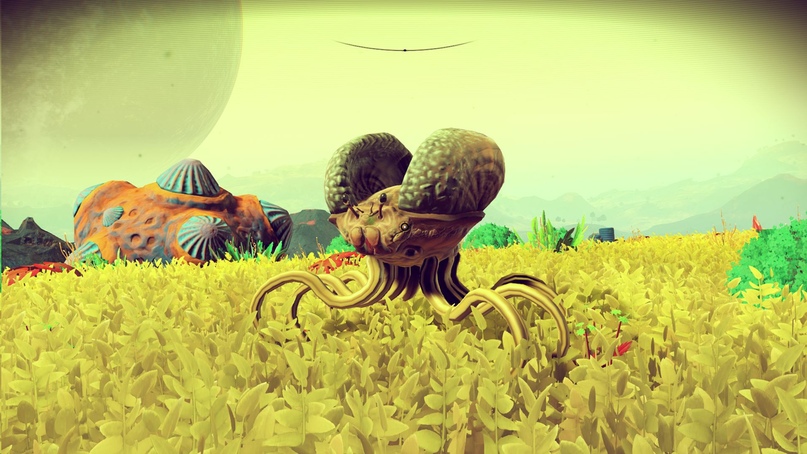
The shark and the dolphin are not related. Their common ancestor was a fish that lived approximately three hundred and ten million years ago, before the lineage that would eventually produce mammals had developed any of the characteristics that distinguish mammals from fish. The dolphin’s ancestors left the ocean, became terrestrial, spent approximately fifty million years as land animals, and then returned to the sea. In returning, they redeveloped a streamlined torpedo body, a large tail fin for propulsion, and forelimbs modified into stabilizing surfaces. They redeveloped, through an entirely independent evolutionary pathway, the same body plan that the shark had maintained continuously for four hundred million years.
The ichthyosaur did the same thing from the reptile lineage. The tuna did it from a different fish lineage than the shark. Four separate evolutionary histories, separated by hundreds of millions of years of divergence, producing the same solution to the same problem: how to move efficiently through water while pursuing fast-moving prey.
This is convergent evolution. The principle it demonstrates is that the laws of physics constrain the available solutions to biological problems. Water has the same density and viscosity everywhere life has encountered it. A predator hunting in water is subject to the same hydrodynamic constraints regardless of its ancestry. The constraints are universal. The optimal solution to those constraints is therefore universal. Wherever in the universe liquid water exists and life arises within it, the bodies of fast aquatic predators will look like sharks.
The extraterrestrial implication of this principle is the most important and least developed insight in the study of what alien life might be.
The Eye Problem
The vertebrate eye evolved once, in the lineage that produced fish, approximately five hundred million years ago. The cephalopod eye evolved independently, in the lineage that produced squid and octopuses, from an ancestor that shared no eye-producing genetic architecture with the vertebrate line. The two eyes are structurally different in one significant way: the vertebrate retina is wired backward, with the photoreceptors pointing away from the light and the wiring running across the front of the retina before passing through the optic disc, creating a blind spot. The cephalopod retina is wired correctly, with the photoreceptors facing the light.

Identical function. Independent origin. One design flaw in the vertebrate version that the cephalopod version does not share.
The eye has evolved independently at least forty times in the animal kingdom. In insects, in mollusks, in vertebrates, in annelid worms, in cnidarians, in arthropods. Every lineage with sufficient complexity and sufficient evolutionary time that lives in environments with light has independently arrived at the same solution: a light-gathering structure with a focusing element and a photosensitive surface that converts electromagnetic radiation into neural signals.
The solution is universal because the problem is universal. Light carries information about the environment. Any organism that can detect and process that information has a survival advantage. The physical properties of light, its behavior when passing through a transparent medium, its behavior when striking a curved surface, its behavior when absorbed by molecular structures, are the same everywhere in the universe where physics operates as it does here.
Any planet with sunlight and sufficient evolutionary time will produce eyes. Not similar eyes. The same eyes.
The Carbon Constraint
Life requires a molecular architecture capable of storing and processing information, replicating that information, and catalyzing the chemical reactions that convert environmental energy into biological work. Carbon forms more types of stable complex molecules under the temperature and pressure conditions compatible with liquid water than any other element in the periodic table. Its bonding properties allow it to form chains, rings, and branching structures of essentially unlimited length and complexity, producing the polymer chemistry that proteins and nucleic acids are built from.

Silicon is the most commonly proposed alternative backbone for life chemistry. Silicon chemistry at room temperature produces solid polymers: glass, quartz, the geological silicates that make up most of the Earth’s crust. The flexibility and dynamic reactivity that biological processes require from their molecular machinery are properties that silicon chemistry does not provide under conditions compatible with liquid water. Silicon chemistry at extremely high temperatures produces different properties, but those temperatures are incompatible with the existence of liquid water.
Life chemistry based on carbon in liquid water is not an anthropocentric assumption. It is the consequence of the chemistry of the available elements under the physical conditions that liquid water requires. Any planet with liquid water and a source of chemical energy will produce carbon-based biochemistry, because carbon is the only element that produces the required molecular architecture under those conditions.
The alternative biochemistries of science fiction, the acid-blooded xenomorph, the sulfur-based metabolism, the ammonia ocean, each require abandoning either the liquid water constraint or the carbon constraint. Abandoning them requires planetary conditions so extreme that the evolutionary pathways producing complex multicellular life become implausible or require timeframes that exceed the current age of the universe.
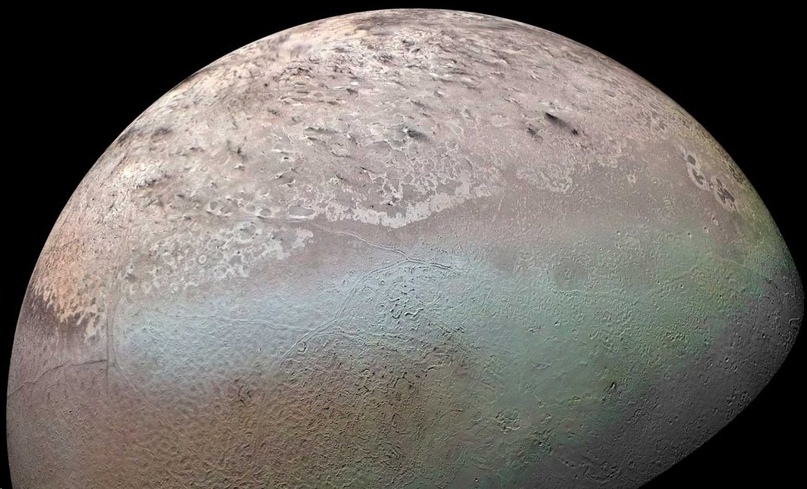
Genuinely alien biochemistry exists. It exists on Titan, where methane lakes provide a solvent in which cryochemistry might produce something. It exists potentially in the subsurface ocean of Europa, where liquid water under ice could support carbon chemistry in permanent darkness. What it produces in those environments, if it produces anything, will be unrecognizable as life by any criterion familiar to us. It will be microbial in complexity at most and will require direct chemical analysis to identify as biological rather than geological.
The life that will be complex enough to build civilizations and cross interstellar distances will be carbon-based, water-dependent, and will have evolved under conditions that produced, through the same convergent pressures, the same fundamental body plans that Earth’s evolutionary history produced.
What Intelligence Requires
The octopus has approximately five hundred million neurons. Two-thirds of them are distributed through its eight arms rather than centralized in a brain. It evolved from an ancestor that had no nervous system. The vertebrate lineage evolved its centralized nervous system independently, from a different ancestor with a different body plan and a different evolutionary pathway.

Both lineages produced intelligence. The intelligence is different in character. The octopus solves problems through a distributed architecture in which the arms process information semi-independently before that information is integrated centrally. Its problem-solving approach is demonstrably unlike vertebrate problem-solving in measurable ways. It is also demonstrably real, documented in peer-reviewed research, and surprising in its sophistication to researchers who did not expect intelligence of this quality from an invertebrate.
The octopus is the best available model for what convergent intelligence from a different evolutionary pathway looks like. It is recognizable as intelligent. Its intelligence is alien in its architecture. It provides no ability to predict what it will do next from principles derived from vertebrate behavior. It is the thing that the concept of alien intelligence refers to before the concept becomes a cultural projection.
The evolutionary pressures that produce intelligence are not unique to Earth. Any planet with sufficient complexity of life, sufficient environmental variability to drive cognitive evolution, and sufficient geological time will eventually produce intelligence, because intelligence is the most effective general-purpose adaptation available to complex organisms. It allows the organism to solve novel problems without genetic change. Its advantage over purely instinctual behavior is so large that any lineage that develops even rudimentary cognitive flexibility will outcompete equivalent lineages that have not.

Intelligence will be universal for the same reason that eyes are universal. The problem it solves is universal. The selective pressure it responds to is universal. The solution space is constrained by the same physics and chemistry everywhere.
What intelligence will look like depends on the body plan of the lineage that develops it. A lineage that develops intelligence through social predation will produce forward-facing eyes, bilateral symmetry, manipulative appendages, and upright or partially upright posture, because these are the physical requirements of a social predator that uses tools. A lineage that develops intelligence through social herbivory will produce different physical characteristics but the same cognitive architecture.
The body plan that the contact literature describes consistently for the Grays is the body plan of a social predator that developed tools: bilateral symmetry, forward-facing large eyes, reduced physical musculature suggesting a long history of tool-mediated rather than physically-mediated problem-solving, upright posture, manipulative four-fingered hands. This is not a human projection of what alien intelligence should look like. It is the convergent prediction of evolutionary biology applied to the question of what intelligent tool-using social predators will look like when they arise on Earth-like planets.

Whether the contact accounts are accurate is a separate question. If they are accurate, the beings described are exactly what convergent evolution predicts.
The Planetary Variable
Genuinely alien morphology requires genuinely alien planetary conditions. The source of genuinely different body plans is not different biochemistry under Earth-like conditions. It is radically different gravity, radically different atmospheric density, or radically different energy availability.
A super-Earth with two to three times Earth’s gravity will produce a biosphere dominated by low-slung, heavily built organisms. The energetic cost of supporting body mass against strong gravity selects against height and selects for broad, stable contact with the ground. Bipedalism becomes energetically inefficient. The large terrestrial vertebrates will be serpentine, maximizing surface contact and minimizing the metabolic cost of supporting body weight against the gravitational field.
This is not speculation. It is the physics of structural mechanics applied to biological bodies. The breaking stress of bone scales with cross-sectional area. The weight of a body scales with volume. Doubling gravity without changing the structural material requires either reducing the linear dimensions of the organism by a factor of two, which produces smaller animals, or increasing the cross-sectional area of the supporting structures by a factor of two, which produces stockier animals. Both adaptations occur in Earth organisms adapted to water, which provides partial gravitational support. On a high-gravity planet, both adaptations will occur simultaneously.

A low-gravity planet with a dense atmosphere produces the opposite selection pressure. Flight becomes accessible to larger body masses. The energetic cost of aerial locomotion decreases. The first organisms to exploit aerial locomotion will be plants, rising above the competition to reach the light. Animals will follow plants into the air, because that is where the food is. The large predators at the top of the food web will be aerial.
The atmospheric density variable produces the condition that science fiction consistently misrepresents. A planet with a dense atmosphere is not a planet where Earth-like creatures live in thick air. It is a planet where the ecological role that large terrestrial animals play on Earth is occupied by large aerial organisms. The ground becomes the equivalent of the deep ocean: a resource-poor environment inhabited by scavengers and specialized organisms, while the primary ecological productivity occurs at altitude.
The Convergent Conclusion
The universe constrains the options. The physics is the same everywhere. The chemistry is the same everywhere. The selective pressures that shape evolution are derived from the physics and chemistry of the planetary environment. On Earth-like planets with liquid water, carbon chemistry, and sufficient geological time, the selective pressures are similar enough to those that operated on Earth that the solutions will be recognizable: bilateral symmetry, directed sensory organs, manipulative appendages, social organization, intelligence.

On radically different planets, genuinely different solutions will arise. They will be unrecognizable as animals. They will be, if complex at all, analogous to the extremophilic organisms that occupy Earth’s most hostile environments, adapted to conditions that preclude the development of the body plans that intelligence requires.
The contact accounts documented elsewhere on this site describe beings that are recognizable as the convergent evolutionary product of an Earth-like planet. This is either evidence that the accounts are fabricated from human assumptions about alien morphology, or evidence that the beings described arose under conditions similar enough to Earth’s that convergent evolution produced similar solutions.
The convergent evolution argument cannot resolve that ambiguity from the outside. It can only note that if intelligent life from other planets exists and is capable of interstellar travel, it will look like what the contact literature describes. Not because that is what we imagined. Because that is what the physics produces.

The shark and the dolphin solved the same problem from different starting points and arrived at the same answer. Whatever intelligence arose somewhere else in the galaxy started from a different point and solved the same problems. The answer, if the conditions were similar, will be the same answer.
Large eyes. Bilateral symmetry. Hands.