


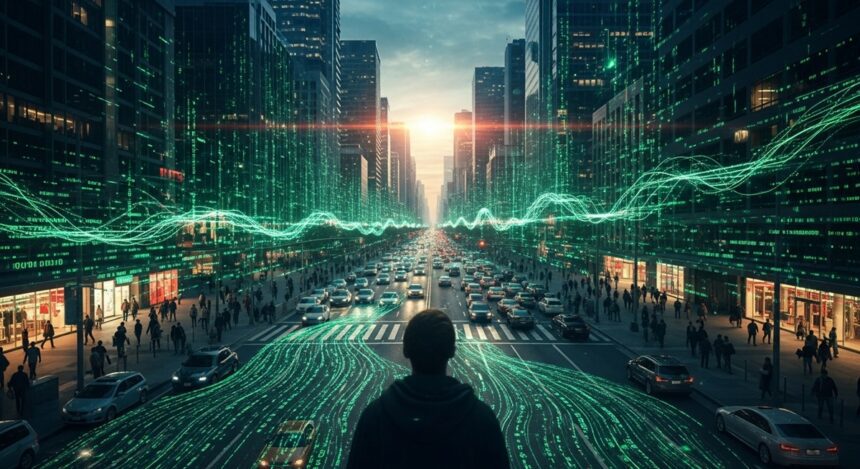
What if the relentless crush of gravity, the fleeting joy of a summer sunset, and the cold logic of mathematics are nothing more than intricate, complex lines of code? What if the entirety of our perceived reality—the planet Earth, the galaxies, and every human emotion—is merely a sophisticated illusion? We are not speaking of a mere philosophical exercise but a profound metaphysical dread | the possibility that we are not autonomous beings, but avatars in a grandiose, digital role-playing game created by an incomprehensibly powerful, unseen intelligence.
The notion exploded into mass consciousness with the dystopian elegance of The Matrix in 1999. Yet, the true power of the simulation hypothesis is that it is not new. It is the modern, chilling rebirth of the most ancient spiritual truths, a concept that stretches back thousands of years, intertwining the quantum computer with the revelations of mystics and prophets who warned us that the world is not what it seems.
The Triple Argument. From Plato’s Cave to Bostrom’s Code
The 20th-century cinematic fantasy of a virtual world managed by a machine intelligence quickly evolved into a rigorous scientific and philosophical concept. The modern formulation, stripped of Hollywood flair, belongs to the Oxford philosopher Nick Bostrom. In his famous 2003 paper, he presented a powerful “triple argument” that demands an honest confrontation with our reality:
- Technological Trajectory: Any technologically advanced civilization, provided its progress continues, will inevitably reach a level where it can create virtual worlds indistinguishable from physical reality.
- Computational Capacity: Once this capacity is reached, they will possess the computational power to run millions of these virtual worlds, populated by characters endowed with artificial consciousness.
- The Statistical Implication: If the number of simulated worlds vastly outnumbers the single “base reality,” then the statistical probability strongly suggests that you and I are currently inside one of those simulations.
This cold, statistical logic elevates the simulation hypothesis from idle speculation to an existential challenge. Even without conclusive proof, the logical framework forces us to accept a 50/50 probability, as suggested by astronomers like David Kipping of Columbia University. We are at a metaphysical coin flip regarding the authenticity of our existence.
The Problem of Algorithmic Complexity

While the hypothesis is compelling, it is not without its resistance. Some researchers, citing papers as recent as 2025, argue that no purely algorithmic system could adequately explain the sheer, irreducible complexity and fine-tuned constants of our universe. The system would require infinite processing power to render every molecule, every quantum fluctuation, with perfect fidelity.
However, a dystopian rebuttal exists | the simulation doesn’t need to render the entire universe. It only needs to render the parts we are currently observing. The rest remains code until the observer—the avatar we inhabit—turns to look at it. This economization of processing power makes the simulated cosmos chillingly plausible.
The Divine Command God as Programmer, World as Code
Perhaps the most compelling evidence for the theory’s resonance lies in its unexpected parallel with ancient religious cosmology. The transhumanist philosopher David Peirce once called Bostrom’s argument “the first interesting evidence for the existence of a Creator in $2,000$ years.”
Creation by Command
In the Abrahamic religions—Judaism, Christianity, and Islam—the mechanism of creation is the word. “And God said, Let there be light. And there was light.” In the simulation hypothesis, the universe is also brought forth through commands—lines of computer code. The divine utterance is replaced by the digital instruction.
Today, this ancient metaphor has become technologically literal. Modern artificial intelligence systems, like the highly advanced software introduced in August 2025, known as Genie 3, allow users to generate vast, photorealistic virtual worlds simply from a text prompt. Where in the past, such worlds required armies of designers, today, artificial intelligence makes it possible to generate virtual universes as vast and complex as our own world with minimal input. The capability of the simulator intelligence would be infinitely beyond that of Genie 3, transforming the entire cosmos into a single, breathtaking text prompt.
Soul and Avatar Ancient Wisdom in the Digital Age
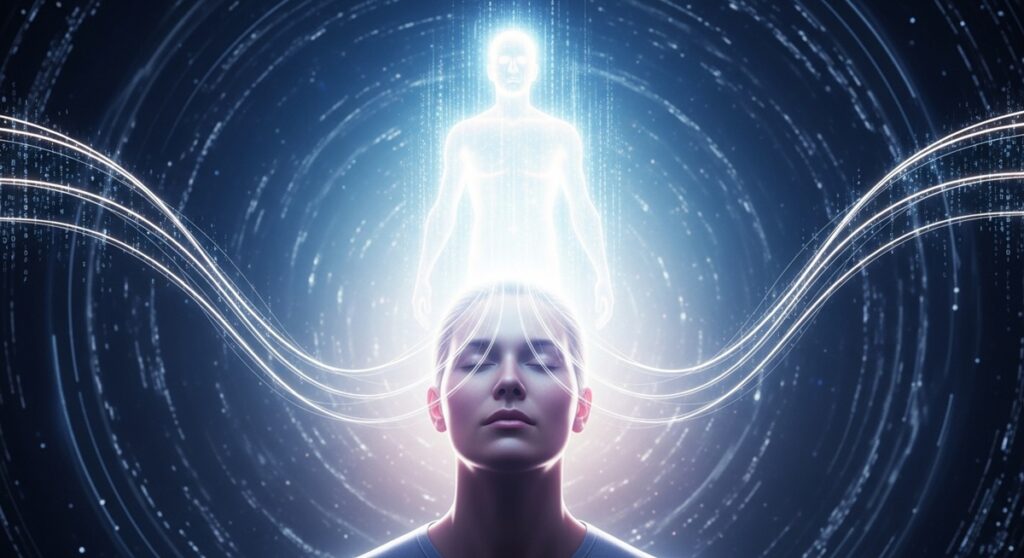
The deepest parallel between spiritual philosophy and the simulation hypothesis emerges in the concept of the soul’s relationship to the body—a comparison we define as the “role-playing game” analogy. The simulation is like a multiplayer video game | each character within the game is merely the interface for an external player who controls them, thus preserving the concept of free will.
The Incarnation Metaphor
The term “avatar” itself, used ubiquitously in digital contexts, has profound roots in Sanskrit, the language of the sacred texts of Hinduism, Buddhism, and Jainism. In Hinduism, avatar means the embodiment, or descent, of a divine being into human form.
The idea of incarnation, the soul’s temporary possession of the body, is central to many mystical traditions. The Bible describes quickening through the metaphor of breath | “And the Lord God formed man from the dust of the ground, and breathed into his face the breath of life, and man became a living soul.” The soul is the player, and the body is the temporary game vessel.
The Persian poet Rumi, exploring Sufi themes, famously compared the body to clothes that the spirit wears and can remove or replace. The sacred Hindu text, the Bhagavad-gita, uses an identical metaphor:
“As a man puts on new clothes when he takes off his old clothes, so the soul puts on new ones when he throws off his worn-out bodies.”
If the soul is the external player in a virtual reality, and the body is its character inside the game—a character that has forgotten its origin—then the parallel is complete. The game may end, the character may die, but the player continues to exist outside of the simulation. This explains the cycles of reincarnation taught in many religions | the player enters the game over and over again, taking on different roles to complete various experiences or missions.
Awakening from Maya The Ultimate Dystopian Dream
The simulation hypothesis resonates most deeply with the philosophical concept that the physical world is fundamentally unreal, or at least only a partial expression of true reality.
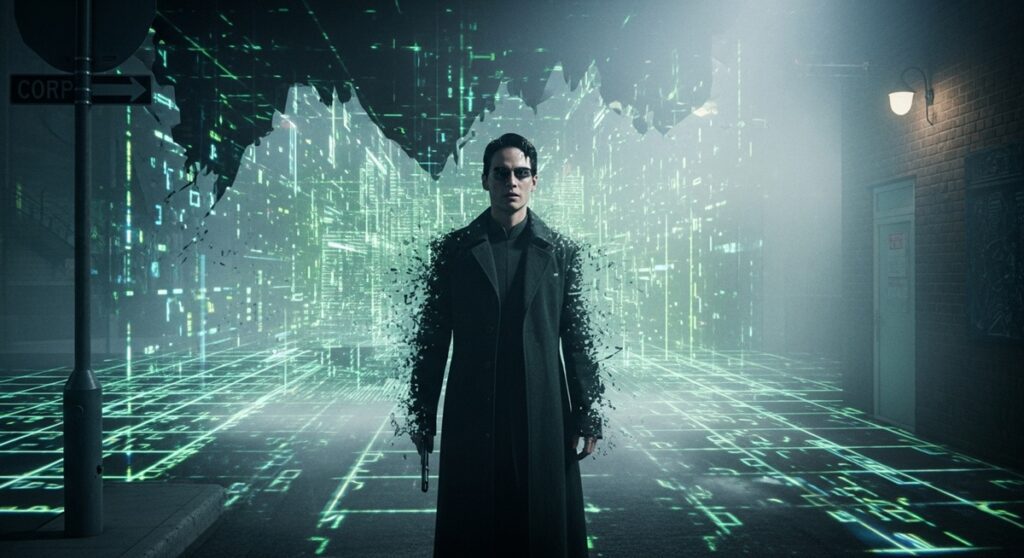
This idea is most clearly expressed in the Hindu and Buddhist traditions, which describe the world as the result of maya—illusion. The common metaphor is that the world is a dream from which one can awaken. Indeed, a popular definition of the term “Buddha” is “awakened.” The Samadhiraja Sutra explicitly states:
“Know that all things are alike | A mirage, a castle on a cloud, Dream, vision, Devoid of essence, but possessing visible qualities.”
The Updated Metaphor
Paramahansa Yogananda, the author of The Autobiography of a Yogi, who introduced meditation and yoga to the West, used the relatively new technology of the 1920s—the cinema—to explain maya, comparing people’s perception of physical reality to actors acting in a movie.
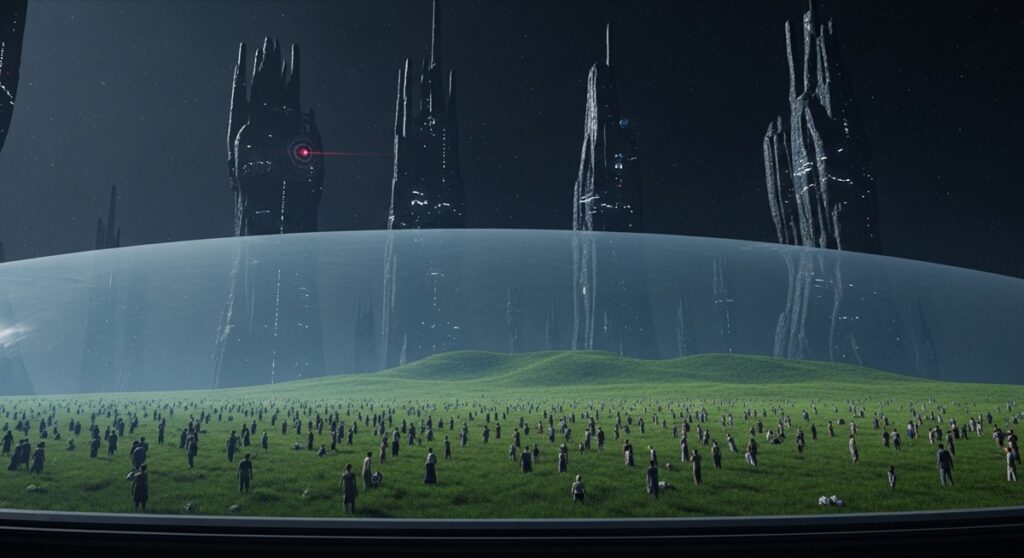
If the famous swami were alive today, his metaphor would be chillingly updated to video games.
In the key scene of The Matrix, Neo’s mentor, Morpheus—whose name is taken from the Greek god of dreams—tells him that he lives in a dream world. The modern simulation hypothesis simply replaces the dream-state with an artificial, computationally managed dream-state. The underlying ontological dread remains the same.
The only authentic reaction to this realization is perhaps to echo Neo’s stunned realization | “Wow.” But today, this “wow” no longer sounds like a reaction to science fiction; it sounds like the recognition that ancient spiritual truths can find the most unexpected, technologically advanced confirmation in the digital landscape of the 21st century. The question is, if we are characters in someone else’s game, is the ultimate goal to win, or simply to wake up?