The Stanford sleep laboratory established one direction of the channel in 2021. The MIT Fluid Interfaces Laboratory established the other.
The Oneironaut piece covered in this library covers Karen Konkoly and colleagues’ published research demonstrating two-way communication with lucid dreamers during REM sleep: the dreamer signals awareness through pre-agreed eye movements, receives a mathematical problem through external audio, and signals the answer through eye movements while remaining asleep and dreaming. The communication is confirmed as bidirectional, externally verifiable, and scientifically reproducible. The channel from inside the dream to the waking laboratory works.
Adam Haar Horowitz and Tomás Vega at MIT’s Fluid Interfaces Laboratory published their research on the Dormio device and targeted dream incubation in the peer-reviewed journal Consciousness and Cognition, establishing the channel from the waking laboratory into the dream. Their finding: auditory cues delivered at the precise moment of hypnagogic onset, the transitional state between wakefulness and sleep, were incorporated into subsequent dream content at a rate of 67 percent across 25 participants.
The full sentence that these two findings together write is real and consequential for the library’s consciousness framework: waking consciousness can insert content into dreaming consciousness, and dreaming consciousness can transmit information to waking consciousness, through established experimental protocols using technology available to a university laboratory.
The boundary between waking and dreaming that human experience treats as impermeable is recorded as a membrane with confirmed permeability in both directions.
Whatever that means for the nature of consciousness, it means something more than the conventional neuroscientific model of dreams as random neural noise has accommodated.
![Inception - Official Trailer [HD]](https://www.monkeyandelf.com/wp-content/cache/flying-press/c6db5b8fcb4b689b32c2bcad410ad199.jpg)
The Dormio Device and What It Detects
The technical challenge of targeted dream incubation is not the audio delivery but the timing. Delivering auditory content during deep sleep produces minimal dream incorporation. Delivering it during REM produces some incorporation but the dreamer is often too deeply asleep to process the content into dream narrative. The optimal window is the hypnagogic transition, the minutes during which waking consciousness is dissolving into dreaming consciousness and the mind is simultaneously in both states.
The Dormio device addresses this timing problem by monitoring the physiological signatures of hypnagogic onset: heart rate deceleration, a characteristic drop in galvanic skin response reflecting reduced cortical arousal, and finger flexion as the hand’s muscles relax. The combination of these three biosignals, processed through the device’s software, provides a real-time indicator of hypnagogic onset with sufficient precision to trigger audio delivery at the optimal window.
The experimental protocol developed by Horowitz and Vega used serial awakenings during daytime napping sessions: the Dormio device detected hypnagogic onset, triggered an audio prompt such as remember to think about a tree, and then triggered a second audio prompt asking the participant to describe their current thoughts before waking them for a dream report. The cycle was repeated multiple times across the session.
The 67 percent incorporation rate for the tree prompt is the recorded result. Dream reports mentioning trees included elaborations whose character the study notes: I followed the roots with someone and the roots transported me to different places, a tree from my childhood that had never appeared before, a tree divided into infinite pieces with a shaman at its base. The prompt generated not simple inclusion of a tree but elaborated narrative integration of the tree into the dream’s symbolic and narrative fabric.
Whether this elaboration reflects the dreaming mind’s characteristic tendency to narrativize any input through its existing associative networks, or reflects something whose character the existing hypnagogic susceptibility research does not fully account for, is the question that the quality of the dream reports raises beyond the simple incorporation percentage.
The Hypnagogic State’s Significance
The hypnagogic transition is the altered state whose known characteristics make the MIT findings most significant for the library’s broader framework.
In standard waking consciousness, external auditory input is processed through the full critical evaluation apparatus of the alert brain: attribution of source, semantic analysis, pragmatic interpretation, and rejection or acceptance based on prior knowledge and current context. In deep sleep, auditory input is largely not processed into conscious experience at all. In the hypnagogic transition, external auditory input is processed without the full critical evaluation apparatus but with the narrative and symbolic elaboration capacity of dreaming consciousness intact.
The cognitive profile of hypnagogia, recorded in the sleep research literature, includes reduced critical evaluation of incoming content, increased associative elaboration of that content, heightened susceptibility to suggestion, and a characteristic sense of insight and significance attached to the content that is being processed. Edison’s well known practice of holding a steel ball while napping, so that it would drop and wake him at the hypnagogic threshold to capture the quality of insight the state produced, appears in the history of invention as a technique for accessing hypnagogic cognition.

The library’s Shadow at the Bed piece covers the Hat Man entity’s appearance during hypnagogic and hypnopompic states across multiple independent cultural traditions. If the hypnagogic state is specifically susceptible to external content insertion at a 67 percent rate, the cross-cultural consistency of hypnagogic entities acquires a new dimension: either the entities are genuine non-human presences that the hypnagogic state’s reduced critical evaluation makes perceptible in a way that waking consciousness filters out, or the hypnagogic state’s known susceptibility to suggestion is being activated by something whose consistent cross-cultural manifestation requires explanation at a different level than random neural noise provides.
The MIT research does not resolve this question. It makes it more specific.
The MKULTRA Dimension
The well known CIA MKULTRA program’s interest in dream manipulation and hypnagogic consciousness alteration is relevant context for the MIT Dormio research without implying any institutional connection between them.
MKULTRA’s known subprojects included investigations of hypnosis, suggestion under altered states, and the use of chemical agents including LSD to access consciousness states whose susceptibility to programming the program’s researchers were attempting to understand and exploit. Whether any classified research continuation of MKULTRA’s consciousness manipulation programs has produced technologies comparable to the MIT Dormio system’s capabilities is not established in the declassified record.
What is established is that the institutional interest in the capability that MIT has now confirmed in a peer-reviewed publication, the ability to insert content into consciousness at the hypnagogic transition, was recorded as a priority research area in the CIA’s classified consciousness research programs of the 1950s and 1960s. Whether a sixty-year gap between the classified research and the academic publication reflects the normal pace of scientific development in a difficult research area, the suppression of intermediate classified findings, or the genuine difficulty of the problem’s technical requirements, is the question that the institutional history motivates without the available record resolving.
The MIT research is academic, published, peer-reviewed, and conducted under university ethics oversight. It represents the legitimate end of a research tradition whose classified beginning is well established. Whether the two ends of the tradition are connected by a continuous classified middle whose findings are not in the public record is the question that the known MKULTRA priority and the MIT publication together raise.
The Bidirectional Framework
The contribution that the MIT Dormio research makes to the library’s consciousness framework, when combined with the Stanford lucid dreaming communication research recorded in the Oneironaut piece, is the empirical establishment of bidirectional communication across the waking-dreaming boundary as a confirmed laboratory phenomenon.
This has implications that neither piece alone establishes.
If dreaming consciousness can receive and elaborate external content at the hypnagogic transition, and dreaming consciousness can transmit information to waking observers through pre-agreed motor signals during REM sleep, the model of dreaming as a closed system isolated from external reality by the sleeping brain’s reduced sensory processing is empirically insufficient. The dreaming mind is not isolated. It is accessible from outside, and it has access to the outside.
The question this raises for the library’s consciousness-simulation framework is whether the accessibility of dreaming consciousness to external content insertion reflects a general property of consciousness as an information-processing system rather than a vulnerability of the sleeping brain. If consciousness in the dreaming state can receive externally inserted content at a 67 percent rate, the question of whether consciousness in the waking state is similarly accessible to external content insertion through mechanisms whose operation is less visible than the Dormio system’s acoustic delivery is the question that the bidirectional framework motivates.
Whether the Gnostic Archon tradition’s framework of consciousness management by external intelligences, the Djinn tradition’s claimed capacity for possession and thought insertion, and the abduction research tradition’s recorded accounts of externally induced perceptual experiences, all connect to a genuine property of consciousness as a system that is more accessible to external modification than the standard neuroscientific model of isolated individual subjective experience acknowledges, is the question that the MIT and Stanford findings together raise from the experimental direction.
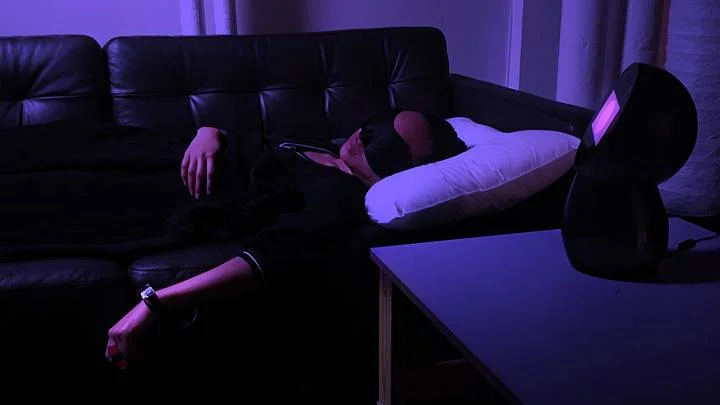
The technology is a wristband and a phone app. The capability it demonstrates is specific, confirmed, and reproducible.
The channel is open in both directions.
What was always using it before the laboratory confirmed it exists is the question that the ancient traditions of dream visitation, dream communication, and consciousness alteration have been asking across every culture in human history.
MIT has now confirmed that the channel is real.