




In September 1981, one of the world’s most respected scientific journals published an editorial with a title that sounded less like a review than a sentence from an inquisition: “A book for burning?”
The book was A New Science of Life. Its author was Rupert Sheldrake, a Cambridge-trained biochemist who had already built a serious career in conventional plant science. He had studied natural sciences at Cambridge, earned a PhD in biochemistry, held a fellowship at Clare College, worked as a Royal Society research fellow, and spent four years in India running a plant-physiology research programme. Before he became associated with telepathy, psychic pets and morphic resonance, he was doing the sort of laboratory biology that belonged comfortably inside the scientific establishment.

That background matters because the Sheldrake story is often told in one of two deliberately simple ways. In one version, an establishment scientist discovered a revolutionary truth and was persecuted because science cannot tolerate ideas that threaten its assumptions. In the other, a respectable biologist abandoned evidence for pseudoscience and received exactly the reaction his claims deserved. Neither version captures what actually happened. Sheldrake really did have substantial scientific credentials. Nature really did publish one of the harshest reviews imaginable. He really did spend decades conducting experiments that he believed could test parts of his broader hypothesis. And yet the existence of those experiments does not establish the hypothesis they were designed to investigate.
Before the Controversy, Sheldrake Was Doing Conventional Science
Alfred Rupert Sheldrake was born in England in 1942 and entered Clare College, Cambridge, where he studied natural sciences. In 1964 he was awarded a fellowship to study the philosophy and history of science at Harvard, before returning to Cambridge for doctoral research in biochemistry. His PhD concerned hormone production in higher plants. He subsequently became a Fellow of Clare College and worked in Cambridge’s Department of Biochemistry, including as a Royal Society research fellow.
His early research was not fringe science. Working with Philip Rubery, Sheldrake investigated the transport of auxin, a plant hormone central to growth and development. Their work helped establish a cellular and chemiosmotic account of polar auxin transport, a mechanism the field would later refine through the discovery of dedicated transport proteins. Whatever one thinks of Sheldrake’s later theories, his early career cannot fairly be rewritten as though he had entered science with no conventional accomplishments behind him.

He then spent several years as principal plant physiologist at the International Crops Research Institute for the Semi-Arid Tropics in India, where he researched crop physiology and co-authored work on the pigeonpea. This was mainstream experimental plant biology, concerned with growth, development, stress and agricultural productivity. The later controversy therefore did not begin with an outsider borrowing scientific vocabulary. It began with a trained biologist deciding that the existing biological picture was incomplete.
Then Sheldrake Proposed Something Radically Different
A New Science of Life, published in 1981, proposed what Sheldrake called the hypothesis of formative causation. He later developed this into the broader concept of morphic resonance. The basic claim was extraordinary: the forms and behaviours of organisms were not determined solely by genes, chemistry and conventional physical causes. Nature, he proposed, possessed a kind of collective memory.
In Sheldrake’s model, once a particular form or pattern had occurred repeatedly, similar systems would become more likely to reproduce that pattern through a process he called morphic resonance. An organism would therefore inherit more than genetic information. Its development would also be influenced by the accumulated history of similar organisms. The familiar shape of an oak tree, in this account, would not be explained entirely by DNA, biochemical processes and environmental conditions. It would also reflect a field-like memory of previous oaks.

That was already a profound departure from conventional biology. Sheldrake then extended the idea into territory that made the controversy much larger: animal learning, crystal formation, animal behaviour and eventually phenomena associated with telepathy and precognition. If morphic resonance were real in the form he proposed, the implications would reach far beyond one disputed mechanism of plant development. It would suggest that memory and information were properties of nature operating outside the boundaries normally assigned to individual organisms.
Why Nature Used the Word “Burning”
John Maddox, then a senior editor at Nature, responded in September 1981 with an editorial titled “A book for burning?” The question mark mattered: Maddox was not literally advocating that Sheldrake’s book be destroyed. But the body of the editorial was unmistakably severe. He called it “the best candidate for burning there has been for many years” and argued that Sheldrake’s proposal was not a scientific argument but an exercise in pseudoscience.
The central criticism was not simply that the hypothesis sounded strange. It was methodological. Maddox argued that morphic resonance was not formulated in a sufficiently falsifiable way. If an unexpected result could always be accommodated by proposing another morphic field or another layer of influence, then the hypothesis risked becoming impossible to defeat experimentally. A theory that can explain both an observed effect and its absence can appear powerful while actually making very few risky predictions.

This distinction is crucial. Saying that an idea is difficult to falsify is not the same as proving that the idea is false. Nor does criticism of its methodology establish that every experiment associated with it is worthless. It means that the burden of specification becomes unusually high: the hypothesis must tell investigators in advance what result would count against it, not merely what result can be interpreted after the fact as compatible with it.
The editorial also became part of the history it was criticizing. The phrase “book for burning” was so memorable that it helped turn Sheldrake from a relatively obscure biologist with an unconventional theory into a public symbol of scientific dissent. Maddox later acknowledged that the tone of the editorial had been injudicious. That concession, however, did not amount to a scientific endorsement of morphic resonance. The rhetorical excess and the methodological criticism were two separate questions.
The Strange Part Is That Sheldrake Kept Doing Experiments
If the story ended with the Nature editorial, it would be easy to classify it as a familiar episode of scientific controversy. It did not. Sheldrake spent much of the following decades trying to construct experiments that could turn his broader claims into measurable questions.
One of the most famous involved a dog named Jaytee. Sheldrake and Pamela Smart conducted videotaped observations in which Jaytee appeared to spend substantially more time at a window when his owner, Smart, had begun her journey home than during the earlier part of her absence. In Sheldrake’s reported experiments, this effect persisted even when the return times were varied and the people with the dog did not know exactly when Smart would return. Sheldrake interpreted the pattern as evidence that the dog was somehow responding to its owner’s intention to return.
The numbers are striking enough to explain why the experiment became famous. In Sheldrake’s analysis, Jaytee spent roughly 4 percent of the relevant time at the window during the main period of his owner’s absence, rising to roughly 55 percent during the first part of her return journey. Sheldrake treated this as evidence for an anticipatory response that could not be explained by ordinary routine, sensory cues or chance.

But this is precisely where the story becomes more interesting than either side’s slogan. Richard Wiseman, Matthew Smith and Julie Milton independently tested Jaytee at Sheldrake’s invitation. Their results did not support the interpretation Sheldrake wanted to draw from the experiment. They used a different criterion for what counted as a meaningful anticipatory response and concluded that the data did not demonstrate the claimed psychic effect.
Sheldrake disputed their interpretation, arguing that the researchers had reduced a continuous pattern of behaviour to an overly narrow definition of success and failure. The disagreement therefore did not disappear when independent researchers entered the experiment. It became more precise: which behaviour should count, which statistical measure should be used, what predictions were made in advance, and whether the apparent effect survived the methodological choices required to test it?
That is a very different question from “Did the dog really know?” Science cannot answer the metaphysical version directly. It can ask whether a preregistered or otherwise clearly specified behavioural effect reliably appears under controlled conditions, whether independent investigators reproduce it, and whether ordinary explanations have been eliminated. On those standards, the Jaytee experiments did not produce a finding that persuaded mainstream animal behaviour research that telepathy had been demonstrated.
The Same Problem Appeared in the “Sense of Being Stared At”
Sheldrake then investigated another familiar human experience: the feeling that somebody is watching you when you cannot see them. He developed experiments in which a participant had to guess whether another person was looking at them or looking away. Across large numbers of trials, Sheldrake reported hit rates above the fifty-percent level expected from guessing.
At first glance, that looks like exactly the kind of claim that science should be able to settle. There is a defined task, a measurable outcome and a statistical baseline. But the existence of a numerical result does not automatically settle the mechanism that produced it. Randomization, sequence effects, sensory leakage, subject expectations, experimenter effects and the statistical treatment of repeated trials all matter. A result can be statistically unusual without identifying the cause responsible for producing it.

This is one of the most important distinctions in the entire Sheldrake controversy. Statistical significance is not the same thing as explanatory significance. A deviation from chance may tell investigators that something happened in the experiment. It does not, by itself, tell them that morphic resonance caused it.
And when the proposed mechanism is as broad as morphic resonance, the problem becomes even harder. The stronger the mechanism’s flexibility, the easier it becomes to reinterpret an unexpected result as confirmation. A scientific hypothesis becomes more powerful, not less, when it makes risky predictions that could fail.
Sheldrake and a Skeptic Once Tested the Same Idea Together
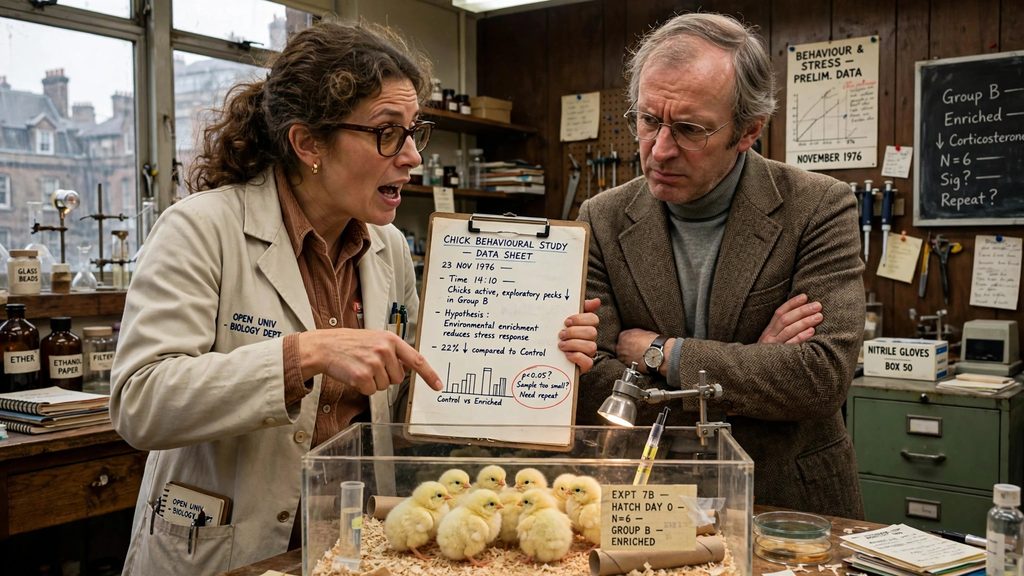
One of the most revealing episodes came when Sheldrake worked with neuroscientist Steven Rose, a prominent critic of his ideas. They examined whether a prediction derived from formative causation could be tested using newly hatched chicks. The experiment was conducted in Rose’s laboratory using a standard behavioural procedure, with the practical work carried out blind to the hypothesis.
That detail deserves attention because it complicates the caricature of Sheldrake as someone who simply refused to expose his ideas to hostile testing. He did sometimes invite critics into the process and attempt to construct experiments that could distinguish his prediction from ordinary learning. The experiment produced data that Sheldrake regarded as consistent with morphic resonance. Rose disagreed with that interpretation, later saying the collaboration convinced him that Sheldrake was so committed to his hypothesis that it was hard to imagine the circumstances in which he would accept its disconfirmation.
And there is the deeper problem again: obtaining a result that one researcher considers consistent with a hypothesis is not the same as establishing the hypothesis. The real test is whether other investigators can reproduce the effect under comparable or stronger conditions and whether competing explanations can be eliminated. The Sheldrake-Rose episode is therefore valuable less as proof for either side than as an unusually clear example of how scientific disagreement can persist after two researchers have actually agreed to test something together.
The TEDx Controversy Repeated the Pattern Four Decades Later
By 2013, Sheldrake was no longer merely arguing about one biological hypothesis. He was challenging what he regarded as the philosophical assumptions built into modern science. In a TEDxWhitechapel talk based partly on The Science Delusion, he argued that science had become constrained by a set of assumptions about matter, consciousness, nature and causation.
The talk provoked another controversy. TED’s scientific advisers questioned several of Sheldrake’s claims and argued that some of his descriptions of scientific assumptions were misleading and that there was insufficient evidence for some of his more radical proposals. TED subsequently moved the talk away from the main TEDx YouTube distribution and presented it with critical context.

Sheldrake described the decision as censorship. TED rejected that characterization and said the talk remained available with a warning and explanatory framing. The disagreement is worth preserving rather than resolving by slogan. Moving a controversial scientific talk can reasonably be criticized as editorial gatekeeping, it can also be understood as a publisher deciding that extraordinary scientific claims require explicit context. Neither description establishes whether the scientific claims themselves are true.
What Four Decades of Experiments Actually Tell Us
After more than forty years, the temptation is to force the story into a verdict. Either Sheldrake was vindicated by the fact that scientists have never definitively disproved morphic resonance, or he was decisively defeated because mainstream science did not accept it. Both formulations smuggle more certainty into the evidence than the evidence can bear.
The first mistake is especially important. A hypothesis does not gain scientific credibility merely because nobody has produced a final experiment proving it impossible. Scientific theories are not normally required to survive an attempt at absolute disproof before they can be rejected as poorly supported. The relevant question is whether the available evidence provides reproducible, independently confirmed support that distinguishes the proposed mechanism from competing explanations. The same standard, and the same shortfall, runs through much of parapsychology’s lab tradition, including the decades-long dispute over whether the Ganzfeld telepathy experiments ever cleanly replicated outside the labs that first reported them.
By that standard, morphic resonance has not become an accepted biological mechanism. Mainstream biology continues to explain inheritance, development and cellular behaviour through established mechanisms involving genetics, molecular interactions, cellular signalling, physiology and environmental effects. Sheldrake’s broader claims about telepathy and animal anticipation likewise have not produced the kind of robust, independently replicated evidence that would force a revision of those fields.
But the opposite simplification is also unsatisfying. Sheldrake’s career cannot accurately be reduced to “scientist makes absurd claim, scientists laugh.” He had real training. He had real research experience. Some of his later experiments were genuine attempts to make controversial claims empirically testable. Critics did identify methodological weaknesses, but the history also contains genuine disputes over experimental design, statistical interpretation and what particular datasets actually demonstrate.

The distinction matters because skepticism is strongest when it does not need caricature. It is not necessary to pretend Sheldrake was uncredentialed to reject morphic resonance. It is not necessary to pretend every experiment was fraudulent to conclude that the evidence has not established the theory. And it is not necessary to claim that Nature was wrong about the scientific weakness of the hypothesis merely because its chosen rhetoric was excessive.
The Real Mystery Is Not Whether Nature Was Right
There is a deeper reason the Sheldrake story has survived long after the original controversy. It exposes a tension that exists inside science itself. Science needs boundaries. Without standards for falsifiability, reproducibility, controls and independent confirmation, almost any interpretation can survive indefinitely. At the same time, scientific history contains genuine discoveries that initially challenged accepted assumptions. The existence of one does not prove the other. A revolutionary idea must still survive the same evidentiary discipline as an ordinary one.
Sheldrake’s career sits directly inside that tension. He began as a conventional biochemist studying plant physiology and ended up arguing that nature possesses forms of memory extending beyond individual organisms. His critics saw the later theory as a retreat from testable biology. Sheldrake saw it as an attempt to explain observations that, in his view, conventional science had prematurely dismissed.

The experiments that followed did not deliver the scientific revolution he hoped for. Nor did the controversies erase the fact that some of the questions he asked can be turned into measurable experiments. That is the narrow space in which the historical record is strongest: the claims remain extraordinary, the evidence remains contested and insufficient for mainstream acceptance, and the methodological arguments are more important than the mythology surrounding either Sheldrake or his critics.
In the end, the most revealing line in the story may not be “morphic resonance.” It may be the question mark in Nature’s “A book for burning?” The question mark leaves room for the distinction that the mythology usually removes. A book can be provocative without being correct. A scientist can possess impeccable credentials and still advance a hypothesis that fails to convince his field. A critic can identify a serious methodological problem and still choose unnecessarily inflammatory language. And an experiment can produce an intriguing result without proving the extraordinary explanation attached to it.
Sheldrake did not prove that nature remembers. His critics did not prove that every strange result has been explained. What the record actually gives us is more difficult, and more interesting, than either side’s legend: a legitimate biologist crossed the boundary of accepted explanation, was publicly condemned in spectacular language, and then spent decades trying to build experiments capable of bringing his ideas back into the laboratory. The evidence never became strong enough to overturn mainstream biology. But the controversy remains a useful reminder that the hardest scientific question is not whether an idea sounds impossible. It is whether the experiment has been designed so that nature itself gets the final vote.