




Imagine a figure standing at the crossroads of art, science, and philosophy, a man whose outstretched arms and legs touch the precise edges of both a circle and a square, embodying the harmony of the universe. This is Leonardo da Vinci’s Vitruvian Man, a masterpiece created around 1490 that has captivated minds for over five centuries. But what happens when this timeless symbol of human proportion is reimagined in the digital age, its boundaries blurred on the cover of The Economist?
Enter the era of transhumanism, a bold vision of humanity’s future where the lines between man, machine, and the cosmos are erased.
The Timeless Genius of Leonardo da Vinci’s Vitruvian Man
Leonardo da Vinci, the quintessential Renaissance man, was no stranger to blending art with science. His Vitruvian Man, sketched in pen and ink, is more than a drawing. It’s a manifesto of human potential. Inspired by the writings of the Roman architect Vitruvius, Leonardo sought to capture the ideal proportions of the human body. Vitruvius believed that a well-proportioned man could fit perfectly within both a circle and a square, symbolizing balance and symmetry.
In the drawing, a male figure stands in two superimposed poses: one with arms and legs spread to touch the circle, and another with limbs aligned to the square. Every line, from the curve of the shoulder to the angle of the knee, is meticulously calculated. Leonardo’s notes, written in his signature mirror script, detail exact measurements like the length of a man’s arm being equal to one-fourth of his overall height. This precision reflects the Renaissance obsession with order, beauty, and the deeply held belief that humanity itself was a direct reflection of divine creation.
But the Vitruvian Man is not just about anatomy. It’s a philosophical statement. By placing man at the center of geometric perfection, Leonardo celebrated humanity’s place in the universe. The drawing became an icon of the Renaissance, a period when thinkers dared to explore the boundaries of knowledge, from astronomy to engineering. Today, it remains a universal symbol of human aspiration, gracing everything from textbooks to T-shirts.
The Symbolism of Circle and Square | Microcosm and Macrocosm
At the heart of the Vitruvian Man lies a profound duality: the circle and the square. In Renaissance philosophy, these shapes carried deep symbolic meaning. The circle, with its infinite, unbroken line, represented the divine, the spiritual, and the cosmos. It was the shape of the heavens, eternal and boundless. The square, grounded and stable, symbolized the earthly, the material, and the human realm. By combining these shapes, Leonardo illustrated the unity of the microcosm (man) and the macrocosm (universe).
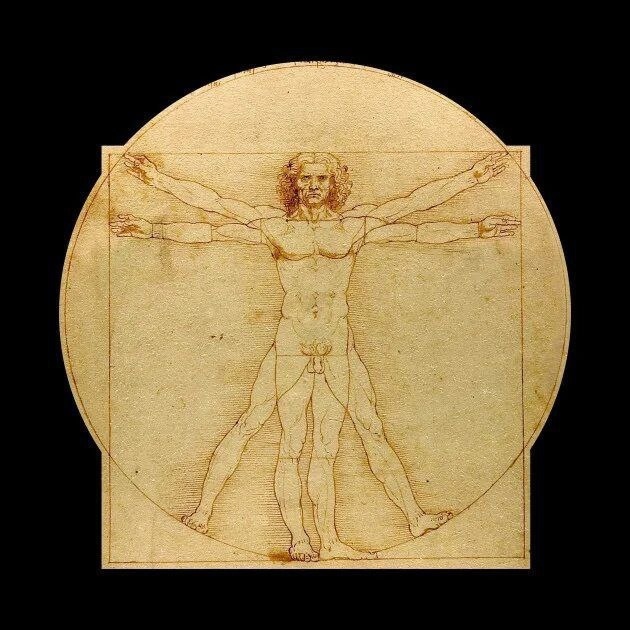
This idea wasn’t new. Ancient philosophers like Plato and medieval mystics had long explored the connection between humanity and the cosmos. But Leonardo’s genius lay in visualizing it with such clarity. The Vitruvian Man suggests that humans are not separate from the universe but are a miniature reflection of its grandeur. This concept resonated deeply in the Renaissance, a time when explorers like Columbus and scientists like Copernicus were expanding humanity’s understanding of the world and beyond.
Fast forward to today, and the Vitruvian Man continues to inspire. Its imagery has been adopted by artists, scientists, and even futurists who see humanity as part of a larger cosmic story. But what happens when the boundaries of the circle and square begin to blur? That’s where the Economist cover comes in, offering a bold reinterpretation of Leonardo’s vision.
The Economist Cover | A New Vitruvian Man for the Digital Age
In a striking homage to Leonardo, The Economist featured a reimagined Vitruvian Man on one of its covers, titled “Rise of the Superhuman.” Unlike Leonardo’s precise lines, this version is a digital evolution. Its circle and square boundaries are deliberately blurred in places, suggesting a dissolution of traditional limits. The figure itself appears enhanced, with hints of technological augmentation, from sleek lines that evoke circuitry to a posture that exudes limitless potential.
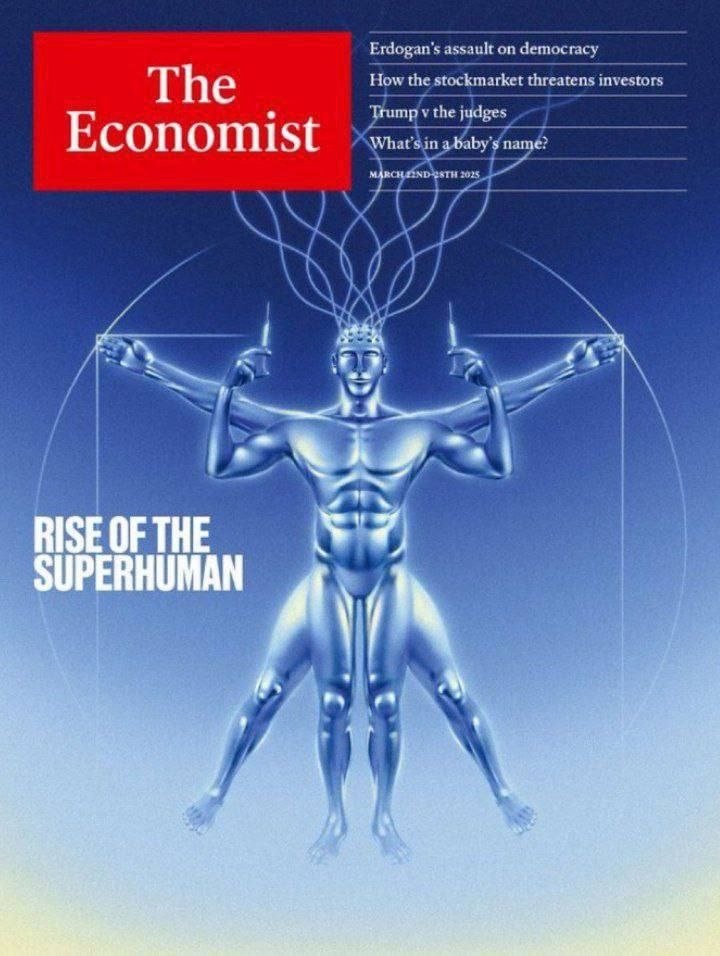
This cover isn’t just art. It’s a cultural statement. By invoking the Vitruvian Man, The Economist draws a direct line from the Renaissance to the 21st century, where technology is reshaping humanity. The blurred boundaries symbolize a world where the distinctions between human and machine, organic and synthetic, are fading. This is the essence of transhumanism, a movement that envisions a future where humans transcend their biological limitations through technology.
The cover’s title, “Rise of the Superhuman,” is a clarion call. It challenges us to imagine a world where artificial intelligence, genetic engineering, and cybernetic enhancements redefine what it means to be human. But to understand this vision, we need to explore transhumanism itself: what it is, what it promises, and what it means for our future.
What Is Transhumanism? The Quest for the Superhuman
It’s worth being clear from the outset that transhumanism, however it’s ultimately dated, represents a documented intellectual and cultural movement with genuine institutional presence today, including academic centers, published journals, and active philosophical debate, rather than a purely speculative or fringe idea existing only in popular culture.
Transhumanism is a philosophical and technological movement that advocates for the enhancement of the human condition through advanced technology. It’s not science fiction. It’s a vision grounded in well-documented advancements, from AI-driven prosthetics to CRISPR gene editing. Transhumanists believe that humans can and should evolve beyond their current physical and mental limitations, achieving what some call the “superhuman.”
Physical Enhancements | Imagine bionic limbs that are stronger than natural ones or organs grown in labs to replace failing ones.
Cognitive Upgrades | Picture neural implants that boost memory or allow direct communication with computers.
Longevity | Envision a world where aging is slowed or reversed, extending human lifespans indefinitely.
The roots of transhumanism can be traced to thinkers like Julian Huxley, who coined the term in 1957, and modern advocates like Ray Kurzweil, who predict a “singularity” where humans and machines merge. But transhumanism isn’t just about technology. It’s about redefining humanity’s place in the universe, much like Leonardo’s Vitruvian Man did centuries ago.
Critics of transhumanism warn of ethical dilemmas. Will enhancements create inequality? Could we lose our humanity in the pursuit of perfection? Yet proponents argue that these technologies are the next step in human evolution, just as fire and the wheel were in their time. The Economist cover captures this tension, using the Vitruvian Man to bridge past ideals with future possibilities.
Blurring Boundaries | The Symbolism of the Economist’s Vitruvian Man
The most striking feature of the Economist cover is the way it erases parts of the circle and square. In Leonardo’s original, these shapes are distinct, representing the balance between the divine and the earthly. But in the modern version, their boundaries blur, suggesting that the divisions between human, machine, and cosmos are no longer clear-cut.
This blurring is a powerful metaphor for transhumanism. As we integrate technology into our bodies and minds, we challenge the traditional definitions of humanity. Are we still “human” if our memories are stored in the cloud or our limbs are made of carbon fiber? The cover implies that these distinctions are becoming irrelevant, just as the circle and square merge into a new, undefined shape.
This imagery also evokes the idea of breaking free from limitations. In Leonardo’s time, the circle and square represented the boundaries of human potential, beautiful, but finite. Today, transhumanism suggests that those boundaries can be transcended. The Economist cover invites us to imagine a future where humanity is no longer confined by biology or even by Earth itself, reaching out to the stars as a true cosmic species.
The Contested History of “Transhumanism” as a Term
It’s worth expanding on the scholarly debate surrounding when and how the word “transhumanism” actually entered use, since the actual history is more contested than popular retellings often suggest. While Huxley’s 1957 essay “Transhumanism,” published in his book New Bottles for New Wine, is the most rigorously documented and textually verified first appearance of the term, a widely repeated claim traces the word instead to Huxley’s 1927 book Religion Without Revelation. A detailed 2015 scholarly investigation published in the academic journal Notes and Queries examined this claim directly and found that the word “transhumanism” does not actually appear anywhere in the 1927 text, the earlier date appears to stem from a documented indexing error in a later edition. This interesting case of scholarly detective work, tracing exactly how a widely repeated historical claim originated from a misread index rather than the primary source itself, is worth knowing as an example of how even foundational intellectual history can require careful, direct verification against original texts rather than secondhand citation.
Current Transhumanist Technology, Beyond Theory
It’s worth grounding the broader transhumanist vision in currently deployed technology, since several significant advances already exist well beyond the theoretical stage. FDA-approved cochlear implants and increasingly sophisticated myoelectric prosthetic limbs, controlled by detected muscle signals, are already in clinical use worldwide. CRISPR gene-editing technology, developed by researchers including Jennifer Doudna and Emmanuelle Charpentier, who shared the 2020 Nobel Prize in Chemistry for this work, has moved from laboratory research into approved clinical treatments for specific genetic conditions including sickle cell disease. Brain-computer interface research, including publicly documented clinical trials from multiple research institutions and companies, has demonstrated genuine, if still early-stage, capability allowing paralyzed patients to control computer cursors or robotic limbs through neural signals alone. This documented technological foundation is worth knowing accurately, since it represents the verifiable substrate the more speculative long-term transhumanist vision builds upon, distinct from unproven claims about consciousness uploading or indefinite life extension that remain, honestly, well beyond current scientific capability.
The 1490 Dating and Vitruvius’s Actual Text
It’s worth adding precise detail about the historical figures behind this drawing’s origins. The drawing’s approximate date, around 1490, comes from scholarly analysis of Leonardo’s notebooks, held today in the Gallerie dell’Accademia in Venice. Vitruvius himself, the Roman architect and engineer whose actual name was Marcus Vitruvius Pollio, wrote his treatise De architectura in the first century BCE, describing his belief that well-designed buildings should reflect the same proportional harmony he observed in the human body. Leonardo was one of several Renaissance artists and scholars, including Francesco di Giorgio Martini, who attempted to visually interpret Vitruvius’s written description into an actual drawn figure, and Leonardo’s version became, through a combination of artistic skill and historical circumstance, by far the most enduring and widely reproduced of these attempts. This collaboration across nearly one and a half millennia, a Roman architect’s written proportional theory finally given its most iconic visual form by a Renaissance artist, is worth appreciating as substantive intellectual history in its own right.
The Future of Humanity | Art, Philosophy, and Technology Converge
The journey from Leonardo da Vinci’s Vitruvian Man to the Economist cover is a story of human ambition. In the Renaissance, artists and thinkers sought to understand humanity’s place in the universe through art and science. Today, we stand on the brink of a new era, where technology allows us to redefine that place entirely. The Vitruvian Man, once a symbol of balance and proportion, has become a beacon for the transhumanist dream of limitless potential.
But this future raises questions. How do we balance progress with ethics? Can we preserve the essence of humanity while embracing radical change? The answers lie in the same spirit of curiosity and creativity that drove Leonardo to draw his masterpiece. By looking to the past, we can find inspiration for the future.