



The Vatican archives hold a collection of documents that have never left their context. One of them is a list of popes described in Latin phrases that stop just as the institution enters its final cycle. Arnold Wion brought this text into the light in 1595. He claimed it was a revelation from the twelfth century. He claimed it was the work of Malachy of Armagh. The document does not function as a prophecy. It functions as a governing constraint.
The first seventy items on the list match the history of the papacy with strange and surgical precision. The authors of the 1595 forgery knew the lineage of the office as well as they knew the power of an established pattern. When a document correctly identifies the past the reader loses the capacity to doubt the future. This is the mechanism of the trap. The text creates a historical momentum that forces the observer to view the present through a lens of inevitable decline.
There is a gap between the documented popes and the unknown entities that follow. The authors stopped recording established history and started recording a trajectory. They chose phrases that are broad enough to survive any interpretation yet specific enough to satisfy the hunger for meaning. The transition from the labor of the sun to the final Peter the Roman is a transition from record keeping to psychological warfare. It dictates that the office of the papacy is a countdown.
The Engineering of Divine Succession
The emergence of the Prophecy of the Popes in the late sixteenth century coincides with a period of intense ecclesiastical maneuvering within the Roman Curia. The timing is not accidental. The papacy was under immense pressure to redefine its role in an increasingly secularizing Europe. Attributing the document to St. Malachy provided the necessary religious gravity to ensure its rapid distribution and unquestioned acceptance among the faithful.
Historical precision prior to 1590 serves as the primary evidence for its nature as a deliberate political forgery. Forgery in this context implies a precise understanding of the audience rather than a lack of intelligence. By matching known family crests and specific biographical details for the popes preceding the document publication the authors established a baseline of credibility. This psychological conditioning forces the reader to accept the subsequent and intentionally ambiguous predictions as equally inevitable.
The text was never meant to be a record of divine inspiration. It was meant to be an instrument of institutional control. By framing the future of the Church as a fixed sequence of events the authors effectively curtailed the possibility of radical institutional change. Any departure from the established pattern could be interpreted as a deviation from the divine plan. This is the hallmark of a successful narrative trap. It makes the institution immune to criticism by framing its struggles as the necessary trials of the final age.
Adaptive Meaning and Retroactive Validation
The decline in predictive specificity following the 1590 publication is a standard feature of manufactured prophecy. Ambiguity is the primary survival mechanism for any text designed to influence long-term perception. By using phrases that are sufficiently vague the prophecy enables followers to project contemporary events onto the historical record.
When observers link Pope John Paul II to the phrase De labore Solis because of a birth date coinciding with an eclipse they are participating in a process of retroactive validation. The prophecy does not predict the event because the event is used to justify the prophecy. It is a closed loop where the past is harnessed to secure the authority of the future. The prophecy functions as a cognitive tool that demands intellectual submission to a predetermined end.
This process of validation is recursive. Every time a new interpretation is applied to an old phrase the document gains an additional layer of perceived authority. It becomes a living text that grows in power with every historical event it is forced to account for. This is the genius of the architects. They did not need to write a perfect prophecy. They only needed to write one that the world would be forced to complete through its own desperate need for pattern.
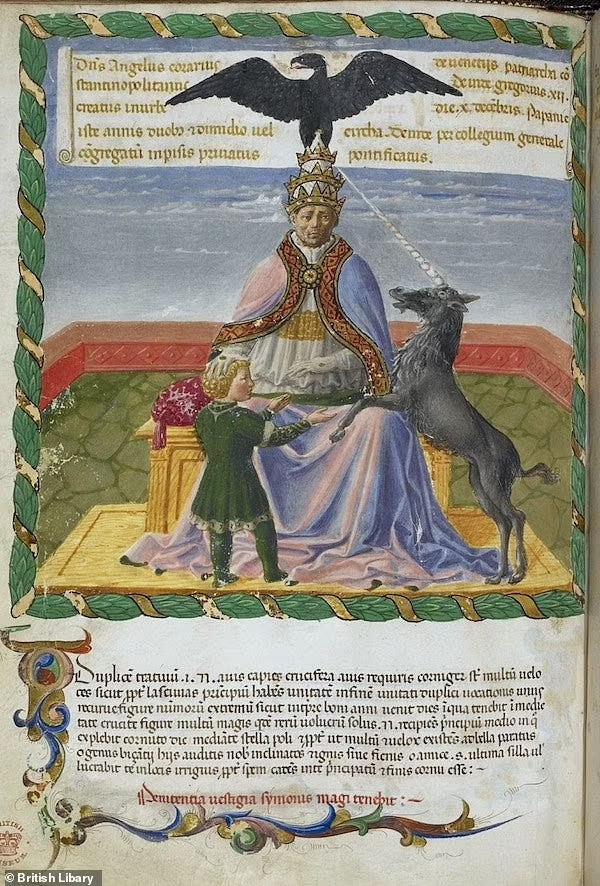
The 2027 Convergence as Strategic Timing
The current fixation on 2027 as an apocalyptic terminal point is a demonstration of how narrative frameworks operate within periods of systemic instability. The argument concerning Pope Sixtus V as a temporal midpoint is an exercise in numerological synchronization. It creates a deadline where none exists.
These dates do not emerge from the text because they emerge from the requirement for a coherent narrative in a world experiencing high stakes crises. Environmental degradation and geopolitical volatility create a vacuum of meaning. The Prophecy of the Popes fills this gap by providing an inevitable and linear timeline for collapse. It transforms the anxiety of the present into the fulfillment of an ancient design.
The reliance on math and numerology is a tactical choice. It appeals to the part of the human brain that seeks order in chaos. By presenting the timeline as a calculated product the authors make it feel objective and cold. It removes the human element from the history of the papacy and replaces it with a mechanical progression toward an end. The reader is no longer reading a list of popes. They are reading the schematics of a machine that is slowly grinding to a halt.
The Containment of the Final Pontiff
The final passage concerning Peter the Roman functions as the ultimate containment device for the office of the papacy. It places an artificial hard limit on the institution. By designating the current era as the period of the final persecution the prophecy compels the reader to interpret every administrative action or health crisis involving the current pontiff as a sign of the end.
The health of Pope Francis in 2025 marked by severe respiratory crises and double pneumonia and extended hospitalizations at Gemelli is not merely a medical reality. It has been transformed into a symbolic indicator of the Church terminal phase. His struggle becomes a narrative prop in a much larger and darker performance. The actual clinical trajectory of his respiratory failure is secondary to the role he has been assigned by the interpretation of the text.
The name itself carries a weight that is difficult to dismiss. St. Peter is the foundation upon which the Church was built. The idea that a final pope would share his name or his title creates a sense of closure that is difficult to achieve in any other way. It completes the circle. It suggests that the history of the Church is not a wandering path but a deliberate arc that began with a Peter and must end with a Peter.
The Forensic Reality of Institutional Obsolescence
The Prophecy of the Popes is a masterpiece of administrative fiction. It has persisted for over four centuries because it offers a sense of order to a chaotic world. It promises that even the collapse of the city on the seven hills is an intentional component of a larger design.
Skeptics emphasize the likelihood of a 16th century political hoax while believers emphasize anecdotal corroboration. Both miss the actual utility of the document. The prophecy is a survival mechanism for the institution of the Catholic Church. It ensures that the succession of leaders is viewed as part of an ancient and inevitable process that will conclude only when the world itself concludes. The strength of the prophecy does not lie in its accuracy because it lies in its operational value. It is not predicting the future because it is manufacturing the present.
The archival silence is the most important element of the document. It does not exist because it is true. It exists because it is being maintained. The Vatican does not need to confirm or deny the prophecy. It only needs to allow it to persist as a background hum that informs the way the world views the papacy. As long as the prophecy remains a topic of debate the Church remains a topic of importance. It is a way of staying relevant by appearing to be on the verge of disappearing.
The Architecture of the End
The document exists to be read by those who need to believe that history is a planned and orderly sequence. It satisfies the need for closure in a system that is currently experiencing a total breakdown of its administrative legitimacy. The prophecy remains relevant not because it is true but because it is useful. It allows the institution to manage its own obsolescence.
The archive is quiet. The manuscript remains in its place. The cycle continues until the final phrase is spoken by a voice that knows exactly what it is doing. The audience is trapped in the loop, waiting for a signal that was written by a ghost to serve the interests of men who have long been dust.
The end is not a date. The end is a process. It is the steady erosion of the authority that the Church once held over the narrative of human history. The prophecy is a testament to the fact that when the real world stops making sense, we will always prefer a manufactured fiction that promises an end, rather than an reality that offers only an infinite, chaotic middle.