




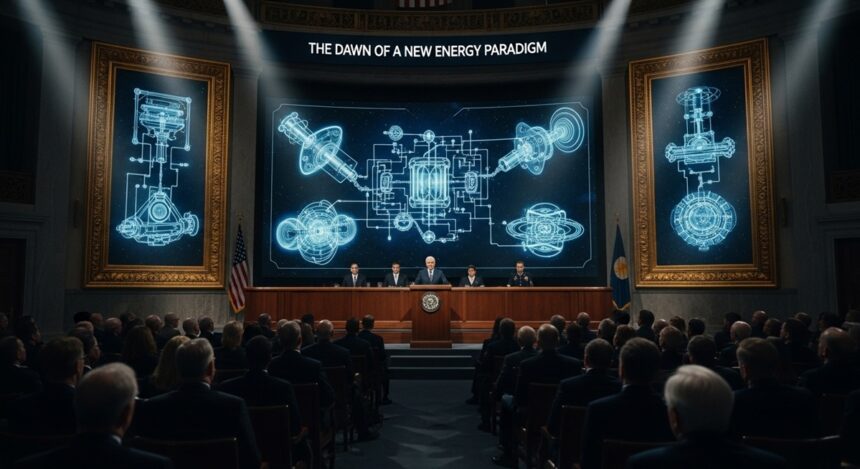
In a world where energy crises loom large and technological stagnation feels all too real, whispers of breakthrough innovations have long tantalized the imaginations of scientists, researchers, and everyday dreamers. But what if those whispers are turning into official declarations?
Recent statements from the heart of American power—the White House—suggest that free energy technologies, once relegated to the fringes of conspiracy theories, might not only exist but have been deliberately withheld from the public. This isn’t just idle speculation; it’s rooted in a high-profile speech that could signal a seismic shift in how we understand energy, propulsion, and even the fabric of reality itself.
Could we be on the cusp of a new era where limitless energy eradicates poverty and reshapes global politics? Or is this another layer of misdirection in a long history of secrecy?
The Bombshell Speech | Hidden Tech in Plain Sight
On April 14, 2025, the White House quietly dropped a bombshell that rippled through alternative science communities and beyond. Michael Kratsios, Director of the White House Office of Science and Technology Policy, delivered a speech titled “The Golden Age of American Innovation” at the Endless Frontiers Retreat in Austin, Texas. On the surface, it was a patriotic rallying cry for revitalizing U.S. technological prowess. But beneath the rhetoric lay hints of something far more profound | acknowledgments of free energy systems, anti-gravity propulsion, and technologies that “manipulate time and space.”
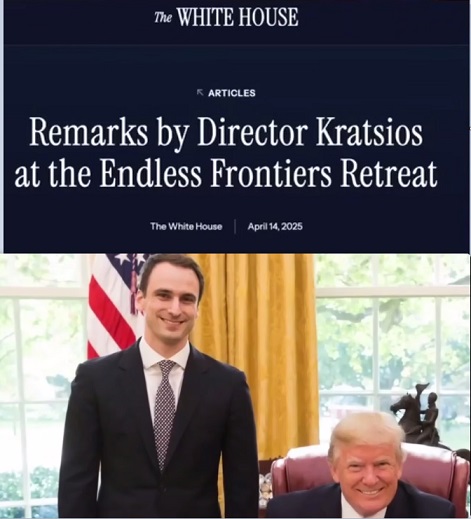
Kratsios didn’t mince words when he lamented the stagnation of modern innovation. He contrasted the optimistic mid-20th century—when nuclear power promised electricity “too cheap to meter” and feats like the X-15 hypersonic aircraft pushed boundaries—with today’s realities. Commercial nuclear development has stalled, airplanes fly slower than decades ago, and U.S. rail systems lag behind global leaders. This isn’t just nostalgia; it’s a pointed critique of how bureaucratic red tape has derailed progress.
What makes this speech extraordinary, however, is Kratsios’s assertion that solutions already exist. He spoke of “limitless energy” being blocked not by scientific limitations but by outdated regulations from the 1970s. Imagine that | a top advisor to the President admitting that free energy—technologies capable of providing unlimited, clean power without fossil fuels or traditional grids—is real and ready, held back only by paperwork and policy. This isn’t science fiction; it’s a direct challenge to the status quo.
Key Quotes and Their Explosive Implications
One of the most jaw-dropping moments came when Kratsios declared, “Our technology allows us to manipulate time and space. They destroy distance.” In the context of aerospace and energy engineering, these aren’t poetic flourishes. “Destroying distance” evokes field propulsion systems that bypass Newtonian physics—think warp drives or inertial manipulation that could make interstellar travel feasible. These concepts have been whispered about in classified programs for decades, often linked to black-budget initiatives exempt from oversight.
Kratsios’s words align with a growing chorus of insider testimonies. In recent years, UFO discussions have gone mainstream, with congressional hearings and declassified documents hinting at “exotic” materials and propulsion tech. Could these be human-made innovations mistaken for alien tech? Kratsios’s speech suggests yes, positioning them as part of America’s hidden arsenal. He frames their disclosure as essential for national revival, urging a break from the “regulatory barriers” that stifle innovation.

This isn’t isolated rhetoric. It echoes broader White House narratives under the current administration, emphasizing technological supremacy amid global competition. By tying these claims to patriotic themes, Kratsios isn’t just informing; he’s preparing the public for revelations that could upend industries worth trillions.
Historical Roots | From Tesla’s Visions to Modern Secrecy
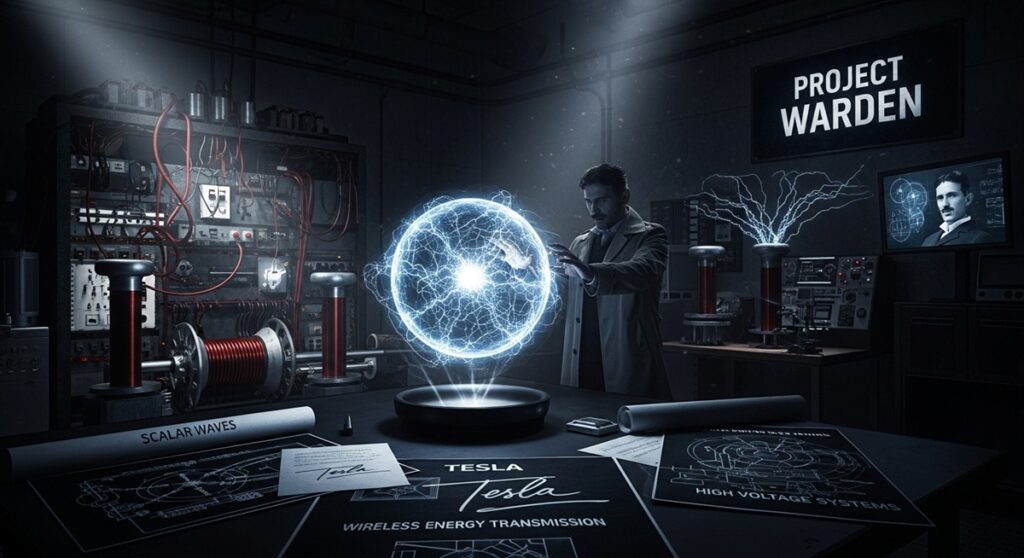
To fully grasp the White House’s claims, we must trace their origins back to one of history’s greatest inventors | Nikola Tesla. Tesla’s work on wireless energy transmission, scalar waves, and high-voltage systems laid the groundwork for what we now call free energy. His dream was a world where power flowed freely, untethered from wires or monopolies. Yet, upon his death in 1943, the U.S. government seized his papers, citing national security.
Enter Dr. John G. Trump, an MIT professor and electrical engineer who reviewed those documents. Officially, he found nothing of “practical value.” But archival footage and letters reveal a more nuanced story. Trump described Tesla’s correspondence with world leaders about a “secret weapon” capable of striking targets at vast distances—echoes of directed energy tech. Given Trump’s own classified work on radars and beam weapons during World War II, it’s plausible he recognized the potential and funneled it into secret programs.
Fast-forward to today | Donald Trump, John’s nephew and current President, has frequently alluded to unimaginable technologies. His mentions of energy “we never dreamed of” and weapons beyond comprehension take on new meaning in light of family ties. Is the administration reviving Tesla’s legacy? Kratsios’s speech certainly suggests so, using language that mirrors Tesla’s ideas of manipulating space-time for energy and transport.
The Role of Secret Programs and Suppressed Science
These technologies didn’t vanish; they went underground. Declassified documents from the Cold War era show U.S. interest in scalar waves and field propulsion, often through programs like NASA’s Breakthrough Propulsion Physics. Patents by figures like Dr. Salvatore Pais—filed via the U.S. Navy—describe inertial mass reduction and high-energy electromagnetic fields, concepts that could enable anti-gravity.
Why the secrecy? Geopolitical fears played a role. Venture capitalist Marc Andreessen recounted White House officials admitting that entire physics branches were classified during the Cold War—and could be again for AI or other fields. This “deep state” bureaucracy, as critics call it, prioritizes control over progress, suppressing innovations that threaten established power structures.
Bureaucratic Barriers | The Real Enemy of Innovation
Kratsios pinpointed regulations from the 1970s as the culprit behind stalled tech. Think about it | environmental laws, safety protocols, and oversight bodies were meant to protect, but they’ve morphed into roadblocks. Nuclear fusion, advanced batteries, and now free energy face endless hurdles, keeping them from market.
This isn’t accidental. Critics argue it’s a deliberate strategy to maintain energy dependence, fueling wars and economies built on scarcity. If free energy were unleashed, it could end climate debates, eradicate poverty, and democratize power—disrupting oil barons and utilities overnight. Kratsios’s call to dismantle these barriers is revolutionary, signaling a policy shift toward openness.
Case Studies in Stagnation
Consider nuclear power | Post-Three Mile Island, regulations exploded, halting new plants. Or high-speed rail | Bureaucracy and funding fights leave the U.S. trailing China and Europe. Extending this to free energy, imagine zero-point devices or cold fusion—ideas dismissed as pseudoscience but backed by patents and experiments. The White House’s acknowledgment challenges this dismissal, urging a reevaluation.
UFO Connections | Human Tech Masquerading as Alien?
The speech arrives amid UFO fervor. Congressional testimonies describe “non-human” craft with impossible maneuvers—speeds defying gravity, instant acceleration. But what if these are black-budget human projects? Kratsios’s “manipulate time and space” phrasing aligns perfectly, suggesting retrieved tech or reverse-engineered innovations.

Insiders like David Grusch have claimed U.S. possession of exotic materials. Linking this to free energy, propulsion systems likely rely on unlimited power sources, blurring lines between energy and transport tech. Disclosure, then, isn’t about aliens; it’s about reclaiming human ingenuity from shadows.
The Disclosure Timeline
Recent hearings and briefings indicate momentum. The Senate Intelligence Committee has pushed for transparency, with officials admitting “out-of-this-world” knowledge. Kratsios’s speech fits this puzzle, laying ideological groundwork for public acceptance.
The Geopolitical Chess Game | Outpacing China
Kratsios framed disclosure as a race against China, where tech leadership ensures supremacy. China’s advances in hypersonics and quantum computing threaten U.S. dominance. By unveiling hidden tech, America could leapfrog ahead, using patriotism to justify revelations.
This narrative sidesteps accountability for past secrecy. Instead of admitting suppression, it’s spun as protection from theft. Genius? Absolutely. It transforms risk into advantage, rallying public support.
Strategic Implications
Free energy could neutralize oil-based conflicts, but geopolitically, it shifts power. Nations like Russia or Saudi Arabia lose leverage, while the U.S. gains. China’s rapid innovation forces the hand—disclose or fall behind.
Deeper Conspiracies | A 500-Year Plan?
Diving deeper, some see a grander scheme. The provided narrative links to a “five-hundred-year plan” from the 15th century, executed via secret societies and the Jesuit Order. They allegedly rewrote history, imposed religions for control, and suppressed tech to enslave humanity.
The Jesuits, founded in 1534, are accused of fabricating biblical texts like the Book of Revelation to outline end-times scenarios—Antichrist, purges, eternal rule by “overcomers.” This frames modern disclosure as the plan’s climax | revealing tech to seduce or control masses.

Why now? The plan’s timeline allegedly ends soon, with AI and global networks enabling absolute power. Suppressed physics, killed inventors, and pseudoscience distractions maintained the facade. Trump’s administration, with Tesla ties, might unwittingly (or wittingly) advance this.
Skeptical? Historical manipulations—like the Council of Trent reshaping Christianity—lend credence. But approach with caution; it’s a lens, not gospel.
Toward a New Dawn | What Disclosure Means for Us
If Kratsios’s claims hold, we’re nearing a tipping point. Free energy could solve crises, but challenges remain | economic disruption, ethical dilemmas, power shifts. The White House’s hints suggest preparation, but true change demands public pressure.
As Tesla said, “The future for which I worked is mine.” Perhaps it’s finally arriving.
Embracing the Unknown
The White House’s acknowledgments are harbingers of transformation. From Tesla’s seized papers to modern speeches, the thread is clear | hidden tech exists, and disclosure looms. Whether driven by patriotism, geopolitics, or deeper agendas, the implications are profound. Stay vigilant; the golden age might be here.