


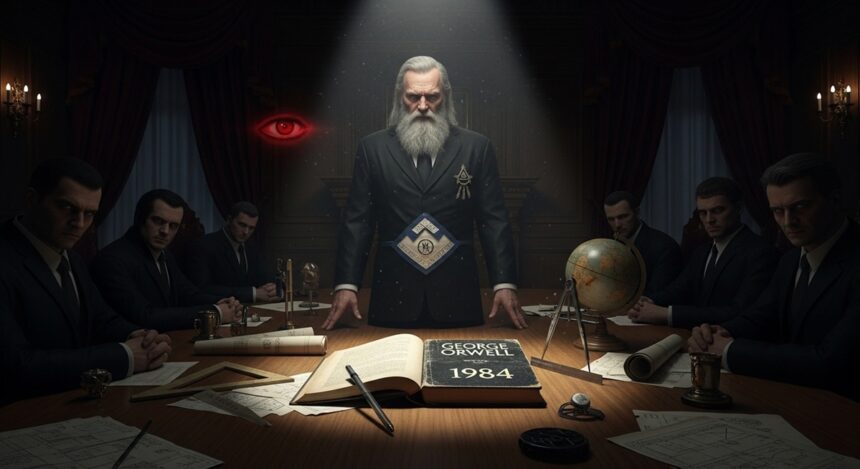
In a world where surveillance cameras dot every corner, governments wield unprecedented power over information, and personal freedoms seem to erode year by year, George Orwell’s 1984 feels less like a work of fiction and more like a blueprint for our reality. Published in 1949, this chilling novel has long been hailed as a warning against totalitarianism, but what if it’s something far more sinister? What if Orwell wasn’t just imagining a dystopia but laying bare the meticulously crafted strategies of a shadowy elite—the Freemasons and their globalist allies—who have never forgiven him for pulling back the curtain on their grand design?
Orwell himself wasn’t some distant prophet peering into a crystal ball. No, he was an insider, a man with ties to intelligence circles and esoteric societies that gave him unparalleled insight into the machinations of power. His book is an instruction manual that accidentally slipped into the hands of the public. And for that transgression, the powers that be allegedly ensured he paid the ultimate price.
Big Brother’s watchful eye to the algorithms tracking your every move online.
Orwell’s 1984 | From Fiction to Forewarning
The Myth of Orwell as Prophet Versus Insider
Let’s set the record straight | George Orwell, born Eric Arthur Blair in 1903, wasn’t spinning yarns from thin air. A former British colonial officer, journalist, and self-avowed socialist, he had rubbed shoulders with the underbelly of empire and espionage. Rumors in conspiracy circle, and even some historical analyses, suggest Orwell had deep connections to Freemasonry, that ancient fraternal order often accused of pulling strings behind global events. As an English intelligence operative during World War II, he was privy to classified information that shaped his worldview.
In 1984, Orwell doesn’t just describe a oppressive regime; he outlines operational tactics for maintaining control over populations. The novel’s Oceania, a superstate encompassing the Americas, Britain, and parts of Africa, is locked in perpetual war with Eurasia and Eastasia, mirroring the geopolitical tensions we see today between Western alliances, Russia-Europe, and Asia-Pacific powers. But here’s the digression for the skeptics and censors | This isn’t an attack on any one nation, like the Soviet Union or modern Russia, as some misinformed critics claim. Orwell’s superstates are global archetypes, not targeted jabs. The book is freely available even in places like the Russian Federation, and its themes transcend borders, applying equally to London, Washington, Beijing, or Moscow.
The quote that hits hardest?
“The Party declared the proles to be inferior beings, they had to be kept in strict obedience, let them work hard and multiply—everything else does not matter.”
This isn’t dystopian hyperbole; it’s a cold assessment of how elites view the masses. Orwell, drawing from his alleged Masonic and spy background, encoded these truths in fiction to evade direct censorship. But the Freemasons, guardians of secret knowledge and hierarchical power structures, saw it for what it was | a betrayal. Rumors persist that his untimely death in 1950 from tuberculosis—exacerbated by wartime privations—was no accident. They haven’t forgiven him, and the suppression of his revelations continues through subtle cultural dismissals and academic gatekeeping.
Why Reading 1984 Today Reveals the Modern World Order
Look at how social media platforms curate content, turning complex debates into emoji-driven soundbites. Doublethink, holding contradictory beliefs simultaneously? That’s the essence of modern politics, where leaders decry surveillance while expanding it.
Orwell’s genius, or perhaps his curse, was in simplifying the chaos of control into digestible layers. He divides society into three strata | the elite rulers, the administrative middle class, and the vast underclass of proles. This isn’t abstract philosophy; it’s a sociological framework that explains everything from economic inequality to pandemic responses. If you’re skeptical, grab a copy, it’s short, punchy, and transformative. You’ll understand why 1984 has sold over 30 million copies worldwide and why it’s banned or challenged in various regimes, for exposing universal truths about power.
The Hidden Hierarchy | Orwell’s Classes and Their Real-World Counterparts
The Elite | Globalists, Freemasons, and Unlimited Power
At the apex sits the Inner Party, or as we might call them today, the globalists. This tiny cadre, perhaps numbering in the thousands worldwide, operates beyond national borders, unbound by the laws that shackle the rest of us. Orwell paints them as architects of perpetual conflict, manipulating wars to justify control. Sound familiar? Think of the interlocking directorates of multinational corporations, central banks, and think tanks like the World Economic Forum, where figures from finance, tech, and politics convene to shape global policy.
These aren’t your everyday billionaires; they’re the ones who “print” money at will. In 1984, resources are rationed for the masses while the elite indulge. Today, it’s quantitative easing on steroids, trillions conjured from digital ether to bail out the powerful, while inflation erodes the savings of the working class. Freemasonry, with its symbols of the all-seeing eye and pyramid hierarchies, is often fingered as the ideological backbone. From the founding of the United States (many signers of the Declaration were Masons) to modern esoteric influences in Hollywood and Silicon Valley, their network ensures loyalty and secrecy.
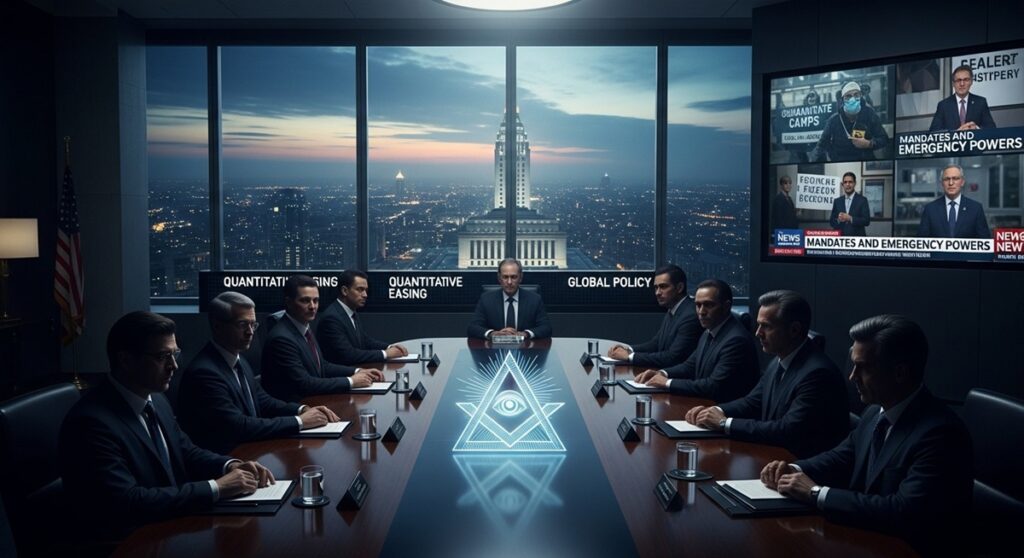
During the COVID-19 era, we saw their playbook in action. Australia erected quarantine camps; Canada invoked emergencies to freeze bank accounts of protesters; and worldwide, mandates forced billions indoors for years. Propaganda blanketed the airwaves, echoing the Ministry of Truth’s revisions of history. The globalists thrive on crisis, it’s their excuse to centralize power. And money? It’s infinite for them. Bitcoin, NFTs, central bank digital currencies, all “created” from nothing, widening the chasm between haves and have-nots.
The Proles | The Controllable Masses and Their Illusions of Freedom
Then come the proles, the “gnomes” or drones of society, 85% of the population in Orwell’s vision, and arguably more today. They’re the factory workers, service employees, and digital gig laborers who keep the machine humming. The elite view them as subhuman, fit only for toil and breeding. “Proles and animals are free,” Winston Smith muses in the novel, but it’s a cruel joke. They’re free to consume distractions, not to influence outcomes.
In our world, proles are herded like sheep by algorithms and media. Social media feeds them outrage porn, keeping them divided and docile. Entertainment—reality TV, endless streaming—numbs the mind, while economic precarity ensures compliance. One shepherd (or CEO, or policymaker) dictates the flock’s direction. Intermediate layers exist | the Outer Party, bureaucratic middle managers who enforce rules without questioning them. Teachers, mid-level officials, influencers—they’re the gaskets, aspiring to elite status but forever trapped.
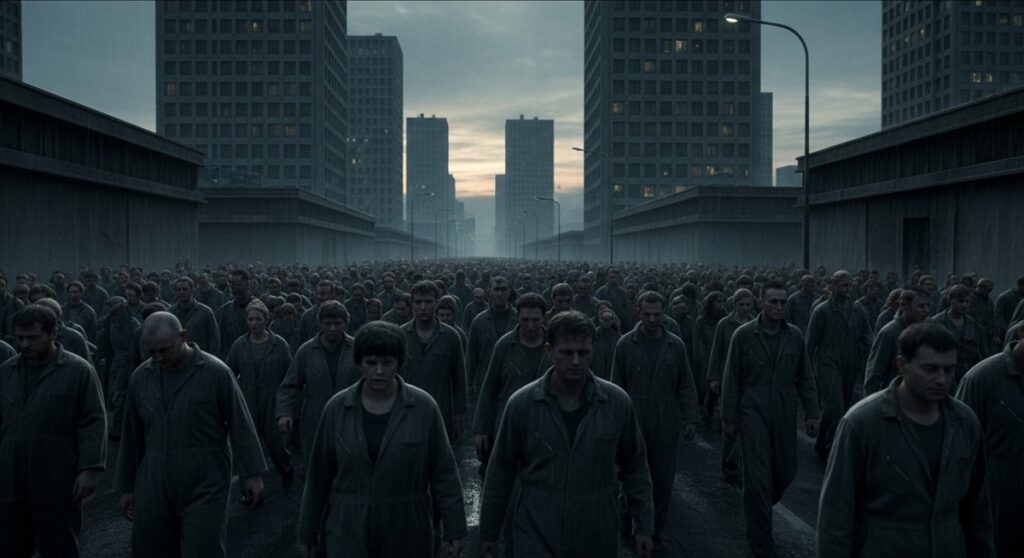
Biologically, almost, these poles don’t mix. Globalists don’t fret over mortgages or healthcare; their wealth multiplies exponentially. Proles chase scraps, trapped in cycles of debt. It’s a deliberate design | inequality as the glue holding the hierarchy together.
The Middle Ground | Gaskets and the Illusion of Mobility
Between the extremes lie the buffers, the Outer Party equivalents. These are the professionals, small business owners, and aspiring influencers who believe in the system because it offers a sliver of upward mobility. In 1984, they’re the most miserable, surveilled constantly, their loyalty bought with petty privileges. Today, it’s the suburbanites glued to 401(k)s, terrified of rocking the boat. They enforce the rules at work, share viral fact-checks online, and vote for “stability,” unwittingly propping up the elite.
This middle class is shrinking, squeezed by automation and offshoring. Yet, they serve a purpose | absorbing dissent and providing the illusion that anyone can “make it.” Without them, the proles might unite against the top.
1984 in Contemporary Society | Predictions or Prescriptions?
The Lottery Trap | From Orwell’s Fiction to Modern Gambling Empires
Orwell nailed it with the lottery, a “fabulous” distraction for the proles, their main thrill in a joyless existence. In the novel, millions in London pin their hopes on weekly draws, with “experts” peddling surefire systems for profit. But the twist? Big wins are myths; only small prizes go to real people, while fictitious winners claim the jackpots. The Party rigs it to foster hope without risk.
Fast-forward to now | Lotteries, sports betting apps, and crypto schemes advertise non-stop. DraftKings and FanDuel rake in billions, promising life-changing wins. Gurus on YouTube charge for “insider tips,” echoing Orwell’s forecasters. And the rigging? Scandals abound—fixed odds, insider trading in sports, even blockchain “transparency” that’s anything but. It’s a psychological op | Keep the proles dreaming, betting their last dime, never revolting.
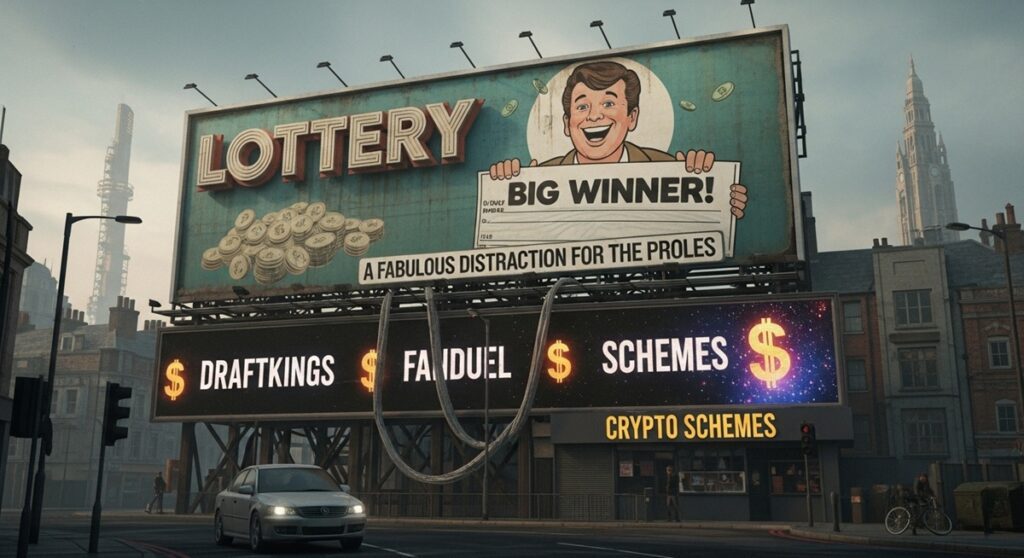
This isn’t coincidence. 1984 was written 75 years ago, yet it anticipates our addiction to chance. The global gambling industry, worth over $500 billion annually, distracts from wage stagnation and housing crises. Orwell’s “instruction” here? Dangle carrots to maintain obedience.
COVID-19 | A Live Demonstration of Globalist Control
No example resonates more than the pandemic. Orwell’s telescreens monitored every single mutter; today’s smartphones and contact-tracing apps do the same. Lockdowns isolated families, mirroring the novel’s emphasis on atomizing society. Propaganda? “Two weeks to flatten the curve” morphed into two years of compliance.
Australia’s “COVID prisons” for the unvaccinated, Canada’s trucker crackdowns, these were beta tests for broader control. The World Health Organization, often linked to globalist agendas, coordinated the response. And the economic fallout? Trillions to elites via stimulus; crumbs for the rest. Orwell would recognize the pattern | Crisis as catalyst for consolidation.
Christianity | The Sole Antidote to Globalist Domination
Amid the gloom, Orwell hints at resistance, but the text provided spotlights Christianity as the ultimate counterforce. Unlike coercive ideologies, it transforms from within, softening hearts and fostering genuine community. Jesus’ teachings in the Gospels, love thy neighbor, resist evil without violence, challenge the hierarchy’s foundation of fear and division.
Globalists have diluted Christianity through scandals and secularism, but its core endures. In a world of manufactured consent, faith offers clarity. Orwell, a lapsed Anglican, might have seen its potential; his Anglican schooling influenced his moral compass. Today, Christian principles underpin movements against surveillance states and economic injustice. It’s no wonder elites promote relativism—absolute truths threaten their relativism of power.
The Peril of Prosperity | Why Equality Dooms the Elite
Here’s the crux | True prosperity—short workweeks, eradicated hunger, universal access to education and tech—spells doom for the hierarchy. In an equal world, inequality vanishes, and with it, the elite’s leverage. Wealth for all erodes difference, the lifeblood of control.
Orwell warns that general well-being invites rebellion; thus, it’s sabotaged. Wars, engineered scarcity, environmental policies that hike costs, all preserve the status quo. Bitcoin’s rise? Not liberation, but another tool for the rich to hoard while proles speculate. Climate agendas? They disproportionately burden the masses, funneling green trillions upward.
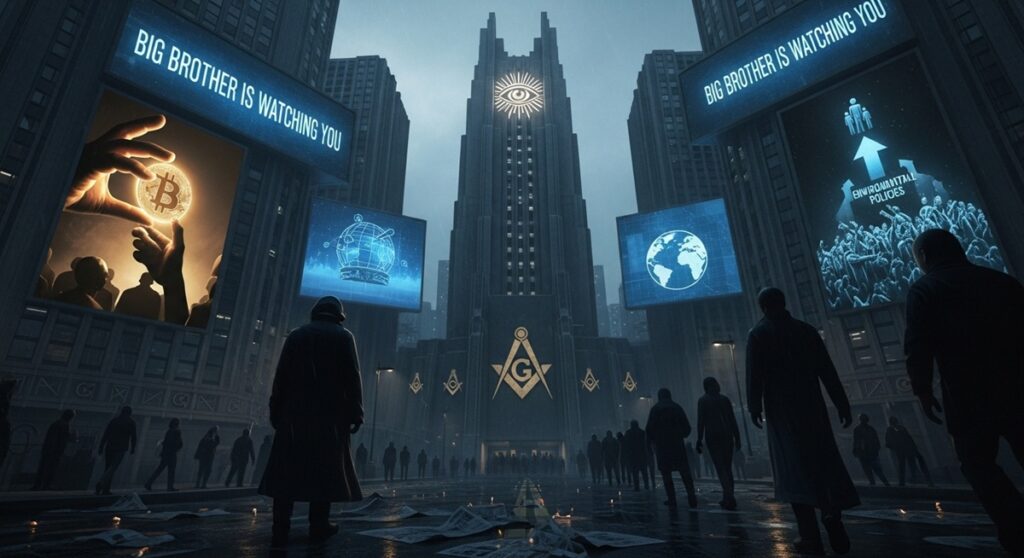
The globalists’ plan, per 1984, is stasis | Keep the world teetering, never thriving. Supranational castes—Freemasons, Davos attendees—ensure power stays concentrated. Orwell exposed this, and for it, he’s vilified or romanticized, but never fully heeded.
In closing, 1984 is a wake-up call from a man who knew too much. The Freemasons and their ilk haven’t forgiven him because the truth hurts. Read it, question everything, and reclaim your sovereignty before Big Brother’s grip tightens further.