



Imagine a library of history, not carved in stone or inked on parchment, but frozen in the deep strata of time. Now imagine a single volume within that library, a book that pre-dates the Old Testament, a text so volatile, so heretical, that a king ordered its complete annihilation, fearing it would unravel the entire spiritual framework of his world.
This is the grim legend of the Kolbrin Bible, a manuscript estimated to be at least 3,600 years old, a time-capsule written by Egyptian high priests and Celtic druids. While the world distracts itself with the vague anxieties of Nostradamus, the Kolbrin offers something far more chilling | not a riddle, but a precise, apocalyptic warning that reads like the blueprint of our current reality. It is a chronicle of ancient catastrophes and a prophecy of a future cataclysm, the return of a celestial entity known simply as the Destroyer—which, according to its ancient cycle, is imminent. The text suggests that the fate of civilizations is not the work of divine judgment, but the inevitable consequence of a recurring, astronomical event. If the words of the forgotten priests are true, we are currently living in the final, decaying generation, watching the harbingers of doom unfold before our eyes.
The Heretical Chronicle Buried Under the Abbey
The origins of the Kolbrin Bible are shrouded in the deepest secrecy, a tradition spanning millennia. Its initial core, known as the “Great Book,” is believed to have been compiled by Egyptian temple priests who meticulously recorded not just religious doctrine, but secret knowledge of cosmology and planetary annihilation. It was an exclusive archive of extinction events, intended only for the chosen guardians who were tasked with preserving the memory of past world collapses and preparing future generations for the cyclical recurrence. The earliest known fragments are thought to predate the Exodus itself, pushing its antiquity beyond the earliest books of the canonical Bible.
Over time, this colossal work migrated. It was carried by Phoenician navigators to the British Isles, where it fell into the hands of the Celtic Caldians, an esoteric spiritual brotherhood. These Celtic priests, who were equally dedicated to preserving ancient astronomical knowledge, supplemented the Egyptian chronicle with their own observations and prophecies, adding depth to the terrifying forecast.
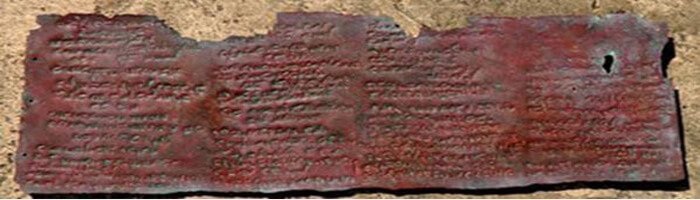
For centuries, this dangerous tome found refuge in the cellars of Glastonbury Abbey, a place already steeped in the myths of King Arthur and the Holy Grail. The manuscript’s presence there created a volatile spiritual tension. It was a time bomb of alternative history, waiting to contradict the single-narrative theology of the burgeoning Christian world. The text was clear | the world was created and destroyed multiple times, not by a single act of divine punishment, but by predictable, colossal forces within the cosmos.
The threat posed by this alternate narrative was finally recognized by King Edward I of England, known as Longshanks. In the thirteenth century, upon learning of the manuscript’s existence and its heretical cosmology, the king became furious. An ancient text that dared to challenge the church’s monolithic authority could not be allowed to exist. The result was predictable | in 1184, a devastating fire engulfed Glastonbury Abbey, consuming the monastery’s priceless library. The Kolbrin Bible was declared lost forever, a footnote in the history of censorship.
Yet, destiny, or perhaps the foresight of the Caldians, intervened. A handful of fragments were smuggled out by monks and entrusted to the secretive Celtic brotherhood, who kept them in the strictest operational secrecy for over five centuries. The surviving fragments, now known as the Kolbrin Manuscript, only began to surface and reach a narrow circle of researchers in the eighteenth century, finally gaining public awareness toward the end of the modern age, precisely the time period the book itself warns us about.
The Dragon’s Tail | Rewriting the Great Flood
The most compelling section of the Kolbrin text is its detailed, physical description of the Great Flood—the defining global catastrophe of the ancient world. The manuscript rejects the notion of divine, morality-based punishment in favor of a devastating, astronomical reality. It substitutes theological judgment with astrophysical mechanics.
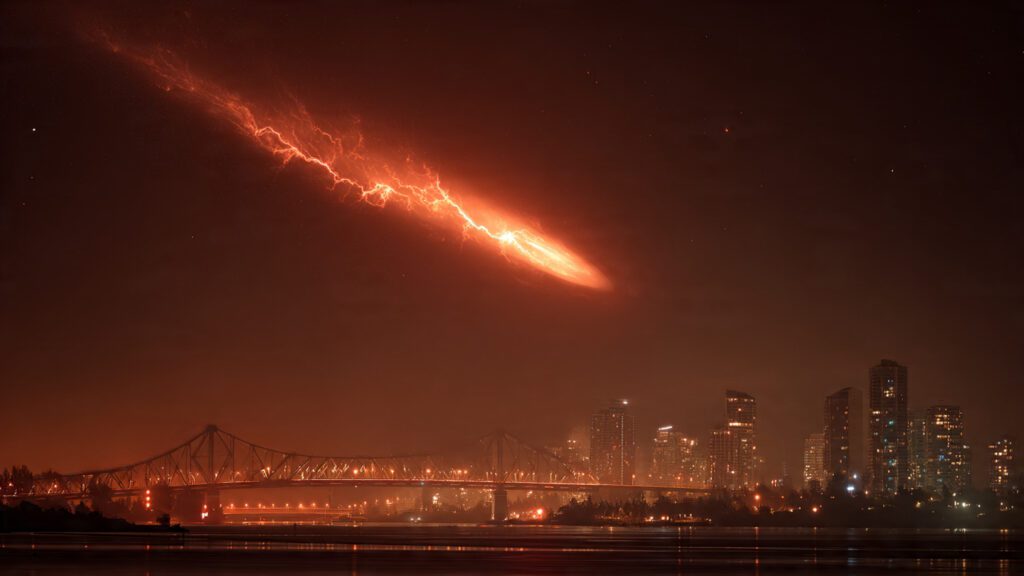
According to the Egyptian and Celtic priests, the cataclysm was caused by the appearance of a massive celestial body they termed the “Destroyer.” They describe it not as an ethereal force, but as a physical object, a harbinger of planetary death:
“The destruction and recreation of the Earth happened not once, but twice. During the great annihilation, God created a dragon from the sky. The dragon was terrible, it whipped its tail, spewed fire and red-hot coals, and a great catastrophe befell humanity.”
This ancient account is remarkably consistent with the observation of a massive comet or a planetary-mass body passing perilously close to Earth. The “dragon’s body glowed with a bright red light” is the perfect visual description of an incandescent object entering the atmosphere or glowing due to friction and composition. The “tail of smoke” and the raining down of “ash and hot stones” points directly to a cometary tail, a massive debris field, and an ensuing bombardment of meteorites and cosmic dust. The gravitational forces of such a large passing object would have caused the earth to “shake and sway,” initiating volcanic eruptions, tectonic shifts, and terrifying tsunamis that made the “seas overflow their banks, flooding everything around.”
Wormwood and the Sky Dragon
What elevates the Kolbrin narrative beyond mere mythological storytelling is its profound correlation with other ancient global texts. The same “celestial dragon” motif, the concept of a great star bringing bitterness and fire, is echoed across vastly different cultures that could not have shared historical contact.
In the classical Bible, the Book of Revelation mentions the “star of wormwood” |
“The third angel sounded, and a great star fell from heaven, burning like a lampstand, and fell on the third part of the rivers and on the springs of water. The name of this star is wormwood; and a third part of the waters became wormwood, and many of the people died because of the waters, because they became bitter.”
The Kolbrin’s Destroyer, a fiery star that causes destruction and poison, aligns perfectly with this terrifying vision.

Beyond the Judeo-Christian tradition, the ancient Indian Vedas describe the battle with the demon Vritra, who covered the sky and the waters. Greek mythology features the cautionary tale of Phaeton, who lost control of the solar chariot, almost incinerating the Earth, a clear analogy for a massive, fiery celestial body veering dangerously off course. Plato, in his dialogues Timaeus and Critias, also speaks plainly of periodic, great destructions that repeatedly obliterate civilizations, not through slow decay, but through sudden fire and water from the heavens.
All these disparate traditions share the same, terrifying, foundational memory | that global disaster is cyclical, astronomical, and has the capacity to utterly reset the human story. The Kolbrin Bible merely provides the most unvarnished, detailed, and non-theological account of the mechanics of this planetary reset.
The Final Countdown | Prophecy of the 110 Generations
The true terror of the Kolbrin text lies in its prophecies concerning the age preceding the Destroyer’s return. The priests set a clear, chilling timeline for the final phase of humanity:
“One hundred and ten generations must go to the Sunset. Kingdoms will rise and fall. People will fly through the air like birds and swim in the seas like fish.”
If we conservatively estimate a generation as approximately twenty-five years, 110 generations span 2,750 years. Measured from the manuscript’s likely creation point around 3,500 years ago, this prophecy lands us squarely within the tumultuous, technologically advanced, and morally fractured modern era. The fulfillment of the technological predictions—air travel and seafaring submarines—is undeniable. The final generations have arrived.
The text then shifts from technological prediction to a bleak, moral and geopolitical forecast that reads like a news feed from our own twenty-first century:
“Men will negotiate peace, but these will be days of hypocrisy and deceit.”
“The tall will fight with the low, the north with the south, the east with the west, and the light with the darkness. People will be divided into races, and their children will be born strangers among them.”
“Brother will fight brother, husband with wife. Fathers will no longer teach their sons, and sons will be wayward. Women will become the common property of men and will not be treated with respect.”
This is a startlingly accurate depiction of modern global affairs | endless diplomatic summits masking deep, cynical geopolitical conflict; a planet consumed by culture wars, political polarization, and the deep, familial schisms caused by rapid societal change. The prophecy describes a spiritual and ethical implosion occurring just as technological prowess peaks, suggesting that moral decay and hyper-connectivity are themselves symptoms of the final age. The wealth will be great, the text warns, but the people will be “poor in spirit,” consumed by “uncertainty and doubt.”
The Rotten Core of the Sea Nation
The Kolbrin singles out specific geopolitical entities whose rise and fall define this final era, using cryptic yet recognizable titles.
It predicts the rise and fall of the “country of legislators,” which conquered the world and talked of peace while bringing war, a clear allusion to the Roman Empire, which laid the foundation for modern law before collapsing into oblivion.
More ominously, it describes a “sea nation” that will become more powerful than others, yet will be “like an apple with a rotten core and will not stand.” This prophecy perfectly mirrors the trajectory of the British Empire, which ruled the waves for centuries before succumbing to internal and external decline, or perhaps the modern United States, with its unparalleled naval superiority masking profound internal socioeconomic and ethical rot.
Finally, it warns that “The Merchant Nation will destroy the miracle workers, and that will be their victory.” This speaks to the absolute supremacy of commerce and consumerism, the global materialist machine which systematically suppresses true scientific discovery, genuine artistic expression, and esoteric spiritual knowledge in favor of profit. The suppression of the Kolbrin text itself, a document of profound cosmic wisdom, is a historic example of the merchant state’s eternal victory over the miracle workers. The world is being consumed by the very commercial forces that make us rich yet spiritually bankrupt.
The Harbinger and the Cyclical Catastrophe
The core function of the Kolbrin Bible is to issue the final warning | the era of the Destroyer’s return is nigh. The priests were clear that this is not a random, one-off celestial event, but part of a deterministic, 3,600-year planetary cycle. If the last major encounter occurred during the Bronze Age Catastrophe (around 1500 BC, correlating with the Exodus), then the next one is mathematically slated to occur within the next few decades or century, a looming appointment with destiny.

The text warns that the return will be preceded by the “Harbinger of Doom,” who will “come unnoticed, like a thief.” This Harbinger is not necessarily a person, but an astronomical phenomenon, perhaps a distant celestial precursor or a subtle, cosmic shift that modern science, with its linear, short-term focus, will fail to correctly interpret until it is too late. The Destroyer itself, they claim, is a periodically returning body, perhaps related to the hypothetical Planet Nibiru mentioned in Sumerian lore, destined to cross the inner solar system and wreak havoc.
The signs preceding the final appearance are already visible | “The sky will be full of omens. People will see strange lights and signs. The land will tremble, and the sea will overflow its banks in places where it is not expected. The weather will become unpredictable, the seasons will become confused.”
The Silent Omen | Before the Body of Doom
When the Destroyer—the “Body of Doom”—finally arrives, the effects will be devastatingly precise, matching the geological records of past world-ending events:
“He will appear, and the mountains will begin to crumble, spewing fire and ashes. The trees will be destroyed, the waters will swallow up the earth, and the sea will boil.”

The ancient descriptions are not vague portents, but a geophysical checklist for global collapse | volcanic mega-eruptions, massive tsunamis, and widespread seismic activity caused by extreme gravitational tides. The atmosphere itself will be fundamentally altered |
“The heavens will glow with a bright red light, and the Earth will turn the color of copper.”
This copper tint is the atmosphere choked with volcanic ash, dust, and cometary debris, scattering light and suffocating the planet.
The psychological impact is predicted to be as destructive as the physical. The population will fall into madness, consumed by fear that flows “like water from a broken jug.” They will be so blinded by their panic, rushing “like moths that fly to their own death to a lighted flame,” that they will become self-destructive. The final devastation will be complete |
“The flame will come and destroy all man’s works, the water will sweep away what is left.”
The Kolbrin Bible is not a text about salvation, but about survival. The ancient priests left this terrifying message not to induce paralysis, but to provide a framework of knowledge. They believed the catastrophe could not be prevented, but the knowledge could save the core of the human race. The final generations are required to use this exposed wisdom to prepare, to heal the self-inflicted spiritual wounds, and to preserve the vital knowledge required to rebuild civilization after the unavoidable astronomical reset.
The time for easy historical denial is over. The Kolbrin text is a clock, and the final generation is now deep into the countdown. The question is not if the Destroyer will return, but whether we, the people living in the predicted age of hypocrisy and spiritual poverty, can find the courage and wisdom to heed the most persistent, specific, and suppressed warning ever delivered from the deep past.