




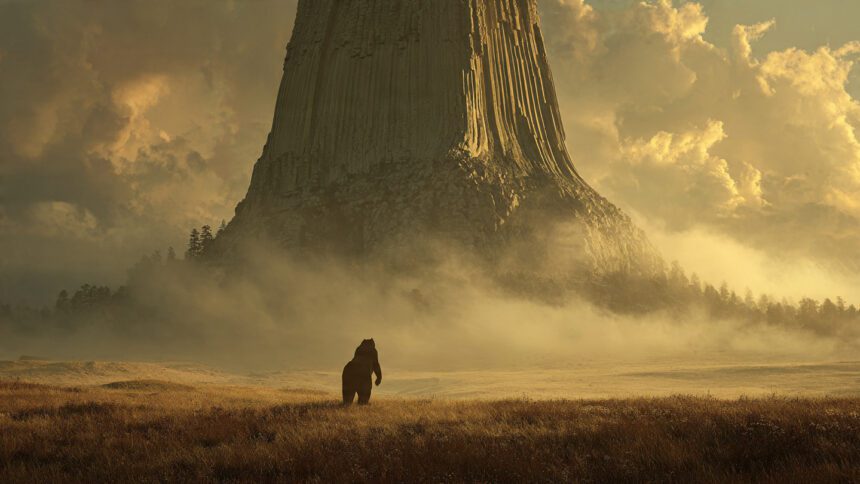
The Earth holds secrets that refuse to be categorized. They are monuments to a reality far stranger than the science of our textbooks allows, structures that defy comfortable explanation and haunt the periphery of our known history. Standing sentinel over the desolate plains of Wyoming is one such enigma | Devils Tower. It is a sheer, colossal pillar of rock that rises 386 meters above its base, dominating the horizon like a giant, petrified stump left behind after an unknown, catastrophic force felled a tree of impossible size.
What is this monolith? Is it merely a magnificent geological accident—a laccolith intrusion of cooling magma—or is it the stark, silent evidence of a forgotten past, a world where life reached proportions that shatter the limits of modern physics and biology? The questions surrounding the Tower are not just scientific; they are deeply metaphysical, forcing a choice between the rational and the truly fantastic.
The Verticality of the Unknown | A Monolith That Defies the Plains
The visual impact of Devils Tower is instantaneous and deeply unsettling. As you drive across the endless, flat expanse of the American West, this solitary, striated column bursts into being, looking less like natural rock and more like a ruined work of colossal masonry. It is the texture that arrests the eye | the entire structure is sheathed in vertical columns, stretching rigidly from the ground to the flat, sheared summit. These columns, some thicker than a car, look exactly like the giant, mineralized fibers of wood. The overwhelming, almost magnetic impression is that this is not a mountain formed by tectonic uplift or surface erosion, but the remnant of something organic, something that grew.
This profound sense of awe is nothing new. Local indigenous tribes, including the Kiowa and the Lakota, have regarded the formation as a place of immense spiritual power and sacred geography for millennia. The Kiowa legend of the giant bear is the most famous, detailing how the stone grew toward the sky to protect seven sisters from the monstrous predator, its vertical grooves forever marked by the bear’s desperate, furious claw marks. The sisters ascended to become the Pleiades constellation, directly linking the monolith to the celestial sphere. This narrative, a common thread throughout ancient mythologies, frames the Tower not as an inert rock, but as an active axis mundi—a point where the earth and the heavens touch.
Is the consistency of this mythology, which transcends cultures separated by oceans, merely a coincidence of symbolism, or is it a deep, collective memory of a time when the World Tree was not a metaphor but a tangible reality?
The Unsettling Theory of the Giants
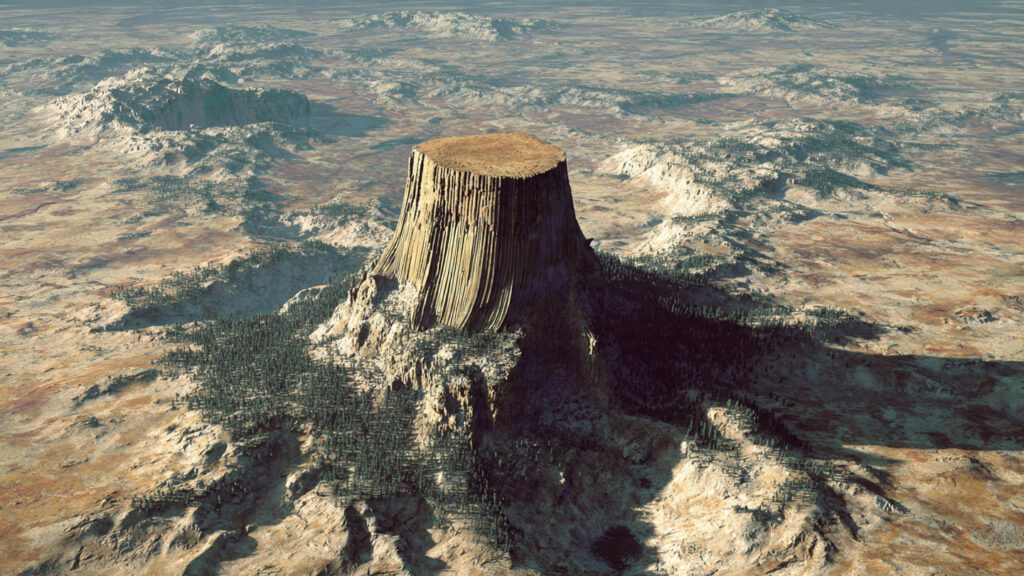
In the shadowy corners of alternative geology, where researchers dare to question the established timeline of deep time, a radical hypothesis has gained unexpected traction. It is the notion that formations like Devils Tower, the immense flat-topped Roraima Plateau in Venezuela, and the stark mass of Table Mountain in South Africa, are all remnants of a former terrestrial era—the stumps of truly gigantic, prehistoric trees that once reached kilometers into the atmosphere.
Devils Tower is the perfect focal point for this theory. Proponents argue that its vertical columns are too regular, too perfectly aligned with the force of gravity, to be merely the result of a random igneous cooling process. They point to the flat top, suggesting it looks less like a weathered dome and more like a precise, purposeful cut. This visual rhetoric, the sheer, visceral resemblance to a colossal, petrified tree trunk, is the central pillar of the argument.
The hypothesis gained viral momentum a few years ago with unverified reports from “researchers in Wyoming” claiming to have detected a vast, deep-reaching root system extending many kilometers underground beneath the Tower. While these claims were quickly dismissed as unsubstantiated rumors and internet folklore by official bodies, the story resonated because it offered the missing piece of the structural puzzle. If the Tower is the stump, the missing subterranean system would logically be the root ball, further cementing the idea that we are looking at the fossilized remnants of a silicon or hyper-carbon-based giant.
The Verdict of Geologic Time | Laccolith vs. Lignin
Mainstream geology approaches the Devils Tower mystery with a quiet, authoritative confidence, classifying it as a textbook example of a laccolith intrusion. Geoscientists are unanimous | the formation is entirely magmatic, a process that played out tens of millions of years ago in the subterranean dark.
The standard explanation runs like this | roughly 40 to 50 million years ago, molten rock—magma—rose from deep within the Earth. It intruded into the existing sedimentary rock layers but failed to breach the surface. It pooled and solidified underground, forming a massive, dome-shaped mass of igneous rock known as phonolitic porphyry.
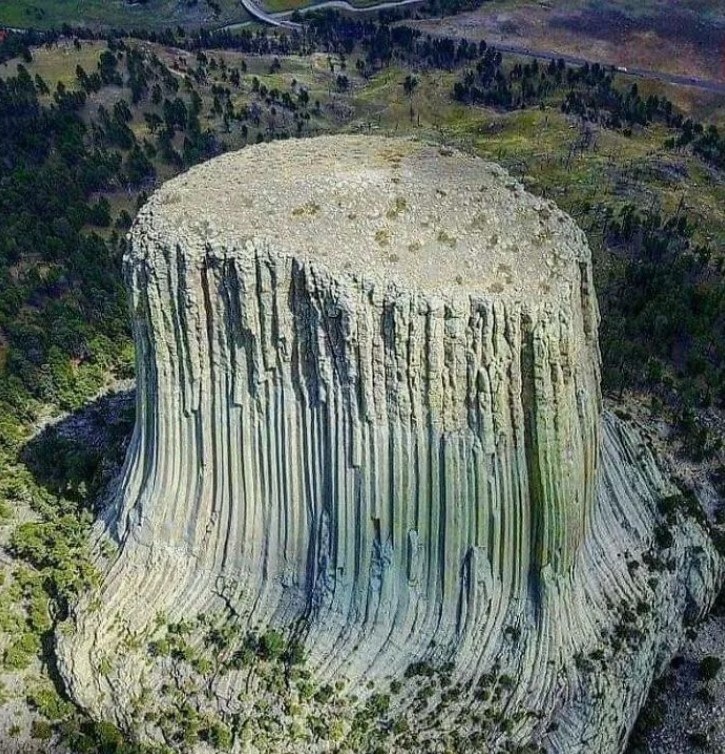
Over the following millennia, the softer sedimentary rocks (sandstone, shale) surrounding this hard core were stripped away, relentlessly eroded by wind and water. This took millions of years, exposing the resistant, dense heart of the ancient intrusion. The vertical columns, which look so much like wood fibers, are actually a common volcanic phenomenon known as columnar jointing or separation. This occurs when cooling magma contracts; the stress of cooling pulls the rock apart into prismatic shapes, usually hexagonal or sometimes pentagonal. We see the same process, the same geological signature, in places like the Giant’s Causeway in Northern Ireland, which is basaltic lava, not magma, but the cooling physics are identical.
The most damning piece of scientific evidence against the giant tree theory is the rock itself. Geologists have rigorously tested samples from the Tower. It is a crystalline igneous rock, not organic material. Under a microscope, petrified wood exhibits a distinct cellular structure—lignin and cellulose that have been mineralized. The rock of Devils Tower displays the interlocking crystalline patterns of magma that cooled slowly underground. The cellular signatures of life are simply not present. The rock is dead, hard fire, not fossilized flora.
The Forbidden Physics of Colossal Life
The greatest stumbling block for the giant tree hypothesis lies not in geology, but in the immutable laws of physics and the constraints of biology.
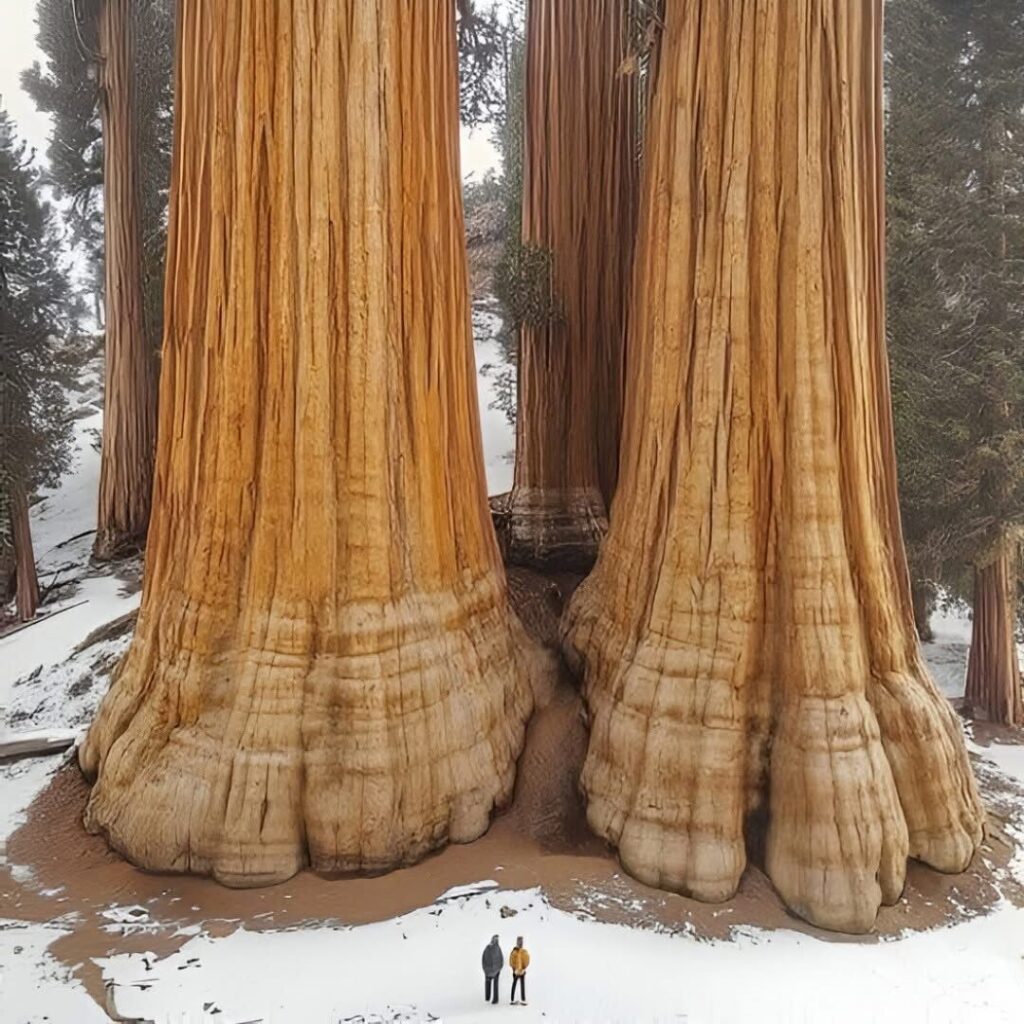
The tallest living trees on Earth, the Hyperion sequoias, max out at around 115 meters. They stand at the very threshold of what is physically possible. Plant physicists are categorical | a tree a kilometer high, let alone several kilometers as proposed for the Tower, is biologically impossible under modern Earth conditions. The limits are threefold:
First is structural integrity. Wood, even the densest type, has a finite tensile strength. A trunk rising a kilometer would simply crush itself under its own immense weight, or snap in high winds. The weight of the crown, the branches, and the leaves would increase the load exponentially.
Second is the problem of water transport. Trees rely on root pressure and the tension created by transpiration in the leaves to pull water up. Beyond about 120 meters, the pressure required to counteract gravity exceeds the capillary strength of water molecules. Water would simply stop flowing to the top of the plant. A tree kilometers high would have a desiccated, dead summit.
Third is gravity itself. Gravity is the unyielding antagonist of large life. The gravity that exists now has been the same for billions of years. To support a kilometer-high tree, proponents must posit a time when Earth’s gravity was significantly lower, or when atmospheric pressure was several times higher—scenarios that lack any corroborating evidence in the paleontological or geological record. Alternative theories involving a silicon age—life based on the more robust, but less flexible, silicon atom—are chemically problematic in the presence of oxygen, which has dominated Earth’s atmosphere for vast stretches of time.
Therefore, to accept Devils Tower as a petrified stump, one must not only dismiss geology and petrology, but also overturn fundamental principles of physics and atmospheric science. This is the profound cost of the alternative theory.
The Universal Archetype of the World Tree
While science struggles with the rock, anthropology struggles with the legend. Why is the image of the World Tree—the axis mundi—so incredibly universal, so detailed, and so consistent across cultures that never communicated?
From the Norse Yggdrasil, the great ash that binds the nine realms, its roots gnawed by the dragon Nidhogg and its crown holding the eagle, to the Hindu Ashwattha, the cosmic banyan tree whose roots grow upward into the heavens, the details are striking. The Mayan Ceiba tree’s roots penetrated Xibalba (the underworld), its trunk was the human world, and its crown stretched into the thirteen levels of heaven.
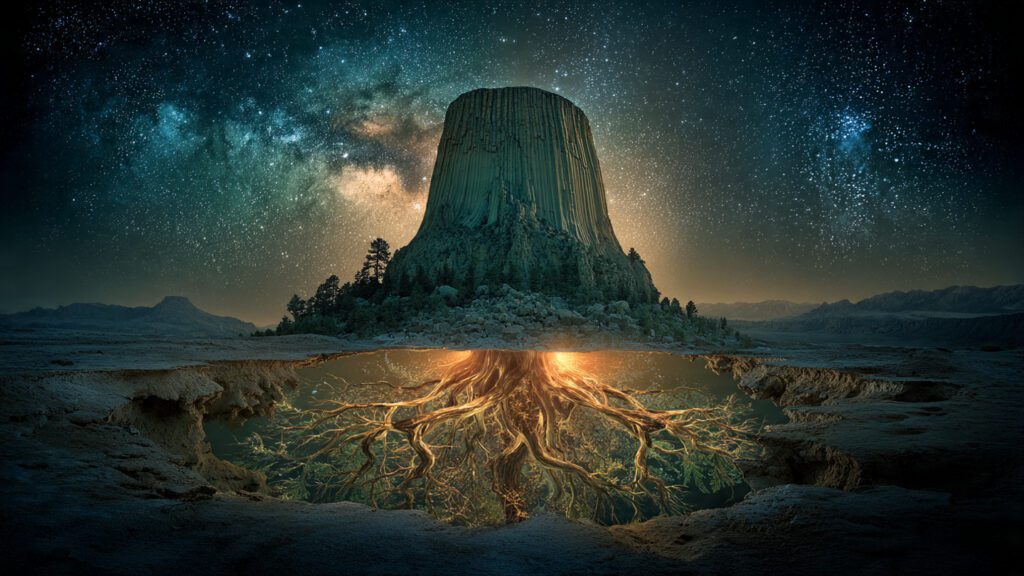
Anthropology, guided by figures like Carl Jung, explains this as the collective unconscious at work. The tree is the most potent, most accessible natural symbol for a three-tiered universe | roots in the hidden, trunk in the present, branches in the divine. It is the perfect logical metaphor for the flow of life, death, and wisdom.
But the question persists | why is the symbolism so specific? Why the eagle and the serpent, the three roots, and the concept of it holding reality together? Is it possible that the archetype is not just a metaphor derived from observation, but a collective memory—a persistent, mythologized echo of a real, astonishing object that once stood on Earth, dominating the horizon in a previous era? The enduring power of these myths suggests that something profound was witnessed, something that irrevocably stamped itself onto the human psyche.
Sacred Geography and the Closed Loop of Belief
Devils Tower forces a confrontation between what we know and what we feel. It sits precisely on the fault line between scientific certainty and existential wonder.
For the geologist, it is a closed case | a laccolith, columnar jointing, and 40 million years of erosion. It is proof that natural processes are powerful and long-lived, capable of creating structures that deceive the eye. For the scientist, the riddle is solved.
But for the alternative researcher, the spiritual seeker, and the indigenous elder, the question remains open. For them, the Tower is evidence that the earth’s timeline is not a simple, linear progression. They see the possibility that our history is cyclically punctuated by eras—a carbon age, a silicon age—each leading to the birth and death of structures and life forms that defy the laws of the current reality. They believe the sacred geography of Wyoming is merely revealing a truth that conventional science is structurally unable to accept.
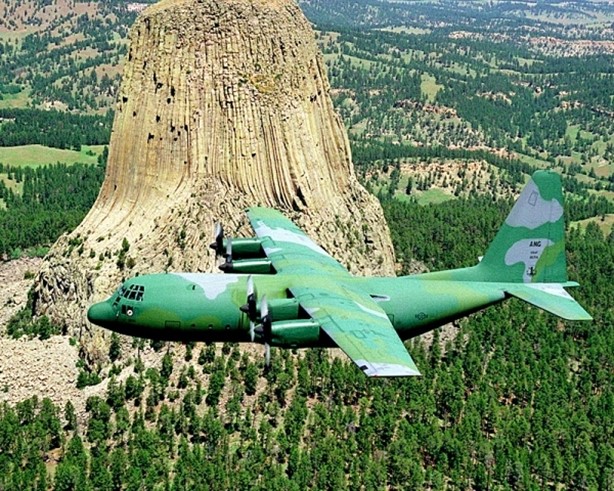
We stand at the base of this monolith, armed with carbon dating and igneous rock analysis, yet the feeling persists | the Tower looks cut. It looks like a stump. We have a powerful, comprehensive explanation for what it is, but a deeply unsatisfying one for how it makes us feel.
The real power of Devils Tower is not in its geological formation, but in its ability to split our perception of reality. Do we trust the microscope, which shows crystalline structure, or the lens of mythology, which shows the Yggdrasil archetype? Do we accept the limits of physics, or do we dare to imagine that the physics of the ancient past were radically different? The Tower keeps its secrets, reminding us that sometimes, the simple act of asking the forbidden question is more illuminating than finding the established answer.