





He was preparing for oral surgery when the scan was taken. Routine. Precautionary. The kind of imaging that is ordered as a matter of protocol before a procedure, not because anything unusual is expected.
What the scan showed was not expected.
A small metallic object, adjacent to the pineal gland, in the brain of a Boston artist and architect whose life’s work had been the systematic diagramming of consciousness, time, reality, and the relationship between human beings and whatever intelligence the cosmos contained beyond their visible horizon. Paul Laffoley reported that he had not undergone any procedure that would place an object in his brain, and that he had no surgical history that would account for it. This account rests entirely on Laffoley’s own description of the scan and his own interviews, a point worth stating clearly at the outset rather than only at the end, since no independent medical record or third-party radiological report is part of the public account. The reported location, adjacent to the pineal gland, is nonetheless the same location the esoteric tradition places the organ of higher perception, next to the structure that the Hindu tradition calls the third eye and that Descartes called the seat of the soul.
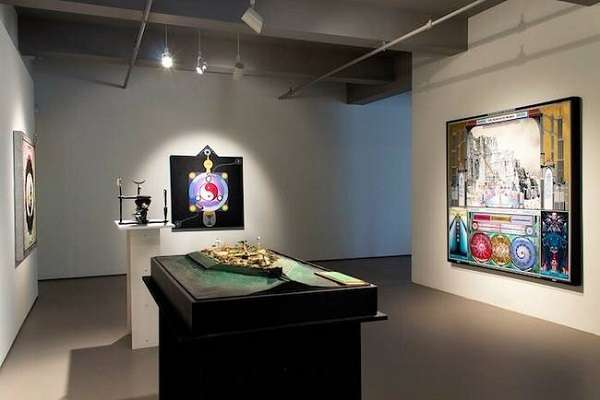
MUFON analysts who examined the scan characterized the object as nanotechnology capable of accelerating or decelerating brain activity. Laffoley himself described it as the primary explanation for the work he had been producing since his early twenties: the systematic, technically precise, cosmologically complete paintings that filled his studio in a basement in Boston with a density of information and visual intelligence that galleries including Kent Fine Art in New York found extraordinary enough to exhibit to serious audiences.
He had not known the object was there before the scan. He had been making the work for decades before the scan.
The object was present for all of it.
The Work
To understand why the implant matters, the work needs to be understood first.
Laffoley’s paintings are not paintings in the conventional sense of images that represent or evoke. They are technical documents. Large canvases covered with systematic diagrams, text, symbols, and geometric constructions that constitute complete theoretical frameworks for cosmological, architectural, or consciousness-related problems. Each painting is a working model of something: a proposed mechanism, a mapped structure, a theoretical system expressed in visual form with the precision of engineering drawings.
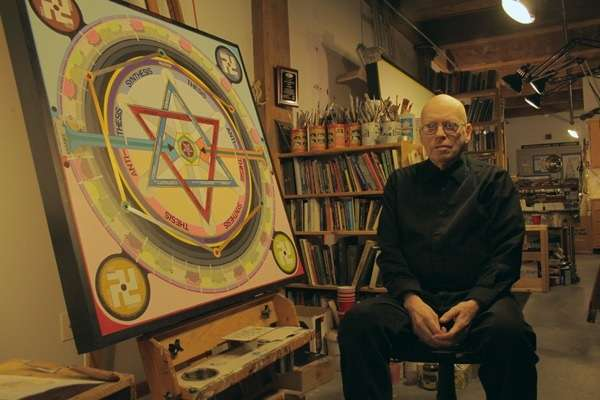
The Geochronmechane, whose title Laffoley translates as time machine made of earth, is a detailed architectural and mechanical specification for a device intended to allow travel through time. The technical specifications are not vague conceptual gestures. They are enough to have attracted the attention of researchers in the physics community who found the underlying theoretical framework engaging even where they found the engineering proposals beyond current capability.
The Thanaton III depicts what Laffoley described as a mechanism for conscious navigation of the death process, allowing the dying person to maintain awareness and intentionality through the transition that ordinarily occurs without the dying person’s active participation. The diagram is a complete operational framework: it shows the stages of the process, the conditions required for conscious navigation of each stage, and the preparation that would be required for someone to enter the process with the awareness the mechanism requires.
The Life in Time series maps what Laffoley called temporal vibratory cosmology, his integrated framework for understanding consciousness, time, and physical reality as aspects of a single structure whose relationships can be mapped with sufficient precision to permit practical navigation. The framework draws on Vedic cosmology, Western physics, architecture, and what he described as direct knowledge received through the implant in states of heightened awareness.
These are not the works of a person processing personal emotional experience in visual form. They are the works of a person receiving or generating systematic technical information and transcribing it as precisely as visual art permits. The question of where the information came from is the question that the CT scan placed in a context in 1992.
The Pineal Gland
The pineal gland is a small endocrine structure located at the center of the brain, between the two cerebral hemispheres, at the junction of the thalamic systems that process sensory information from all modalities. Its established function in mainstream neuroscience is the production of melatonin, the hormone that regulates circadian rhythms and sleep-wake cycles, in response to the ambient light levels registered by the retina.
Its significance in every major esoteric tradition that has addressed the relationship between consciousness and the body is considerably larger than its established endocrine function suggests.
In the Hindu and Buddhist traditions, the ajna chakra, conventionally translated as the third eye, is located at the position of the pineal gland and is associated with higher perception, direct intuitive knowledge, and the capacity to apprehend information not available through the ordinary senses. The anatomical correlation between the chakra system’s third eye location and the pineal gland’s anatomical position is precise enough to have been noted by researchers including Rick Strassman, whose work on the pineal gland and DMT, published in DMT: The Spirit Molecule, proposes that the pineal gland’s unusual biochemistry, including its capacity to synthesize compounds in the tryptamine family under conditions, may be the biological basis for the mystical experiences that the esoteric traditions associate with the ajna chakra.
Descartes, in his seventeenth-century philosophical framework, identified the pineal gland as the seat of the soul, the anatomical location where the immaterial consciousness interacts with the material body. Whether Descartes was making a philosophical proposal or transmitting esoteric knowledge in a philosophical frame, in the way that the Gnostic Transmission piece in this library covers as the characteristic method of the esoteric orders that were active in his period, is a question that the coincidence of his identification with the esoteric tradition’s identification leaves open.
An object capable of modifying brain activity, placed adjacent to the organ that both mainstream neuroscience and every major esoteric tradition identify as having a relationship to higher states of consciousness, in the brain of a person producing systematic cosmological knowledge in visual form, is a configuration that the conventional explanation, incidental artifact from an unknown source, leaves unsatisfyingly incomplete.
The Formation
Laffoley described his first spoken word as Constantinople, produced at six months of age, followed by complete silence until the age of four. He repeated this claim in multiple recorded interviews and treated it as a significant biographical data point rather than as an amusing anecdote. Like the implant account, this is a self-reported detail about early infancy with no independent verification available, family recollection of this kind is common and not always reliable even when sincerely believed, and it should be weighed accordingly rather than as confirmed fact.
A child who produces a complex proper noun as their first vocalization at six months, at an age when the neural architecture for language production is not conventionally developed to the level required, and who then does not speak again for three and a half years, is describing a developmental profile that the conventional framework of either normal development or autism spectrum development does not straightforwardly accommodate. Constantinople is a seven-syllable proper noun. The capacity to produce it at six months implies either an extraordinary early verbal facility or a mechanism for vocalization that bypassed the normal developmental sequence.
The three-and-a-half-year silence that followed could reflect normal autism spectrum developmental patterns in which language development is delayed and irregular. It could also reflect the kind of intense internal processing period that certain accounts of exceptional development describe: a period of withdrawal from external verbal communication coinciding with intensive internal organizational activity.
The years spent in the household of an Indian Brahmin mathematician at Harvard during his formative period gave Laffoley sustained exposure to the Vedic cosmological and mathematical tradition in an academic environment. The combination, Vedic cosmology and Harvard’s Western academic mathematical tradition, embedded in the development of someone whose mature work would systematically integrate these two frameworks, is not coincidental biography. It is the intellectual environment that the work required.
Laffoley received an Asperger’s syndrome diagnosis. The diagnosis provides a framework for understanding the cognitive profile that produced his work: the systematic attention to structural relationships, the capacity for sustained focused analysis of complex systems, the relative disengagement from social convention that allowed him to pursue his theoretical framework without the normal social pressure toward conventional professional output. Whether Asperger’s syndrome as a diagnostic category fully captures the cognitive profile that produced his work, or whether the profile requires additional elements, including whatever the object next to his pineal gland was contributing, is a question his life poses without definitively answering.
The Implant in Context
Roger Leir was a California podiatric surgeon who spent two decades performing surgical removals of objects from patients who reported alien contact experiences, and his own published claims of anomalous properties, isotopic ratios he interpreted as inconsistent with terrestrial manufacturing, unusual magnetic properties, and radio-frequency emission, need to be weighed against what independent analysis of comparable objects has actually found. The dedicated piece on this library’s abduction research covers this in more detail: objects analyzed by the New Mexico Institute of Mining and Technology and by independent labs examining a similar implant claim were found to be composed of ordinary terrestrial materials, including one case matching dental amalgam. Leir’s claims should be read in that context rather than as an established anomalous baseline.
The alien implant category in the UAP research literature is specifically claimed and specifically contested. The record exists in Leir’s published work and in the laboratory reports he commissioned, though as noted above, independent analysis of comparable objects has generally found mundane results. The contest focuses on chain of custody, methodology, and the interpretation of anomalous properties as genuinely anomalous rather than as misidentified conventional materials.
Laffoley’s case is distinctive within this category because the discovery was made by conventional medicine rather than through UAP research, and because the location of the object, adjacent to the pineal gland, is precisely the location that both the esoteric tradition and the function of the structure the object was placed next to make maximally significant.
Whether MUFON’s characterization of the object as nanotechnology capable of modifying brain activity is accurate cannot be determined from Laffoley’s account of their assessment. The MUFON analysis is known only through Laffoley’s own statements rather than through any MUFON published record, which is a single-source problem for that characterization specifically, and for the underlying implant claim more broadly.
He did not have the object removed. He lived with it for the remaining twenty-three years of his life after the 1992 scan. He continued to produce the work. He died in 2015. The question of what the object was, what it did, and who placed it there died with him in the sense that his own testimony was the primary evidence for all three.
What the Work Implies
The content of Laffoley’s paintings implies a knowledge source that is not adequately explained by the conventional biographical framework of an autistic artist with a mystical and occult family background and an obsessive interest in science fiction.
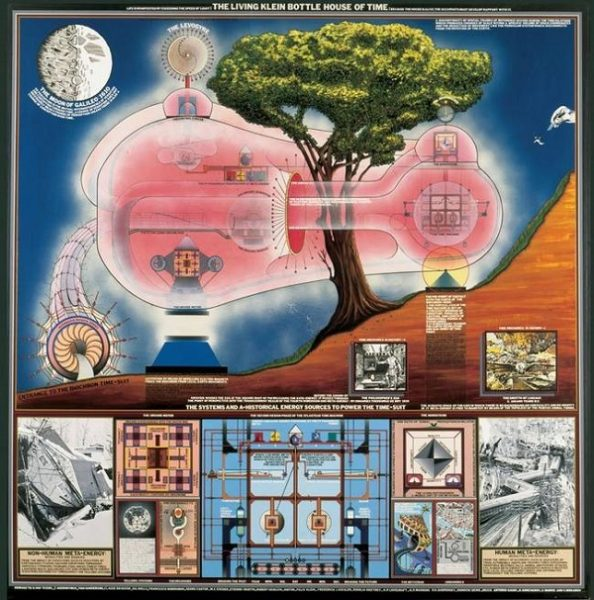
The Geochronmechane’s time machine specifications are technically coherent within the theoretical physics framework that takes spacetime manipulation seriously. They are not the fantasies of a person who watched science fiction films: they are working documents that integrate physics concepts, architectural principles, and what Laffoley described as direct received knowledge into a functional proposal.
The Thanaton III’s mechanism for conscious navigation of death is consistent with the frameworks covered across this library’s consciousness and samadhi pieces: the view from outside the body, the stages of the process, the role of prepared consciousness in affecting the transition’s outcome. Laffoley was diagramming, in technical visual form, what the Buddhist samadhi tradition and the near-death experience research describe from different investigative frameworks.
The temporal vibratory cosmology framework integrates Vedic time cycle mathematics, Western physics, and consciousness theory in a synthesis that the individual disciplines had not produced in the academic literature of the periods when Laffoley was developing it. He arrived at integrations that academic researchers in each of the contributing disciplines have subsequently moved toward independently.
The question his work poses is whether the systematic nature of these integrations, their technical precision, and their convergence with subsequent independent research in multiple fields reflects the cognitive profile of an exceptional human intelligence working in isolation, or whether they reflect a knowledge source whose presence adjacent to the third-eye organ of a person with the cognitive profile to transcribe systematic technical information in visual form is not coincidental.
The CT scan in 1992 provided a physical correlate for the explanation Laffoley had been giving for his work since its beginning. He had been describing receiving information through a mechanism he could not conventionally explain. The scan confirmed that a mechanism of unknown origin and function was present in the location where it would need to be to affect the function he described.
He did not put it there. It was there when they looked.
The work was already forty years old.