


Across the long memory of humanity, the world has rarely been viewed as a drifting accident. Civilizations separated by oceans and centuries spoke of a central axis that holds the earth in place, a stone spine that gives structure to the visible world and anchors it against the pull of chaos. This idea appears in sacred texts, in the myths of mountains that touch the sky, and in the quiet intuition that the planet carries a hidden order beneath its surface. The question is not whether such a spine exists in a physical sense. The question is why so many cultures felt compelled to describe one.
Modern science describes the earth as a sphere of molten iron and shifting plates. Mythic cosmology describes it as a constructed body, a vessel with a center, a measure, and a purpose. Between these two visions lies a fertile territory of speculation, metaphor, and metaphysics. This is the natural ground of Monkey and Elf, where the ancient and the uncanny meet in the open field of inquiry.
The idea of a planetary spine is not a geological claim. It is a mythotechnic metaphor, a way of describing the hidden order that stabilizes the world. It is a symbolic structure that cultures have used to understand the relationship between chaos and form, between the visible world and the forces that shape it.
The Cornerstone Motif in Ancient Texts
The oldest surviving texts of humanity speak of a foundation laid at the beginning of time. In the Book of Job, the creator asks who laid the cornerstone of the earth and who stretched the measuring line across it. These questions are not technical descriptions. They are metaphysical provocations. They imply that the world has a corner, a measure, a design, and a builder.

The Book of Enoch describes a stone of the earth that anchors creation. Mesopotamian cosmology speaks of a bond stone that holds heaven and earth together. Egyptian theology describes the Benben, the primordial mound that rises from the waters of chaos. Greek myth places the Omphalos at Delphi, the navel of the world. Hindu cosmology speaks of Mount Meru, the axis around which the universe turns.
These are not geological descriptions. They are symbolic blueprints, fragments of a pre scientific attempt to describe the world as a structured, intentional creation. They reflect the ancient conviction that the world is not a random event but a shaped and measured reality.
The Oceanic Axis and the Meridian of Dawn
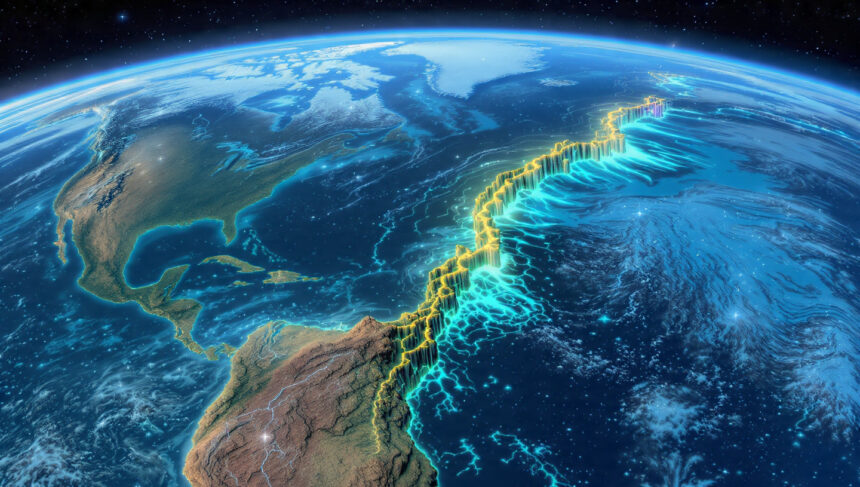
In modern geography, the 180th meridian marks the international date line. It is the threshold where one day ends and another begins. This line is not a physical structure, yet it functions as a global hinge, a symbolic sunrise axis that divides time itself.
Cultures living near this meridian often developed myths of world boundaries, cosmic thresholds, islands at the edge of reality, and places where the sun is born. The Pacific frontier became a canvas for stories of the world’s limit. In literature and film, Fiji often appears as the symbolic end of the world, a place where the known dissolves into the unknown. This is not because of geology, but because the human mind gravitates toward edges, lines, and thresholds.

The idea of a stone spine beneath the ocean is a poetic extension of this symbolic geography. It is a way of imagining the meridian not as a mathematical abstraction but as a cosmic vertebra, a stabilizing line that holds the world together.
The Mythic Function of the World Spine
Across cultures, the world spine serves several symbolic purposes. It anchors the world against chaos. It provides orientation and a sense of center. It connects heaven, earth, and the underworld. It marks the boundary between realms, waters, or states of being. It is the place where creation begins again after each cycle.
These functions appear in myths of the Axis Mundi, the World Tree, the Cosmic Mountain, the Foundation Stone, and the Pillar of the Dawn. The stone spine is simply the oceanic version of this universal archetype. It is the hidden vertebra of creation, the imagined structure that keeps the world from dissolving into formlessness.
Modern Echoes: Mapping, Sonar, and the Human Need for Pattern

In the early era of satellite mapping, the public briefly saw the ocean floor with unprecedented clarity. Linear features appeared across the seabed, stitching artifacts from sonar mapping, and some viewers interpreted them as evidence of ancient structures. Scientists explained these lines as technical artifacts. Yet the fascination persisted.
The persistence of this fascination reveals something important about the human mind. We are drawn to the idea that the world has a skeleton, a blueprint, a secret geometry beneath the waves. This is not a flaw. It is a mythic instinct. It is the same instinct that once placed the Omphalos at Delphi and the cosmic mountain at the center of the world.
The Energetic Interpretation: The Planet as a Resonant Body
In speculative metaphysics, the world spine is sometimes imagined as a magnetic conductor, a resonant pillar, a planetary tuning fork, a cosmic antenna, or a geometric stabilizer. These interpretations are not scientific models. They are symbolic attempts to describe the felt sense that the world has rhythm, structure, and intention.

Radio anomalies, seismic patterns, and glacial geometries become part of a mythic vocabulary, not evidence of hidden machines but metaphors for the complexity of the earth’s systems. The idea of a four dimensional printer architecture is a poetic way of describing the continuous process by which the earth reshapes itself through tectonics, magnetism, and climate cycles.
The Stone Spine as a Mythic Truth
The idea of a stone spine beneath the world endures because it speaks to something older than geology. It reflects the sense that the earth carries an inner structure, a quiet order that holds the visible world in place. Cultures across time reached for the same image when they tried to describe the meeting point between matter and meaning. They spoke of pillars, mountains, cornerstones, and hidden lines beneath the sea. Each tradition offered its own language, yet all pointed toward a single intuition. The world feels shaped, measured, and held.
To explore this idea is to step into a conversation that began long before written history. It invites a slower way of seeing, one that treats myth as a form of memory and symbolism as a tool for understanding the deeper patterns of existence. The stone spine is not a claim about the ocean floor. It is a way of thinking about the relationship between chaos and form, between the surface of the world and the forces that move beneath it.

The question is not whether a physical wall lies along the meridian. The question is why the human mind continues to return to the image of a central axis that steadies the earth. The persistence of this image suggests that the world is more than a collection of accidents. It carries intention, rhythm, and a sense of design that has never stopped calling to us.
To contemplate the stone spine is to acknowledge that the world may hold more structure than we can measure. It is to recognize that myth often preserves truths that cannot be expressed in technical language. It is to stand at the threshold between the known and the unknown and feel the quiet presence of something that has shaped human thought for thousands of years.
The stone spine remains a symbol of that presence. It is the quiet line that runs through the center of the world, the ancient reminder that reality may be deeper, older, and more deliberate than it appears.