




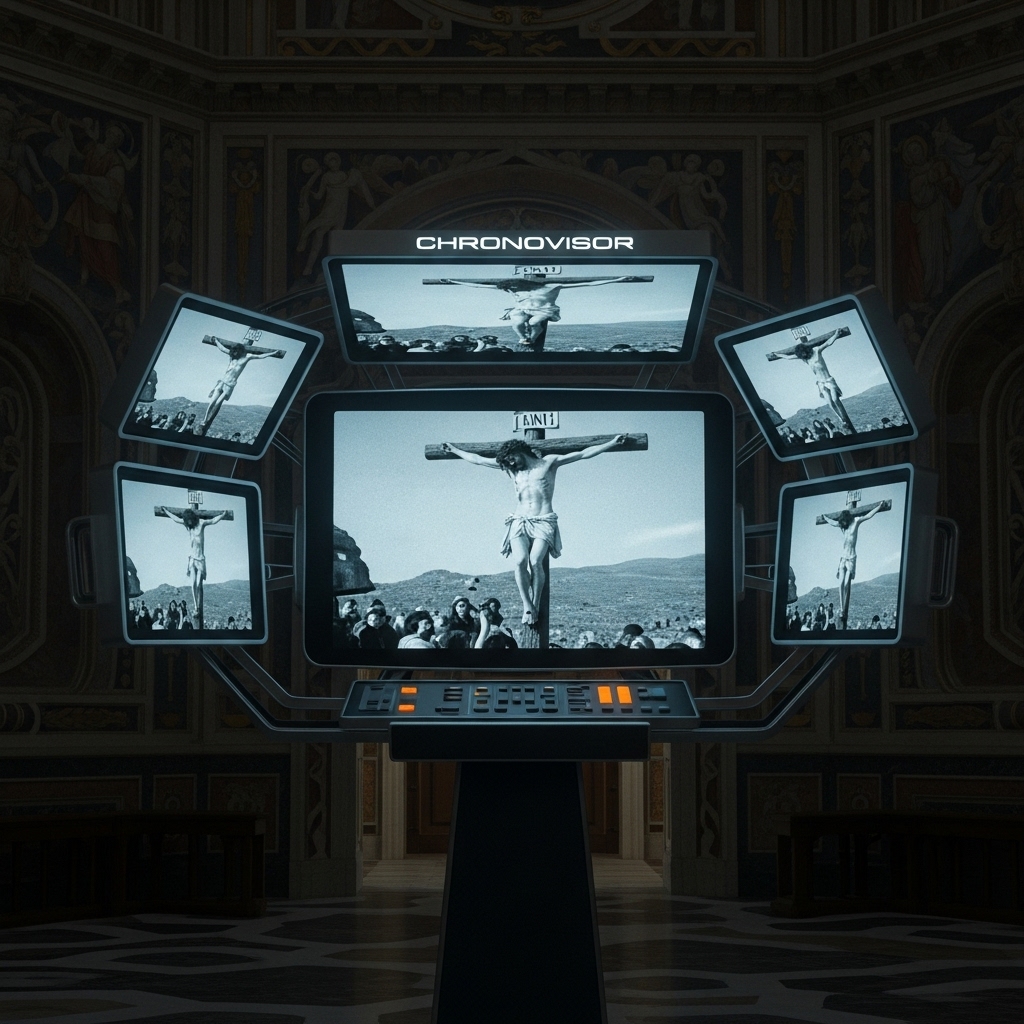
The idea that the Vatican may possess a device capable of peering into the past — even to the moment of Jesus Christ’s crucifixion — sounds like something ripped straight from a sci-fi thriller. And yet, this is not a new rumor.
It’s a theory that has quietly smoldered for decades, inflamed occasionally by anonymous whistleblowers, strange books, and whispered confessions from clergy and scientists alike. At the center of it all lies the mysterious “chronovisor” — a supposed time-viewing machine built in secret, hidden deep within the walls of the Holy See.
The Vatican’s Secret Archives | A Labyrinth of Lost Time
When Pope Leo XIV was recently enthroned in a ceremony rich with symbolism and centuries-old tradition, it wasn’t just Catholics around the world who watched. Conspiracy theorists, historians, and technologists turned their eyes once more to Vatican City — the most secretive nation on Earth. Beneath its golden domes and saintly sculptures lies the Vatican Secret Archives, an 85-kilometer-long stretch of sealed knowledge, inaccessible to all but a chosen few.
Publicly, access ends at documents dated 1939. Everything beyond that is off-limits. Behind those walls, say believers, are blueprints of unthinkable technologies, religious relics whose existence challenges our understanding of history, and — perhaps most tantalizingly — the chronovisor.
The Birth of a Controversy | Marcello Pellegrino Ernetti and the Machine That Sees the Past
Marcello Pellegrino Ernetti was no ordinary man. Born in 1925, he was both a Benedictine monk and a gifted physicist — a rare combination of devout faith and cutting-edge intellect. While studying ancient music and texts, Ernetti allegedly encountered obscure references that hinted at the possibility of seeing historical events as they truly happened.
He claimed that, with the help of 12 scientists — including Nobel Prize-winning physicist Enrico Fermi and rocket pioneer Wernher von Braun — he developed a machine that could tune into past events by capturing residual electromagnetic energy. This device, called the chronovisor, could allegedly convert these energy remnants into both audio and visual data, allowing observers to “watch” scenes from history as if they were unfolding in real time.
Ernetti’s reported achievements were astonishing. He said he had witnessed Cicero’s orations in the Roman Senate, the fall of Sodom and Gomorrah, and — most controversially — the crucifixion of Jesus Christ himself.
Seeing Jesus on the Cross | Hoax or Heavenly Glimpse?
One of the most explosive claims came when an Italian weekly published a grainy image, said to have been captured by the chronovisor, of Christ dying on the cross. The photograph shocked the public. If true, it was the first ever visual proof of the life — and death — of Jesus.
Skeptics quickly pounced. Researchers traced the image back to a known statue of Christ from the Temple of Merciful Love in Umbria. The angle and lighting were cleverly manipulated to resemble a live-action photo. Detractors accused Ernetti of a hoax, while his supporters insisted that he had been forced to use a substitute photo under pressure from high-ranking Church officials, who feared the truth would shake the foundations of both religious and political power.
Shortly before his death in 1994, Ernetti reportedly sent a letter to his relatives insisting that the chronovisor was real and that he had genuinely witnessed the crucifixion. The Vatican, as always, remained silent.
Ghostly Voices and the Birth of Instrumental Transcommunication
According to Ernetti, the chronovisor’s origins lay in earlier experiments attempting to capture the voices of the dead. Working in a Milan physics lab, he claimed to have recorded the baritone voice of one assistant’s long-deceased father. These eerie phenomena were later categorized as Instrumental Transcommunication (ITC), a concept which suggests that electronic devices can serve as portals to realities beyond normal human perception.

Ernetti believed these mysterious transmissions were made possible by subtle energy fields that still carry the imprints of events, voices, and images from the past. Under specific conditions, these fields could be tapped into — revealing not only lost words but also entire scenes of antiquity.
Mirages of Time | Are We Tuning into Historical Echoes?
Though the chronovisor’s existence is unproven, history is full of strange “time slips” and ghostly apparitions. In his book Hearing the Dead, French priest François Brune recounts stories that seem to support Ernetti’s theory. One woman reportedly heard the battle in which her son died while standing on the very battlefield years later. Two English tourists claimed to have seen Queen Marie Antoinette at Versailles. In Crete, others saw ghost-like visions of ancient Greek warriors.
Even psychologist Carl Jung spoke of inexplicable visions of historical scenes appearing near his home — people in traditional dress from another era moving in ghostly procession, completely invisible to others.

Some theorists suggest that strong emotional or historical events leave behind energetic echoes — or “psychic recordings” — stored in the environment. The chronovisor, they argue, was merely a tool for decoding these echoes.
The Thyestes Manuscript and the Limits of Proof
If the chronovisor existed, it wasn’t just used to witness the crucifixion. Ernetti also claimed to have recovered the full text and music of Thyestes, a lost tragedy by Roman poet Quintus Ennius. The claim generated excitement among scholars — until they examined the text.
Critics pointed out that the manuscript contained anachronistic language and unusual vocabulary. It lacked the length and complexity expected of classical Roman drama. While the document was intriguing, its authenticity remained unverified, and the academic community ultimately rejected it as a modern forgery or a well-intentioned fiction.
Why Would the Vatican Bury the Truth?
If the chronovisor truly existed, why would the Church suppress it? According to Brune and other insiders, the device was dismantled under Vatican orders. The potential consequences were too dangerous to ignore. A machine that could replay the past might expose falsehoods in religious texts, undermine governments, or destroy sacred traditions.
In the wrong hands, it could be weaponized — politically, religiously, or even militarily.
A Technology Ahead of Its Time — Or Pure Myth?
Could Ernetti’s story be a clever blend of science fiction, spiritual yearning, and theological metaphor? Perhaps. But dismissing it outright might be equally short-sighted. Modern quantum physics has shown us that time is not as linear as once believed. Some researchers now theorize that information from the past may still exist in some quantum form, ready to be accessed when — and if — we develop the right tools.
What seems like madness today could be mainstream science tomorrow.
You can be skeptical about these stories, but it is also unwise to completely exclude such things. Whether the chronovisor was real or not, it touches on something deeply human — the desire to understand where we come from, to witness the truth with our own eyes, and to find meaning in the echoes of history.