



The cosmic stage is rarely set with such high, agonizing suspense. When the Mars Reconnaissance Orbiter (MRO) finally positioned itself to capture close-range imagery of the rogue interstellar object, 3I/ATLAS, the world of fringe science held its breath. This was the moment of revelation, the first truly intimate look at the comet that continuously spat defiance in the face of orbital physics.
What we got in return was not clarity, but a calculated insult | two months of tense silence followed by a handful of inexplicably low-resolution images, clumsily dismissed as the best a multi-billion-dollar space agency could muster. It was a digital shrug, a pixelated lie designed to conceal rather than expose.

The MRO, with its formidable HiRISE telescope, an instrument designed to photograph car-sized features on the Martian surface from orbit—was ten times closer to ATLAS than any Earth-based observatory. The images delivered, however, appeared suspiciously indistinguishable in resolution from those captured by distant armchair astronomers. This act of bureaucratic opacity, where a government agency clearly downsizes or degrades vital intelligence, served only to confirm the darkest suspicions | NASA was hiding something profound about 3I/ATLAS. But that concealment was only the prelude to a far more disturbing event—the abrupt, unnatural silence of a highly reliable machine orbiting the Red Planet.
The Martian Sentinel Goes Dark
Just as the global discussion around the suspicious ATLAS imagery reached a fever pitch, the narrative of concealment was amplified by a chilling technical failure. On December 6, the deep space communication network registered something unprecedented with a veteran of the Martian orbit | silence. The Mars Atmosphere and Volatile EvolutioN (MAVEN) spacecraft, a stalwart sentinel that has flawlessly monitored the Martian atmosphere and relayed signals since 2013, had gone dark.
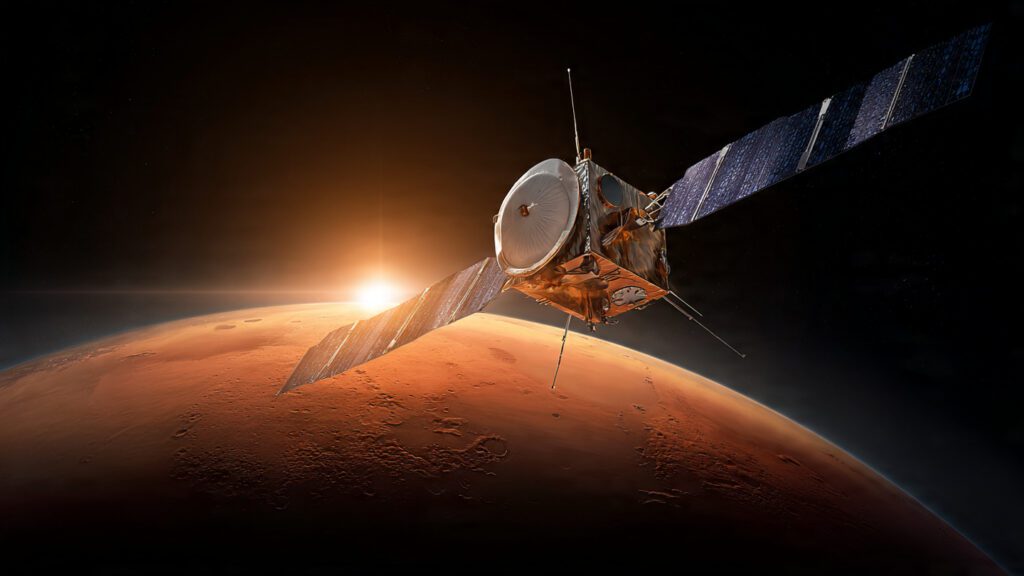
The official statement, referencing telemetry before the device passed beyond the Red Planet’s visible orbital field, insisted that all subsystems were operating normally. But the projected return signal never materialized. The agency, citing typical long-term operations issues—software failure, orientation problems, or battery degradation—began an investigation into the “anomaly.” However, ufologists, independent researchers, and anyone tracking the relentless anomalies of 3I/ATLAS recognized the situation for what it truly was | an impossibility masquerading as coincidence.
The timing of the failure is too perfect, too neatly aligned with the history of the interstellar visitor, to be dismissed as simple chance. MAVEN, besides its atmospheric science duties, served as a crucial data relay for the Perseverance and Curiosity rovers, and more relevantly, for the Mars Reconnaissance Orbiter itself. MAVEN was intimately involved in the data collection from the ATLAS flyby that occurred on October 2. The spacecraft had stared directly at the object, recording plasma parameters and solar wind interaction during its transit. Now, right after its gaze fell upon the rogue comet, MAVEN was suddenly and completely incapacitated.
Ten-Year Track Record of Silence
In the harsh vacuum of space, a decade of continuous, stable operation speaks to the exceptional engineering and robust redundancy built into a mission like MAVEN. Failures are expected, but they are rarely instantaneous and total, especially after the spacecraft has exited a relatively predictable observational window. Previous communication losses were consistently resolved, attributed to antenna orientation or safe mode switches. This time, the silence persisted.
This abrupt termination of contact, occurring immediately after the MAVEN’s equipment had been directly exposed to the unique emissions and plasma field of 3I/ATLAS, begs the question | Did the interstellar object emit something more than just atypical methanol and hydrogen cyanide? Did it project a directed energy pulse, or perhaps an electromagnetic field so powerful and alien that it instantly fried the sensitive instruments and communication systems of a decade-old orbiter? To assume random component failure at the exact moment of post-observation data relay is to accept a statistical miracle designed to protect a deeply unsettling reality.
Plasma Echo – The Moment of Contact
The MAVEN incident cannot be analyzed in isolation. It is an event positioned at the epicenter of an accumulated web of anomalies surrounding 3I/ATLAS. The object is not merely odd; it is fundamentally non-compliant with physics. Its perfectly smooth, spherical coma without chaotic dust structures, its rhythmic brightness pulsations with a period of about sixteen hours, and its unbending, perfectly straight jets of emission all point toward intelligent control rather than chaotic sublimation.

MAVEN was positioned to study the solar wind and plasma parameters precisely as 3I/ATLAS passed. If, as some have theorized, this is an artificial object utilizing advanced, plasma-based propulsion (as suggested by its unexplained non-gravitational acceleration), then the MAVEN orbiter likely received a massive, potentially destructive dose of highly exotic energy. The spacecraft was fulfilling the role of an unintended forensic witness, and was summarily silenced. The agency’s quick denial of a direct connection is less an assurance of scientific fact and more a hurried exercise in strategic damage control.
The Unbreakable Anchor – Second Object
As if the MAVEN catastrophe weren’t enough, the obscured MRO images and other amateur telescope data revealed a second, equally impossible truth | 3I/ATLAS is not alone. Images captured by the HiRISE telescope in early October and corroborated by observations from the Stereo A HI1 platform in early December clearly show a second object tracking the first. This companion has remained anchored to 3I/ATLAS for months, maintaining a constant proximity despite the primary object’s violent, non-gravitational flight path corrections.

The phenomenon of the non-gravitational acceleration is central to the mystery. Officials attempted to rationalize the sudden, unexplained boost in velocity (which will eventually slingshot the object toward Jupiter) as merely the emission of gases. However, if ATLAS suddenly erupted with a massive expulsion of material, all nearby debris and fragments would have scattered violently due to the increased thrust and subsequent changes in momentum. Yet, the second object remains tethered, following the larger body as if it were mechanically connected.
Defying Gravity and Expectation The Non-Gravitational Chain
The persistence of this companion confirms the suspicion that neither body is a natural comet. If 3I/ATLAS were accelerating due to chaotic, natural gas jets, the accompanying body would have been left far behind. The only way for the secondary object to maintain that perfect, constant spatial relationship is if it is either actively maneuvering and correcting its own trajectory, or if it is somehow gravitationally or electromagnetically linked to the primary body in a way that defies conventional physics.
This leaves only one logical conclusion | the second object is artificial. It is not debris or a fragment. It is a “probe,” an escort, or perhaps a component of a larger system. It is running on the same program, maintaining the same mysterious non-gravitational acceleration profile, and obeying the command system of the main interstellar craft.
The Probe or The Escort Tracking the Trajectory

The immediate intrigue shifts from what these objects are, to where this inseparable pair is headed. The non-gravitational correction has altered ATLAS’s trajectory toward Jupiter. Is this the intended destination, or merely a gravitational pit stop? The idea that this probe could eventually detach and be directed toward Earth or the Moon adds a fresh layer of dystopian dread to the narrative. The objects are not just passing through; they are manipulating their path through our inner solar system, and they have the capability—demonstrated by the MAVEN failure—to instantly silence our attempts at observation.
The sudden interest shown by global security organizations, and the quiet activation of planetary defense systems, suddenly makes sense. The decision-makers are not reacting to a rogue chunk of ice; they are reacting to a coordinated, non-terrestrial incursion that seems to be operating under a fixed set of programmed behaviors.
Chemistry of the Impossible
The non-compliant physics is supported by the non-compliant chemistry. The data collected by Chilean radio telescopes—before MAVEN was taken offline—revealed a highly anomalous chemical signature around 3I/ATLAS.
Rhythmic Pulse and Directed Jets
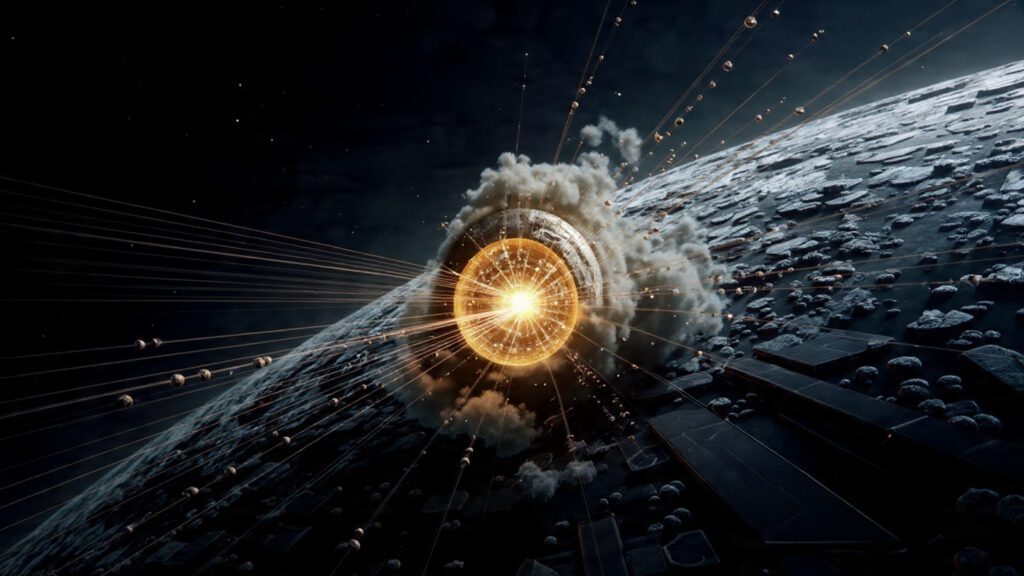
In addition to the smooth coma, the object exhibits two chemical extremes simultaneously. Some molecules, such as certain hydrogen cyanide compounds, are being ejected outward in perfectly directed, unbending streams, like exhaust from a controlled engine. Meanwhile, other molecules are concentrating near the nucleus with an unusual, dense distribution. This separation, where certain components are actively expelled in directed streams while others are tightly held or synthesized near the core, is completely alien to the behavior of known comets, where the process is chaotic and homogeneous evaporation.
Anomalous Composition and the Separation Factor
The abnormally high methanol content observed also contributes to the picture of a highly exotic, engineered object. The chemical separation and the precise, stable rhythmic pulsation of brightness—too exact to be explained by ice evaporation—suggest an internal process, perhaps an advanced chemical reactor or a directed energy mechanism, that is manipulating the emissions for purposes unknown. The object is not just burning; it is manufacturing and controlling its own external environment with surgical precision.
Dystopian Equation – The Cost of Coincidence
The entire saga of 3I/ATLAS has become a masterpiece of cosmic misdirection, orchestrated by the very agencies tasked with transparency. The sequence of events is too mathematically impossible to be random | an interstellar object appears, it violates all physical laws, it is secretly photographed at close range, the images are suspiciously degraded, and the veteran spacecraft that conducted the photography is instantaneously and permanently silenced. All the while, the object continues its non-gravitational flight, accompanied by an impervious companion probe.
The refusal to release the high-resolution data confirms the fear of what was seen | the image likely showed structure, lights, or a propulsion system that would have instantly shattered the official “natural comet” narrative. This calculated denial creates a vacuum of information that is immediately filled by the terrifying clarity of the conspiratorial view | we are under a cosmic lockdown, and the silence of MAVEN is merely the first casualty in the effort to keep the public calm while humanity faces a technologically superior, non-terrestrial entity that is currently mapping our solar system. The irony is tragic—our most trusted sentinel was neutralized right after obtaining the most important photograph of the modern age.
The narrative we are being fed is designed to maintain the status quo, preserving the delusion of human control. But the cold, hard data—the rhythmic pulses, the non-gravitational acceleration, the impenetrable link between the two objects, and now the death of MAVEN—all scream a different, far more frightening truth. The sky is no longer safe, and the future is not ours to command. We are merely observers, watching from the outside as our solar system is explored by the very consciousness that may have engineered it.