Every famous mystery has a first record. A council minute, a ship’s log, a carved caption, a newspaper report written the morning after. Most people who repeat the story have never seen it. This archive goes looking for it every time, and then stamps the file with what it found.
On 28 October 2026 we counted every stamp. This report is what the count shows, the claims that fell apart, the ones that held, and the surprising difference between ancient mysteries and modern ones.
The Count | 443 Claims, Four Verdicts
The headline number is the one people expect. Of the 443 famous claims traced to their oldest record, 217 did not survive it. That is 49 percent, almost exactly half, stamped Debunked.
The number beside it is the one people do not expect. The other 226 held. Fifty-eight turned out to be true in their strangest part, 42 still divide serious researchers, and 126 ran out of record before anyone could close them. For every mystery that collapsed, another one held up, split the experts or left the question open. The strange did not go away. It moved.
Every stamp is given under the same published rules, set out in the Archive Standard. A stamp judges one core claim, never a whole subject. The Tartessos file is a good example. The kingdom existed, and its gold sits in a museum in Seville. The claim that it was Plato’s Atlantis is what the stamp rejects.
Ancient Mysteries Fall Hardest
Split the files by wing and the sharpest difference in the archive appears. In Culture, the wing of lost civilisations, ancient technology and sacred texts, 84 of 135 stamped files are Debunked, 62 percent. In Unknown, the wing of sightings, disappearances and signals, only 35 percent are, and almost half are Unresolved.
The reason is not that ancient mysteries are sillier. It is that their records survive. A claim about the Sumerian tablets can be checked against the tablets, and the idea that the Anunnaki were astronauts who engineered humanity turns out to begin in a book of 1976, not in any line of cuneiform. A claim about a carving can be checked against the carving. The Dendera light has captions beside it, cut by the people who made it, and they describe a sun god born from a lotus. The older the story, the more likely someone kept the paperwork, and the paperwork is usually less sensational than what was built on top of it.
Ancient does not mean doomed, though. Culture also holds more Documented files than any other wing, 23 of them. The Antikythera mechanism, a geared calculator of the heavens recovered from a Roman-era wreck in 1901, is no legend.
Modern Mysteries Stay Open Longest
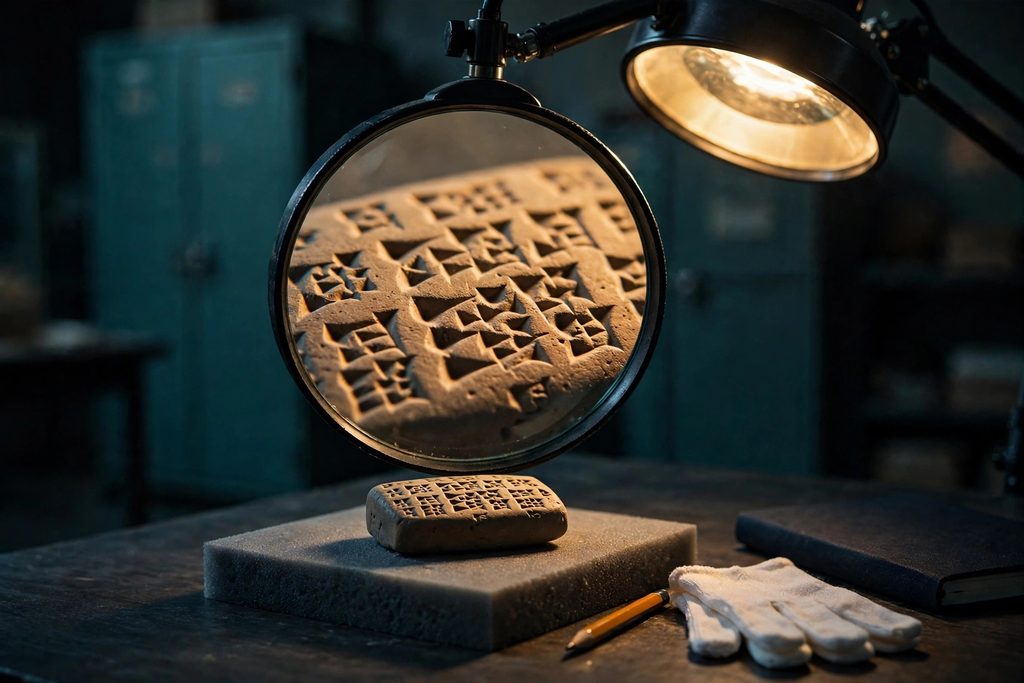
The wing of sightings and signals behaves the opposite way. Of its 111 stamped files, 54 are Unresolved, the highest share in the archive.
Modern cases often have the reverse problem from ancient ones. There is plenty of testimony and very little record that can be tested. The Wow! signal lasted 72 seconds in 1977 and never came back. The Tunguska explosion flattened about 2,000 square kilometres of Siberian forest in 1908 and left no crater. The pilots of the USS Nimitz described what they saw in 2004, and the full record of that day has never been made public. None of these is a mystery because nobody looked. They are mysteries because the record ends where the answer would begin.
When a modern case does fall, it usually falls the same way the ancient ones do, on a detail that was never in the record. The people of Point Pleasant reported the Mothman to the police in 1966, and that report is history. The idea that the creature foretold the collapse of the Silver Bridge thirteen months later is not. Engineers traced the collapse to a crack in a single steel eyebar.
Five Ways a Mystery Falls Apart
None of these failures needs anyone to lie. A detail added by a later writer, a quote passed from one website to the next, a name repeated until it sounds familiar. Most debunked mysteries were not invented in one go. They grew, one retelling at a time, until the version everyone knows had drifted a long way from the record that started it.
The dancing plague of 1518 shows the whole process in one file. The event happened, and the file is stamped Documented. Strasbourg’s council papers prove it. The famous details, the first dancer, the four hundred dancers and the fifteen deaths a day, arrive decades or more than a century later.
The Ones That Held
The 58 Documented files are the archive’s quiet surprise. These are the cases where the oldest record turned out to be at least as strange as the legend.
In 536 the sun went dim across the Northern Hemisphere for more than a year, as the Byzantine historian Procopius complained at the time, and ice from an Alpine glacier has since given up the volcanic glass that explains it. The year without a sun is no longer a question of whether. In 1971 a group of burglars took files from an FBI office in Pennsylvania and mailed them to newspapers, exposing COINTELPRO. And in 1978 the telepathy results of S. G. Soal, a former president of the Society for Psychical Research, were shown to have been altered, exposed from inside the society he had led.
The 42 Disputed files are the hardest to write and the most honest. The Enfield poltergeist, the medium Leonora Piper and the Voynich manuscript all sit here, cases where the evidence is serious on more than one side and no one has earned the last word.

What These Numbers Are, and What They Are Not
This is a count of one archive’s files, not a census of every mystery in the world. The archive chose which claims to investigate, and it leans toward the famous ones, the stories that circulate widely enough for people to ask whether they are true. Another archive with another selection would count differently.
Each file was stamped by following its claim to the oldest record that could be found, and judging the core claim against it. The rules for each verdict, the source ladder behind it and the way a stamp can change are published in the Archive Standard. Files still being reviewed are marked Open file and are left out of the 443, as are the 69 works of fiction kept in their own wing. The live tally, which moves as new files are stamped, is in the Verdict Index.
Quick Answers About the Verdict Index Report
What is the Verdict Index Report 2026? A count of every stamped case file in the Monkey & Elf archive on 28 October 2026, showing how 443 famous claims divide between the verdicts Documented, Disputed, Unresolved and Debunked.
How many famous mysteries were debunked? 217 of 443, or 49 percent. The other 226 were Documented, Disputed or Unresolved.
Which kind of mystery is most often debunked? Claims about ancient civilisations, ancient technology and sacred texts. In that wing, 62 percent of stamped files are Debunked, mostly because the ancient records survive and can be checked.
Which kind of mystery is most often left open? Sightings, disappearances and signals. Almost half of those files are stamped Unresolved, because the record runs out before an answer can be reached.
How is a verdict decided? Each claim is followed back to the oldest record that mentions it and judged against that record, under the published rules of the Archive Standard.
Can I use these figures? Yes. Please cite Monkey & Elf, The Verdict Index Report 2026, with a link to this page. The full data is available as a spreadsheet.