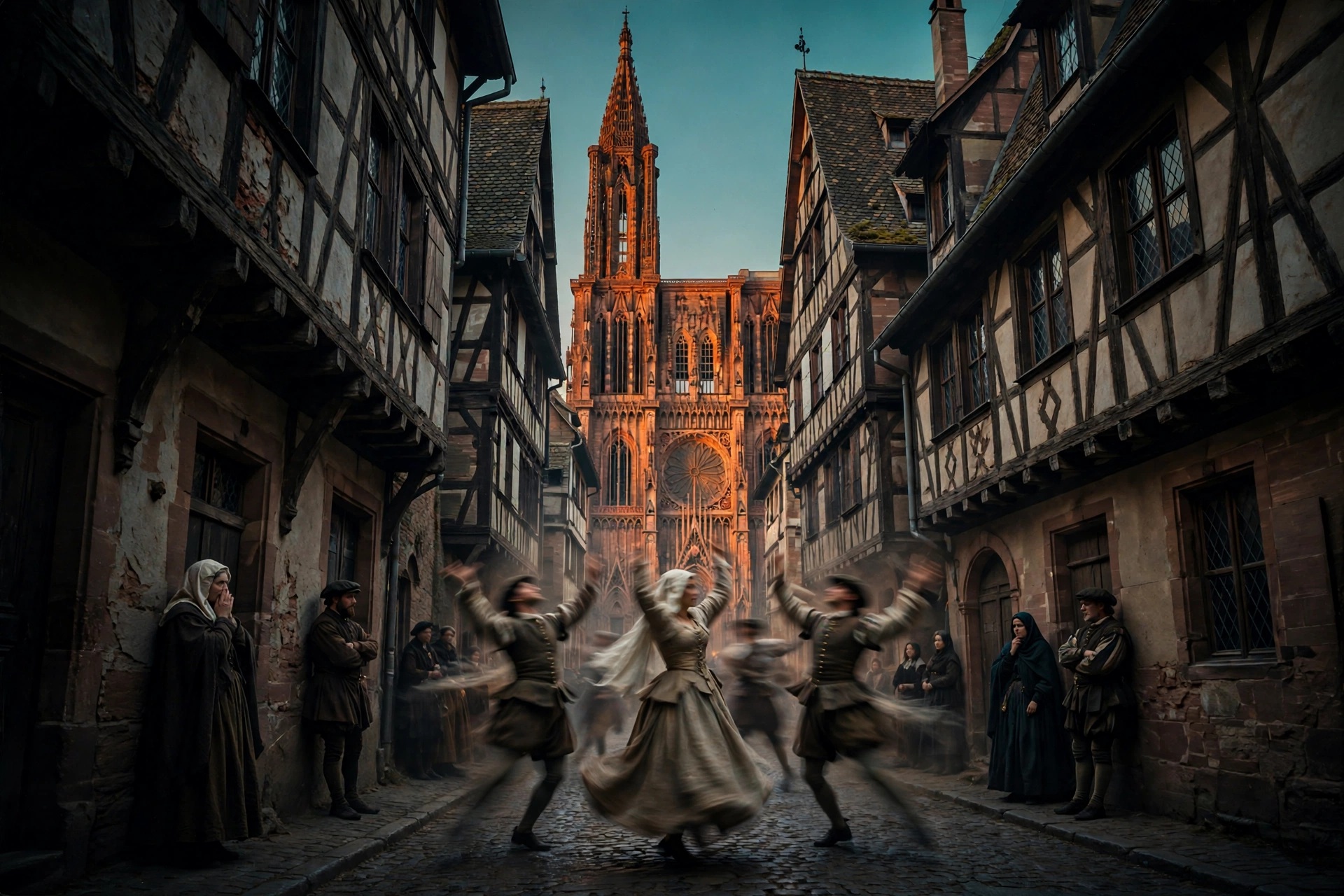
In the summer of 1518, in the free imperial city of Strasbourg, people began to dance in the streets and could not stop. They danced in the heat of July under the shadow of the cathedral, through the markets and along the river, past the point of exhaustion, while their families watched and the city’s rulers argued about what to do. A local humanist, Hieronymus Gebwiler, wrote that the affair should be remembered for a thousand years.
Five centuries on, it is remembered in a form he would not recognise. The story told online has a first dancer named Frau Troffea, a crowd of four hundred, a council that built a stage to let the dancers dance it out, and a death toll of fifteen a day. Some of that is in the city’s archives. Some of it appeared decades later. Some of it is not in any record from the summer itself.
- The Source Ladder | How the Dance Grew
- A Hungry City in a Hot Summer
- What the City Wrote Down
- Dance It Out, Then Stop the Music
- Red Shoes at Saverne
- The Woman Who May Never Have Existed
- Did Anyone Dance to Death?
- Why They Danced
- A River of Dancers
- The Verdict | Documented
- Quick Answers About the Dancing Plague
This file follows the dancing plague back to the papers Strasbourg wrote while it was happening, and then forward through every retelling that changed it.
The Source Ladder | How the Dance Grew
Based on the sources transcribed for the Musée de l’Œuvre Notre-Dame exhibition 1518, La fièvre de la danse (2018 to 2019) and the accounts cited by its historians. The only fifteen-a-day figure in the early record counts new dancers, not the dead.
A Hungry City in a Hot Summer
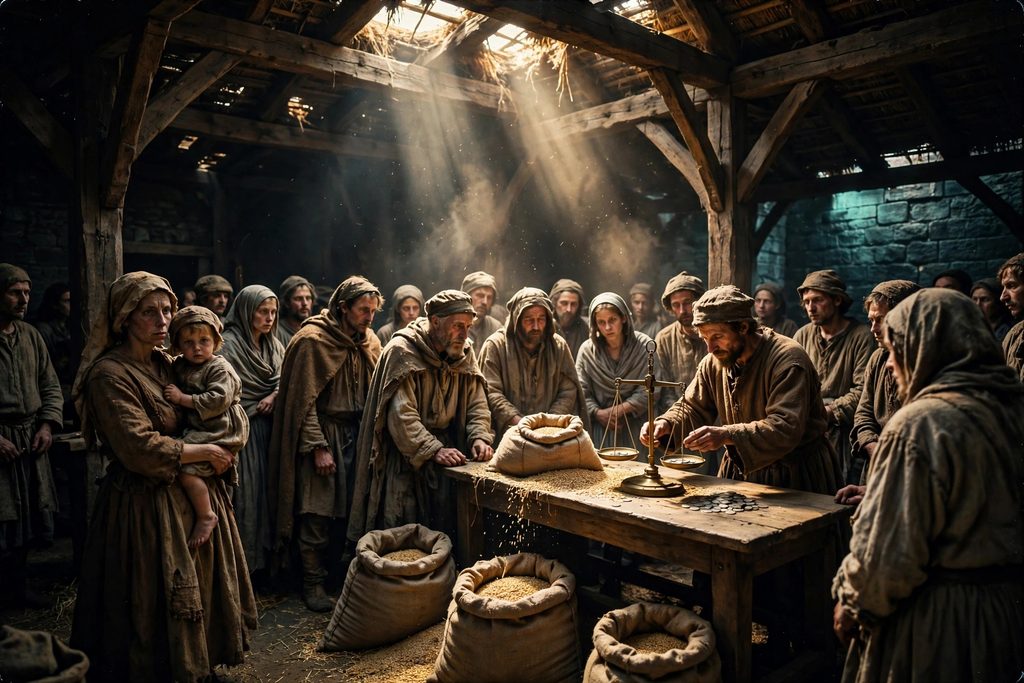
Strasbourg in 1518 was one of the great cities of the Holy Roman Empire, a self-governing republic of merchants and guilds on the Rhine, with a printing industry, a famous cathedral and a council that kept careful records. It was also a city under strain. The historian John Waller, whose books did more than anything to bring the episode to a modern audience, describes years of poor harvests and hunger in the region, rising bread prices, an exceptionally hot summer, and the spread of the new pox that Europeans called the French disease.
The people of the upper Rhine also carried a particular fear. Saint Vitus, a fourth-century martyr, was believed to have the power to curse a sinner with dancing, and to lift the curse at his shrines. Dancing outbreaks had swept the region before, in 1374 and again in Strasbourg itself in 1418. In a city that knew the story, a person who began to dance and could not stop had an explanation waiting.
What the City Wrote Down
The best evidence for the dancing plague is the least dramatic. It is a set of administrative papers kept by the Magistrat, Strasbourg’s governing council, They were transcribed and translated from old German by the historian Élisabeth Clementz, and many went on show at the Musée de l’Œuvre Notre-Dame in 2018, for the five-hundredth anniversary.
On 23 July 1518, a commission named by the council deliberated on the dancers and drew up instructions for those being sent to the shrine of Saint Vitus near Saverne. On 25 July the council wrote to the bishop, Wilhelm von Honstein. A note went out to the city’s confraternities. On 2 August a public ban on dancing was issued over the name of the city secretary, Sebastian Brant, already famous across Europe as the author of the satire The Ship of Fools. The city’s accounts record the cost of the pilgrimage. Families petitioned for financial help, and five individual cases survive in those petitions.
Brant also kept annals of his own. He records the city physicians’ verdict that this was a natural disease, caused by overheated blood, and he describes the sick who would not stop dancing. At one point he counts about fifty dancing at the same time.
These papers leave no doubt that something happened. They also leave out most of what the modern story says happened.

Dance It Out, Then Stop the Music
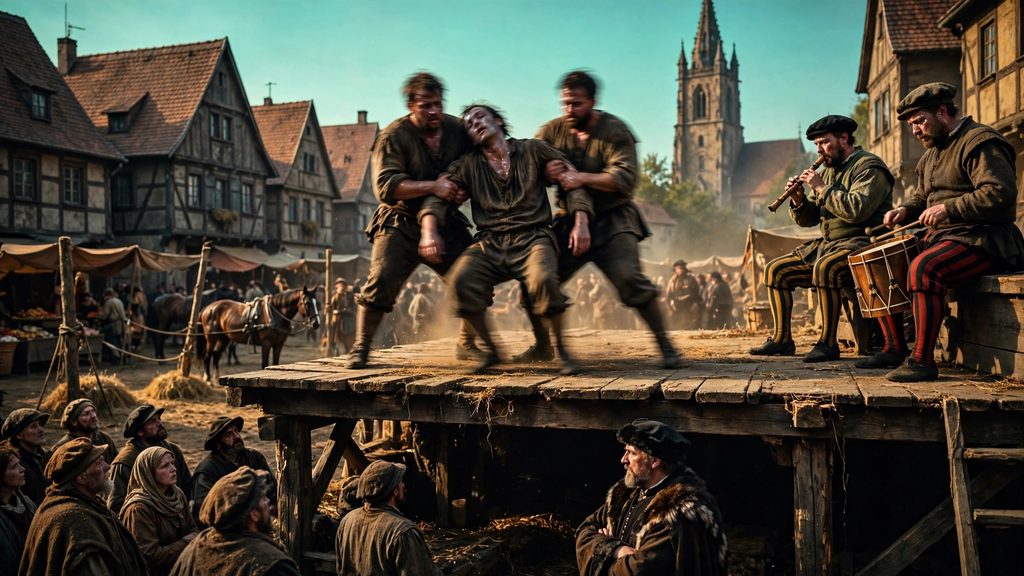
If the dancers’ blood was overheated, the physicians reasoned, the cure was not bleeding but more dancing, until the fever burned itself out. The fullest account of what followed comes from the architect and chronicler Daniel Specklin, writing around 1580. In his version the council set up platforms in the horse market and the grain market, ordered the carpenters’ and tanners’ guilds to turn their halls into dance floors, hired musicians and paid strong, healthy men to keep the dancers on their feet.
If it happened that way, it failed. The 1518 papers show the council reversing course. Brant’s ban of 2 August forbade public dancing and music in the city, with a small exception for weddings and first Masses, which could still have music from stringed instruments but not from drums or tambourines. The dancing was to be taken out of the streets and out of sight.
Red Shoes at Saverne
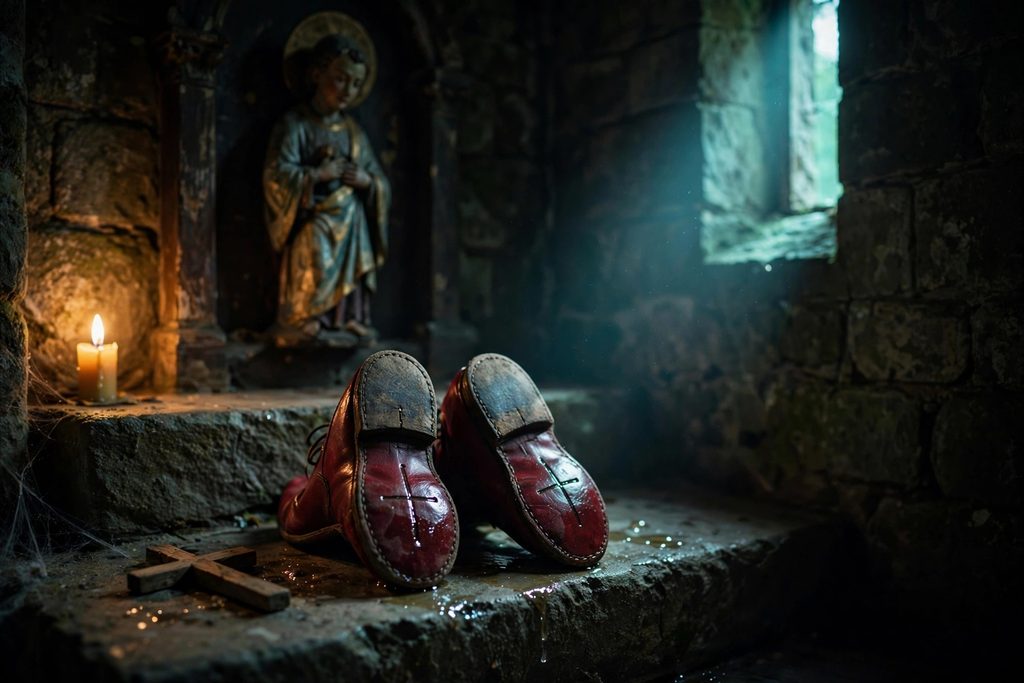
The cure the council trusted most was the saint. The worst affected were put into wagons and taken to the chapel of Saint Vitus near Saverne, about forty kilometres to the north-west, on the edge of the Vosges. The city paid for the journey.
Specklin describes what happened there. The dancers were brought before a wooden image of the saint. They were given small crosses to hold. They were fitted with red shoes, sprinkled with holy water, with crosses drawn in consecrated oil on the soles and on the tops. A relief of the Virgin with Saint Vitus and a pope, from that same chapel, hung in the Strasbourg exhibition in 2018.
By early September the dancing in Strasbourg had died away.
The Woman Who May Never Have Existed
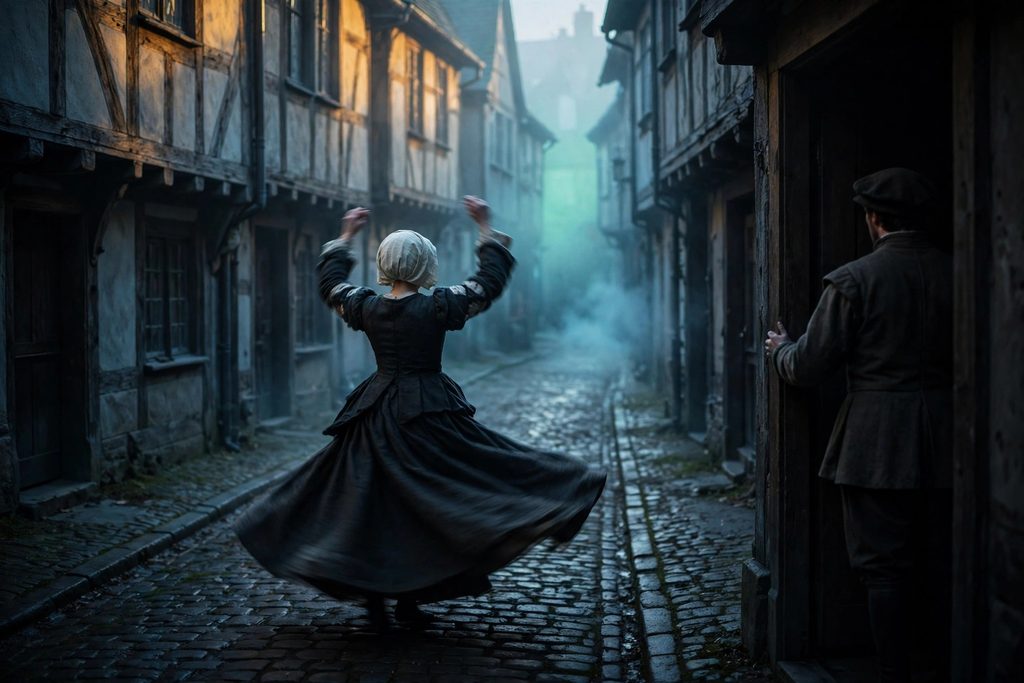
Almost every modern account begins with one woman, Frau Troffea, who stepped into a narrow street on 14 July and danced for days while her husband begged her to stop. She is a vivid beginning. She is also absent from every paper written in 1518.
Her name comes from the physician Paracelsus, who wrote about the outbreak in the 1530s and divided such dancing into three kinds, the lewd, the imagined and the natural. He made Troffea a case of the second kind, a wife who started dancing to spite her husband. Paracelsus did not arrive in Strasbourg until late in 1526, eight years after the summer he described. Élisabeth Clementz calls the name very improbable. Her colleague Georges Bischoff is blunter. Frau Troffea, he says, never existed.
Did Anyone Dance to Death?
This is the claim that made the dancing plague famous, and it is the weakest part of the story.
No paper from the summer of 1518 records a death. Not the council’s deliberations, not the letter to the bishop, not Brant’s annals, not the accounts or the family petitions. The city kept no running count of the sick at all. The figure of fifteen a day, repeated in books, articles and television, has a curious history. The one fifteen-a-day figure in an early source, a chronicle written outside Strasbourg, counts new dancers, not the dead, and even that number cannot be checked.
Deaths enter the record only in an astrological chronicle of 1636, which says that some of the sufferers fell down unconscious and succumbed to death. That is one hundred and eighteen years after the event, written in an age that wanted its portents dramatic.
People may well have died. Dancing for days in a hot summer on an empty stomach is dangerous, and the council’s silence is not proof that no one collapsed. But the claim that hundreds danced themselves to death is a claim about the retelling, not about Strasbourg in 1518. When the city’s own historians gathered the sources for the anniversary, they found the event and they did not find the toll. Waller’s books have been criticised in Strasbourg for leaning on the later chronicles and on Paracelsus.
The same drift, from a quiet record to a spectacular retelling, runs through the archive’s file on spontaneous human combustion.
Why They Danced
The dancers of 1518 were not choosing to perform. The sources describe people who could not stop, and the explanations have changed with every century.
A saint’s curse. For most people in Strasbourg the answer was Saint Vitus, and the cure was his shrine. The belief itself may have been part of the cause, since it told sufferers what was happening to them and how it would behave.
Overheated blood. The city physicians placed it within medicine, as a natural disease, which is why they prescribed dancing rather than prayer.
Ergot poisoning. In the twentieth century, the Swedish pharmacologist Eugène Louis Backman proposed that ergot, a fungus that grows on damp rye, poisoned the dancers. Ergot can cause hallucinations and convulsions. It also cuts off the blood supply to the hands and feet, and no one in Strasbourg was reported with blackened limbs. Waller points out that a person with convulsive ergotism could not dance for days, and that ergot cannot explain why outbreaks clustered along the Rhine and the Moselle and nowhere else.

Mass psychogenic illness. The explanation most historians now favour is a collective stress reaction, in which people under severe strain, primed by a shared belief, develop the same involuntary behaviour and pass it to one another. Waller calls it a stress-induced psychosis on a mass scale and compares it to the laughing epidemic that began at a girls’ school in Tanganyika in 1962 and spread for months through the surrounding villages. The mind can produce experiences the body feels as wholly physical, as the file on shadow people and sleep paralysis shows, and crowds can carry them. The same pattern of contagious symptoms sits at the heart of the possessed nuns of Loudun a century later.
Ritual, not illness. A minority view, argued by the sociologist Robert Bartholomew, holds that some medieval dancing outbreaks were organised religious or pilgrimage rituals that outsiders described as madness. It fits some earlier episodes better than it fits Strasbourg, where the dancers’ own families petitioned the city for help.
A River of Dancers
Strasbourg was not alone. The chronicles of the Rhineland record a long line of dancing outbreaks, and almost all of them sit within reach of the same river.
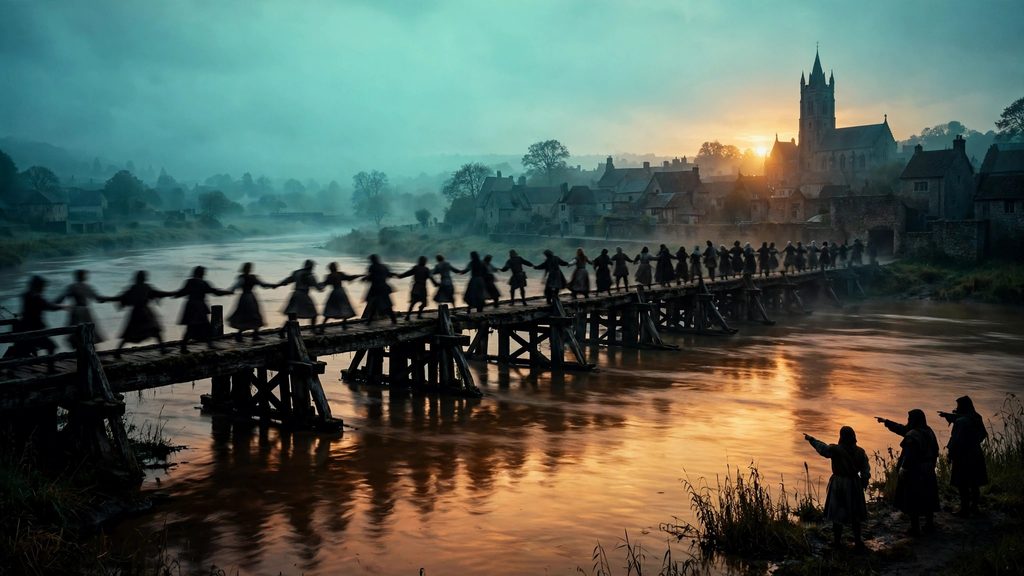
In 1237 a crowd of children was said to have danced and leapt the twenty kilometres from Erfurt to Arnstadt. In 1278 about two hundred people were said to have danced on a bridge over the Meuse until it collapsed. In June 1374 the largest recorded outbreak began around Aachen and spread to Cologne, Metz, Utrecht, Strasbourg and beyond. In 1418 Strasbourg had dancers of its own. After 1518 the outbreaks grew smaller and rarer, a group of children in Basel in 1536, a single man in Anhalt in 1551, and the women who returned to a chapel of Saint Vitus at Drefelhausen every year in the seventeenth century to dance.
Many of these stories reach us through the same kind of later chronicle that inflated Strasbourg’s toll, and they deserve the same caution. What they show is a region where dancing beyond control had a name, a saint, a cure and a history, and where people who were suffering knew what shape their suffering could take.
The Verdict | Documented
The dancing plague of 1518 happened. The council of Strasbourg debated it, wrote to its bishop about it, paid for its victims to travel to a saint, and banned music in the streets to stop it. The city secretary watched about fifty people dancing at once and recorded the physicians’ diagnosis. The file is stamped Documented.
What the stamp does not cover is the legend that grew around the record. There is no contemporary trace of Frau Troffea, of four hundred dancers, or of fifteen deaths a day. Those came later, from a physician who arrived eight years afterwards, from chronicles written two and three generations on, and from a chronicle of 1636. The true story is stranger in its way, a well-run city facing something its medicine, its faith and its laws could not explain, and handling it with the paperwork that survives today.
Every stamp in the archive is gathered in the Verdict Index, and Strasbourg and Saverne are pinned on the Atlas.
Quick Answers About the Dancing Plague
What was the dancing plague of 1518? An outbreak of uncontrollable dancing in Strasbourg, then a free city of the Holy Roman Empire and now in France, from July to early September 1518.
How many people danced? The city secretary, Sebastian Brant, counted about fifty dancing at the same time. Later chronicles give a hundred, more than two hundred and finally about four hundred.
Did people die from dancing? No record from 1518 mentions a death. The first mention of deaths appears in a chronicle of 1636. The often-repeated figure of fifteen deaths a day is not supported by the contemporary record.
Who was Frau Troffea? The name of the first dancer according to Paracelsus, writing in the 1530s. She appears in no 1518 source, and Strasbourg historians doubt she existed.
What caused it? Most historians favour a mass psychogenic illness, a collective reaction to hunger, disease and stress, shaped by the local belief in a dancing curse of Saint Vitus. Ergot poisoning is now considered unlikely.
How did it end? The council banned public music and dancing and sent the worst affected to the chapel of Saint Vitus near Saverne. By early September the outbreak had subsided.