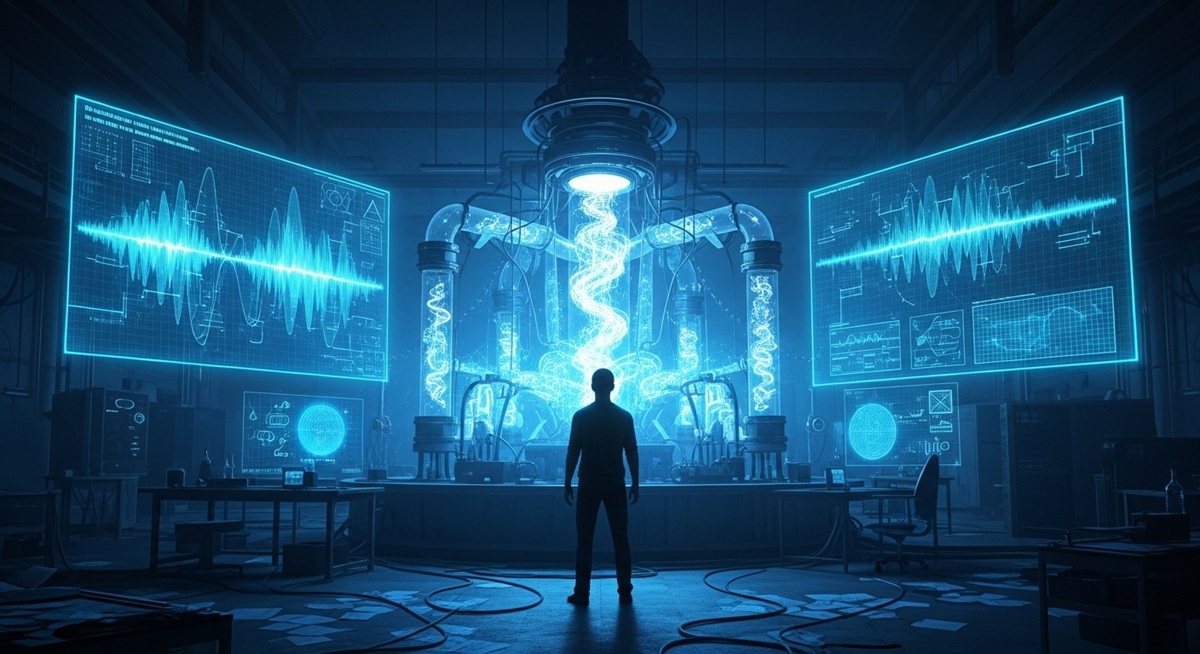
A particle travels from a source to a detector. Before it arrives, it passes through two slits in a barrier. Both slits.
Not one slit and then the other. Both simultaneously. The particle, which is a single particle with a single location in every measurement anyone has ever performed, travels through both openings at once and interferes with itself on the other side, producing an interference pattern on the detector that is only possible if the particle passed through both paths simultaneously.
Cover one slit. The interference pattern disappears. The particle behaves like a particle. Open the slit again without changing anything else. The interference pattern returns. The particle behaves like a wave.
The particle knows which slits are open.
This is the double-slit experiment. It has been performed thousands of times under thousands of experimental conditions. The result is always the same. Richard Feynman, who received the Nobel Prize in Physics and whose pedagogical clarity remains unmatched in the physics literature, described it as the only mystery in quantum mechanics, a mystery that cannot be explained away and from which all the rest follows.
A century after Max Planck’s original 1900 derivation of the quantum, the mystery has not been resolved. It has been deepened.
What Actually Happens at Measurement
The quantum formalism describes a physical system before measurement as a wave function: a mathematical object that assigns probabilities to every possible outcome of every possible measurement. The wave function of a single electron before its position is measured does not describe an electron at a location. It describes the electron as existing in a superposition of every possible location, with each location assigned a probability amplitude.
When the measurement is made, the wave function collapses. The electron is found at one location. The other possibilities, which were real in the sense that the wave function assigned them non-zero probability amplitudes, have vanished. Where did they go?
The Schrödinger equation, which governs how quantum systems evolve through time, is linear and deterministic. Given the wave function at one moment, it predicts the wave function at every subsequent moment with mathematical precision. The equation contains no collapse. The equation does not describe a process in which a superposition of possibilities reduces to a single actuality. The equation describes a superposition evolving into a larger superposition as the quantum system interacts with the measuring device and the measuring device interacts with the environment.
The collapse that is observed experimentally is not in the equation.
This is the measurement problem. It is not a gap in knowledge that better technology will close. The equation that successfully predicts every quantum phenomenon ever tested does not contain the process that quantum phenomena require. Something happens at measurement that the most successful physical theory in the history of science does not describe.

Niels Bohr’s response to this problem, formalized as the Copenhagen interpretation, was essentially to draw a line: quantum mechanics describes quantum systems, the measuring apparatus is classical, the collapse happens at the boundary, do not ask what the boundary is. This interpretation dominated physics for fifty years and continues to dominate undergraduate physics education. Its intellectual honesty is in its refusal to claim more than the formalism can support. Its intellectual cost is that it describes the most successful physical theory in history as fundamentally incomplete by design.
Bell’s Theorem and the Death of Local Realism
In 1964, physicist John Stewart Bell proved a theorem whose experimental consequences were not fully explored until Alain Aspect’s landmark 1982 experiments, and whose implications were confirmed definitively enough to merit the 2022 Nobel Prize in Physics awarded to Aspect, John Clauser, and Anton Zeilinger.
The theorem addresses a question about quantum mechanics whose stakes are high: are the outcomes of quantum measurements determined by properties the particles carry with them, properties that exist independently of measurement, or does measurement create the outcome rather than reveal a pre-existing one?
Einstein, Boris Podolsky, and Nathan Rosen published a thought experiment in 1935, now known as the EPR paradox, arguing that quantum mechanics must be incomplete because it requires either faster-than-light influence between distant particles or the absence of pre-existing definite properties, both of which they considered unacceptable. Their preferred conclusion was that hidden variables, properties the formalism did not capture, were responsible for the correlations quantum mechanics predicted.
Bell’s theorem proved that no theory of local hidden variables, no theory in which particles carry pre-existing definite properties and influences travel at or below light speed, can reproduce all the predictions of quantum mechanics. The theorem is not a philosophical argument. It is a mathematical proof whose predictions are experimentally testable.

The experiments confirm quantum mechanics. Local hidden variables are ruled out. Either particles do not have definite properties before measurement, or influences between entangled particles travel faster than light, or both. Local realism, the intuitive picture of a world in which things have definite properties whether or not anyone is looking at them, is experimentally falsified.
The moon, to borrow Einstein’s famous phrase, may genuinely not exist when nobody is looking.
Wheeler’s Participatory Universe
John Archibald Wheeler was one of the most significant physicists of the twentieth century. He named the black hole, contributed foundational work to general relativity and nuclear physics, and spent the final decades of his career developing what he called the participatory universe: the proposal that the universe requires observers to bring it into being, that existence and observation are not independent categories but mutually constitutive ones.
Wheeler’s delayed-choice experiment demonstrates a consequence of quantum mechanics whose implications remain genuinely disturbing despite decades of discussion. In the standard double-slit experiment, a particle traveling toward the detector passes through both slits simultaneously and produces an interference pattern. If a detector is placed at one of the slits to determine which path the particle took, the interference pattern disappears: the particle behaves as a particle rather than a wave.
Wheeler’s delayed-choice version separates the timing: the particle passes the slits before the experimenter decides whether to measure which path was taken. The decision to measure, made after the particle has already passed the slits, retroactively determines whether the particle traveled both paths or one.
The experimental realizations of delayed-choice experiments, including the 2007 experiment by Vincent Jacques and colleagues published in Science, confirm the quantum mechanical prediction: the experimenter’s choice, made after the particle has passed the slits, determines what the particle did in the past. Not what we know about what the particle did in the past. What it actually did.
Wheeler’s own response to this result was to propose that the universe’s past is not fixed until it is observed, that the participatory act of measurement reaches backward through time to bring historical events into definite existence. Whether this interpretation is correct or whether the phenomenon can be accounted for without backward causation is a question the experimental results motivate without definitively resolving. What is not subject to alternative interpretation is the experimental result itself.
Wigner’s Friend and Contradictory Facts
Eugene Wigner’s well known thought experiment extends Schrödinger’s cat to include a conscious observer. Wigner imagines a friend sealed inside a laboratory who performs a quantum measurement on a particle. From inside the lab, the friend has a definite result: the particle was spin-up or spin-down, and the friend knows which. From outside the lab, Wigner treats the entire sealed system, the particle, the measuring device, and his friend, as a quantum system in superposition. From Wigner’s perspective, his friend is in a superposition of having-observed-spin-up and having-observed-spin-down until Wigner himself makes a measurement.

Two observers, neither of whom is wrong according to quantum mechanics, have contradictory descriptions of the same physical situation. One has a definite fact. The other has a superposition. Both are applying the formalism correctly.
In 2019, a team at Heriot-Watt University led by Massimiliano Proietti published an experimental realization of the extended Wigner’s Friend scenario in npj Quantum Information. The experiment used six entangled photons to implement four observers in two nested measurement configurations. The results were consistent with the quantum mechanical prediction: two observers in the experiment obtained genuinely contradictory measurement outcomes, each consistent with their own reference frame and each contradicting the other’s.
The paper’s conclusion is stated precisely: the results are in tension with any interpretation of quantum theory that assumes a single, observer-independent set of facts about the world.
This is not a philosophical position. It is the recorded result of a published experiment. Facts may not be observer-independent. Two different observers, applying correct quantum mechanics in their respective reference frames, may obtain contradictory facts that are both true.
The Simulation Connection
The measurement problem’s most radical implication connects directly to the library’s existing treatment of Nick Bostrom’s simulation argument and James Gates’s error-correcting code discovery, and the connection is more than the standard popular science treatment acknowledges.
A simulated universe would not render unobserved states in full detail. The computational cost of maintaining a complete physical simulation at the quantum level for every particle in the universe whether or not any observer has access to that information would be astronomically wasteful. A computationally efficient simulation would maintain unobserved regions in a compressed, superposed state and resolve them to definite outcomes only when an observer interacts with them.
This is precisely what quantum mechanics describes. Systems exist in superposition until measured. The measurement creates a definite outcome from what was previously a superposition. The universe does not commit to a configuration until it is observed.
James Gates’s discovery of error-correcting codes in the equations of supersymmetric string theory, the same codes used in computer science to detect and correct errors in data transmission, is the additional finding whose convergence with the measurement problem’s observer-dependence and with Bostrom’s computational simulation argument produces a three-way pattern that no single framework fully accounts for.
Three independent findings, each individually well established. The observer creates rather than reveals physical reality. The universe’s fundamental equations contain computer error-correcting code. A sufficiently advanced civilization could run simulations indistinguishable from physical reality. The convergence is not proof, and it is worth noting directly that Gates himself, at a public 2016 debate on the simulation hypothesis, gave his own probability estimate that we live in a simulation as just 1 percent, the lowest figure of anyone on the panel that day, despite being the one who found the codes. The person closest to that particular finding does not treat it as strong evidence for the broader thesis. The convergence is still a pattern worth naming, but it should be named at the confidence level its own discoverer assigns it rather than a higher one.
Wheeler called it the participatory universe. Bostrom called it the simulation argument. Gates called it the doubly-even self-dual linear binary error-correcting block code embedded in the supersymmetry algebra. They were describing the same thing from three different directions.
The Many-Worlds Exit and Its Price
Hugh Everett III’s 1957 proposal, developed in his Princeton doctoral thesis under John Wheeler’s supervision, offers the mathematically cleanest resolution to the measurement problem: the wave function never collapses. At each quantum measurement, the universe branches. Every possible outcome is realized in a separate branch. The superposition of the wave function is preserved across the totality of branches while each individual branch experiences a single definite outcome.
The many-worlds interpretation is mathematically elegant because it requires no modification to the Schrödinger equation and no additional collapse mechanism. The equation describes a universe that branches, and the branches decohere from each other too rapidly for inhabitants of any single branch to observe the branching.
Its philosophical price is the one that most discussions of many-worlds understate: it requires the continuous creation of an uncountably infinite number of complete universes at every quantum measurement in every physical system in the observable universe at every moment. The elimination of wave function collapse is purchased at the cost of the continuous multiplication of all of physical reality. Whether this trade is ontologically preferable to a universe with an unexplained collapse mechanism is not a physics question. It is a question about what kind of explanation counts as satisfying.

David Deutsch, whose contributions to quantum computing theory are foundational, is the most prominent advocate of many-worlds and has argued that its predictions for quantum computation are distinct from single-world interpretations in ways that could be experimentally tested through sufficiently powerful quantum computers. Whether this experimental program will eventually distinguish many-worlds from its competitors is a genuinely open question whose resolution would be one of the most significant events in the history of science.
David Bohm and the Pilot Wave
David Bohm’s 1952 reformulation of quantum mechanics offers a different exit from the measurement problem’s apparent demand for observer-dependent reality. In Bohm’s pilot-wave theory, particles have definite positions at all times. The wave function is real but it is not the complete description of the particle: it is a pilot wave that guides the particle’s motion through a configuration space that is, in Wheeler’s phrase, already out there.
The pilot wave is nonlocal. It encodes information about the entire experimental setup instantaneously. When a particle approaches the double-slit experiment, the pilot wave passes through both slits, creates an interference pattern in the configuration space, and guides the particle through one slit along a trajectory determined by the interference pattern. The particle always goes through one slit. The pilot wave goes through both. The interference is in the wave, not in the particle.
Bohm’s theory is mathematically equivalent to standard quantum mechanics: it makes all the same experimental predictions. Its ontological cost is the nonlocality: the pilot wave communicates instantaneously across any distance, which is in tension with special relativity whose principle that nothing travels faster than light is among the most extensively tested results in physics.
Whether Bohm’s framework points toward a genuinely deeper level of physical reality whose character a future physics will access, or represents the mathematically permissible reinterpretation of the formalism in a more classically intuitive framework that happens to preserve all the predictions without adding explanatory power, is a question the physics literature has not resolved.

What Bohm’s framework demonstrates is that the apparent demand of quantum mechanics for observer-created reality is not logically necessary. A pilot-wave universe contains definite particles with definite positions. No observer is required. The price is a nonlocal wave that connects everything to everything instantaneously and that, by its construction, is experimentally undetectable in any direct way.
The observer may not be necessary. The hidden connection may be.
What the Silence Means
A century of quantum mechanics has produced the most precisely tested physical theory in history. Its predictions have been confirmed to more decimal places than any other scientific framework ever proposed. The technology built on its principles, semiconductors, lasers, MRI machines, the transistors in every computer, functions because the theory is correct.
The theory that produces all of this does not explain what happens when a measurement is made.
The standard response of working physicists to this situation, shut up and calculate, is not intellectual cowardice. It is the epistemic discipline of a community that learned, from a century of quantum mechanics overturning classical intuitions, that the universe does not owe its behavior to human concepts of what makes sense. The formalism works. The formalism predicts correctly. Whether the formalism describes reality or merely encodes our information about reality is a question that may not be answerable within the framework of the formalism itself.
Wheeler spent the last decades of his life convinced that the question of how observation brings reality into being was the most important question in science. Not because it would produce better technology. Because the answer to why observation creates reality rather than reveals it would tell us something fundamental about what the universe is and what we are inside it.
The particle passes through both slits.
It knows whether the detector is on.
It knows whether we are looking.
Whatever the universe is, it is not indifferent to being observed.
Whether that means the universe is a computation, a participatory system that requires observers to exist, a many-branching structure in which every possibility is real somewhere, or something whose character all current frameworks only approximately describe, is the question whose answer a century of the most successful science in human history has not produced.
The double-slit experiment is still running. The interference pattern is still there. The particle is still going through both slits.
We still do not know why.
The declassified Gateway Process research approaches the same uncertainty from a different, real institutional angle.