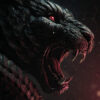



For decades, the theory that reptilian humanoids secretly govern the Earth has mesmerized, unsettled, and provoked millions. Combining elements of ancient lore, sci-fi speculation, and modern distrust in authority, the so-called “reptilian agenda” suggests that shape-shifting lizard-like beings control global institutions and manipulate humanity from the shadows. To believers, this narrative reveals a hidden truth about who really pulls the strings on our planet. To skeptics, it’s an elaborate web of pseudoscience, mythology, and psychological projection.
But where did this extraordinary idea originate? And why does it continue to grip the public imagination, even in the age of scientific enlightenment?
Ancient Roots | Serpent Gods and Reptilian Archetypes
Long before YouTube channels and conspiracy forums began circulating videos of “shapeshifting politicians,” civilizations across the globe were already weaving serpentine deities into their mythologies. From Mesopotamia to Mesoamerica, ancient cultures depicted snake-like beings not as monstrous aberrations, but as divine figures—guardians, creators, and sometimes destroyers.
In Sumerian mythology, the god Enki, often depicted with serpent attributes, was revered as a deity of wisdom and water. His stories whisper of a time when serpentine beings walked alongside humans, guiding and governing the earliest societies. In India, the Nagas—serpent beings capable of taking human form—were both protectors of sacred knowledge and fearsome entities. Chinese lore elevated dragons to symbols of divine power and imperial destiny. And in Mesoamerica, Kukulkan and Quetzalcoatl, feathered serpent gods, were central to cosmology and kingship, their image immortalized in towering stone carvings.
Egyptian mythology introduced Sobek, the crocodile-headed god representing strength and military might. His presence in temples and tombs adds yet another piece to the global puzzle of reptilian reverence. These shared symbols suggest either an archetypal pattern rooted in the human subconscious—or, as some argue, a fragmented memory of actual reptilian entities that once walked the Earth.
The Lost Continent and the Occult Origins of the Reptilian Theory
The 19th-century mystic Helena Blavatsky introduced the esoteric concept of Lemuria—a now-lost continent said to be home to advanced reptilian beings. In her magnum opus The Secret Doctrine, she described a civilization of dragon-like entities with psychic abilities and ancient wisdom, sparking early whispers of a pre-human race that seeded the Earth.
Though modern science has dismissed Lemuria as a geological fiction, its influence on occult and conspiracy thought endures. These early ideas planted the seed for the modern reptilian hypothesis—a narrative that would explode in popular consciousness decades later.
David Icke and the Rise of the Reptilian Agenda
The modern reptilian theory owes much of its popularity to British author and former footballer David Icke. In his 1999 book The Biggest Secret, Icke posited that a race of shapeshifting reptilian extraterrestrials—originating from the Draco constellation—has infiltrated human civilization, manipulating governments, corporations, and religious institutions from within.
According to Icke, these beings arrived thousands of years ago and established hybrid bloodlines through interbreeding with humans. Today, these hybrids allegedly occupy the highest echelons of power—from royalty to presidents to CEOs. Icke’s work, dismissed by mainstream media and scientists alike, nonetheless struck a powerful chord with audiences disillusioned by institutional power and political corruption.
His lectures attracted thousands, his books sold globally, and his theory became a cornerstone of 21st-century conspiracy culture. Despite its outlandishness, the reptilian narrative offered something profound | a villain that was both ancient and current, invisible yet everywhere, powerful yet vulnerable to truth.
Beyond Icke | Expanding the Reptilian Research
Other theorists soon expanded on Icke’s foundation. John Rhodes proposed that reptilians may not be extraterrestrials at all, but rather an advanced, hidden species evolved from Earth’s own prehistoric reptiles—perhaps descendants of dinosaurs like troodons, which paleontologist Dale Russell once speculated could have evolved into sentient, humanoid forms.
Rhodes also introduced the idea of subterranean reptilian civilizations, claiming these beings live in vast underground networks, hidden from public view but influencing events on the surface. Jordan Maxwell, a prominent voice in symbolic analysis, argued that serpent imagery in logos, religious art, and heraldry reveals an ancient, ongoing worship of reptilian forces.
These interpretations feed into a larger belief system where symbolism, hidden knowledge, and suppressed history intersect with modern fears of manipulation and control.
Searching for Evidence | Is There Any Proof?
Reptilian believers point to a wide array of “evidence,” ranging from ancient carvings and religious texts to anecdotal eyewitness accounts. Sumerian tablets referencing the “Anunnaki,” serpent-like beings with divine powers, are frequently cited. Mesoamerican pyramids adorned with serpent motifs and Egyptian frescoes showing crocodile-headed gods are seen not as myth, but as documentation of forgotten truths.
Eyewitness testimonies, though unverifiable, also abound. Some claim to have seen politicians briefly reveal reptilian traits—slit pupils, scaly skin, or unblinking stares—often in videos that go viral online. Others describe secret military bases or underground labs where reptilian beings conduct genetic experiments.
Symbolism is another cornerstone of the reptilian theory. Conspiracy theorists highlight corporate logos featuring snakes or dragons, such as the Alfa Romeo emblem or the caduceus in medical imagery. Royal coats of arms, religious icons, and media portrayals are reinterpreted as veiled acknowledgments of an ancient reptilian presence.
The Internet and the Age of Viral Conspiracy
In the digital era, reptilian conspiracies have flourished like never before. Social media platforms, video sharing sites, and forums allow enthusiasts to disseminate theories, share “proof,” and recruit others into the fold. Viral videos claiming to show shapeshifting newscasters or politicians rack up millions of views, while forums delve into esoteric texts and decode public speeches for hidden meanings.
This modern ecosystem of content blurs the line between entertainment, paranoia, and belief. Algorithms reward sensationalism, while distrust in media and authority drives people toward alternative explanations—however implausible they may seem.
The Scientific and Psychological Rebuttal
Despite the theory’s popularity, science remains unequivocal | there is no evidence that reptilian humanoids exist, let alone run the world. Biology offers no precedent for a cold-blooded species achieving warm-blooded intelligence and global dominion. Genetic science cannot support the concept of shapeshifting. Astronomy finds no habitable planets near Thuban or other Draco stars.
Psychologists suggest that reptilian conspiracies stem from cognitive dissonance, pattern recognition errors (pareidolia), and fear-based projection. In times of societal upheaval, such narratives offer simple answers to complex problems—blaming the world’s ills on a hidden enemy that is powerful, alien, and fundamentally inhuman.
Metaphor or Manifestation?
Still, the power of the reptilian narrative may not lie in its factual basis, but in what it represents. Serpents have long symbolized deceit, danger, and hidden knowledge. In religious texts, they tempt and corrupt. In mythology, they guard treasures and ancient wisdom. In modern conspiracies, they personify fears of surveillance, elitism, and systemic control.
Whether or not reptilian beings physically exist, they serve as potent metaphors for power structures that feel alien, inaccessible, and uncaring.
The Reptilian Mythos in Pop Culture
From the alien lizards of the V series to the Silurians in Doctor Who, reptilian entities have long been staples of science fiction. H.P. Lovecraft’s sinister creatures with reptilian traits, video games like Mass Effect and The Elder Scrolls, and urban legends of lizard people beneath Los Angeles all reflect the enduring fascination.
These stories are not just entertainment—they’re cultural echoes of deeper anxieties, blending folklore with futurism in a uniquely modern mythology.
Reptilian Theories and Modern Global Events
Some theorists go further, linking reptilian influence to major global trends. Claims of population control, artificial intelligence agendas, or environmental manipulation are woven into a larger “anti-human” narrative. Even dietary shifts—like the push toward insect-based protein—are interpreted as catering to reptilian biology rather than environmental sustainability.
While these interpretations often rely on cherry-picked facts and speculative logic, they underscore a growing unease with rapid societal change and diminishing trust in official explanations.
Truth, Tale, or Transformation?
So, are reptilians real? Or are they a psychological projection of ancient fears and modern mistrust?
At its core, the reptilian theory is a mirror. It reflects humanity’s deepest questions about control, identity, and the unknown. While no credible scientific evidence supports the existence of shape-shifting lizard overlords, the persistence of the narrative suggests a different kind of truth—one that speaks to emotional realities rather than empirical ones.
In a world of constant change and uncertainty, stories like these offer clarity, even if that clarity is illusory. The challenge is not simply to debunk or believe—but to understand what such stories reveal about us.