



“The individual is ephemeral, races and nations come and pass away, but man remains.” | Nikola Tesla
Solar systems maintain a wilderness facade to distract the unobservant. Empty space and random debris serve as a cover for a star surrounded by planets tracing ellipses dictated by an invisible, rigid architecture. This narrative of “natural formation” collapses under a geometric audit of the orbital map.
Modern astronomy filters out the truth: the ecliptic is a plane shaved to a precision that mocks accident. Dust clouds never produce symmetry this sharp. Violent accretion fails to resolve into a clock face. Order was pressed into the chaos before the dust cooled.
Geometry of the Scaffolding
Evidence of ancient design remains embedded in the spacing of the worlds. A quiet, persistent rhythm exists between planetary distances. Ratios repeat with the stubbornness of an unbreakable code fragment. Mainstream astronomers dismiss these patterns as numerical coincidence because the pattern is older than their textbooks and defies probability curves. The Lattice exists as a scaffold of invisible geometry holding the orbits in place. This represents a field of pressure and memory rather than a physical structure. It persists as the residue of an architecture that once existed in matter and now survives only as a governing influence. Planets move through this grid like insects crawling along the structural ribs of a buried, gargantuan machine.
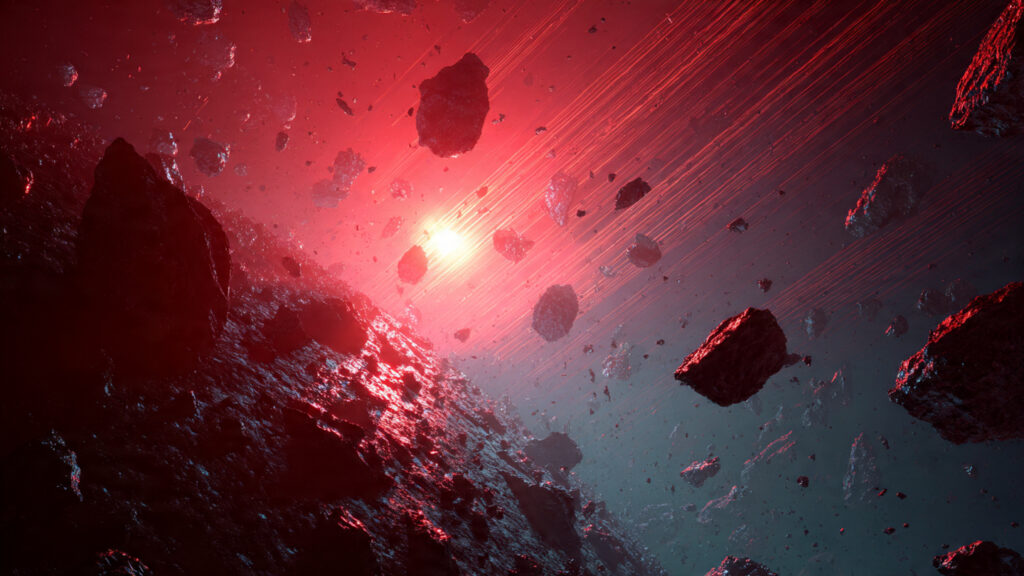
Every civilization reaching for the sky eventually stumbled upon this grid. Sumerians carved orbital order into clay tablets, disguising the technical reality as the work of gods because the truth was too vast for city walls. Egyptians encoded these exact ratios into temple corridors. Vedic astronomers wrote of a celestial grid predating humanity. They reported data instead of poetry. However, the lattice has lost its original perfection. Something fractured the sequence. Observe the break in the asteroid belt. A jagged wound marks the spot where a planet should logically exist. Debris circles like a funeral procession around a grave that never received a body. Official stories call it a failed formation. The mathematics suggest a structural collapse.
Architects and the Recurrence
Architects left no written instructions, only the permanence of alignment. They left a system that behaves like a finely tuned instrument long after the musician has vanished. Orbits hum with a frequency that does not belong to simple rock and gas. This resonance returns with the precision of a metronome during solar minima and magnetic inversions. Planetary resonances lock into place as if obeying a command issued eons ago. The lattice functions as an inherited mechanism. Evidence suggests something still actively maintains the integrity of the system. The fracture that began in the asteroid belt has spread like a slow distortion through the orbital field. It acts like a bruise on the fabric of the system refusing to fade.
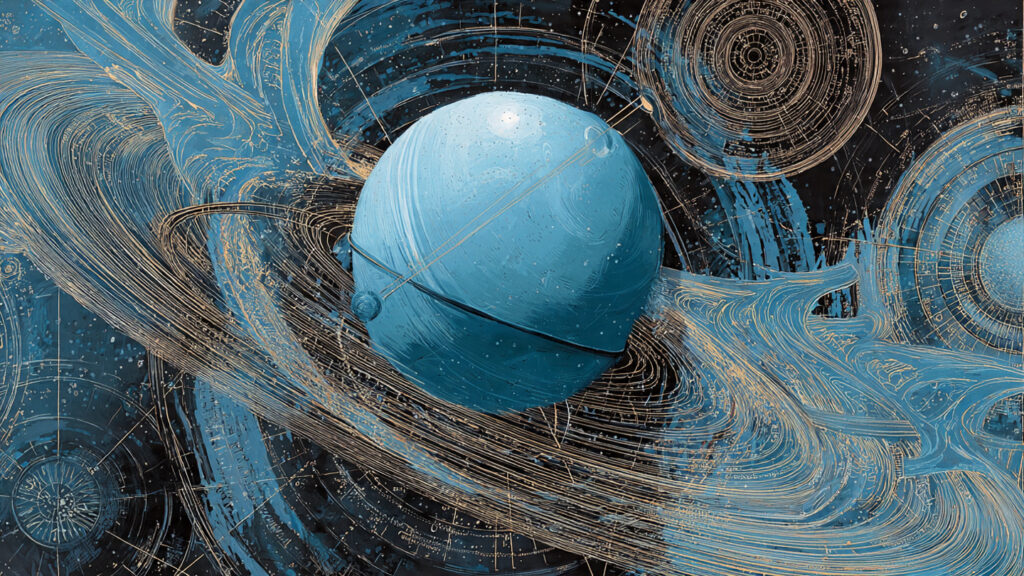
Uranus reveals this distortion most clearly. A planet knocked on its side, left to spin like a broken gyroscope. Modern textbooks rely on collision theory whenever the architecture misbehaves to keep the sky small and the mind obedient. Yet, the tilt is not random. It aligns with a vector pointing toward a region of space ancient astronomers treated as a celestial wound. Babylonians mapped this area with extreme caution. Chinese imperial astronomers refused to speak its name. The Maya encoded this pressure point in a calendar scholars insist was ritualistic. They all observed a place where the lattice thins. This indicates a vulnerability in the cosmic structure.
Corridor of the Messengers
Architects did not design the solar system to be a permanent monument. They built it to endure long enough for a specific cycle to reach completion. Remnants of this design are found in long-period comets returning like messengers carrying instructions written in ice. Trajectories are not the result of random gravitational tugs. They follow the old corridors that still hum beneath the cosmic dust. Every few centuries, a messenger brushes too close to the inner system, sparking panic among priesthoods and frantic damage control from modern governments. Astronomers issue statements to tranquilize the public while the lattice absorbs the intrusion. But each pass leaves a mark. A slight deviation. A whisper of mounting strain.
Strain is beginning to accumulate in ways that can no longer be ignored. Solar cycles show quiet years growing shorter and violent years becoming dangerously sharp. The star’s magnetic field twitches like a muscle under immense stress. Something is pushing against the system from the perimeter. This External Force remains indifferent to the species on the third orbit. Architects anticipated this and built redundancies into the grid. Jupiter and Saturn lock into patterns that stabilize the inner system like a gravitational firewall. Ancients did not worship these planets out of superstition. They recognized them as the anchors of our reality.
The Drift and the Technical Correction
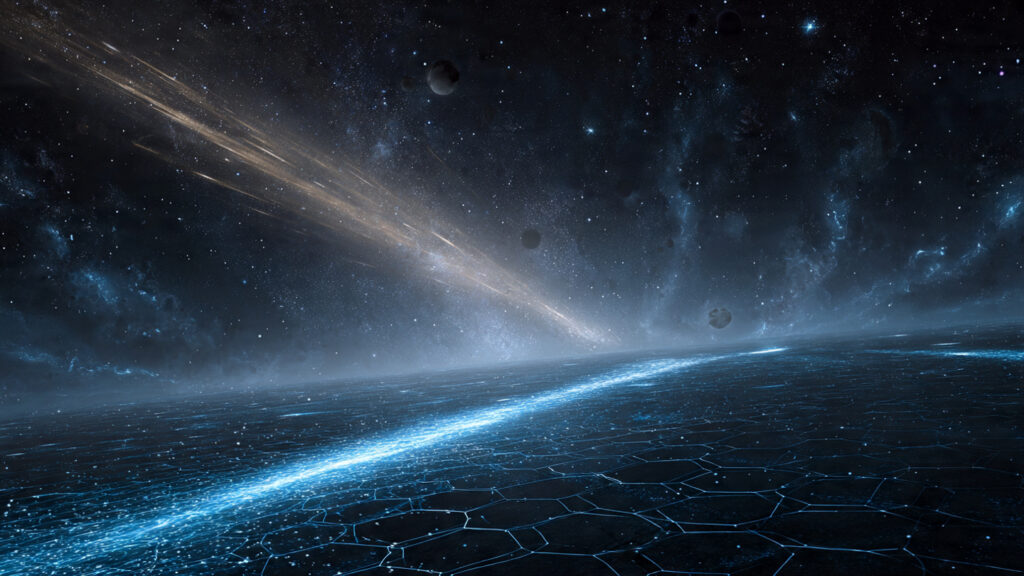
Anchors have begun to slip. Resonance between Jupiter and Saturn has started to drift. The public remains unaware, but quiet departments inside space agencies produce reports that never reach the press. They track this drift with the same dread ancient sailors felt when a compass needle began to tremble. It serves as a sign the architecture is waking up. The lattice is not passive. It reacts and adjusts like a system remembering its original purpose. We are seeing subtle corrections in orbital eccentricity and faint shifts in inclination. These movements are too small for the press, but too precise to be anything other than a mechanical realignment.
Something is maintaining the system, or perhaps something is attempting to break it. The distinction is irrelevant. The effect remains the same. The solar system only maintains the appearance of stability. Space agencies release diagrams with soft colors, talking about perturbations as if the word itself could act as a sedative. Real internal memos speak of stress points and orbital fatigue. They describe a structure under a massive, invisible load. This load does not come from within our star. It comes from the perimeter. A pressure moves like a tide with no water. It creates a force human instruments were never designed to register.
Outer Influence and the Reset Threshold
Old astronomers called it the Outer Influence. This phrase survives in fragments of manuscripts locked in climate-controlled vaults, untaught and unpublished. The Outer Influence is not a physical body or a rogue star. It behaves like a focused intention. A slow encroachment testing the strength of the lattice. Pressure increases in long, predictable cycles matching the rise and collapse of human civilizations with terrifying accuracy.
Every collapse in history follows the same sequence. Solar instability, magnetic alignment shifts, and atmospheric anomalies occur. Then comes the cultural unraveling. Priests lose their grip. Rulers succumb to panic. Cities fracture. Survivors write myths to explain why the sky betrayed them, blaming gods because the alternative—a mechanical reset of the celestial grid—is too large to name. The lattice absorbs this pressure until it reaches a critical threshold. Then it resets. Not always a full reset, but a partial recalibration leaving deep scars in the geological record. Abrupt climate shifts and ash layers appear with no volcanic source. These events never fit the neat timelines of the classroom.
The Indifference of the Grid
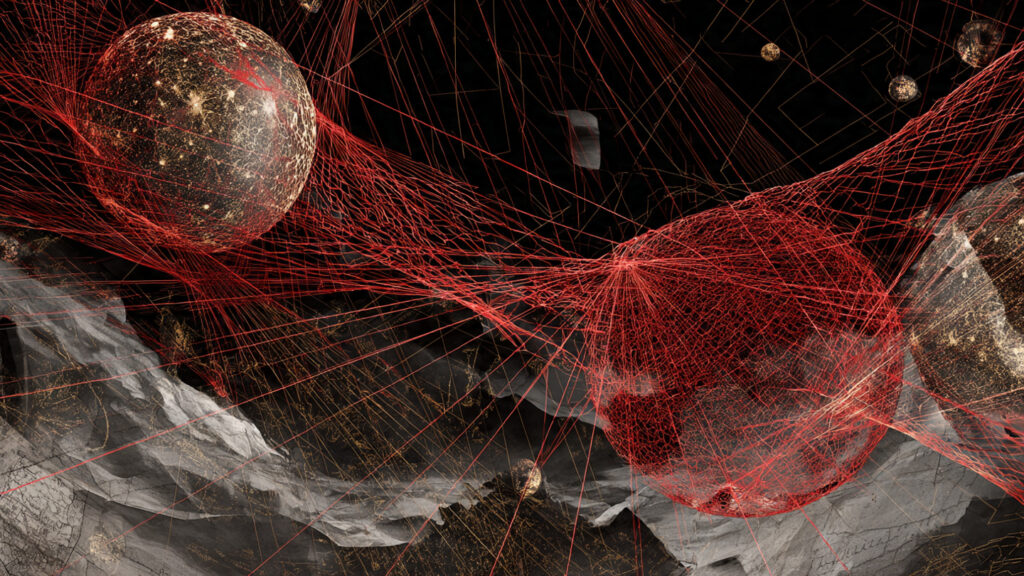
Architects built this system to endure the cycles, not to protect the temporary occupants of the third orbit. Humanity is incidental to the lattice. We are fleeting passengers in a structure designed for an older, grander purpose. Occult traditions preserved fragments of this, speaking of celestial gates and harmonic corridors binding the visible world to the invisible. Modern scholars dismiss these as metaphors, but they always do when the metaphor points toward a functional mechanism.
The mechanism is real. Alignments trigger geopolitical events with a precision mocking coincidence. Empires rise when the lattice is stable and fall the moment it strains. Leaders believe they control history. They are merely moving according to pressures they cannot perceive. They mistake the tremors of the sky for the tremors of their own ambition. The Outer Influence is rising. Agencies, militaries, and financial sectors know. They track the drift in the same quiet rooms where they monitor currency collapses. They do not speak publicly. They prefer a panic they can control.
Final Realignment
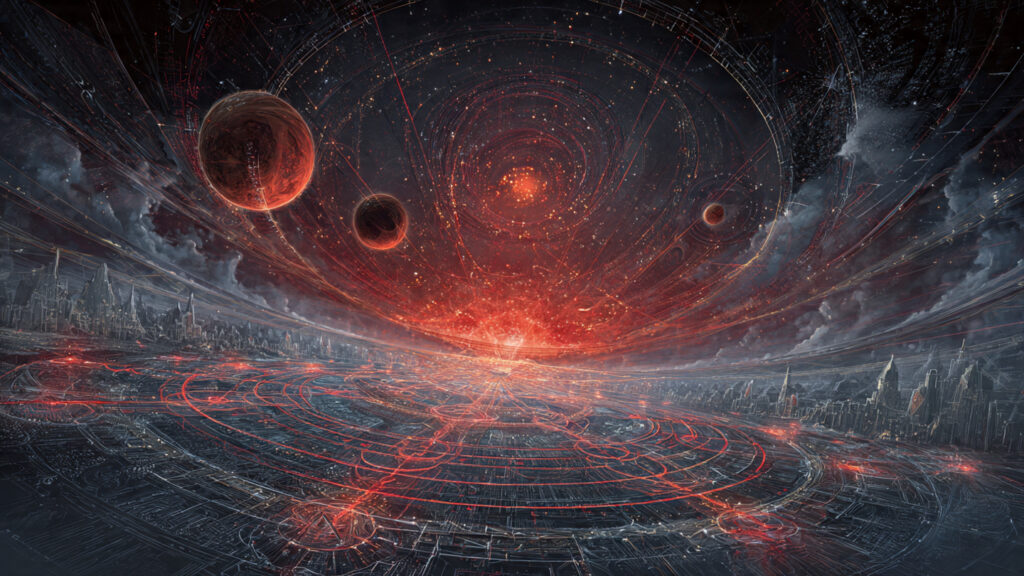
The lattice enters a phase it has not encountered in thousands of years. Anchors are weakening. Pressure is mounting. The architecture prepares for a massive correction. This correction will not announce itself with a trumpet blast. It begins in the quiet, thin places of the grid—the zones mapped by ancient astronomers with trembling hands. Modern agencies classify these as transitional sectors to avoid alarming the populace.
Drift is no longer a theory. A delay in the orbital timing of the outer planets exists. A hesitation in the dance should not be there. The machinery is stuttering. Authorities claim it is data noise. Their own instruments disagree. The correction is moving inward, a patient pressure testing the structural memory of every planet. They respond like old bones remembering an injury. Shifting, tightening, resisting. But the resistance will not hold. The lattice was built for recurrence. It functions as a cycle resetting the entire field when the threshold is reached.
Inevitability of the Pulse
The threshold is nearly here. Our star flickers with a rhythm that does not match the standard eleven-year cycle. It is a pulse that feels like a warning. The magnetic field is twisting into shapes that match the forbidden diagrams found in the deepes Vatican archives. Those drawings were not symbolic. They were observational records of a sky preparing for a reset. Governments are building underground networks and moving assets into regions aligning with the stable nodes of the lattice, pretending these movements are merely geopolitical.
Truth is leaking through the cracks. Classified construction and sudden relocations align perfectly with the old maps of the celestial grid. Occult orders have always known this day was coming. They speak of the Great Realignment. The moment the sky resets its geometry, we are forced to adapt or vanish. They view the lattice as a living intelligence with memory and intent. It is a field that does not negotiate. Scientists who think in forbidden directions see the convergence approaching. They publish nothing. They simply wait.
The lattice is tightening. The system is preparing. The architects are long gone, but their work is active. The correction will come from the perimeter and test every resonance and anchor. The solar system will obey. Humanity will see a disaster, but the lattice will see only its purpose. The sky is finally preparing to remember itself.