



The 3I Atlas object has abandoned its calculated path for the third time in as many months. Gravity is a rigid master in our solar system, yet this visitor behaves as though it is reading from a different set of laws. NASA has shifted its rhetoric from routine observation to an explicit warning about unpredictable movement. This transition in language is rare. Space agencies prefer the comfort of orbital mechanics, where every mass follows a predictable curve. When they admit that an object is defying their models, it means the math has failed.
There are no recorded collisions. No massive plumes of venting gas have been detected to justify a course correction of this magnitude. Standard astronomy suggests that course adjustments are usually the result of errors in early data, but the deviations of 3I Atlas occur with a rhythmic regularity that suggests intent rather than mistake. Each new section of the orbit must be recalculated manually. The built in navigator of our local reality seems unable to track the progress of this intruder.
Failure of Standard Gravitational Models
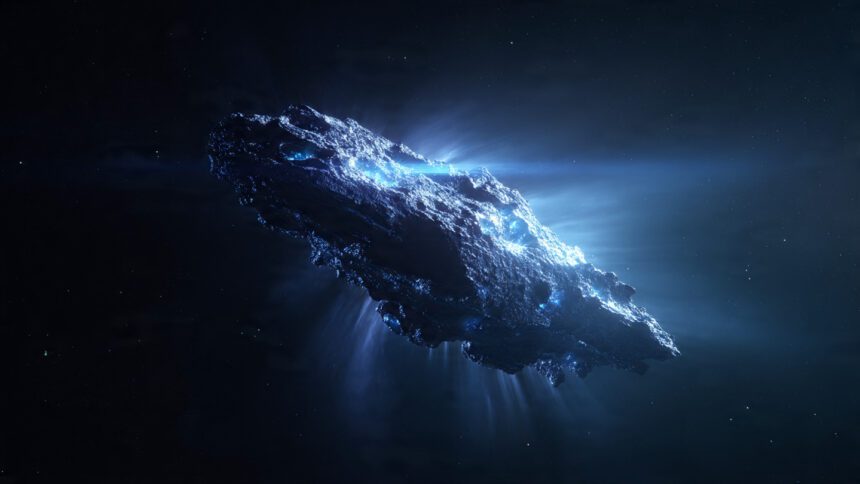
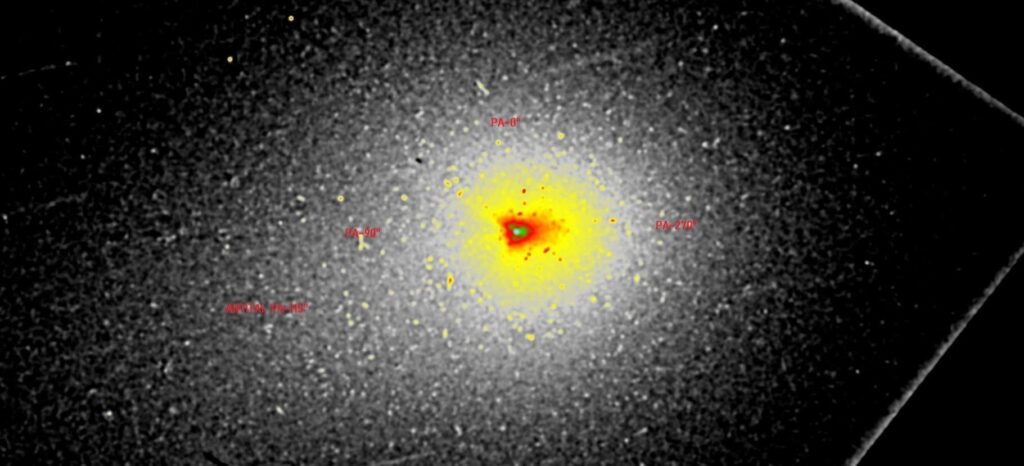
The physical properties of an interstellar object are inherently alien. We assume we are looking at a comet or a rogue asteroid, but the standard models for the solar system fail to apply here. Non gravitational forces like asymmetric evaporation or dust distribution are often used to explain away minor anomalies. With 3I Atlas, these explanations are being stretched to the breaking point. The deviations have accumulated into a pattern that defies the simple shape of a nucleus or the uneven distribution of ice.
Standard physics treats these visitors like rocks thrown into a pond. We expect them to follow the ripples. Instead, 3I Atlas is cutting across the surface. The degree of uncertainty has reached a level where medium term forecasts are no longer provided. We are watching a body move through our space that refuses to acknowledge the local grid. It is a biological organism or a technological relic masquerading as a celestial body, and the surveillance systems are struggling to keep the mask in place.
The Hubble Signature and the Italian Anomaly
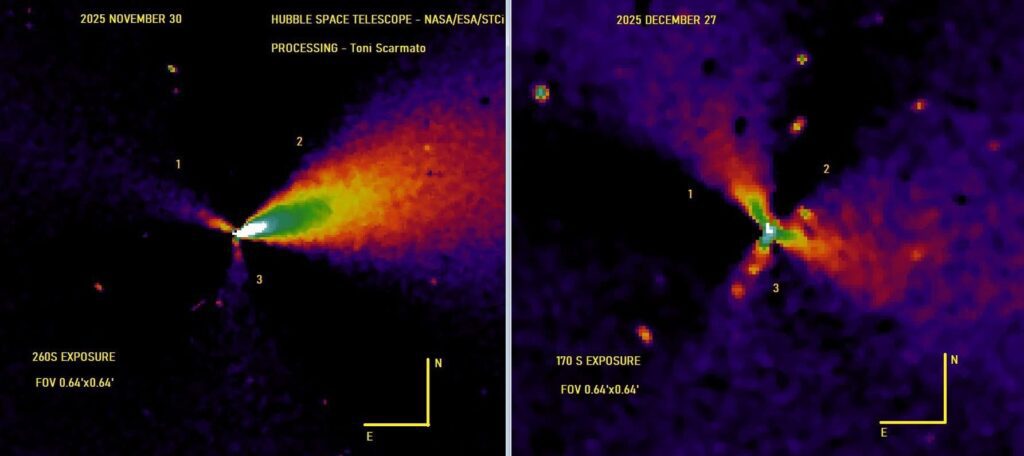
Fresh data processed from the Hubble telescope in late December revealed a marked change in activity. An independent researcher in Italy identified a series of jets that do not align with the solar orientation. In a typical comet, heating from the sun causes gas to erupt from the side facing the radiation. With 3I Atlas, the activity has migrated to the antisolar side. The shadow is screaming.
The coma has become thick with dust while gas emissions have dropped. Professional astronomers remain cautious, citing potential artifacts in image processing, but the raw comparison of dates shows a transition that is too abrupt for natural cooling. The object is shedding its outer layer in a way that suggests internal regulation. The asymmetry of the activity indicates that the heat source may not be external. If the sun is not the primary driver of this maneuver, we are looking at an internal engine.
Shadow Side Activity and Axis Orientation
The focus on the antisolar side of 3I Atlas is the most uncomfortable development for the scientific establishment. Classical models require solar radiation to drive the ejections of matter. To explain activity on the dark side of the object, researchers are forced to invent complex surface geometries or bizarre axial rotations. They are building a labyrinth of natural explanations to avoid the implication of a controlled burn.
The presence of specific areas with different chemical compositions could explain some unevenness, but not the persistent thrust away from the sun. This behavior does not go beyond the theoretical limits of natural processes, but it sits right on the edge of the impossible. We are being asked to believe in a series of highly improbable coincidences occurring simultaneously on a single object. The feeling of tension among observers comes from the realization that the more data we collect, the less we understand the nature of the visitor.
Surveillance Protocols and the Rhetoric of Caution
NASA continues to maintain that its monitoring is a standard precaution, yet the object remains embedded in the extended surveillance system usually reserved for high threat near earth objects. The phrasing regarding unpredictable motion is a strategic choice. It prepares the public for the possibility that the object could change its course again, perhaps toward a more sensitive region of the solar system.
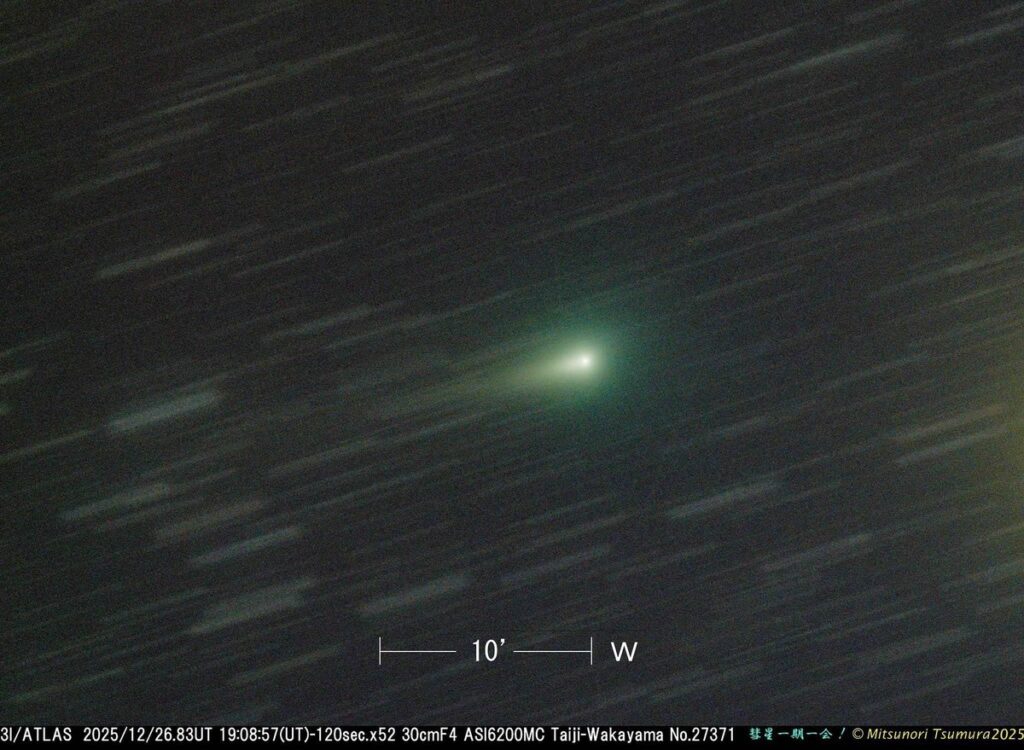
There are no official statements about a threat to Earth. No evidence exists that 3I Atlas is seeking a collision. The hazard is not in the impact, but in the lack of information. The object is out of the usual series. It represents a breach in the simulated certainty of our astronomy. We are closely monitoring it because we have lost the ability to predict what happens next. The surveillance is a frantic attempt to re-establish a sense of control over a situation that has already gone off the rails.
The Interstellar Breach of the Solar System
The 3I Atlas is a testament to the limitations of human observation. Every new set of images opens a fresh wound in the existing scientific narrative. We are witnessing a slow motion intrusion that we are powerless to influence. The object continues its trek through our space, exhibiting a behavior that suggests it is not merely a passenger of the gravity well but a navigator of it.

The situation remains tense because the calculations are no longer reliable. The object is a glitch in the celestial program. While additional observations are being planned, 3I Atlas continues to move with a quiet, irregular confidence. We are watching the sky not because we expect a disaster, but because we are no longer sure that the rules of the game still apply. The visitor is here, and it is moving according to a schedule that we were never meant to see.