



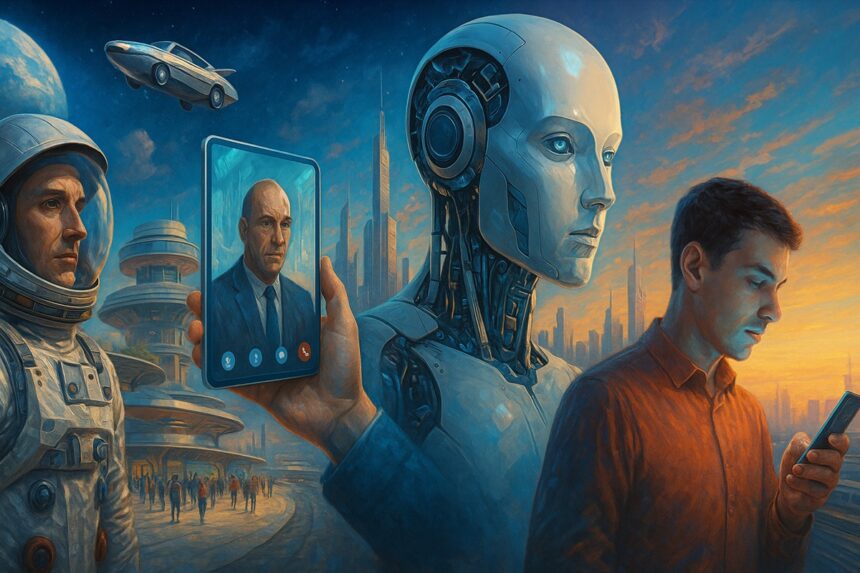
Every generation remembers the predictions that came true. We remember the science-fiction writer who imagined the tablet before the tablet existed, the author who described video calls before anyone carried a camera in a pocket, the futurist who understood that machines would eventually become collaborators rather than calculators. We build museums around those hits because they make the future look almost inevitable. But the misses are more revealing. They show where intelligent people, armed with the best science and technology of their own era, systematically misunderstood cost, politics, human behavior, business incentives, regulation, and the sheer unpredictability of which invention would become the one that mattered. The future did not simply prove them wrong. It proved them wrong in patterns.
That is why failed predictions are more valuable than perfect ones. A correct prediction can tell us that someone saw a technological possibility early. A spectacularly wrong prediction tells us what the person could not imagine. And the most interesting failures are not the flying cars that never arrived or the lunar hotels that missed their appointment. They are the predictions that got the underlying technology roughly right while completely misunderstanding the form it would take. We did get global communication. We did get artificial intelligence. We did get permanent human habitation in orbit. We did get machines that increasingly anticipate what we want. But the world that emerged from those technologies was stranger, cheaper, more decentralized, more commercial, more algorithmic, and far more socially complicated than most of the old futures imagined.
Failure #1 | The Internet Was Hiding in Plain Sight
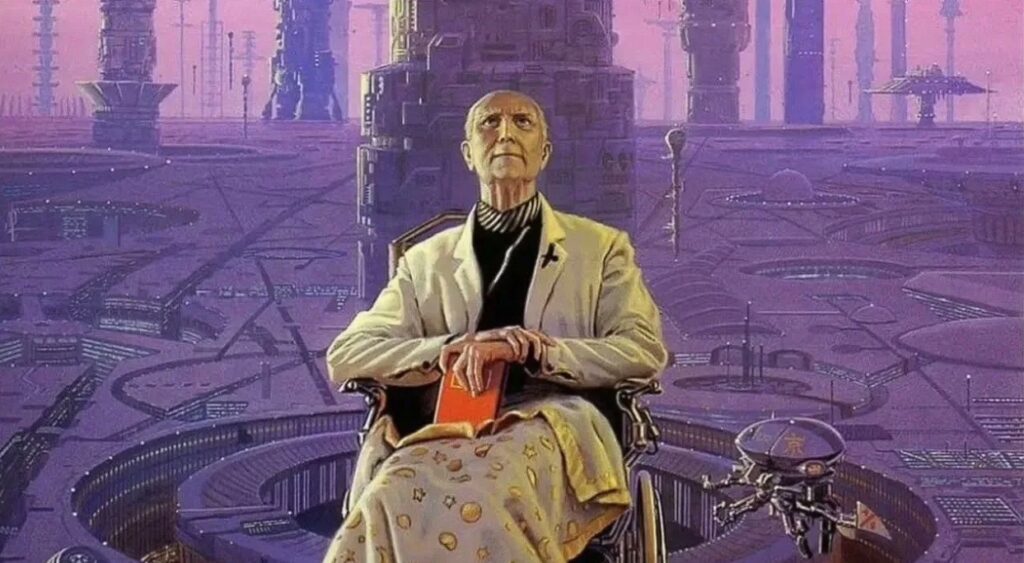
It is tempting to say that science fiction imagined a future of giant centralized computers and completely missed the Internet. That is too simple. The history of computing contains genuine visions of networked, distributed information systems decades before the web. J.C.R. Licklider was already describing a globally interconnected “Galactic Network” in the early 1960s, while the engineers behind ARPANET were deliberately building a network of independent machines rather than one omniscient central computer. The Internet therefore did not appear from nowhere. What many older visions missed was not networking itself but the social consequence of putting the network into the hands of billions of ordinary people.
That distinction changes everything. The revolutionary object was not merely the computer. It was the cheap networked computer becoming personal, portable and eventually nearly invisible. ARPANET began with expensive machines used by researchers, but its users quickly discovered that electronic mail and personal messaging were more compelling than remote computer sharing. The architecture expanded from a handful of research nodes into an open network of networks, while personal computers and workstations transformed who could participate. The Internet’s history is therefore almost a warning label attached to technological prediction: the original engineers can build the infrastructure correctly while having only a faint idea of what millions of strangers will actually do with it.
From Information Superhighway to Pocket Empire
The final surprise was that decentralization did not remain decentralization. The network atomized publishing, broadcasting, retail, photography, music and communication, but enormous platforms subsequently rebuilt concentrations of power on top of that open infrastructure. We did not end up with one government supercomputer. We ended up with billions of devices connected to a relatively small number of platforms capable of measuring attention at planetary scale. The old prediction was wrong about the shape of the machine, but the underlying concern about concentrated information power turned out to have a different and arguably more consequential form.
We became our own broadcasters, publishers and marketplace owners. We also became the raw material of the systems doing the broadcasting, publishing and selling. Algorithms decide which arguments become visible. Recommendation engines determine which songs, faces and political stories reach millions of people. Advertising systems construct behavioral profiles from fragments of ordinary life. The future did not abolish gatekeepers. It changed the gatekeeper from a person standing behind a desk into software operating at a speed no human editor can match.
Failure #2 | The Space Age Arrived, Just Not on Schedule
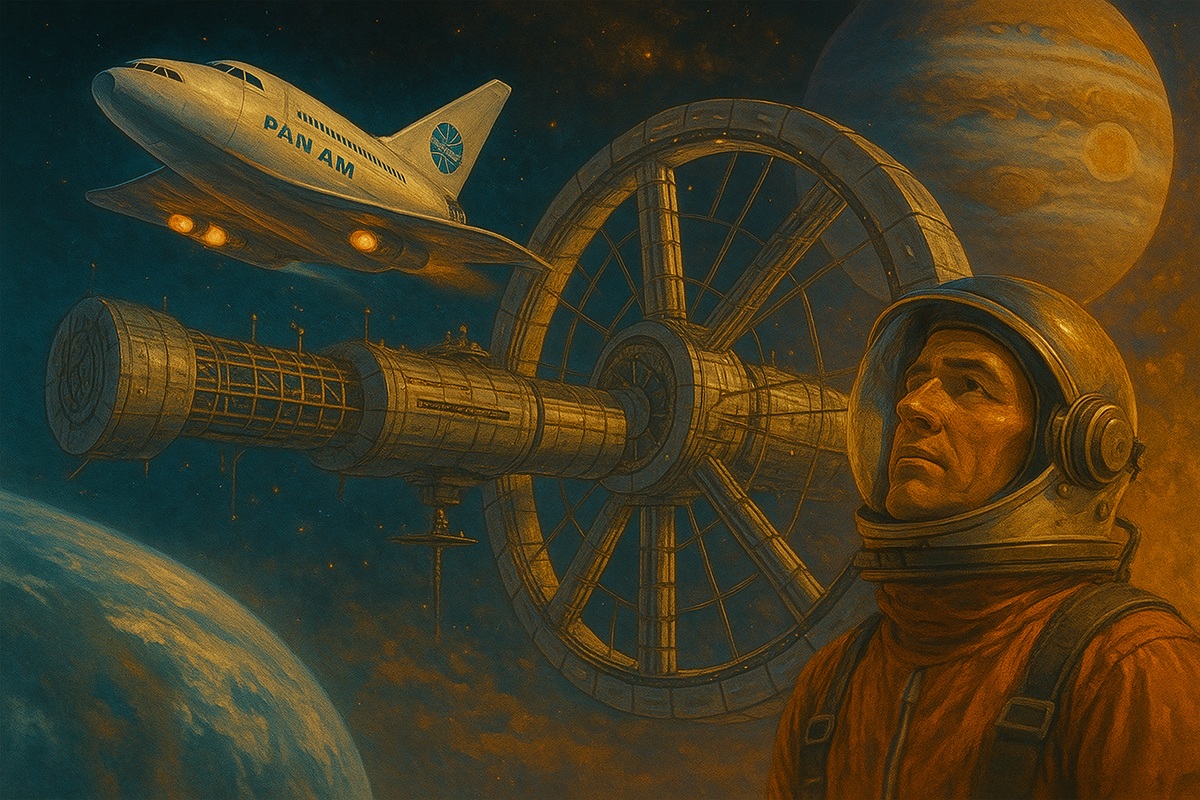
The classic space-age mistake was not imagining the Moon or Mars. Humanity really did reach the Moon, really did build reusable spacecraft, really did send machines across the Solar System and really did establish a permanent human presence beyond Earth. The mistake was assuming that technological capability would automatically produce technological expansion. Once Apollo demonstrated that humans could land on another world, many futurists treated the remaining problem as engineering. But the harder problem turned out to be political will, cost, risk, logistics and the absence of an obvious economic reason to build a civilization on another planet.
The result is a peculiar halfway future. NASA and its partners have maintained continuous human habitation aboard the International Space Station since November 2000, a quarter-century of permanent human presence in orbit. More than 290 people from 26 countries have lived and worked there, and thousands of experiments have been conducted in microgravity. Yet the human frontier has barely moved outward compared with the confidence of mid-century futurism. We built a remarkable laboratory circling Earth rather than the lunar suburbs and Martian settlements that once seemed like the obvious next chapter.
That is not failure in the ordinary sense. It is a failure of chronology. The technology progressed. The timetable did not.
The Robots Got There First
The deeper surprise is that the most successful space explorers have not been humans at all. They have been machines: orbiters, landers, rovers, telescopes and autonomous spacecraft capable of operating where a human mission would be vastly more expensive and dangerous. Mars became a laboratory before it became a destination. The outer Solar System became accessible to robotic probes long before human beings could realistically contemplate going there. In this sense, science fiction often got the destination right and the passenger wrong.
That distinction is likely to matter even more in the future. A human being requires oxygen, food, radiation shielding, medical support, exercise, waste management and a safe return path. A robotic spacecraft needs electricity, communications and enough engineering reliability to survive. The cosmos does not care which one is more cinematic.

Failure #3 | The Future Refused to Choose One Ideology
Some of the most spectacular failed futures were not technological predictions at all. They were predictions about what society would become. Soviet science fiction could imagine a communist civilization in which material scarcity had been overcome, work had become creative rather than coercive, and humanity’s collective energy could finally be directed toward science, culture and exploration. Western futurists produced mirror images: worlds dominated by corporate power, militarized technology and permanent ideological conflict. Each side could imagine the other’s future more easily than it could imagine a world in which neither side won completely.
The collapse of the Soviet Union made the communist-utopia prediction look spectacularly obsolete, but the alternative did not unfold exactly as cyberpunk expected either. Capital accumulated in enormous corporations, yet those corporations became dependent on international supply chains, governments, regulators and digital infrastructure. Surveillance expanded, but much of it arrived through consumer devices willingly carried in people’s pockets. Political power became entangled with platforms, finance, data and communications rather than simply belonging to either the state or the corporation.
Cyberpunk Got the Mood Right and the Machinery Wrong
Cyberpunk’s neon megacities, corporate dominance and pervasive surveillance can look astonishingly prophetic in retrospect. But its villains were often too visible. The modern surveillance economy does not require a trench-coated executive monitoring every citizen from a glass tower. It can operate through terms of service, recommendation systems, advertising exchanges, smartphones, loyalty programs and databases that nobody experiences as a single command center. The machine is distributed precisely enough to feel invisible while remaining centralized enough to become extraordinarily powerful.
And that is another recurring problem with prophecy: reality rarely chooses one genre. The future can be simultaneously utopian and dystopian, liberating and controlling, decentralized and concentrated. The same smartphone that gives a dissident access to the world’s information can give an authoritarian government a powerful surveillance tool. The same artificial intelligence that makes knowledge more accessible can also automate persuasion. The same network that allows anyone to publish can amplify nonsense at industrial speed.
Failure #4 | The Future Did Not Add Devices. It Dissolved Them.
Older visions of the future often imagined technological progress as accumulation. People would have more machines: a telephone, a television, a computer, a camera, a navigation device, a music player, a calculator, a map and perhaps a robot servant. What actually happened was stranger. Entire categories of objects began disappearing into one device. The smartphone did not merely become a better telephone. It absorbed the alarm clock, camera, calendar, atlas, compass, radio, newspaper, music collection, notebook, television, wallet and increasingly the office itself.
The result is a form of technological disappearance that earlier futurists often struggled to imagine. The most important device in the room can look like a rectangle of black glass. The infrastructure behind it, cloud computing, fiber-optic networks, data centers, satellites, machine-learning systems and enormous electrical grids, is almost completely invisible to the person using it. The physical world did not become less complicated. It became better at hiding its complexity.
The Robot Butler Became a Software Layer
This is especially visible in artificial intelligence. The old robot was a body: metal limbs, wheels, glowing eyes and mechanical hands. The new machine can be almost entirely disembodied. It can draft an email, summarize a document, translate a language, generate an image, write software, recommend a song or converse through an earbud without ever looking like a robot at all. The hardware has become less interesting precisely because the intelligence can migrate into the background.
That may eventually prove to be one of the biggest forecasting lessons of the century. We tend to imagine new technologies as new objects. The most consequential technologies may instead be new layers inserted into objects that already exist.

The Predictions That Missed, and the Ones That Nearly Nailed It
Isaac Asimov’s famous 1964 essay imagining 2014 is almost a perfect laboratory for studying the problem. He foresaw sight-and-sound communications, increasingly cordless devices, automated vehicles, sophisticated computer use and a world in which machines performed much of the routine work. Some of those predictions now look uncannily familiar. Yet he also expected lunar colonies, large-scale nuclear power, radioisotope-powered household appliances and other developments that did not arrive on his timetable. His record is neither “genius who predicted everything” nor “futurist who got it wrong.” It is much more interesting: he correctly identified technological directions while repeatedly misjudging which bottlenecks would dominate the next fifty years.
One of the most revealing omissions was the Internet in anything like its eventual social form. Asimov imagined extraordinary communications technology but did not foresee the particular networked culture that would emerge from cheap computers, open protocols, personal devices and billions of users. That omission matters because it demonstrates how difficult it is to predict second-order effects. Inventing a faster telephone is one prediction. Predicting social media, search engines, online marketplaces, viral culture, streaming video, cloud computing and algorithmic attention economies is an entirely different task.
Paul Krugman’s famous 1998 prediction is an even cleaner warning. Writing in Red Herring during the dot-com boom, he argued that by around 2005 the Internet’s economic impact would prove no greater than that of the fax machine. Krugman later explained that the remarks were intended to be provocative rather than careful forecasting. They remain useful precisely because the mistake was not ignorance of the Internet. It was underestimating how a network could become infrastructure for entirely new forms of commerce, communication and organization.
The Supersonic Future That Economics Grounded
The fate of supersonic passenger travel exposes another forecasting trap: confusing physical possibility with commercial viability. Supersonic flight worked. Concorde proved that passengers could cross the Atlantic at extraordinary speed. Yet the technology was expensive, fuel-hungry and operationally constrained by noise and route restrictions, while the market for premium supersonic travel remained tiny. Concorde ultimately retired in 2003 after decades of service. The failure was not that engineers could not make a supersonic airliner. They could. The failure was turning an impressive engineering achievement into an economically ordinary form of transportation.
This distinction appears everywhere in technological history. A laboratory demonstration is not a mass market. A working prototype is not an industry. A technically possible invention is not necessarily an economically rational one. And a technology that works brilliantly under special conditions can still lose to a slower, cheaper, uglier technology that works everywhere.
Why Futurists Keep Making the Same Mistakes
There is a recurring structure behind many failed predictions. First comes an impressive new capability. Then comes extrapolation: if the technology improved this much in ten years, surely it will improve by the same amount in the next ten. What gets neglected is everything that does not sit inside the laboratory, manufacturing capacity, energy costs, regulation, public resistance, business models, infrastructure, cultural habits, wars, recessions, competing technologies and the possibility that society simply decides it does not want the supposedly inevitable future.
There is another problem: futurists tend to predict visible things. Flying cars are visible. Robot servants are visible. Moon bases are visible. A new social protocol is not. An algorithmic recommendation system is not. A semiconductor manufacturing breakthrough buried inside a supply chain is not. The most transformative technologies often become boring precisely because they work quietly in the background.
This creates a profound forecasting bias. We imagine the future as a collection of spectacular inventions rather than as an ecosystem of mundane improvements. Yet civilization is often transformed by things that would make terrible movie props: cheaper sensors, better batteries, faster networks, improved manufacturing, software standards, logistics systems, databases, compression algorithms and increasingly capable chips. The future often arrives disguised as infrastructure.

The Predictions That Actually Landed
The failures should not obscure the extraordinary successes. Arthur C. Clarke’s 1945 proposal for geostationary communications satellites was technically specific enough to become part of the conceptual foundation of modern satellite communications. The first geostationary communications satellites followed less than two decades later, with Syncom 3 achieving geosynchronous orbit in 1964 and subsequent systems making global satellite communications practical. Clarke did not invent the entire field single-handedly, the underlying idea was part of a wider technological conversation, but his paper remains one of the great examples of engineering-minded foresight.
Mark Twain produced another remarkable example in his 1898 story “From the ‘London Times’ of 1904.” Its fictional “telelectroscope” allowed people to communicate across enormous distances through a global network. It was not literally a blueprint for the Internet or modern video calling, and hindsight can make similarities look cleaner than they were. But the basic intuition, that communication technology would collapse geographical distance and allow people to see and hear events and people far away, was astonishingly prescient.
The common thread in these successful forecasts is revealing. They tended to extrapolate from physical principles and engineering capabilities rather than predicting that society would suddenly become a different species. Clarke looked at orbital mechanics and radio. Twain imagined communication technology extending an existing human desire to see and hear across distance. Their predictions were not perfect. They were anchored.
The Most Dangerous Prediction Is “Inevitable”
The word that should make us suspicious in almost any forecast is not “impossible.” It is “inevitable.” Technology does not move along a single track. It competes. It collides with economics. It encounters regulation. It gets absorbed into existing institutions. It creates new markets that nobody predicted and destroys others that seemed permanent. A technology can become technically mature decades before society finds a reason to deploy it at scale.
That is why the future keeps embarrassing intelligent people. The problem is rarely that they were stupid. They were often looking at the correct technological frontier. What they could not see was everything around it.
What Our Own Predictions Will Look Ridiculous
We are now making exactly the same mistake with a new vocabulary. Commercial fusion will transform civilization. Artificial intelligence will replace most knowledge work. Humans will establish permanent settlements on Mars. Autonomous vehicles will eliminate private car ownership. Three-dimensional printing will manufacture almost anything. Biotechnology will radically extend healthy human life. Some of these predictions may eventually prove correct. Others may arrive decades late. Some may work technically but fail commercially. Others may be overtaken by something nobody is currently paying attention to.
And some of our most confident predictions will probably fail for a reason that has nothing to do with technology. People may simply choose differently.
That is the part futurism repeatedly forgets. Humans are not passive passengers inside technological progress. We regulate, resist, subsidize, ban, commercialize, sabotage, ignore and reinvent technologies. We decide what is worth building and what is not. The future is therefore not merely what science makes possible. It is what millions of imperfect decisions allow to survive.
So the greatest lesson of failed predictions is not that the future is impossible to see. It is that the future is almost never wrong in the way we expect. The technologies we imagine may arrive, but in another form. The machines we fear may become tools. The inventions we dismiss may become infrastructure. The civilization we expect to emerge may never appear at all. And somewhere right now, someone is making a prediction that sounds absurd because it ignores the one variable every prophet eventually discovers: the future does not owe us the plot we wrote for it.
The future was wrong often enough that the pattern itself became the more interesting subject to study.
Predictions for the world in 2050 will very likely join this same list of confident forecasts that missed the actual shape of the future.