




Mars has always been a canvas for human imagination, a red dot in the night sky that whispers secrets of ancient worlds and hidden wonders. For centuries, we’ve gazed at it through telescopes, dreaming of canals and civilizations. Now, with rovers crawling across its surface and orbiters snapping high-resolution photos, the planet continues to surprise us.
But amid the dust storms and craters, unusual formations keep popping up—shapes that look eerily like boats, pyramids, domes, and even foundations of long-lost buildings. Are these remnants of an ancient Martian society, or just tricks of geology and light?
Bizarre Martian Anomalies | Why We Can’t Look Away
Ever since NASA’s Viking 1 orbiter captured the infamous “Face on Mars” in 1976, humanity has been hooked on spotting patterns in the planet’s rugged terrain. That shadowy visage in the Cydonia region sparked wild theories of alien monuments, only to be debunked as a play of light and shadow by later missions. Yet, the hunt continues. Independent researchers like Jean Ward scour archival images from NASA’s Mars Reconnaissance Orbiter (MRO) and HiRISE camera, unearthing shapes that challenge our understanding of natural formation processes.

In 2025, with NASA’s Perseverance and Curiosity rovers still active, we’re getting even more data. Recent updates reveal bizarre “spiderweb” patterns, leopard-spotted rocks, and intersecting ridges that add layers to the enigma. These are invitations to question what Mars was like billions of years ago—wet, warm, perhaps even alive. But scientists remind us | pareidolia, the brain’s tendency to see familiar shapes in randomness, is a powerful force. Wind erosion, volcanic activity, and ancient water flows can sculpt the impossible. Still, the photos demand attention. Let’s start with one of the most talked-about finds | the “boat” in Noachis Terra.
The “Boat” in Noachis Terra | A Nautical Enigma on a Dry World
There is a vast crater in the southern highlands of Mars, known as Noachis Terra—ironically named the “Land of Noah.” In June 2024, independent researcher Jean Ward zoomed in on a HiRISE image (frame ESP_024515_1320) and spotted an elongated object, roughly 20 meters long, that bears an uncanny resemblance to a modern boat hull. Ward even dubbed it the “Boat,” inspired by the region’s biblical nod. The structure appears streamlined, with curved edges that suggest deliberate design, not random rock.
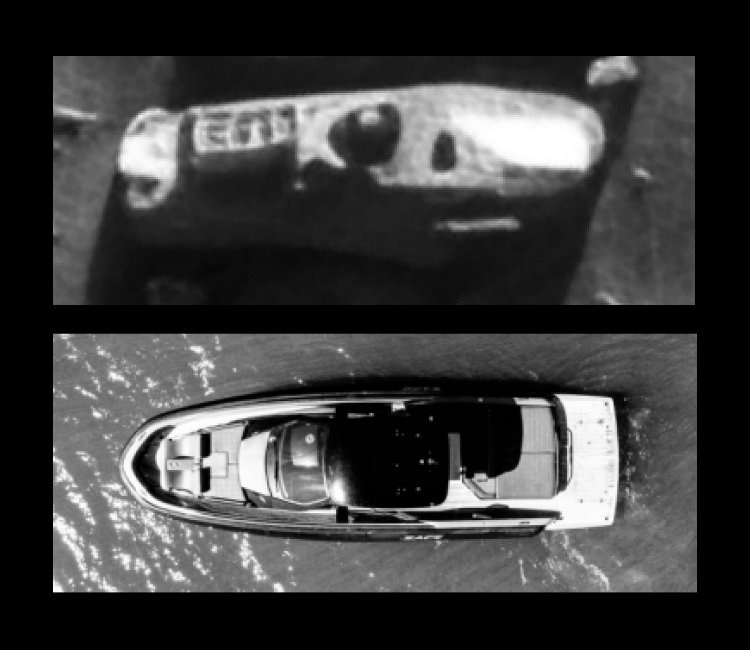
Social media exploded with speculation. On X (formerly Twitter), users compared it to a 65-foot power yacht, fueling debates about ancient Martian seas or crashed spacecraft. Ward’s YouTube channel, dedicated to Martian anomalies, features detailed breakdowns, showing how the object stands out against the surrounding aeolian ridges—wind-sculpted dunes that dominate the Proctor Crater floor.
But hold on, could this be real? NASA’s official description of the image focuses on “transverse aeolian ridges,” natural formations shaped by relentless Martian winds. Geologists argue that erosion over eons can create symmetrical shapes, especially in a world with no liquid water to smooth things out differently. Tectonic shifts and dust devils might have carved this “hull,” making it look artificial. Skeptics point to pareidolia | our brains wired to see vehicles where none exist. Yet, Ward’s analysis highlights its isolation—no similar natural features nearby match its precision. Today, with no new rover missions targeting this spot, the “Boat” remains a tantalizing puzzle, urging us to wonder | what if Mars once had oceans teeming with life, leaving behind relics?
Expanding on this, recent rover data from Perseverance shows evidence of ancient water in Jezero Crater, with rocks hinting at microbial life. If water shaped Mars’ past, could it have also preserved artificial structures? The “Boat” might not be a vessel, but its form echoes earthly erosion patterns in dry lake beds. Still, the debate rages on forums like Reddit, where users dissect pixels for hidden details.
Rectangular Foundations in Chryse Planitia | Echoes of Ancient Settlements?
Shifting north to Chryse Planitia, a vast plain where NASA’s Viking 1 lander touched down in 1976, we find another set of anomalies | rectangular contours etched into the surface, reminiscent of building foundations. Independent analysts have compared these to LiDAR scans of ruined farms in the UK—straight lines, right angles, suggesting organized construction. The patterns span kilometers, with what appear to be grid-like arrangements that defy random cracking.

Research from 2019 and beyond reveals Chryse as a hotspot for buried craters and tectonic features. A 2023 structural map highlights thrust-fault landforms, or “shortening structures,” that could mimic foundations through compression and uplift. But enthusiasts argue the symmetry is too perfect for faults alone. New studies on subsurface sediment mobilization suggest ancient floods reshaped the area, possibly exposing or creating these outlines.
Geologists counter with examples of natural polygons on Earth, like the Giant’s Causeway in Ireland, where cooling lava forms hexagons. On Mars, freeze-thaw cycles in a permafrost-rich past could have cracked the ground into rectangles. Yet, the comparison to terrestrial ruins is compelling. Ward and others overlay images, showing striking parallels. If these are artificial, they might hint at a Martian civilization that built on floodplains, much like early humans along the Nile.
Adding to the intrigue, the latest discoveries include mysterious mounds in Chryse, layered deposits that preserve evidence of ancient water. These “windows into Noachian Mars” could bury more anomalies, waiting for future drills. For now, Chryse’s “foundations” fuel theories of lost cities, balanced by science’s call for caution.
Comparing to Earthly Ruins | A Visual Breakdown
To appreciate the resemblance, consider this | UK farm ruins show eroded walls in grids, much like Chryse’s contours. But Mars lacks vegetation or human interference, so why the straight lines? Periodic bedrock ridges, formed by consistent winds, offer one explanation. Chains of small cones and cycloid forms add to the oddity, possibly volcanic in origin. It’s a reminder that nature loves geometry too.
The Square and Dome in “Martian Atlantis” | Symmetry from Chaos
Not far from the so-called “Martian Atlantis”—a chaotic terrain in Atlantis Chaos—lies a large square imprint with a central dome-like elevation. This anomaly, spotted in MRO images, measures about 3 kilometers across and has ignited online frenzy since early this year. The perfect squareness and domed center evoke ancient ziggurats or modern observatories, leading some to speculate about buried alien bases.
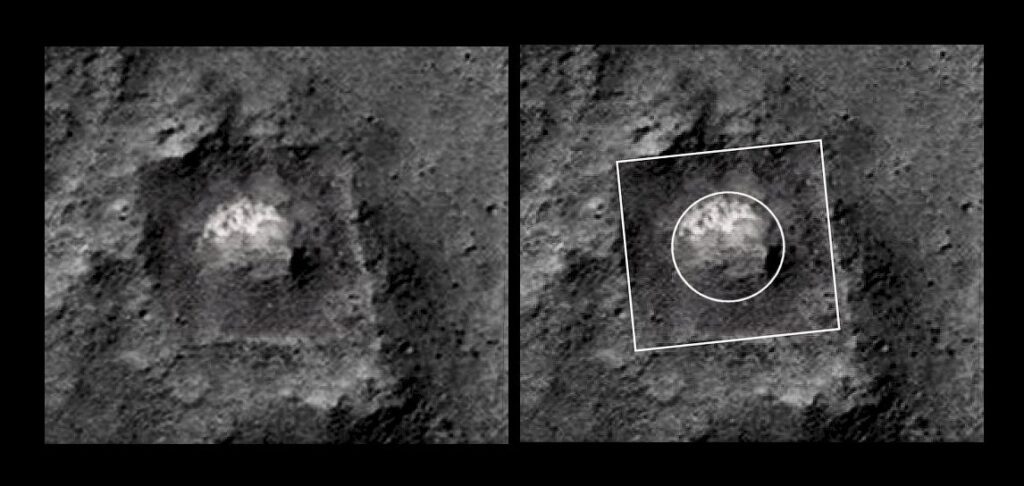
YouTube videos dissect the feature, comparing it to Giza’s pyramids. But scientists attribute it to erosional remnants in a once-watery basin, canyons carved by floods suggest vast lakes long ago. Light and shadows play tricks, creating illusions of regularity in uneven ground.
In February 2025, conspiracy theorists dubbed it “xenoarchaeological,” but experts like those at IFLScience call it pareidolia amplified by low-res photos. Natural squares aren’t unheard of; think of salt flats on Earth. Yet, the dome’s centrality teases artificiality. With no rover nearby, it joins the list of “what ifs.”
Online Buzz and 2025 Updates
X posts from users like @maniaUFO highlight the dome’s isolation, while Reddit threads debate its origins. Recent NASA releases show similar formations, tying them to atmospheric pressure variations.
Pyramids in the Elysian Plain | Echoes of Teotihuacan?
Jean Ward strikes again with a pyramidal structure in Elysium Planitia, complete with an adjoining platform, mirroring Mexico’s Pyramid of the Moon in Teotihuacan. The four-sided form, with clean lines, suggests steps or terraces, fueling ancient astronaut theories.

Comparisons to Teotihuacan’s layout are vivid in illustrations, but geologists cite rock erosion and lava flows as culprits. The Cydonia Institute’s field journal notes similar oddities in the eastern quadrant. Pareidolia links it to earthly monuments, yet the symmetry persists.
In 2025, semantic searches on X reveal Ward’s ongoing posts about megalithic blocks nearby, adding context.
The Rectangular Pyramid in Cerberus | A Step Back in Time
Back in 2002, Nathan Schöller and Greg Orme identified a rectangular pyramid in Cerberus/Tartarus, with ledges and central mounds, akin to Peru’s Caral pyramid. The uniform frame screams design, but science points to volcanic layering.
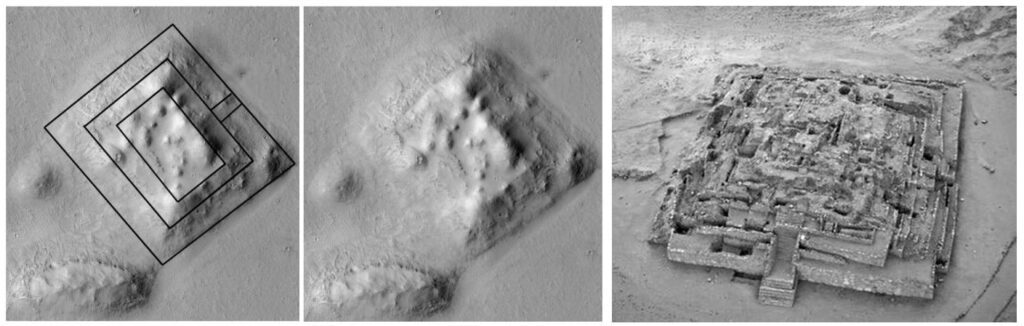
Recent X discussions revive it, linking to Ward’s work.
The Iconic D&M Pyramid in Cydonia | The Grandfather of Anomalies
No Mars anomaly list is complete without the D&M Pyramid, named after discoverers Vincent DiPietro and Gregory Molenaar. Compared to the Pentagon by Mark Carlotto, its pentagonal shape and geometric lines have inspired books and films.

Scientists call it a butte, eroded by wind. Pareidolia explains the rest.
What Do Scientists Say? Balancing Wonder with Reality
Across all these, the consensus is natural | winds at 100 mph, ancient tectonics, and pareidolia. 2025 finds like “spiderwebs” (araneiform terrain) and spotted rocks reinforce this.
No confirmed artifacts exist after decades of study. But the photos unite us in curiosity.
Emerging Anomalies | Spiderwebs, Spotted Rocks, and More
This year, Curiosity captured “spiderweb” ridges, likely from CO2 bursts. Perseverance found leopard-spotted rocks, potential biosignatures. Intersecting ridges and mounds add to the list.
These “structures” might not be built, but they hint at a dynamic past.
The Ongoing Debate | Natural Wonders or Hidden History?
Mars’ anomalies captivate because they mirror our hopes for cosmic company. While science leans natural, the questions persist. Future missions might resolve them. Until then, stare at the photos and wonder.